How to Keep Track of a Coin Collection: 5 Methods Compared
Every collection reaches the point where memory stops being enough: you buy a coin you already own, or someone asks what the lot is worth and you cannot say. There are five realistic ways to keep track of a coin collection, from a paper album to an online tracker that values each coin from sold prices. This guide compares them honestly, including where our own tool is not the right answer.

What to record for every coin
The method matters less than the record. Whichever of the five you pick, capture the same facts for each coin, and capture them on the day the coin arrives. Purchase details are the hardest thing to rebuild later and the first thing an insurer, an auction house or an executor will ask for.
| Field | Example | Why it matters |
|---|---|---|
| Denomination and year | 50p, 2009 | The basic identity of the coin |
| Design or variety | Kew Gardens | Two coins of the same year can differ in value a hundredfold |
| Mint mark or privy mark | None / tower privy | Separates otherwise identical issues |
| Grade | EF, or PCGS MS65 | Drives the price more than anything except rarity |
| Quantity | 2 | Shows your swaps and duplicates |
| Purchase date and price | 14 March 2024, £165 | Proof of ownership; profit and loss |
| Source | Dealer name, auction lot, found in change | Provenance, and who to go back to |
| Storage location | Album 2, page 4 | Lets you find the coin, and spot one that is missing |
| Photos | Obverse and reverse | Evidence of condition for a claim or a sale |
| Metal, weight and purity | 22ct gold, 7.98g | Bullion floor value for gold and silver |
If you are not sure how to describe condition, our grading guide covers the UK and US scales side by side.
The five methods at a glance
| Method | Cost | Shows current value | Works for | Main weakness |
|---|---|---|---|---|
| Paper album | £10 to £40 per album | No | Small sets, change collecting | No record of what you paid; one copy |
| Log book or spreadsheet | Free to £10 | Only if you type it in | Up to a few hundred coins | Values go stale; every field typed by hand |
| Numista | Free, optional paid membership | Catalogue estimates | World collections | Not built around UK sale prices |
| Royal Mint MyCollection | Free with a Royal Mint account | No | Coins bought from the Royal Mint | Circulating coins and market values are not covered |
| MyCoinage | Free to 25 coins, then £1.99 a month | Yes, from realised sale prices | UK and US coins | Free tier is capped; no world catalogue |
1. A paper coin album
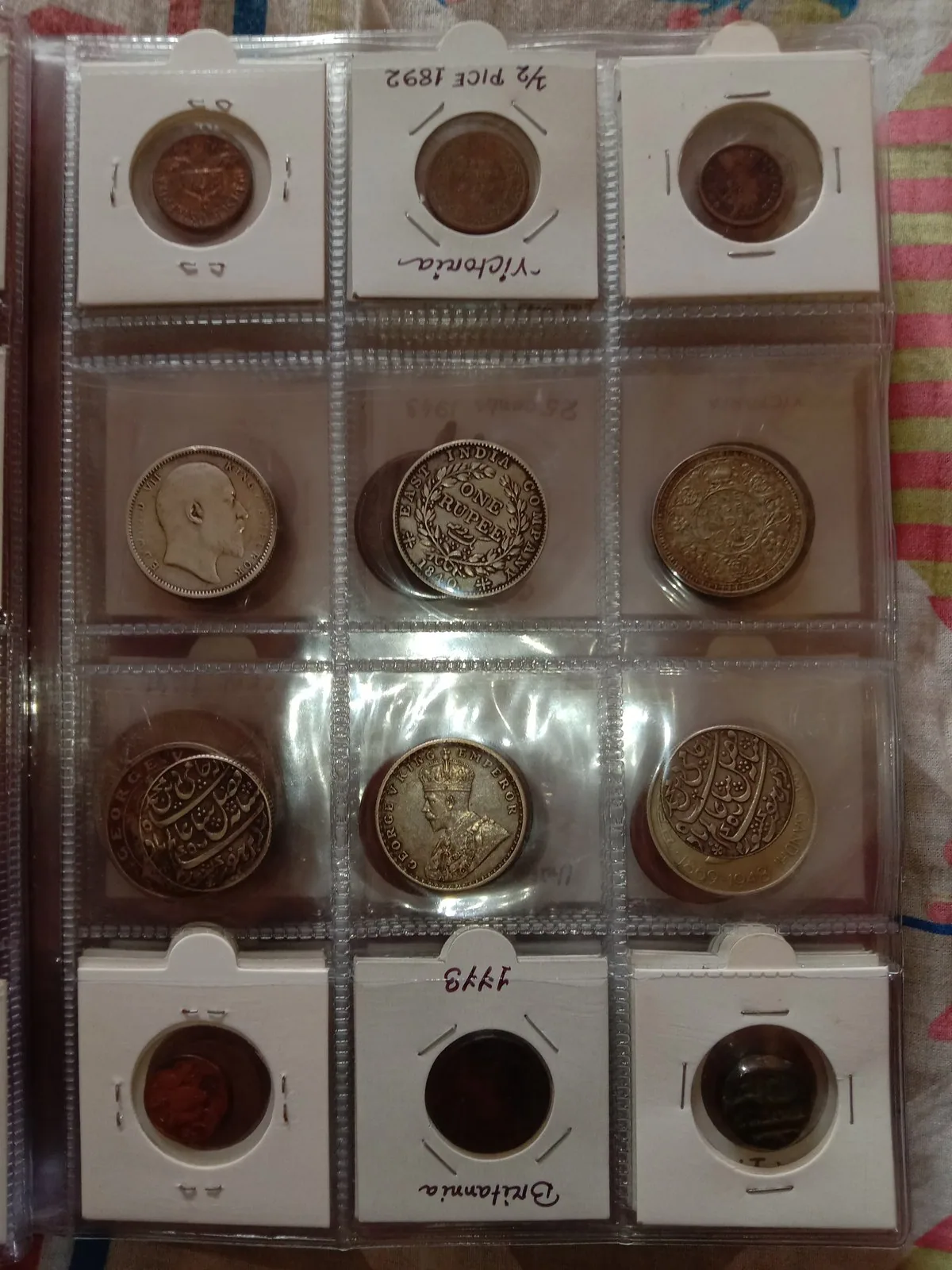
The album is where most collectors start, and for change collecting it is still hard to beat. A printed album for the 50p or £2 series has a labelled space for every design, so the album itself is the checklist: an empty slot is a coin you still need.
Cost. £10 to £40 for a series album, more for archival ring binders with inert pages.
What it does well. It stores and tracks in one object. You see the gaps at a glance, it is satisfying to fill, and it needs no login.
Where it falls short. An album records that you have a coin and nothing else. It does not hold the price you paid, the date, the grade or the seller, and it cannot tell you what the set is worth. It is also a single copy that sits in the same place as the coins, so a fire or a theft takes the record with the collection.
Who it suits. Anyone collecting from change, children, and collectors filling one defined series. Choose the album carefully: soft PVC pages damage coins over time. Our coin storage guide explains what to look for.
2. A log book or spreadsheet
A coin inventory log book is the paper version; a spreadsheet is the same idea with a search box and a total at the bottom. Both let you record everything in the table above, which an album cannot.
Cost. A printed log book is £5 to £10. Google Sheets is free, and Excel or Numbers may already be on your computer.
What it does well. You own the file and decide the columns. It sorts, filters and totals, it works offline, and a copy in cloud storage survives anything that happens to the coins. For a collection of a couple of hundred coins it is a perfectly good answer.
Where it falls short. Every field is typed by hand, so mintages, weights and designs have to be looked up one coin at a time. The value column is only as current as the last time you updated it, and most people stop updating it. Photos sit awkwardly in a sheet, and nothing warns you when a coin you hold moves in price.
Who it suits. Organised collectors with up to a few hundred coins who care more about a clean record than a live valuation.
3. Numista
Numista is a volunteer-built catalogue of world coins with a collection manager attached. You find the coin type in the catalogue, tick the years and grades you hold, and it keeps the list for you.
Cost. Free, with an optional paid membership.
What it does well. Breadth. If your collection runs from Roman bronzes to modern euros, no other free tool will have an entry for nearly all of it. The swap system is active and the catalogue data is carefully maintained.
Where it falls short. It is a world catalogue, not a UK price guide. Values are catalogue estimates and do not come from British auction results, and the collection list is not revalued day to day. Modern UK commemoratives, where the price of a single 50p design can move quickly, are not its focus.
Who it suits. World and type collectors, and anyone who swaps. Plenty of collectors use Numista for foreign coins and a UK tool for British ones. We set out the differences on the MyCoinage and Numista comparison page.
4. Royal Mint MyCollection
MyCollection lives inside a Royal Mint online account. Coins bought from the Royal Mint website are added automatically, and a My Albums feature lets you group them.
Cost. Free with a Royal Mint account.
What it does well. It takes no effort. If you buy proof sets, Brilliant Uncirculated packs or bullion direct from the Mint, the record builds itself, with the official product details attached.
Where it falls short. It is built around Royal Mint purchases. Coins found in change are not covered, and it does not show market or auction values, so it tells you what you bought but not what it is worth now. Anything bought from a dealer, an auction or another collector sits outside it.
Who it suits. Collectors who buy mainly from the Royal Mint and want a tidy record of those orders alongside another method for everything else.
5. MyCoinage

This is our own tool, so weigh what follows accordingly. MyCoinage is an online tracker built around UK coins, with US coins alongside. You pick a coin from the catalogue, add the grade and what you paid, and the collection is valued from realised sale prices: sold listings and auction results, never asking prices.
Cost. Free for up to 25 coins. Pro removes the cap for £1.99 a month or £19.99 a year, with a 7-day trial.
What it does well. The catalogue fills in mintage, metal, weight and design, so you only enter what is particular to your coin. Values are medians of sold prices by grade and update without you doing anything. You can attach photos, set price alerts, import an existing spreadsheet by CSV and export it again whenever you like. Pro adds a PDF inventory formatted for home insurers.
Where it falls short. The free tier stops at 25 coins. There is no world catalogue, so a collection of European or ancient coins is better served by Numista. Thinly traded coins have few recorded sales, and for those the value shown is a guide to be checked against a dealer or auction house. There is no swap or trading feature.
Who it suits. Collectors of British coins who want to know what the collection is worth today and to have an inventory ready for an insurer. See how it works on the coin collection tracker page, or read about the coin collection app.
Which method should you use?
| Your situation | Best fit |
|---|---|
| Filling a 50p or £2 set from change | Album, plus a checklist |
| Up to 200 coins, comfortable with spreadsheets | Spreadsheet from the free template |
| World coins, type collecting, swapping | Numista |
| Most coins bought direct from the Royal Mint | MyCollection, plus another record for the rest |
| UK coins and you want a live valuation | MyCoinage |
| Insuring the collection or planning to sell | MyCoinage or a spreadsheet with dated valuations and photos |
| An inherited collection you need to make sense of | Spreadsheet first to list it, then value it |
These are not exclusive. A common and sensible setup is an album for the coins themselves, one digital record for the details, and a copy of that record stored somewhere other than the house. If the collection came to you from a relative, start with our guide to an inherited coin collection.
How to start if you have never kept a record
- Count first. A rough count tells you which method fits. Twenty coins and two thousand coins are different jobs.
- Sort by denomination, then by year. It makes look-ups fast and shows duplicates straight away.
- Record the valuable coins first. Gold, silver, proofs and anything you paid real money for. If you stop halfway, the part that matters is done.
- Photograph as you go. Both sides, in daylight, on a plain background. Do not clean anything: see why cleaning destroys value.
- Find the receipts. Search your email for dealer and auction confirmations and add the prices while you can still find them.
- Keep a copy away from the coins. Cloud storage, an online tracker, or a printout with a relative.
- Review once a year. Check the coins against the record and refresh the values. If the total has grown, check your cover: our coin collection insurance guide explains single-item limits.
If all you want today is a number, the coin collection value page shows how a valuation is built from sold prices.
Featured coins on MyCoinage
Related guides
- Coin storage UK
- Coin collection insurance UK
- How to start a coin collection
- Inherited coin collection UK
- Coin value checker UK
- How to grade a coin