Princess Diana Coin Value UK 2026: The 1999 Memorial £5 Crown
The 1999 Princess Diana Memorial £5 crown is one of the most-searched British commemorative coins on Google UK. It is also one of the most misunderstood. Viral social media posts repeatedly claim "any Diana coin" is worth thousands; the actual realised prices range from £15–30 for a cupronickel BU in the original Royal Mint folder to £5,000–6,500 for the gold proof quintuple sovereign, with two silver formats in between. This guide explains all four formats, the design by sculptor Mark Richards, the mintages, authentication, and how to tell the 1999 Memorial crown from its sister coin the 1981 Royal Wedding crown.

A £5 crown for the People's Princess
The 1999 Princess Diana Memorial £5 crown was the first UK coin to commemorate a member of the British royal family by marriage following her death. Diana, Princess of Wales, died on 31 August 1997; the coin was issued two years later, timed for the second anniversary of her death and the launch of the Diana, Princess of Wales Memorial Fund. Royal Mint proceeds from premium-format sales (silver proof, silver Piedfort, gold proof) were committed to memorial causes recommended by the Memorial Committee.
The crown was the first UK coin to depict a non-royal-blood individual by name on its reverse since the 1965 Churchill crown. Although Diana was a Princess of Wales by marriage, she held no hereditary title at the time of her death (she had been styled "Diana, Princess of Wales" without the prefix "Her Royal Highness" since her August 1996 divorce from Charles, Prince of Wales). Issuing a Royal Mint commemorative for a commoner-by-birth was an unusual decision and required the active approval of both the Royal Mint Advisory Committee and the Spencer family.
The Mark Richards reverse portrait
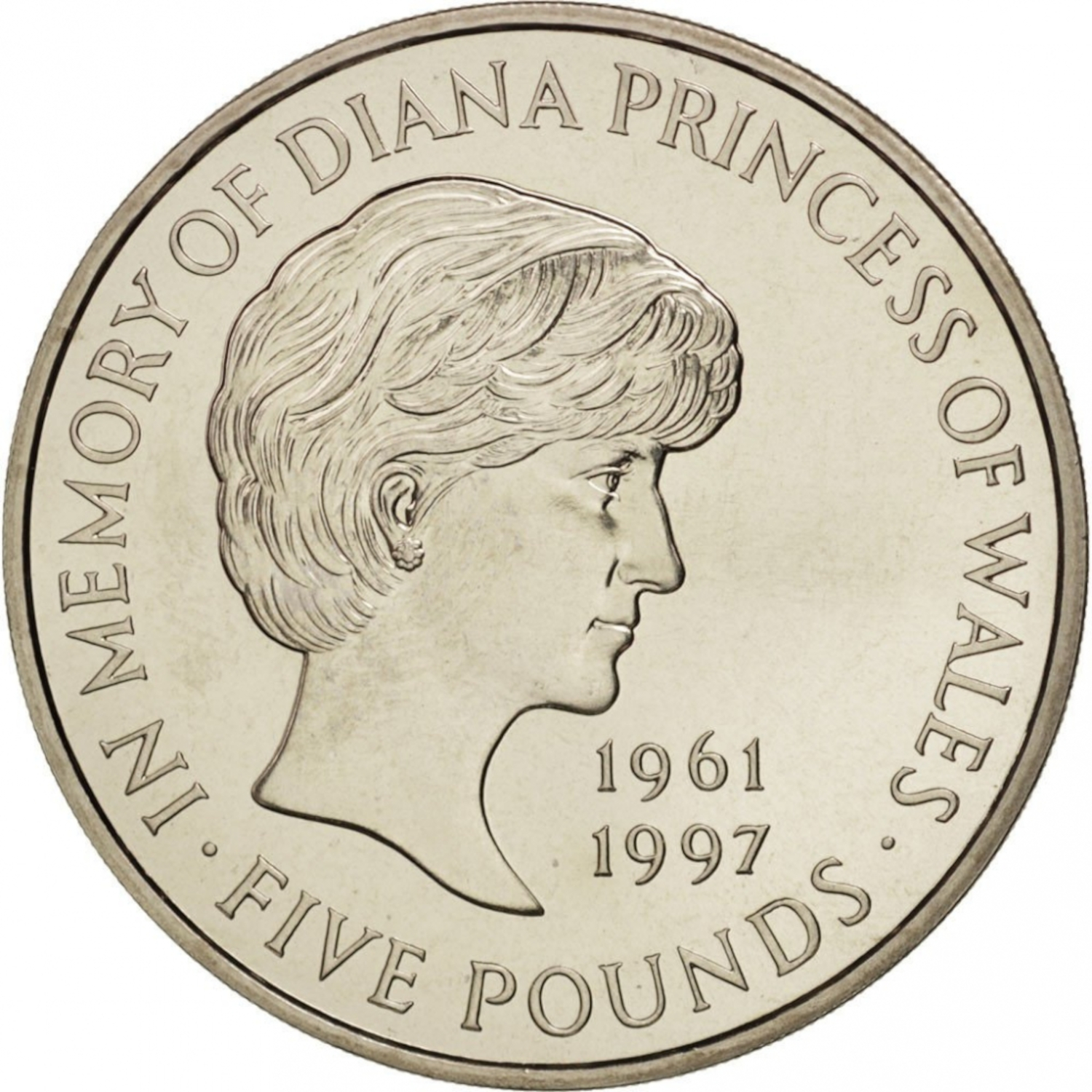
The reverse was designed by sculptor Mark Richards FRBS (Royal British Society of Sculptors), one of several Royal Mint engravers selected through a closed design competition. Richards' design shows Diana in three-quarter profile facing left, her hair lifting slightly behind her shoulder. The legend "DIANA / PRINCESS OF WALES" is arched above the portrait, with her dates "1961–1997" inscribed beneath the bust. The portrait deliberately avoids the glamour-photography conventions of late-1990s celebrity imagery and instead works in the classical numismatic tradition.
The obverse carries Ian Rank-Broadley's portrait of Elizabeth II, the fourth definitive UK portrait, in use 1998–2015, recognisable for its slightly older monarch facing right and the legend "ELIZABETH II D.G. REG. F.D. FIVE POUNDS". The Rank-Broadley portrait paired with the Richards memorial reverse is now one of the most-recognised obverse-reverse pairings of late-twentieth-century UK coinage.
Specifications across all four formats
| Property | Cupronickel BU | Silver proof | Silver Piedfort | Gold proof |
|---|---|---|---|---|
| Year of issue | 1999 | 1999 | 1999 | 1999 |
| Designer (reverse) | Mark Richards | Mark Richards | Mark Richards | Mark Richards |
| Obverse portrait | Ian Rank-Broadley (4th) | Rank-Broadley | Rank-Broadley | Rank-Broadley |
| Composition | Cupronickel (75% Cu, 25% Ni) | .925 sterling silver | .925 sterling silver | .917 fine gold |
| Weight | 28.28 g | 28.28 g | 56.56 g (double thickness) | 39.94 g |
| Diameter | 38.61 mm | 38.61 mm | 38.61 mm | 38.61 mm |
| Edge | Milled (reeded) | Milled | Milled | Milled |
| Mintage | 5,396,160 | 49,997 | ~7,500 | ~1,500 |
| Original issue price | £6.95 | £30 | £75 | £695 |
Realistic 2026 values by format
All prices below are based on UK realised auction data and eBay UK Sold listings filtered to the trailing six months, the realised market, not the asking market. Active asking prices on the cupronickel BU in particular are systematically inflated to the £200–500 range; these almost never sell. Filter to Sold listings to see what the coin actually trades for.
| Format / condition | Typical realised range | Notes |
|---|---|---|
| Loose cupronickel (out of folder) | £6 – £10 | No folder, light handling wear. |
| BU in Royal Mint blue folder | £15 – £30 | Folder present and intact, no outer slip. |
| BU in folder + outer cover slip | £25 – £45 | Pristine, with the printed outer card sleeve. |
| Silver proof (in original case) | £40 – £90 | Navy slipcase with COA and white satin lining. |
| Silver Piedfort (in original case) | £150 – £280 | Wooden-feel slipcase, "PIEDFORT" on COA. |
| Gold proof (in original wooden case) | £5,000 – £6,500 | 0.94 troy oz fine gold, COA required. |
| Slabbed PCGS PR-69 / PR-70 (gold) | £7,000 – £8,500 | Top-grade gold proof with third-party slab. |
| Slabbed MS65+ (cupronickel) | £25 – £55 | Slabbing cost typically exceeds resale uplift for CuNi. |
The Diana coin universe: which "Diana coin" do you have?
The single most common confusion in Diana coin valuation is conflating different issues. There are essentially five categories, only two of which are UK Royal Mint coins:
| Coin / issue | Issuer | UK legal tender? | Typical realised |
|---|---|---|---|
| 1999 Memorial £5 (this guide) | UK Royal Mint | Yes | £15 – £6,500 |
| 1981 Royal Wedding 25p crown | UK Royal Mint | Yes | £5 – £3,200 |
| 1997 Tristan da Cunha £5 | Crown Dependency | No (UK) | £25 – £60 |
| 1997 Alderney £5 | Crown Dependency | No (UK) | £30 – £80 |
| 1997 / 2007 Gibraltar Crown | Overseas Territory | No (UK) | £25 – £65 |
| 1997 Cook Islands £5 | Cook Islands | No (UK) | £20 – £50 |
| Private Diana medallions | Westminster, Franklin Mint etc. | No (not coins) | £5 – £15 |
A reliable shorthand: only coins bearing a UK monarch's portrait and a UK face value (£5 or 25p) are UK Royal Mint Diana coins. Anything else, including the heavily-marketed Westminster Collection Diana commemoratives and the various Crown Dependency tributes, is a separate market with much lower resale floors.
1981 Royal Wedding vs 1999 Memorial: side-by-side
The 1981 and 1999 crowns are frequently confused. They share dimensions but they are separate issues:
| Property | 1981 Royal Wedding crown | 1999 Memorial £5 crown |
|---|---|---|
| Commemorates | Wedding of Charles + Diana | Death of Diana (memorial) |
| Designer | Philip Nathan | Mark Richards |
| Portrait subject | Charles + Diana (conjoined) | Diana (alone, three-quarter) |
| Face value | 25 pence | £5 |
| Cupronickel mintage | 26,773,600 | 5,396,160 |
| Silver proof mintage | 218,142 | 49,997 |
| Gold proof mintage | 750 | ~1,500 |
| Cupronickel realised (BU) | £5–12 | £15–30 |
| Gold proof realised | £1,800–3,200 | £5,000–6,500 |
The 1981 cupronickel mintage was five times the 1999 mintage, which is why the 1981 trades cheaper despite being older and arguably more historically resonant. The gold proof relationship runs the other way: the 1981 gold proof had a lower mintage but the 1999 gold proof carries a higher Diana-memorial premium and substantially more gold spot exposure (39.94 g vs the 1981's standard 39.94 g but at slightly different gold prices at issue relative to today). See our 1981 Royal Wedding crown guide for the wedding crown in full detail.
Why TikTok thinks every Diana coin is worth thousands
The 1999 Diana £5 has been a fixture of viral "rare coin" content on TikTok, YouTube and Facebook for over a decade. Three mechanisms drive the inflated valuations:
- Gold proof price quoted for cupronickel. The genuine gold proof realises £5,000–6,500. Viral creators quote this price for what is almost always a cupronickel BU worth £15–45. The simple test: weigh the coin. Cupronickel = 28.28 g (rich grey colour); gold proof = 39.94 g (rich yellow colour). There is no realistic middle case.
- Asking-price scrapes. "Princess Diana £5 coin £500" Buy-It-Now listings appear regularly on eBay UK; they almost never sell. The realised distribution for the cupronickel BU sits firmly at £15–30 in folder. Filter to Sold listings to see the truth.
- Privately-minted medallions sold as "coins". Westminster Collection, Bradford Exchange and Franklin Mint heavily marketed Diana memorial medallions (not legal-tender coins) in the years immediately after 1997. These have no resale floor and trade at £5–15 in original packaging. Some viral content blurs the distinction and quotes Royal Mint gold proof prices for what is actually a Westminster medallion.
A short authentication routine resolves nearly all of these cases in under sixty seconds: check the date is 1999, check the obverse legend reads "ELIZABETH II D.G. REG. F.D. FIVE POUNDS" (UK Royal Mint), weigh the coin, and confirm the reverse reads "DIANA / PRINCESS OF WALES / 1961–1997". A 28.28 g UK Royal Mint coin matching that description is your £15–90 piece; a 39.94 g yellow-gold version is your £5,000+ piece; anything else is a Crown Dependency issue or a private medallion.
Authenticating a 1999 Diana £5
The five-point checklist for any Diana £5 you are considering buying:
- Date. Only 1999. Reject any UK Royal Mint "Diana memorial" coin claiming a different date.
- Weight. 28.28 g (CuNi or silver proof), 56.56 g (silver Piedfort), or 39.94 g (gold proof). Outside these windows is suspect.
- Diameter. 38.61 mm exactly, standard UK crown size. A digital caliper costs £10 and resolves this in five seconds.
- Edge. Milled with a fine reeded pattern. The edge is plain on counterfeit Chinese-origin Diana £5 coins documented since 2008.
- Magnetism. All four genuine formats are non-magnetic. A magnetic Diana £5 is fake.
- Reverse legend. Should read "DIANA / PRINCESS OF WALES" arched above the bust with "1961–1997" beneath, separated by a proper en-dash rather than a hyphen. Counterfeit examples often misspell or mis-typeset the legend.
- Portrait detail. Genuine Royal Mint strikes show exceptionally fine hair detail. Soft, muddy or "splattered" hair detail under a 5× loupe suggests a counterfeit cast.
Anniversary-cycle pricing and timing
Diana coin prices show modest but reliable spikes around anniversary cycles. The pattern is most visible on the cupronickel BU but extends to the silver proof and Piedfort formats too.
- 1 July (Diana's birthday). Annual modest spike of around 8–12% above six-month baseline; usually short-lived (two to four weeks).
- 31 August (anniversary of her death). Sharpest annual spike, typically 12–20% above baseline. The 20th anniversary in 2017 produced a 35% spike that held for three months.
- Milestone anniversaries. The 20th anniversary in 2017 (death) and the 60th anniversary of her birth in 2021 produced the largest spikes of the modern era. The 50th memorial anniversary in 2047 is the next major expected demand event.
- Diana media releases. The 2021 Netflix series The Crown Season 4 (Diana storyline) produced a sustained 15–20% lift; the 2022 Princess Diana documentary cycle (The Princess, Diana the musical adaptation) drove a more modest 5–8% lift.
Net effect: if you plan to sell, time the listing for late August or for the run-up to a milestone anniversary or major Diana media release. The cupronickel BU and silver proof are the formats that respond most reliably to these cycles; the gold proof tracks gold bullion more closely and shows less anniversary sensitivity.
Where to sell a 1999 Diana £5
- Cupronickel BU singles: eBay UK auction format, low (£0.99) start, list in late August for the anniversary spike. Avoid Buy-It-Now at inflated prices; they rarely sell. Selling fees ~13%.
- Silver proof + silver Piedfort: eBay UK for fastest turnover, or specialist coin Facebook groups for cleaner buyer pool. Provide high-resolution photographs of the original case, COA and edge.
- Gold proof: consign to Spink, Noonans or Baldwin's rather than eBay. Auction-floor buyers pay closer to true value for verified gold; eBay buyers heavily discount for authentication risk on four-figure-plus pieces.
- Avoid: pawn shops (40–60% of eBay realised), high-street jewellers (price by gold weight only, ignoring numismatic premium), and Cash for Gold scrap operators (will offer melt value only on the gold proof and refuse the cupronickel entirely).
For a full venue commission comparison see our where to sell rare coins UK guide; for the auction houses specifically, see our UK auction house comparison.
Featured £5 crowns on MyCoinage
Related guides
- 1981 Royal Wedding crown guide, the sister Charles + Diana wedding crown, with full mintage and format breakdown.
- £5 coin values UK, the wider universe of UK £5 crowns from 1990 onwards.
- Crown coin values UK, the historical context of UK crowns from Queen Victoria to the present.
- 2022 Charles III memorial coinage, the modern successor in the Royal Mint memorial-coinage tradition.
- Coin collecting myths 2026, the broader pattern of social-media "rare coin" content.
- Westminster Collection & Bradford Exchange explained, the private "Diana medallion" market, why those medallions are not coins, and why they have no resale floor.
- CGT-exempt coins UK, why the gold proof Diana £5 qualifies as a tax-free UK gold coin.
- How to grade a coin, the condition language used in the price tables above.