Florin Values UK: Complete 1849–1970 Price Guide
The British florin, face value two shillings, ran from 1849 to 1970 and was the country\'s first attempt at a decimal coin. The 1849 "Godless" florin and the 1851 Gothic redesign are among the most collected first-year issues in the British series. This guide covers every reign, the key dates, the 1937 Edward VIII pattern, the silver content of pre-1947 issues and realised auction prices.
Background: Britain\'s first decimal experiment
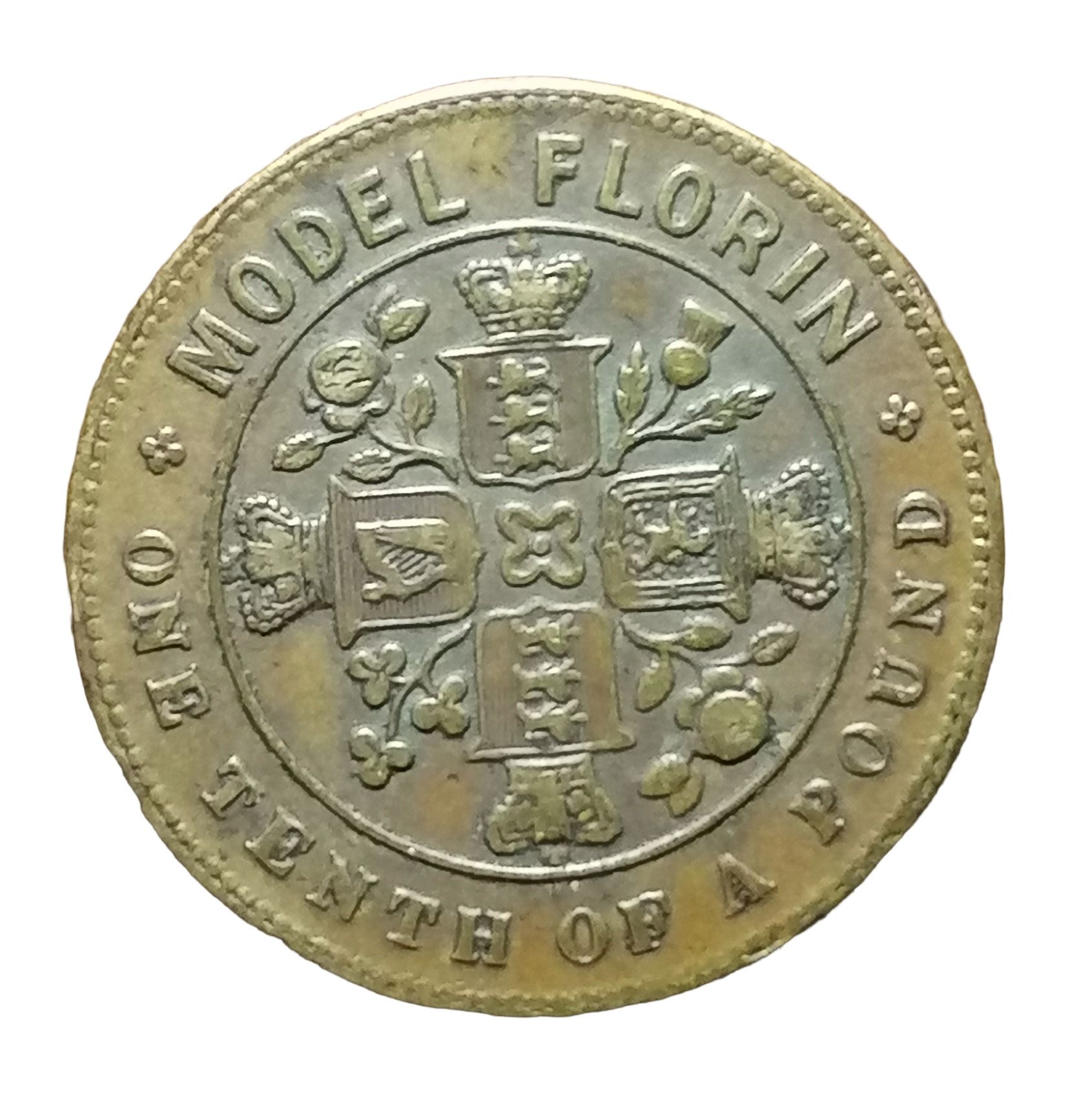
The florin was introduced in 1849 as a deliberate experiment in decimal coinage. At a face value of two shillings, it was exactly one tenth of a pound, the cleanest possible decimal fraction in the £sd system. Parliament debated decimalisation throughout the mid-19th century, and although full decimalisation was never adopted at that time, the florin survived as a popular silver coin for the next 122 years. When Britain finally went decimal in 1971, the florin\'s exact one-tenth value meant it could simply continue circulating as a 10p piece without any redenomination.
The 1849 Godless florin
The first florin, struck in 1849, omitted the words "DEI GRATIA" ("By the Grace of God") and "FID DEF" ("Defender of the Faith") from Queen Victoria\'s titles on the obverse. Whether by oversight or by deliberate design choice (the engraver William Wyon may have wanted to emphasise the modern, secular nature of the new decimal experiment) the omission triggered public outrage from the Church of England, and the design was withdrawn after a single year. The 1849 issue is universally known as the "Godless florin" and is one of the most desirable first-year-of-issue coins in the British series.
| Grade | Realised price range |
|---|---|
| Fair / Good | £20, £40 |
| Fine | £40, £80 |
| Very Fine | £80, £180 |
| Extremely Fine | £180, £500 |
| Uncirculated / mint state | £500, £1,800 |
| Proof / FDC | £1,500, £4,000 |
Gothic florins 1851–1887
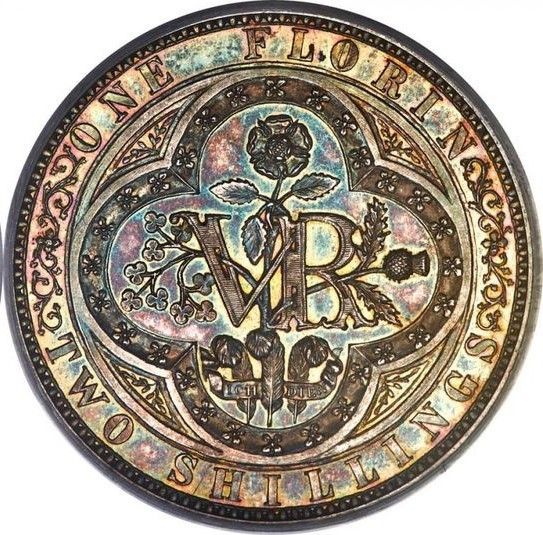
The 1851 redesign reinstated the religious legend and adopted a fully Gothic-script lettering, plus a more medieval bust of Victoria with a crown rather than the modest portrait-head wreath of the Godless issue. The Gothic florin ran for 36 years and is widely regarded as one of the most beautiful British coin designs ever produced. Date markings are themselves in Gothic numerals (the 1854 reads "mdccclv" rather than 1854, confusing many casual buyers).
Key Gothic florin dates:
| Date | Mintage | Notes | VF realised range |
|---|---|---|---|
| 1851 | 1,540 | First year Gothic; very low mintage | £1,500, £5,000 |
| 1854 | 552,000 | Key date; very few survive | £800, £3,000 |
| 1859 | 2,239,380 | Common | £30, £90 |
| 1872 | 7,199,690 | Most common Gothic year | £25, £75 |
| 1887 Gothic | included with Jubilee total | Final year; transitional issue | £40, £120 |
Jubilee Head florins 1887–1892
For Victoria\'s Golden Jubilee year of 1887 the florin was redesigned with a "Jubilee Head" bust and a crowned cruciform-shields reverse. The 1887 issue is one of the most-collected single-year designs in the Victorian series because of the historical association. Mintages were lower than the late Gothic years and survivors are well-distributed across the world\'s collections.
| Date | Mintage | VF realised |
|---|---|---|
| 1887 | 1,084,990 | £25, £80 |
| 1888 | 1,547,540 | £25, £75 |
| 1889 | 2,973,561 | £25, £70 |
| 1890 | 1,684,737 | £30, £90 |
| 1891 | 836,438 | £40, £120 |
| 1892 | 283,401 | £60, £180 |
Old Head florins 1893–1901
Victoria\'s final coinage portrait, the "veiled" or "Old Head" by Thomas Brock, ran on the florin from 1893 to 1901. The reverse switched to three crowned shields. Common dates trade at £15-50 in average grade; the 1901 (Victoria\'s death year) carries a small premium because of its historical interest.
Edward VII florins 1902–1910
Edward VII\'s florin reverse showed a striking standing Britannia, often regarded as the finest design of the short Edwardian series. The 1902 first year was issued in both currency and matt proof finishes; the matt proof is one of the most desirable Edward VII coins and trades at £200-500 depending on grade. Currency Edwardian florins typically trade at £15-60 in collectable grades.
George V florins 1911–1936
The George V florin returned to a crowned cruciform-shields reverse, similar to the Jubilee design. The 1932 issue is the famous key date of the series, with a low mintage of 717,041. The 1933 and 1936 are also scarcer than typical years.
| Date | Mintage | Notes | VF realised |
|---|---|---|---|
| 1911 | 5,951,284 | First year George V | £15, £40 |
| 1920 | 15,387,833 | First .500 silver year | £10, £30 |
| 1926 | 5,125,410 | Modified effigy variety | £15, £45 |
| 1932 | 717,041 | Key date | £40, £120 |
| 1933 | 8,685,303 | Lower than typical | £15, £40 |
| 1936 | 9,897,448 | Final George V year | £15, £40 |
The 1937 Edward VIII pattern florin
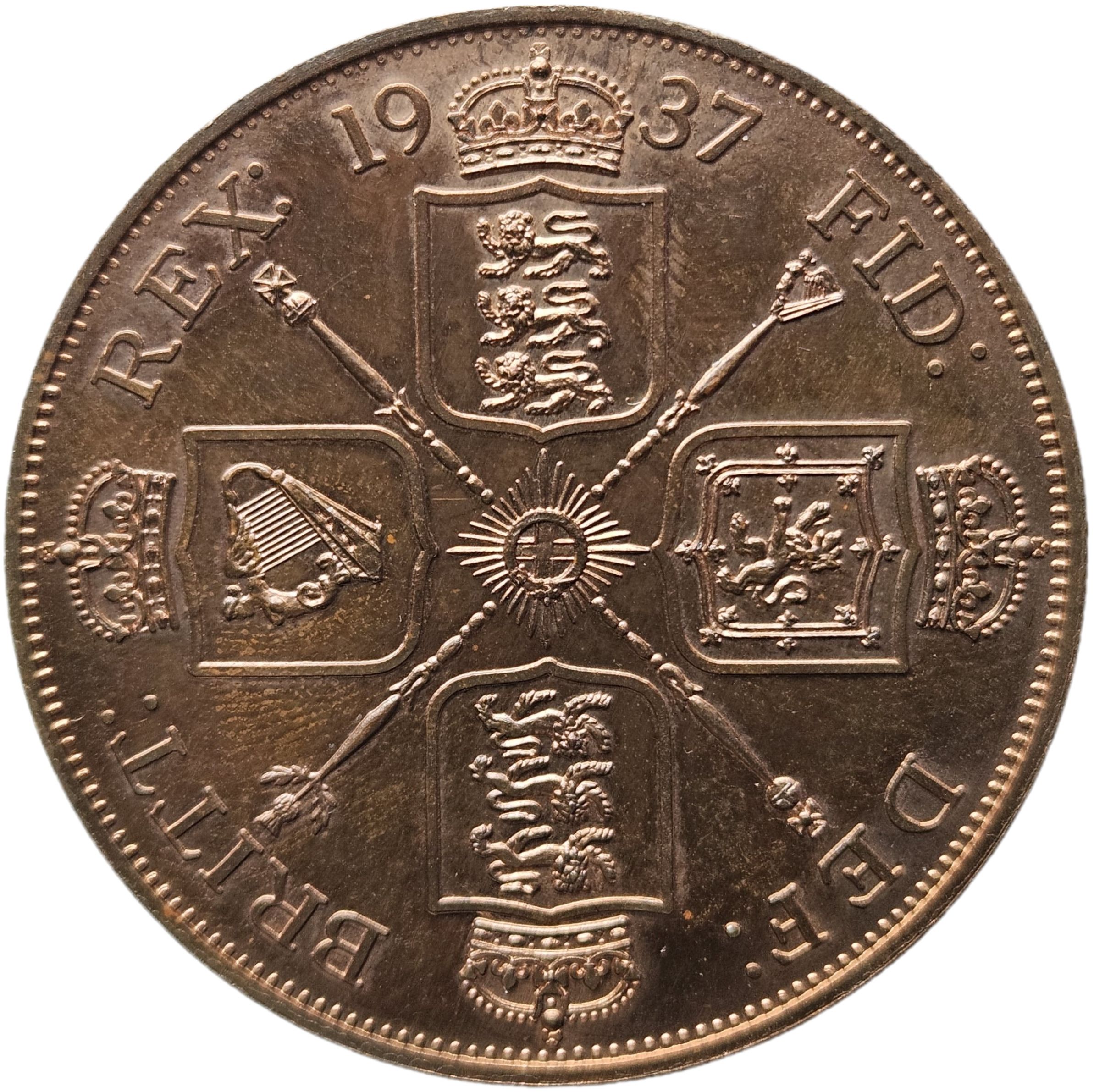
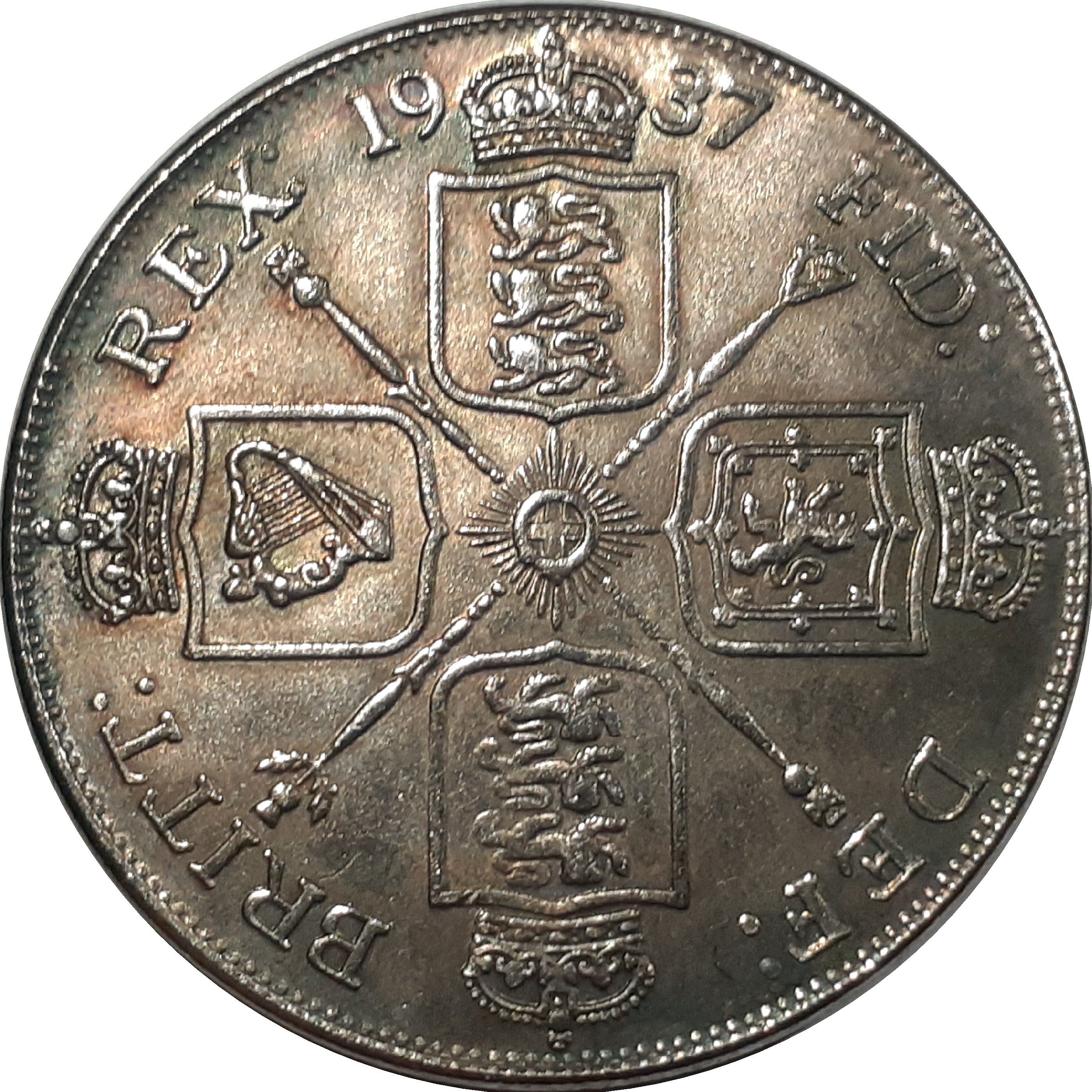
Edward VIII abdicated on 11 December 1936, before any of his coinage entered circulation. Pattern strikes of the 1937 Edward VIII florin exist (used by the Royal Mint to test dies and dies-and-blanks combinations) but were never officially issued. Fewer than ten Edward VIII pattern florins are known to exist, most held by the Royal Mint Museum and a tiny number of major private collectors.
The pattern would have shown an Edward VIII bust on the obverse and a redesigned crown-over-rose reverse, similar to the eventual George VI design. When an example has surfaced at auction (it has happened only a handful of times in the post-war era), realised prices have exceeded £30,000. Any 1937 florin offered on eBay or at low prices is a modern souvenir, not a genuine pattern.
George VI florins 1937–1951
The George VI florin, designed by George Kruger Gray, introduced a striking crowned-rose reverse flanked by a thistle and shamrock. From 1947 the florin became cupronickel rather than silver. The series ran from 1937 to 1951; no business-strike florins were issued in 1952 (Elizabeth II coronation transition).
| Date | Mintage | Notes | VF realised |
|---|---|---|---|
| 1937 | 13,006,781 | First year George VI | £6, £15 |
| 1946 | 22,910,085 | Final .500 silver year | £5, £12 |
| 1947 | 22,910,085 | First cupronickel year | £3, £8 |
| 1951 | 27,431,747 | Festival of Britain proof | £5, £15 |
Elizabeth II florins 1953–1970
Elizabeth II florins (sometimes called "two-shilling pieces" rather than florins on later issues) ran from 1953 to 1970, all in cupronickel. The 1953 Coronation issue is the most-collected date. From 15 February 1971 these coins continued circulating as 10p pieces until the smaller decimal 10p replaced them in 1992. Common dates trade at £1-5; the 1953 in mint state can fetch £15-30.
Featured florins on MyCoinage
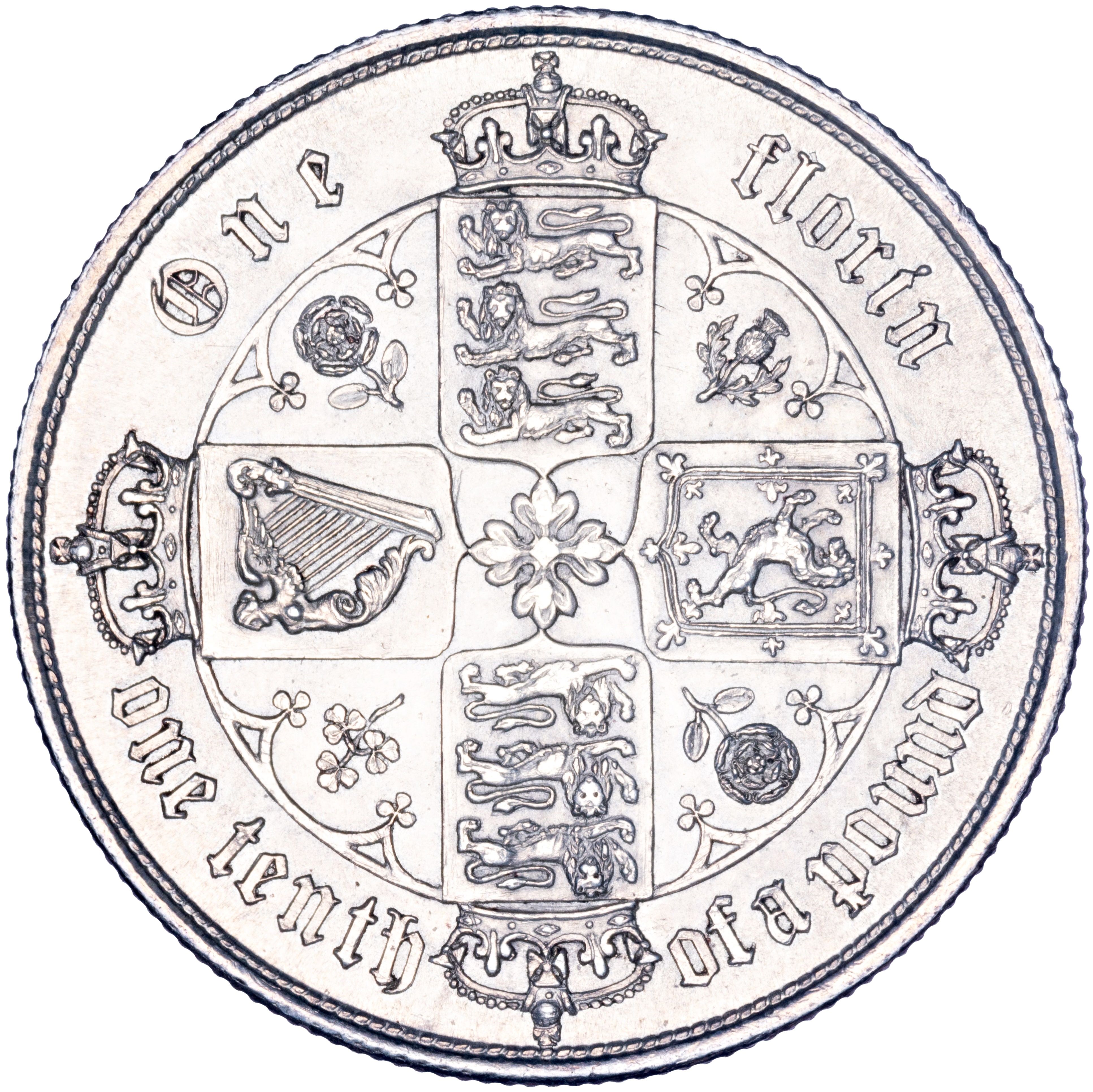
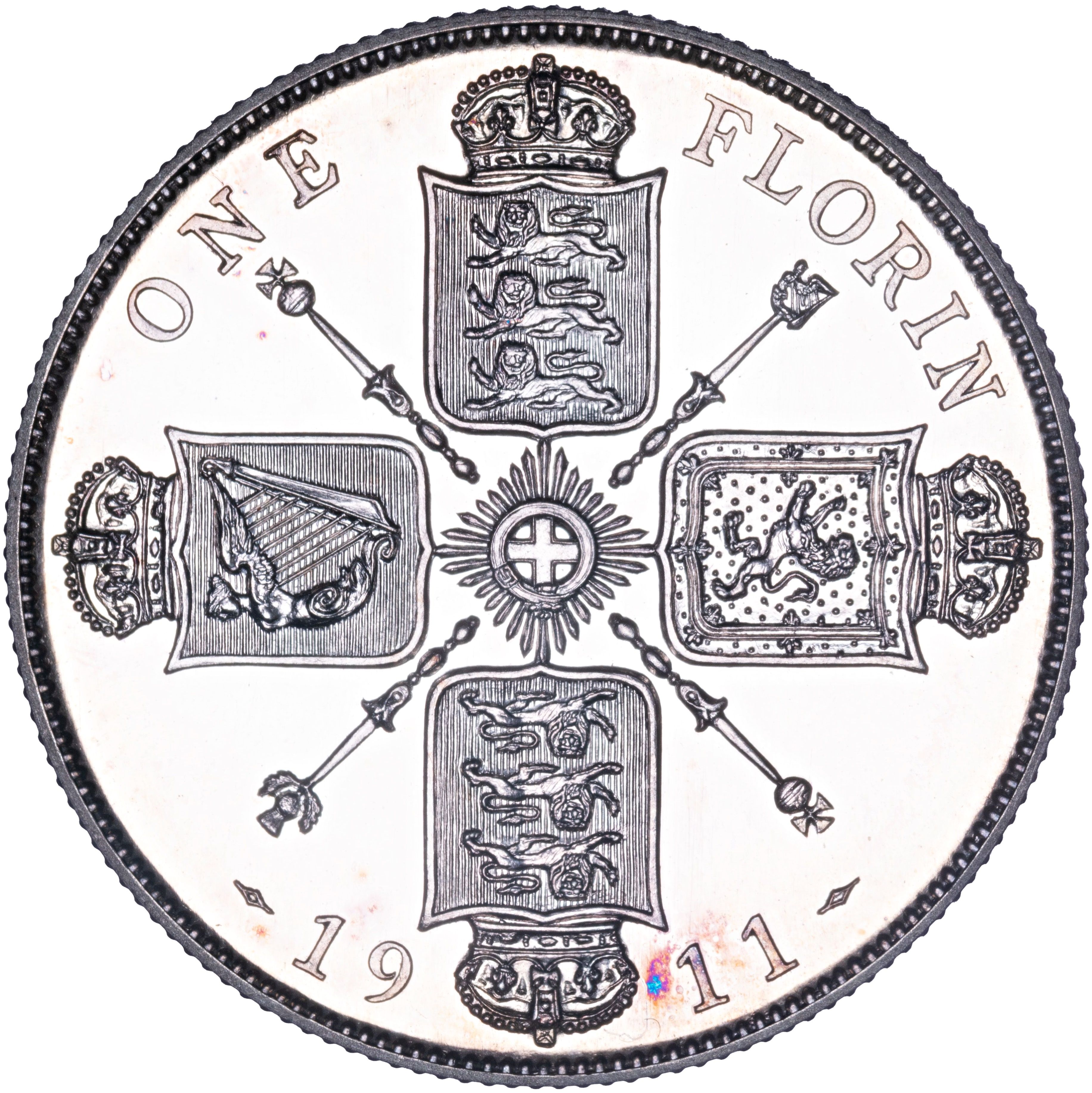
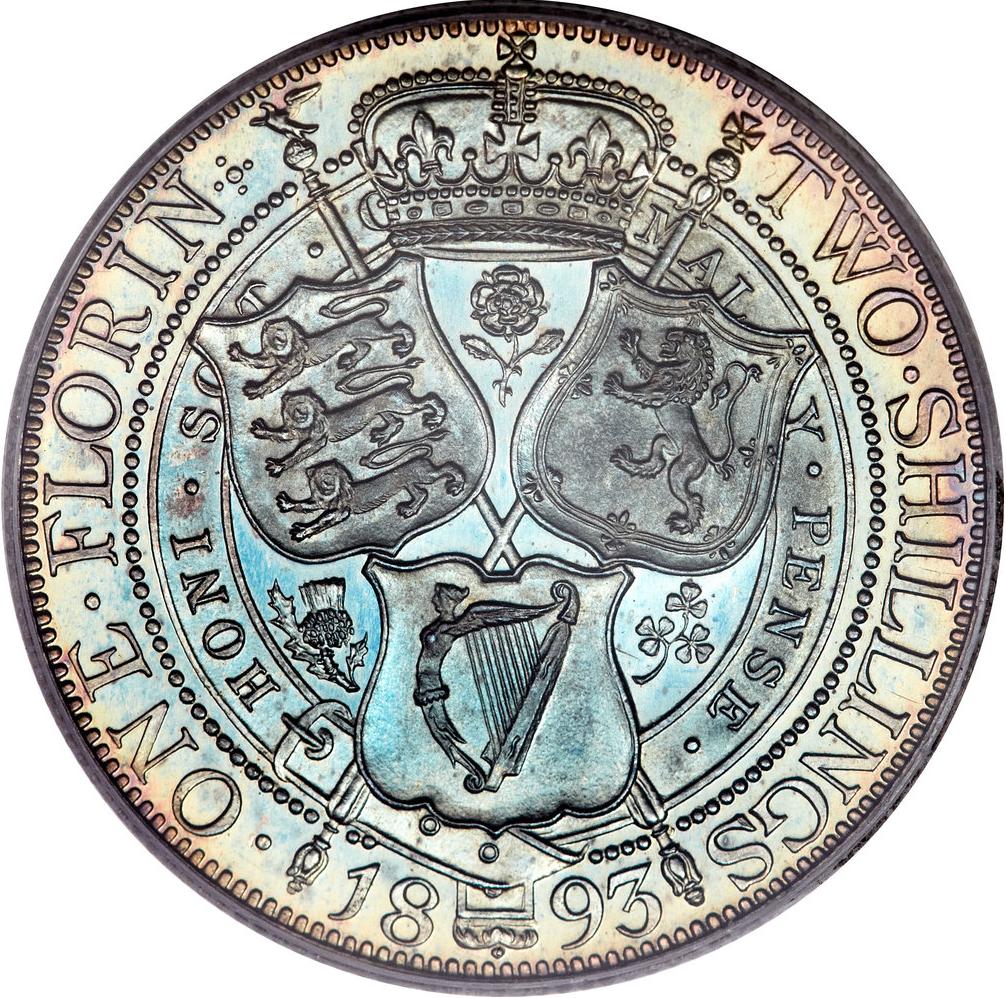
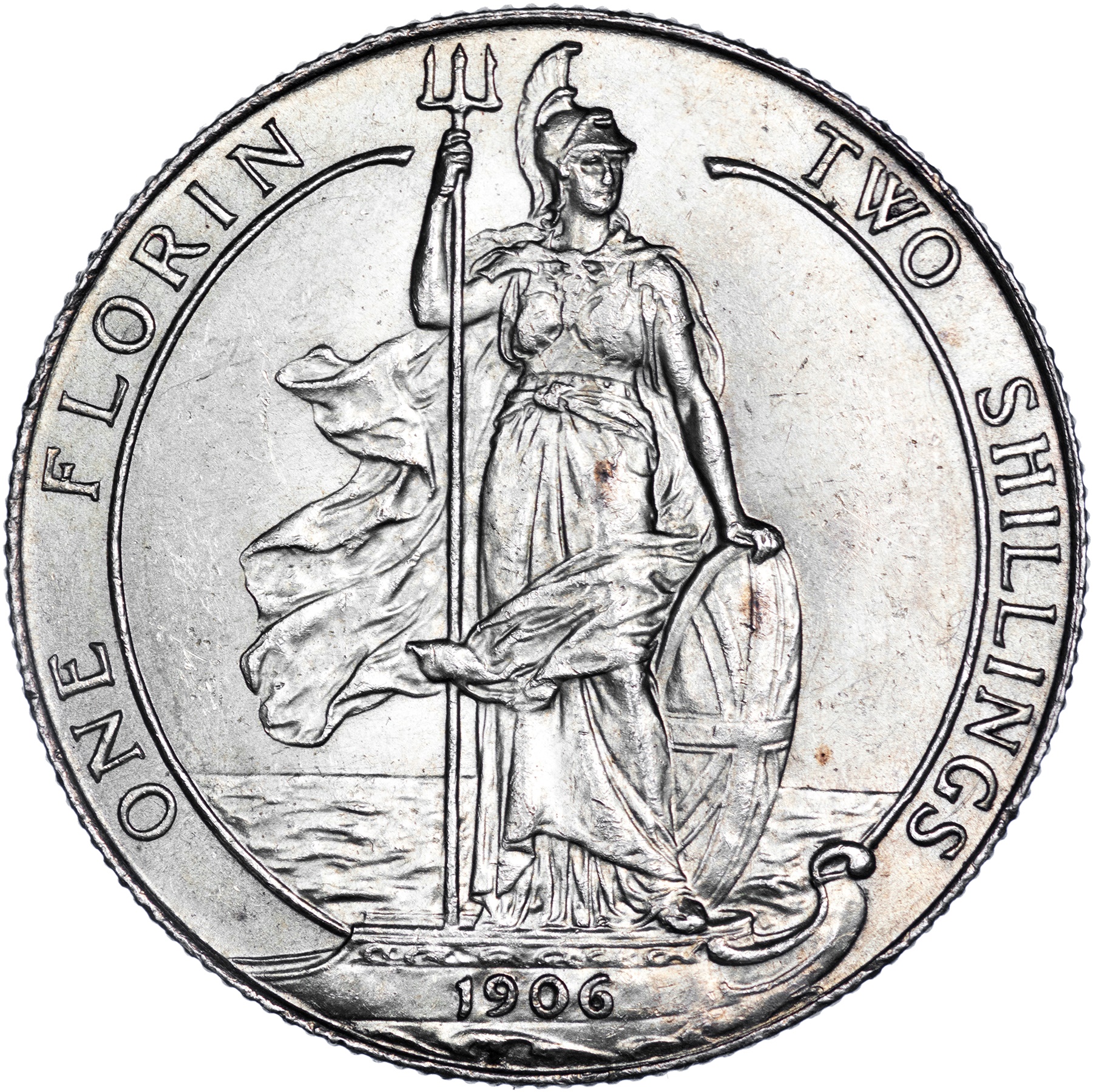
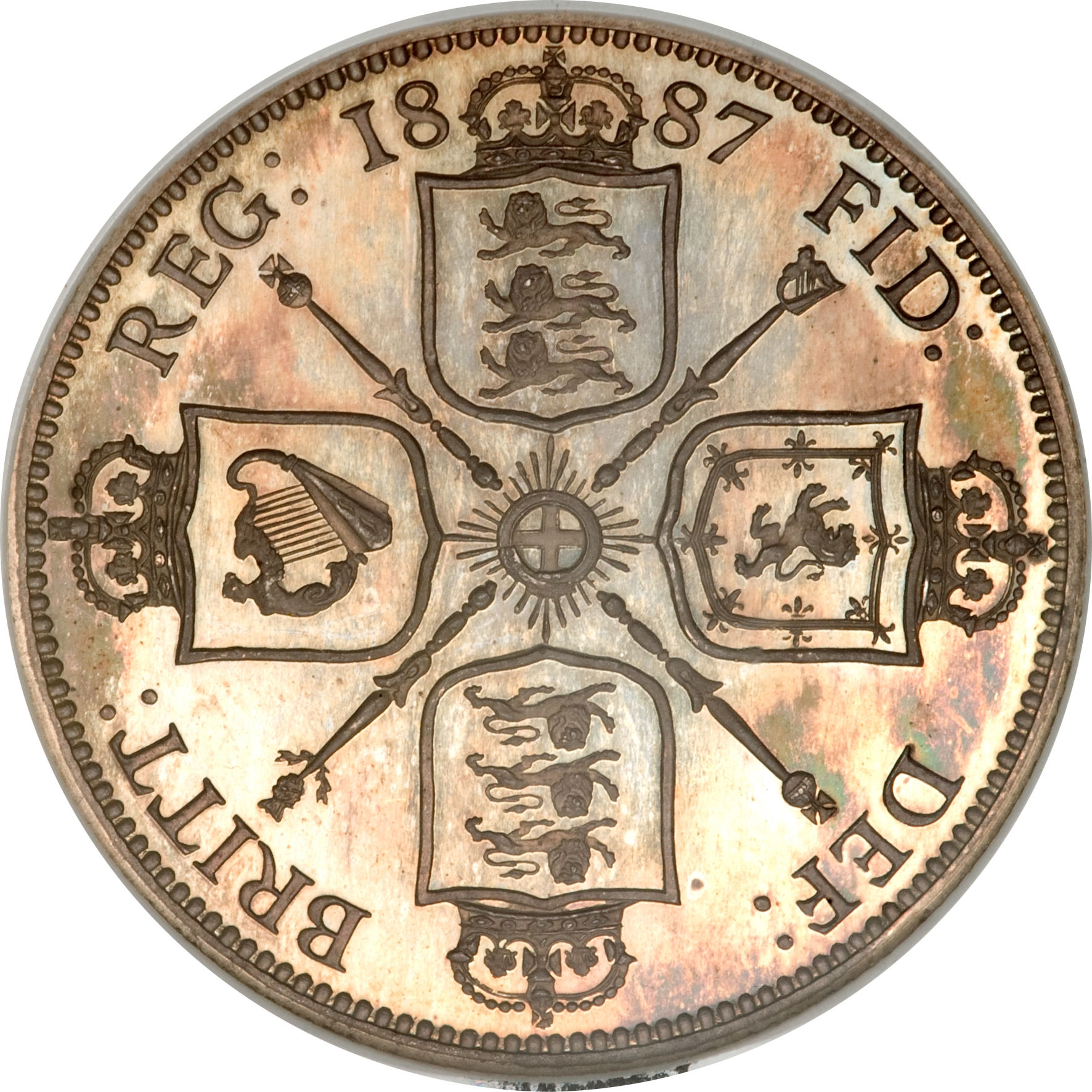
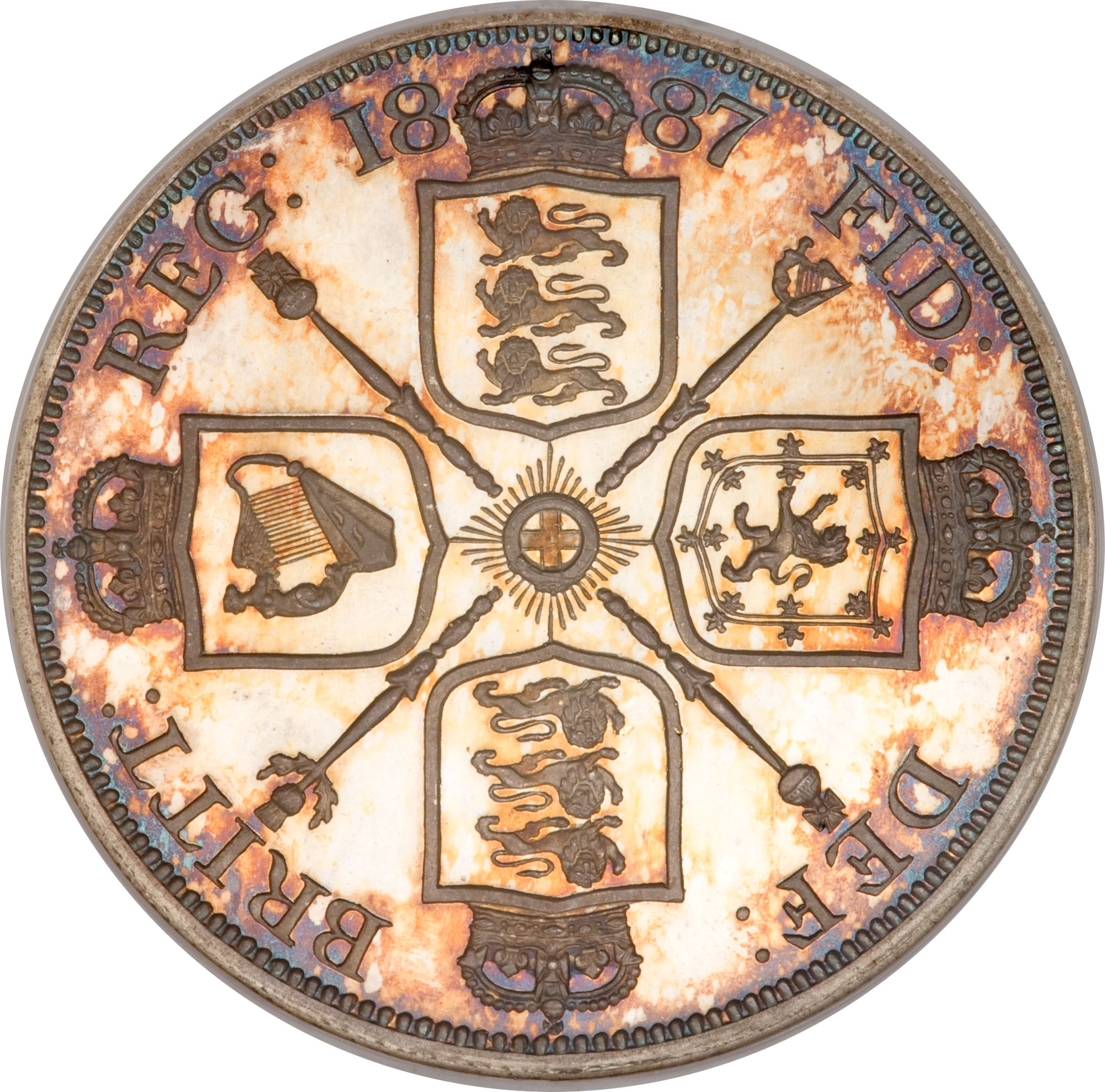
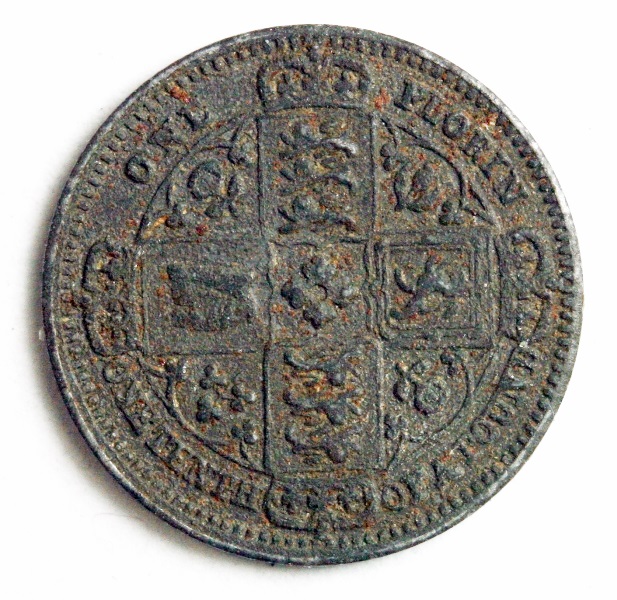
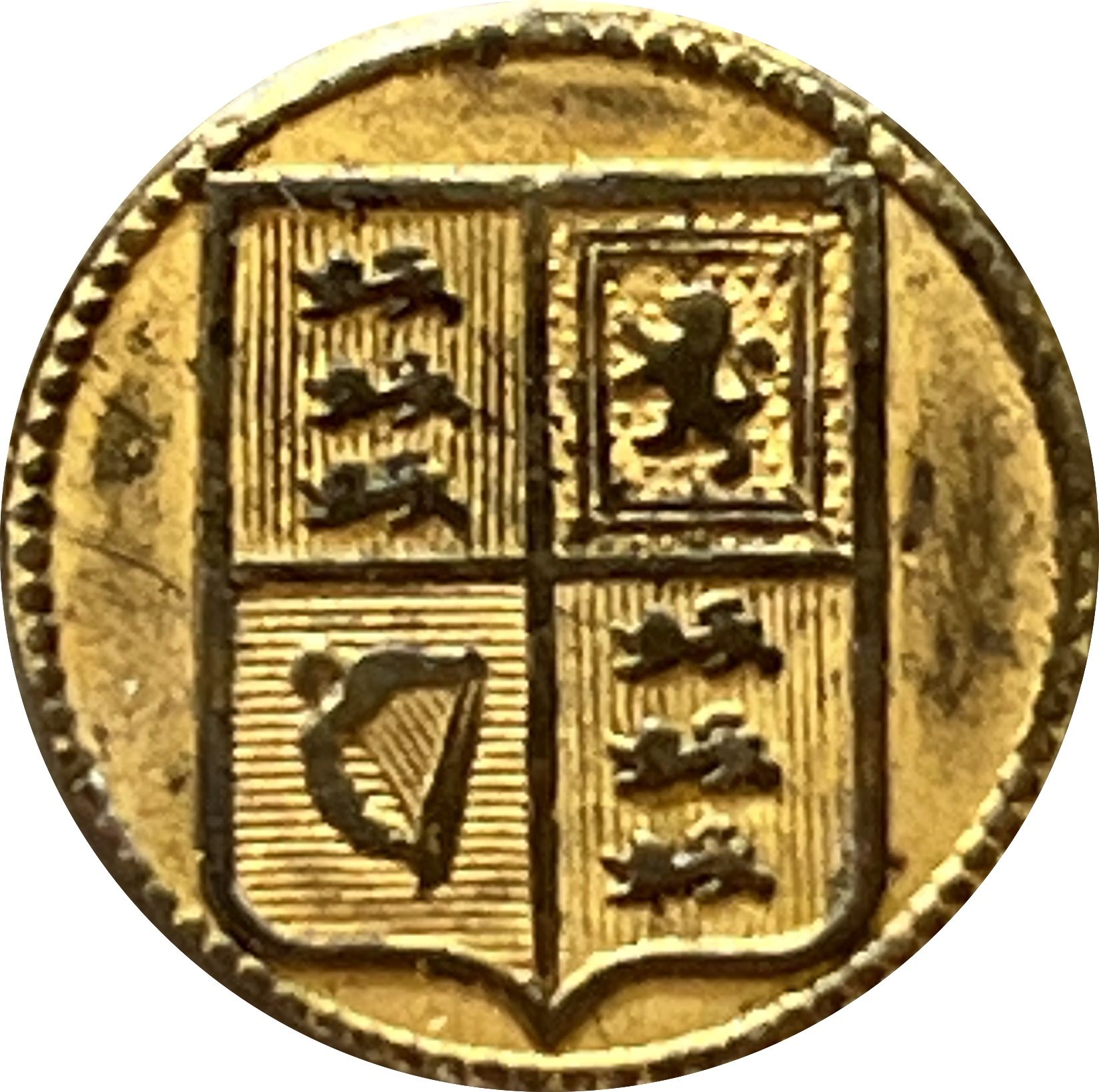
Browse every florin in our database →
Silver content and bullion floor
Pre-1947 florins carry a meaningful silver-content floor under their numismatic value. A worn common-date sterling florin (1849-1919) is worth its silver melt plus a small premium; the same is true for the .500 silver florins of 1920-1946.
| Era | Fineness | Pure silver per coin | Bullion floor at £25/oz |
|---|---|---|---|
| 1849-1919 | .925 sterling | 10.46 g (0.337 oz) | £8.40 |
| 1920-1946 | .500 silver | 5.66 g (0.182 oz) | £4.55 |
| 1947-1970 | cupronickel | 0 g | No bullion value |
Related guides
- Pre-decimal coins UK: complete guide
- Shilling values UK, the florin\'s smaller silver companion
- Crown coin values UK, the larger silver denomination
- Where to sell rare coins UK
- How to grade a coin
- Coin collecting glossary
External references
- The Royal Mint, first-party reference and historical archive.
- British Numismatic Society, academic reference for Victorian and Edwardian florin varieties.
- Spink Standard Catalogue of British Coins, the trade reference.
- Baldwin\'s of St James\'s, specialist British coin auctions.
- Noonans Mayfair, quarterly British coin sales.
- eBay UK florin category, useful for tracking realised prices on common dates.
Buying florins on eBay
The links below open eBay UK searches; if you buy through them, MyCoinage earns a small commission at no cost to you. We only link to coins we'd genuinely buy ourselves.
Florins are one of the better-value entry points into Victorian and pre-decimal silver. A common-date Victoria Gothic florin can be had for £30-50 in collectable grade, while a 1953 Coronation florin in BU is £15-25. The links below pre-filter eBay UK to the most-collected dates and varieties.
Victoria Gothic florins (sold) ↗ 1887 Jubilee Head florin ↗ Edward VII florin ↗ 1953 Coronation florin ↗ Slabbed PCGS florins (sold) ↗ Slabbed NGC florins (sold) ↗ George VI florin ↗ Florin date-run lots ↗