Quintuple Sovereign £5: 1 Ounce of UK Gold
The quintuple sovereign, also called the "£5 sovereign" or "five sovereign coin", is the largest standard UK gold sovereign denomination. Containing 1.177 troy ounces of pure 22-carat gold in a 36-mm coin, it sits at the top of the sovereign-family pyramid and is one of the most prestigious modern gold collector pieces. This guide covers specifications, historical and modern issues, realised auction prices, and how the quintuple sovereign compares to the 1 oz gold Britannia for UK gold investors.
What is a quintuple sovereign?
A quintuple sovereign, sometimes simply called a "£5 sovereign", "five sovereign coin" or in older sources a "double crown", is the largest standard member of the British sovereign family. The name describes the gold content (five times the pure-gold weight of a single sovereign) while the legal-tender face value is exactly £5. Specifications:
- Gross weight: 39.94 g
- Pure gold: 36.61 g (1.177 troy ounces)
- Fineness: 22-carat / .9167
- Diameter: 36.02 mm
- Thickness: approximately 2.30 mm
- Edge: milled (reeded)
- Face value: £5 (legal tender)
Crucially, the quintuple sovereign is not the same coin as the £5 commemorative crown. The crown is a 28.28 g cupronickel coin (or sometimes a silver / gold proof variant of the same diameter); the quintuple sovereign is a 39.94 g 22-carat gold sovereign with a Pistrucci St George reverse. The two share a face value but nothing else. Mistaking one for the other is the single most common error in pricing this denomination.
The denomination has been struck only intermittently since 1820. It has never been a circulating coin in modern Britain, every example was made for presentation, proof set, or collector purposes, which is precisely why even modern issues hold meaningful numismatic premium over their bullion content.
Quintuple vs full vs double sovereign, weights and gold content
Where the quintuple sits in the sovereign family, with current-market premium ranges:
| Format | Total weight | Pure gold | Diameter | Spot value (today) | Typical premium | Mintage tier |
|---|---|---|---|---|---|---|
| Full sovereign | 7.988 g | 7.322 g | 22.05 mm | ~£520 | 5-15% bullion / 50-200%+ proof | Mass / 50,000-1M+ bullion |
| Double sovereign £2 | 15.976 g | 14.63 g | 28.4 mm | ~£1,040 | 15-40% bullion / 80-300% proof | Limited / 1,000-15,000 |
| Quintuple sovereign £5 | 39.94 g | 36.61 g | 36.02 mm | ~£2,600 | 40-200%+ over bullion | Very limited / 250-2,000 |
Spot values use a representative gold price of £2,200/oz; refresh against your live spot for current numbers. Premium ranges reflect realised UK auction-house prices over the past 18 months for the bullion / proof finishes indicated. Mintage tier is illustrative across the modern Royal Mint era (1980-present).
Two clear patterns emerge. First, the per-gram premium over bullion rises sharply as you move up the size ladder, the quintuple sovereign carries far more numismatic premium than the full or double, because production is much more limited. Second, the larger denominations are almost always proof: there is no "quintuple sovereign bullion" market in the way that there is a thriving full-sovereign bullion market.
History of the £5 quintuple, Pistrucci 1820 onwards
The quintuple sovereign is, properly speaking, the quintuple sovereign of the modern series, not to be confused with the much older Tudor and Stuart "five-pound piece" patterns of the 16th and 17th centuries. The modern quintuple sovereign starts with George IV in 1820, when Pistrucci struck a small number of pattern five-pound pieces using the same St George and Dragon reverse he had cut for the 1817 sovereign. Surviving 1820 patterns are six-figure rarities at any meaningful auction.
Subsequent landmarks:
- 1839 Victoria "Una and the Lion" £5, mintage 400, designed by William Wyon, widely held to be one of the most beautiful coins ever struck. Realised prices at major auctions sit at £100,000-300,000+ in proof condition. Technically a different reverse design from the standard quintuple sovereign but the same face-value tier.
- 1887 Victoria Jubilee £5, the first quintuple sovereign produced for general collector sale. Mintage 797 in proof. Realised range £5,000-15,000+ depending on grade.
- 1893 Victoria Old Head £5, mintage 773 in proof. Realised range £6,000-14,000.
- 1902 Edward VII Coronation £5, matt-proof mintage 8,066, the most-collected pre-modern quintuple. Realised £3,500-7,500.
- 1911 George V Coronation £5, mintage 2,812. Realised £6,000-12,000.
- 1937 George VI Coronation £5, mintage 5,001 in proof (cancelled coronation series). Realised £7,000-15,000.
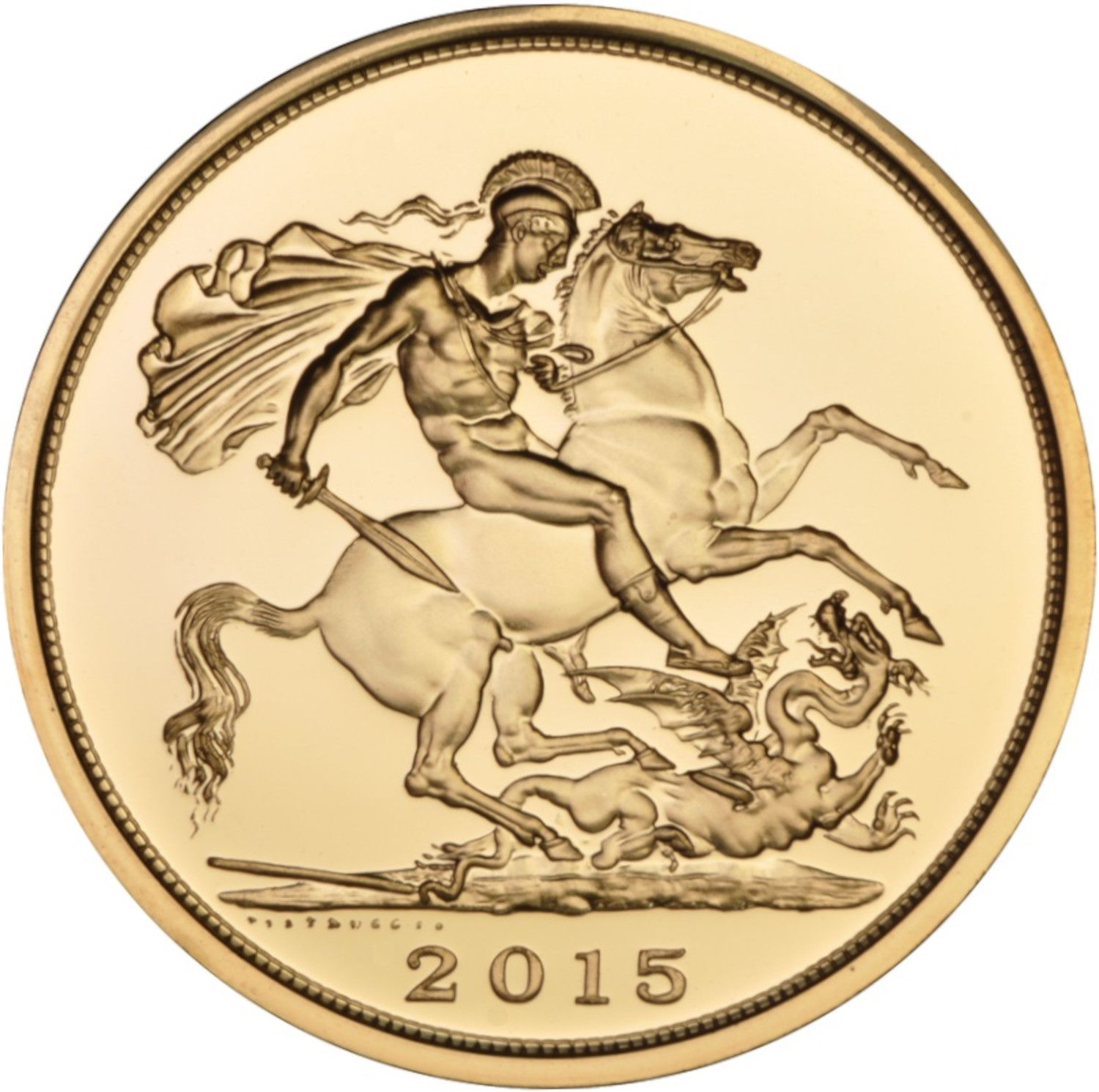
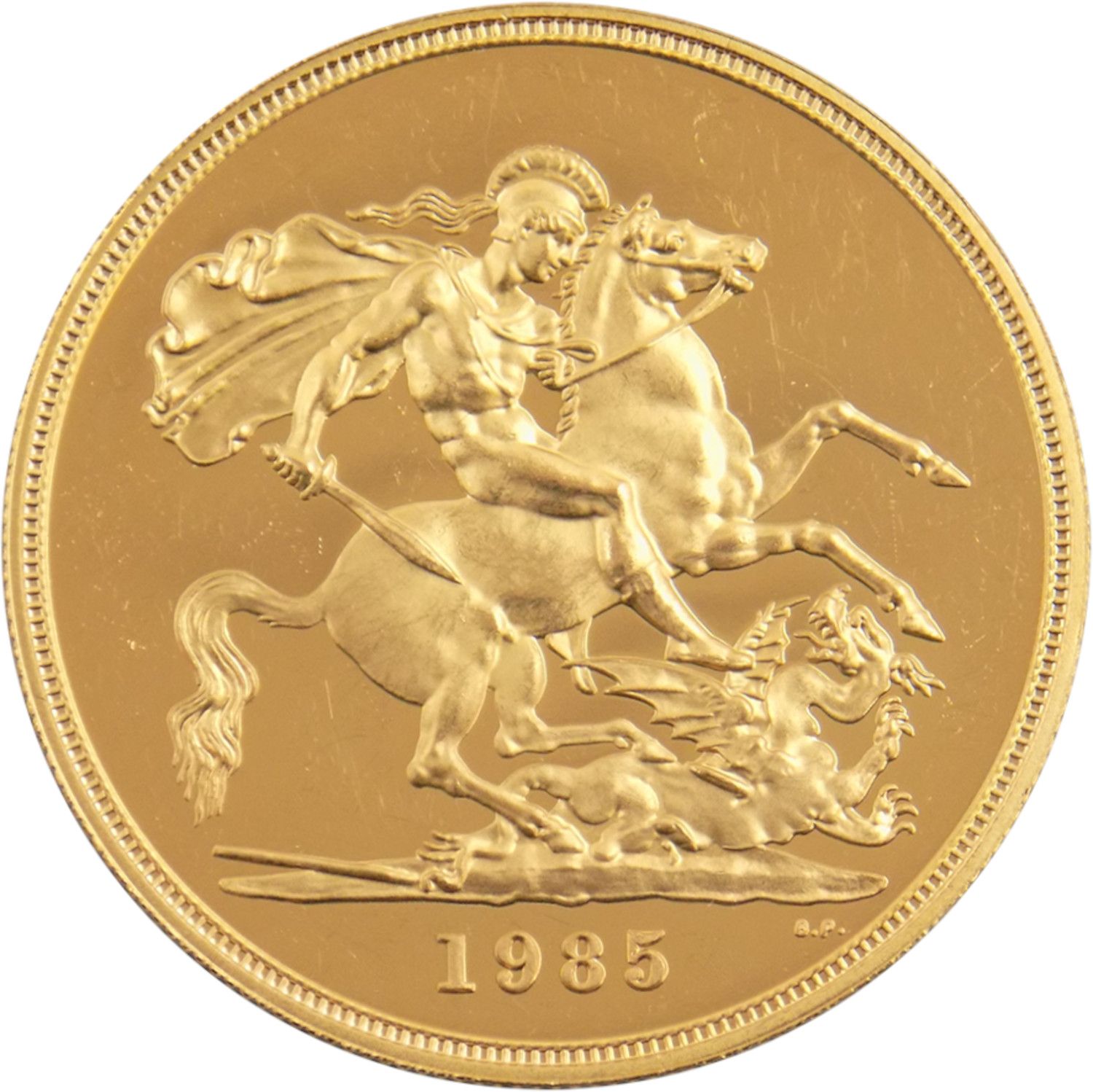
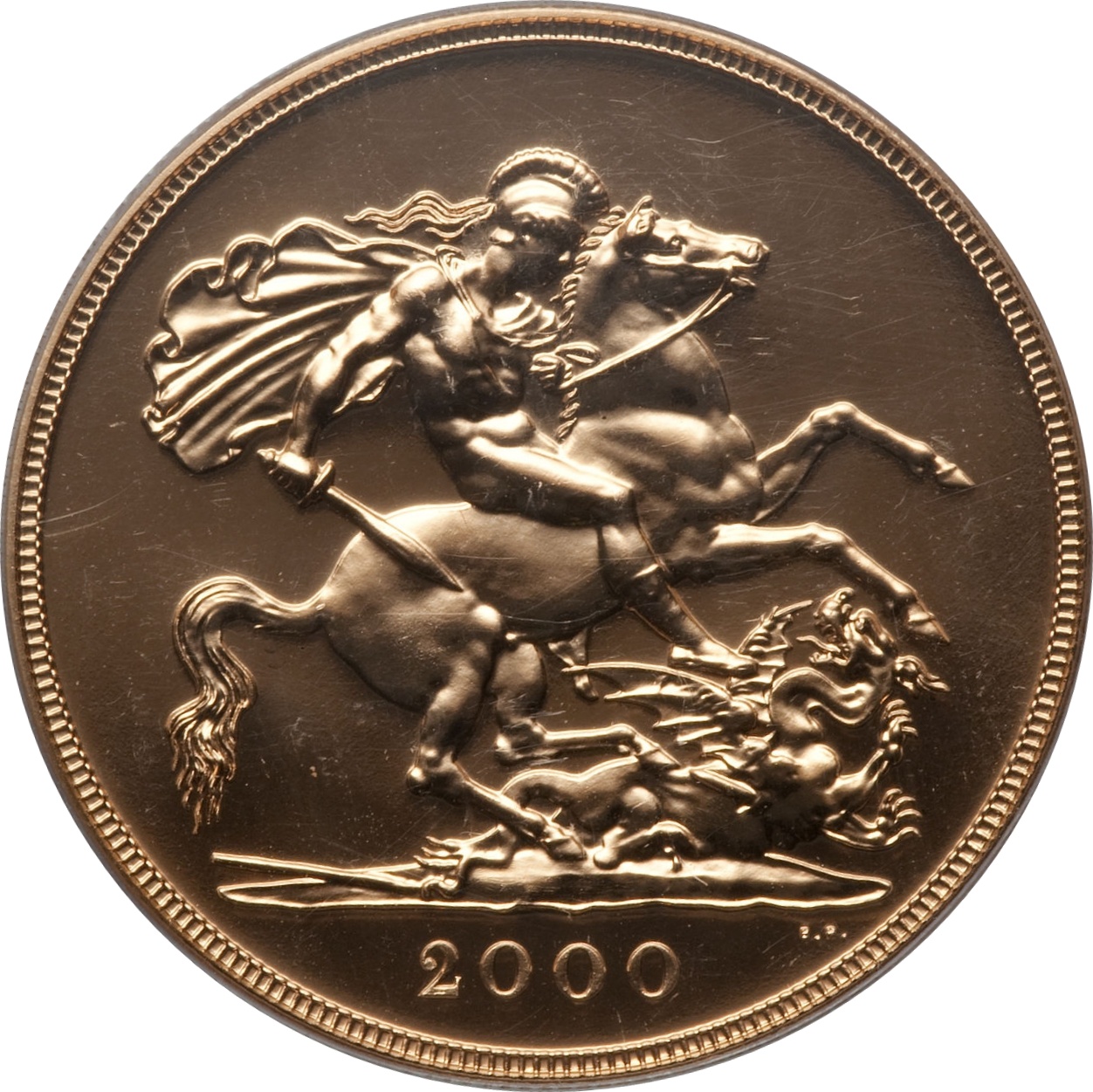
Pistrucci's St George reverse appears on the great majority of these, the same design DNA that started on the 1817 sovereign carrying through to 100+ years later in five-times-larger form. See our Pistrucci St George guide for the full design lineage.
Modern Royal Mint quintuple sovereigns 1985-2026
Modern quintuple sovereigns resumed in 1980 and ran annually from 1985 as proof-only issues at strictly limited mintage. The series breaks naturally by reign:
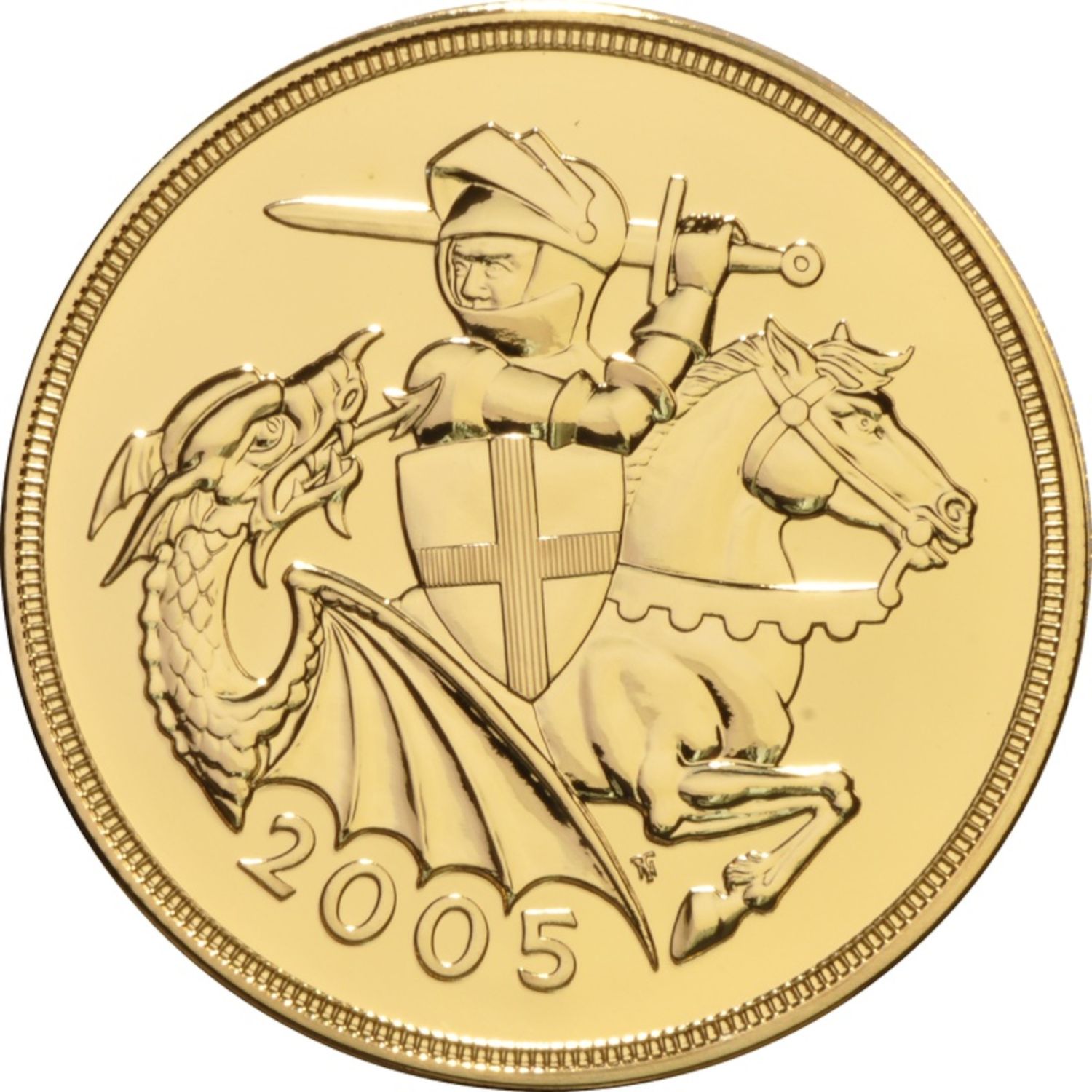
- Elizabeth II 1980-2022, annual proof £5 with Pistrucci St George reverse for most years. Notable issues: 1989 500th Anniversary £5 (mintage 750, realised £5,500-8,500); 2002 Golden Jubilee £5 with the rare shield reverse (realised £3,500-5,500); 2012 Diamond Jubilee £5 (realised £3,200-4,800); 2022 Memorial £5 (realised £3,500-5,000).
- Charles III 2023-2026, the first Charles III quintuple sovereigns. The 2023 Coronation £5 at mintage 1,250 is the headline modern issue, realised range £4,500-6,500. The 2024 definitive £5 with Charles III obverse and Pistrucci reverse runs £3,500-5,000. Charles III quintuple sovereigns are the strongest modern-collector category to enter on the day of issue, given limited mintages and the first-of-reign cachet.
Mintages across the modern era have generally sat at 250-2,000 per year, with anniversary years (1989, 2002, 2012, 2022, 2023) running tighter than common-year issues. Across the full Charles III reign, expect mintages in the 500-1,500 range for annual definitive issues and lower (250-750) for special-anniversary pieces.
Buying and authenticating quintuple sovereigns
Quintuple sovereigns are large, heavy and visually distinctive, which makes simple weight-and-size authentication more reliable than for smaller coins. Five tests:
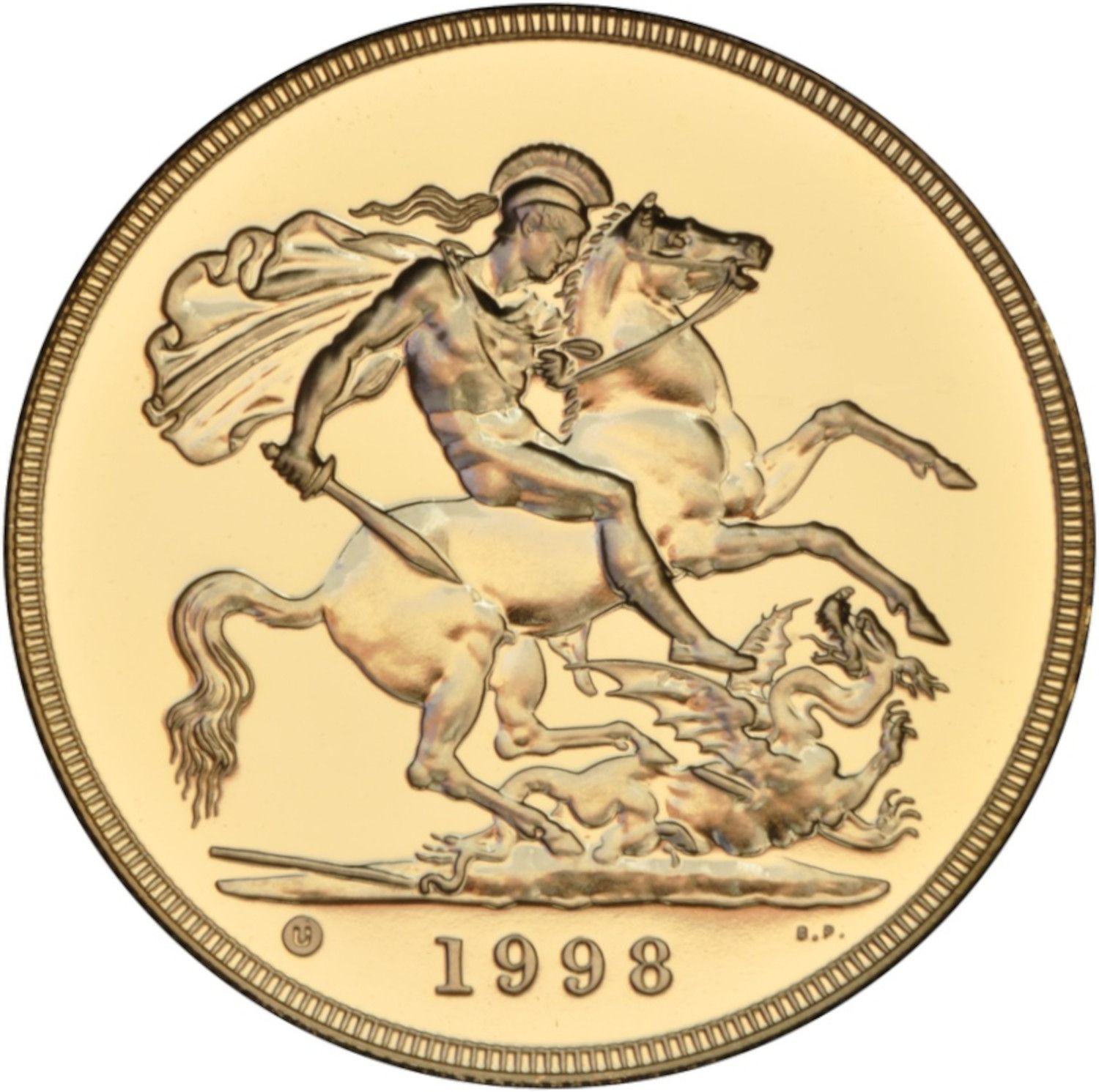
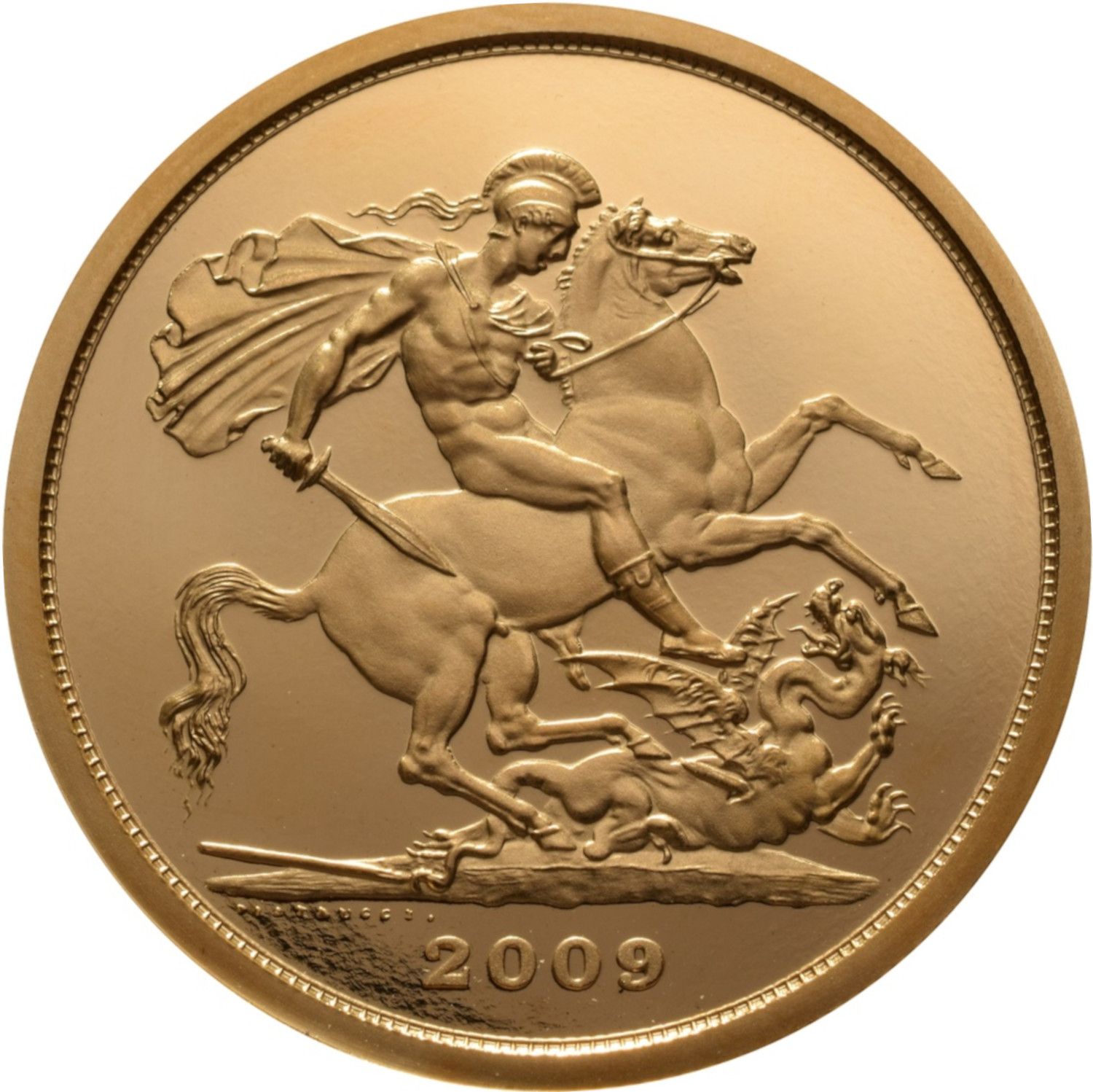
- Hallmark / signature. Modern Royal Mint quintuple sovereigns are not hallmarked but should carry Pistrucci's "B.P." or "BP" signature on the ground line below St George (or the relevant designer's mark for non-Pistrucci issues such as the Paul Day 2012 redesign). Original Royal Mint cases include a numbered Certificate of Authenticity.
- Weight. 39.94 g ± 0.05 g on a calibrated jewellery scale. Tungsten-core counterfeits are the only realistic risk because tungsten is the only metal that matches gold's density at a meaningful price point; tungsten cores still typically weigh 0.1-0.4 g off because of plating thickness variance.
- Diameter and thickness. 36.02 mm and ~2.30 mm. Calliper to 0.05 mm. Cast counterfeits run small.
- Specific gravity. 17.7 g/cm³ via water displacement. The single most reliable home test for tungsten-core fakes (tungsten alone is 19.3 g/cm³; tungsten with thin gold plating gives readings of 18.5-19.0 g/cm³, distinguishable from solid 22-carat).
- Surface relief. Pistrucci's St George should show crisp dragon detail, clear sword definition, and individual horse-mane strands. Soft, rounded high relief is a casting tell.
Slab vs raw
For a coin sitting at £3,500+ entry, professional grading is normally worth the cost. PCGS and NGC charge £30-60 for a quintuple sovereign at standard service speed; CGS UK is similar. The slab does three things: authenticates the coin, fixes a numerical grade for resale comparability, and protects the surface during storage and handling. Raw quintuple sovereigns sell at a 10-25% discount to slabbed equivalents because the buyer carries the authentication risk.
For Victorian and Edwardian quintuple sovereigns at £5,000+, slabbed is effectively required, bare-coin offers at this tier are met with scepticism by the market and you will leave money on the table at sale.
Investment outlook, quintuple vs Britannia 1 oz vs sovereign
The quintuple sovereign sits in a different investment lane from the 1 oz Britannia and the full sovereign. The choice between them depends on whether you want bullion exposure, numismatic upside, or a balance of both. Comparison at a representative gold spot of £2,200/oz:
| Coin | Pure gold | Spot value | Typical retail | Premium over melt | Investment role |
|---|---|---|---|---|---|
| 1 oz gold Britannia (bullion) | 31.103 g | ~£2,200 | ~£2,300 | 3-6% | Pure bullion exposure, most efficient per-gram gold |
| Full sovereign (bullion) | 7.322 g | ~£520 | ~£560 | 5-15% | Compact bullion, easy to liquidate, gift-friendly |
| Quintuple sovereign £5 (proof) | 36.61 g | ~£2,590 | ~£3,500-5,000 | 40-100%+ | Numismatic + bullion blend, prestige holding |
The takeaway: if you want pure gold for the lowest dealer cost, the 1 oz Britannia wins. If you want a tax-efficient compact bullion holding you can split or gift, the full sovereign wins. If you want the prestige of a single large 22-carat coin with limited-mintage numismatic upside and a bullion floor underneath, the quintuple sovereign earns its premium. Many UK collectors hold all three, in different proportions, for diversification.
The quintuple sovereign also benefits from full CGT exemption as UK legal tender (post-1837) and counts as VAT-free investment gold at £5 face value, the same tax treatment as the full sovereign and the Britannia. For the broader bullion-vs-Britannia comparison see our sovereign vs Krugerrand piece, which extends the framework to non-UK 1 oz competitors.
Featured quintuple sovereigns on MyCoinage
Related guides
- Gold sovereign values UK, the full sovereign-family price reference, bullion to rare-date.
- Sovereign vs Krugerrand, UK 22-carat sovereign against the South African 22-carat 1 oz benchmark.
- Sovereign weight & specifications, full physical specs across every sovereign denomination.
- How to buy gold sovereigns, dealer comparison, premium mechanics and authentication.
- CGT-exempt UK coins, tax basis for quintuple sovereign investing.