Olympic Football 50p: The Offside-Rule Coin Worth Hunting
The 50p with the offside rule on it. The most-collected coin of the 29-piece London 2012 Olympic 50p set, and the lowest mintage of the lot at 1,125,500. Designed by Neil Wolfson through the Royal Mint’s 2009 open competition, it is the only UK circulating coin to engrave an explanatory rulebook diagram rather than an action pose. This guide covers mintage, realised prices, the rejected pre-correction variant, and how to spot a fake.
The story behind the offside-rule coin
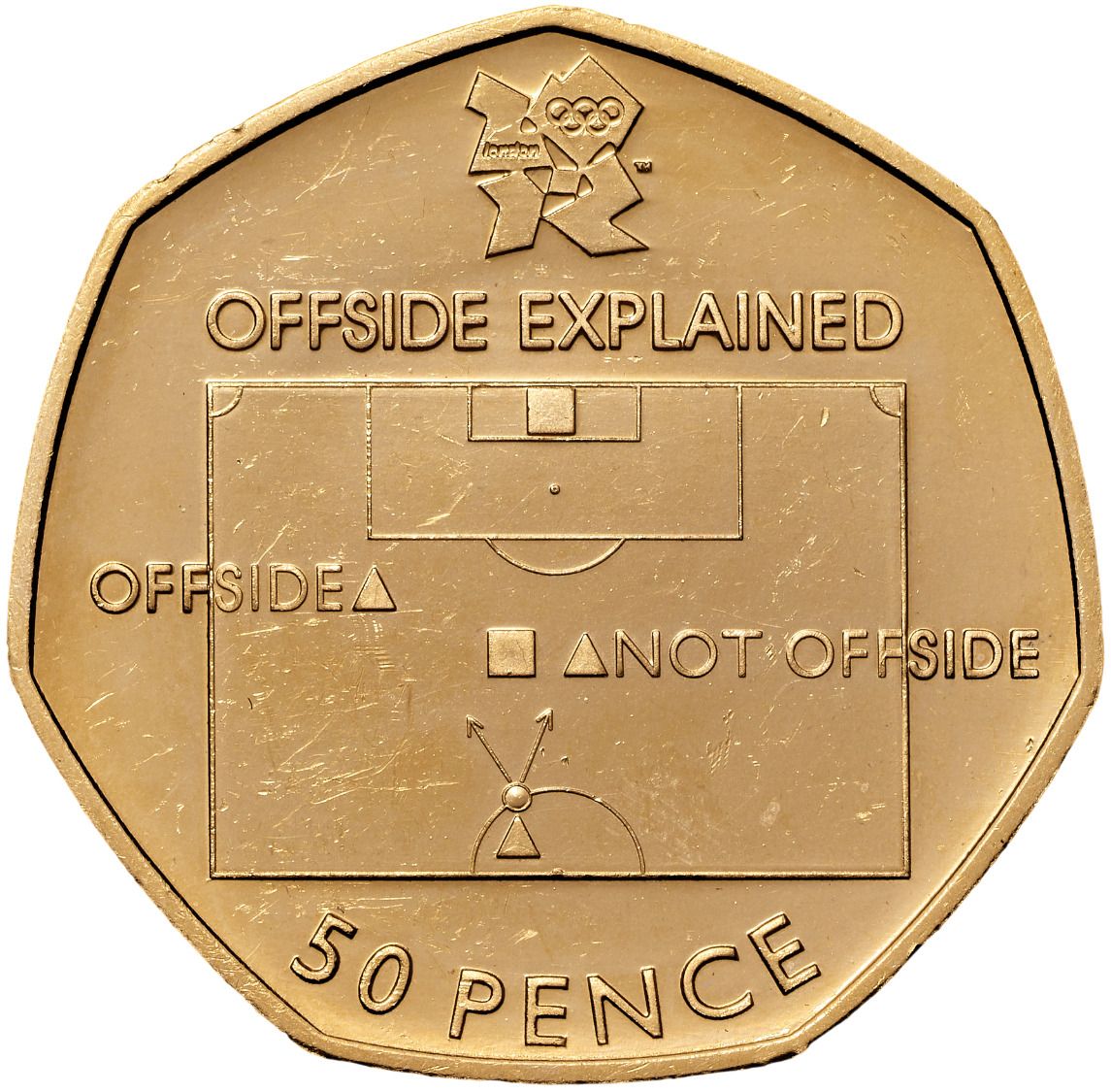
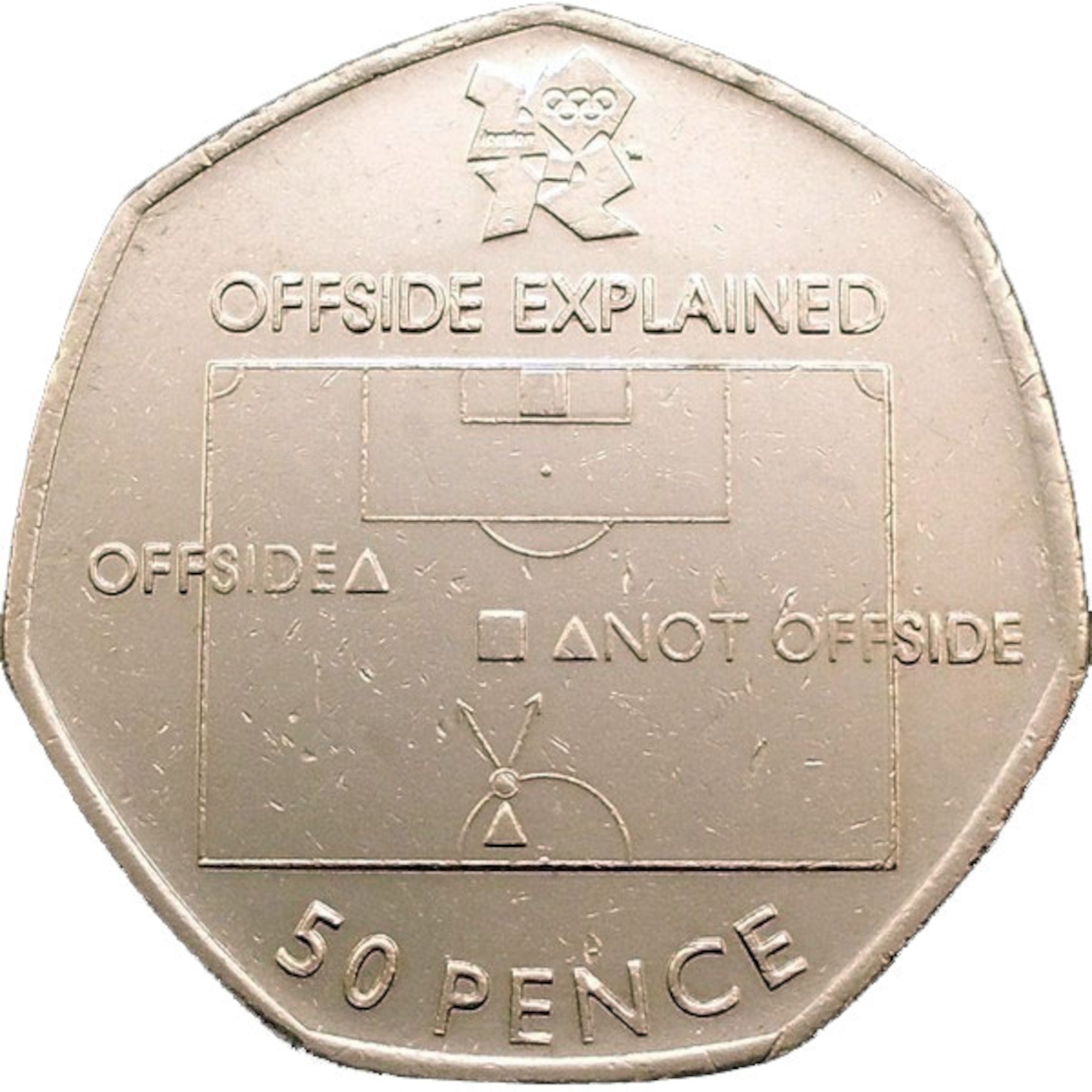
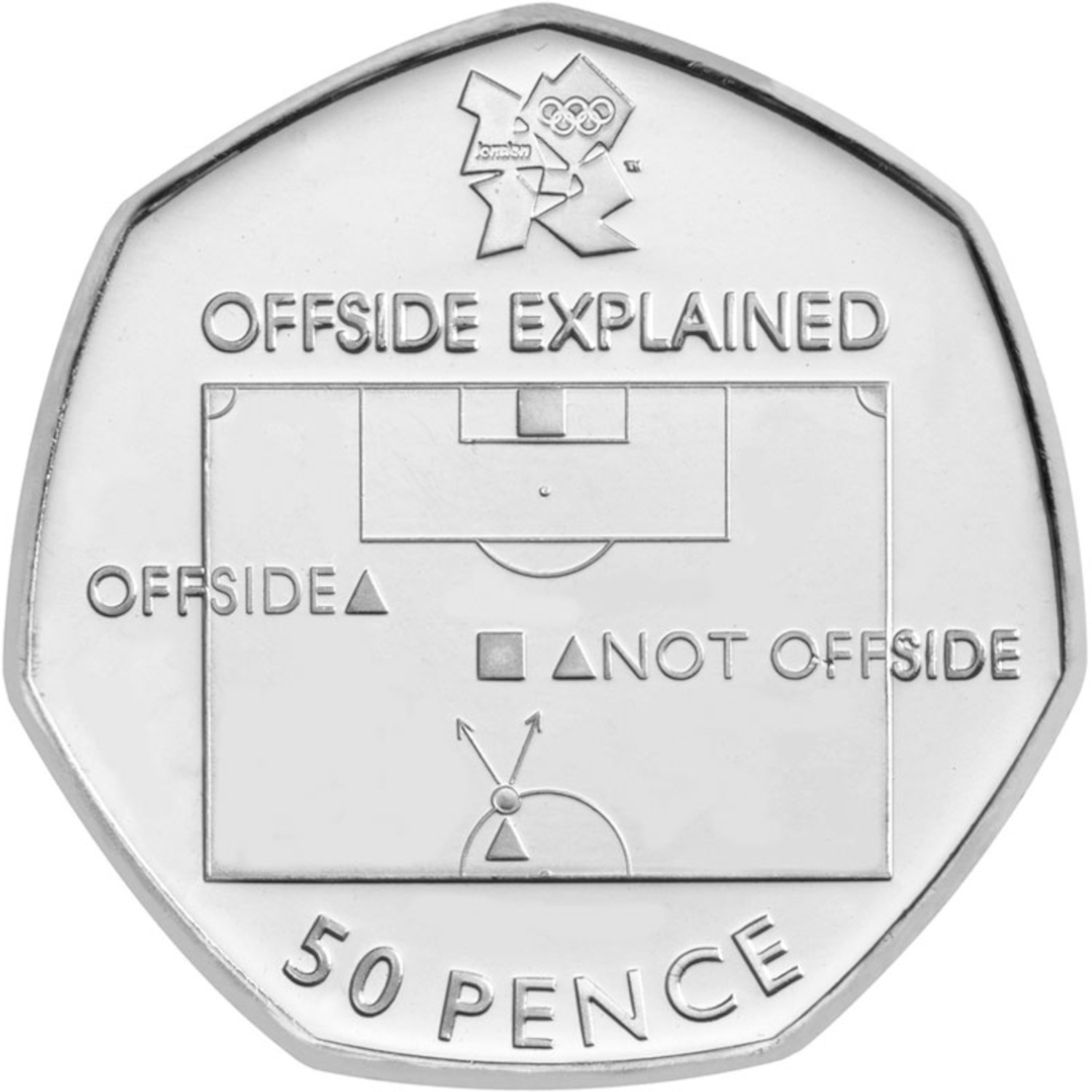
The Football 50p is the most distinctive coin in the entire London 2012 Olympic 50p programme. While 28 of the 29 sport designs picked an action pose, athlete portrait or piece of equipment, designer Neil Wolfson took a different route. His winning entry engraved a diagrammatic explanation of the offside rule onto the reverse: a horizontal line representing the offside line, a striker forward of the line, a defender at the line, and a goalkeeper behind it. Three small dots and three arrows show the direction of play.
Wolfson, a London-based graphic designer with no prior coin-design experience, submitted the design to the Royal Mint’s open public competition in 2009. The competition received around 17,000 entries across the 29 sports, and a panel including the sculptor Sir Anthony Caro selected the winners. Wolfson was paid the standard £5,000 commission. His design was selected because it captured something genuinely specific to football, the rulebook controversy that fans argue about every weekend, rather than the generic boot-and-ball composition that several other entries had submitted.
The coin was struck for circulation in 2011 and entered general change ahead of the London 2012 Olympic Games. It is one of two football-themed designs in the Olympic set; the other is a more conventional men’s and women’s tournament commemorative which never circulated and exists only in collector formats. When numismatists and the press talk about “the Olympic Football 50p” they almost always mean the Wolfson offside-rule version.
The London 2012 Olympic 50p set as a whole remains the largest single circulating-coin commemorative programme ever issued in the UK. For the full 29-coin context, see our Olympic 50p coin guide.
Mintage: the lowest of the Olympic set
Royal Mint published mintage: 1,125,500 coins for circulation. This figure is taken from the official Royal Mint mintage register and has not been revised since publication. It puts the Football 50p firmly at the top of the rarity table for the Olympic set:
| Rank | Sport | Mintage | Premium over face |
|---|---|---|---|
| 1 | Football (offside diagram) | 1,125,500 | 30–60× |
| 2 | Wrestling | 1,129,500 | 25–50× |
| 3 | Judo | 1,161,500 | 20–40× |
| 4 | Triathlon | 1,163,500 | 18–30× |
| 5 | Tennis | 1,454,000 | 14–26× |
Football beats Wrestling by 4,000 coins, which is statistically a rounding error but matters in collector psychology because the Football 50p also has the most distinctive design. Mintage scarcity and design notoriety together explain why the Football consistently trades at a premium to Wrestling despite their near-identical production numbers.
For comparison, the wider 50p denomination context: the famous 2009 Kew Gardens 50p has a mintage of just 210,000, an order of magnitude lower than Football. The Football 50p sits in “collectable scarcity” territory rather than “genuinely rare”: high enough that you can still find one in change with patience, low enough that secondary-market premiums hold. For full denomination context see our 50p coin values UK guide and our rare UK coins list.
Realised prices in 2026
| Format | Specification | Mintage | Realised range |
|---|---|---|---|
| Circulated | Cupronickel, 8.00 g, average wear | 1,125,500 | £8 – £18 |
| Brilliant uncirculated | Cupronickel, 8.00 g, in original RM card | (part of circulation strike) | £15 – £30 |
| Slabbed PCGS/NGC MS65 | Cupronickel, 8.00 g, third-party graded | scarce | £30 – £50 |
| Slabbed PCGS/NGC MS66+ | Cupronickel, 8.00 g, top grade | very scarce | £40 – £70 |
| Silver proof | .925 sterling, 8.00 g, capsuled | ~10,000 | £35 – £70 |
| Silver Piedfort | .925 sterling, 16.00 g (double thickness) | 3,500–5,000 | £200 – £350 |
| Gold proof | .9167 (22 carat), 15.5 g | ~1,000 | £600+ |
| Pre-correction proof | Cleaner offside diagram amended before mass production | very few survive | £400 – £800 |
Realised price ranges reflect eBay UK sold listings and Spink / Baldwin’s auction realisations averaged over the past 12 months. Gold-proof figures move with current bullion spot.
The cupronickel circulating coin is the version most collectors will hold. A clean BU example in the original Royal Mint sealed card is the safest buy at around £20–£25 from a reputable seller. Slabbing only makes economic sense from MS65 upwards, and even then the margin is thin. Silver and gold variants outperform on a percentage basis but require larger upfront capital and have a shallower secondary market.
The rejected first design
The Football 50p has one of the more interesting backstories in modern UK coinage because two visually distinct versions exist with the same 2011 date. Wolfson’s original winning design contained a slightly more elaborate offside diagram, with additional pitch markings and a fuller composition of figures around the central play. After the design was previewed to the public ahead of mass production, feedback was that the engraving was too cluttered to read at coin scale.
The Royal Mint redrew the diagram with cleaner, more spacious lettering and figure positioning. That is the version that circulated in 2011 and that you find in change today. A small number of pre-correction proof coins were struck before the design was amended; most were retained internally or destroyed but a handful entered private hands. They surface at specialist auction perhaps once or twice per year and have realised £400–£800 over the past five years at Baldwin’s and Spink.
Pre-correction Football 50ps are a niche detail that most casual collectors do not need to worry about. They are not findable in everyday change; if you have a coin showing the busier diagram you should photograph it carefully and consign it to a BNTA-member auction. For full context on Olympic 50p variants and the more famous Aquatics “swimmer face” redesign, see our Olympic 50p coin guide.
Authenticating an Olympic Football 50p
Counterfeit Olympic Football 50ps are more common than counterfeits of most modern UK coins. The design’s notoriety tempts cheap replicas onto the market, and they are usually coarser than the more skilled fakes of the rare 2009 Kew Gardens 50p. Six checks:
- Weight. 8.00 g ± 0.05 g on a 0.01 g jewellery scale. Replicas typically fail by 1–2 g.
- Diameter. 27.30 mm flat-to-flat across the seven sides. Use vernier callipers; a soft tape measure is not accurate enough.
- Shape. True heptagonal Reuleaux (constant-width seven-sided curve, with curved sides). A flat-edged seven-sided polygon is wrong.
- Edge. Plain, no reeding. Reeded edge is an immediate fail.
- Font kerning on the diagram labels. The genuine coin has clean, evenly spaced letters on the diagram annotations. Fakes typically show uneven spacing, especially around lowercase letters.
- Diagram clarity. The genuine offside-rule diagram is intricate but every figure and line should be sharp under magnification. Cast or pressed-resin replicas show soft, blurry lines.
Cross-check against verified images on the Royal Mint Museum reference site. For full authentication methodology and the Sheldon grading scale see our grading guide. For other commonly faked British coins, our spotting fake £1 coins guide covers similar ground.
The full Olympic 50p set in context
The Football 50p is the rarest of the 29 London 2012 designs. Quick comparison of all 29 by mintage:
| Sport | Mintage | BU value |
|---|---|---|
| Football (offside) | 1,125,500 | £15 – £30 |
| Wrestling | 1,129,500 | £15 – £28 |
| Judo | 1,161,500 | £12 – £22 |
| Triathlon | 1,163,500 | £12 – £20 |
| Tennis | 1,454,000 | £10 – £18 |
| Goalball | 1,615,500 | £8 – £15 |
| Shooting | 1,656,500 | £7 – £14 |
| Archery | 1,662,500 | £6 – £12 |
| Taekwondo | 1,664,000 | £7 – £13 |
| Handball | 1,676,500 | £7 – £13 |
| Modern Pentathlon | 1,689,500 | £7 – £14 |
| Rowing | 1,717,300 | £6 – £11 |
| Gymnastics | 1,720,000 | £6 – £11 |
| Table Tennis | 1,737,500 | £6 – £11 |
| Basketball | 1,748,000 | £6 – £11 |
| Sailing | 1,749,500 | £6 – £11 |
| Wheelchair Rugby | 1,765,500 | £7 – £13 |
| Hockey | 1,773,500 | £6 – £11 |
| Weightlifting | 1,879,500 | £6 – £12 |
| Canoeing | 1,981,500 | £6 – £12 |
| Cycling | 2,090,500 | £5 – £10 |
| Fencing | 2,115,500 | £5 – £9 |
| Volleyball | 2,133,500 | £6 – £12 |
| Badminton | 2,133,500 | £5 – £10 |
| Equestrian | 2,142,500 | £5 – £9 |
| Boxing | 2,148,500 | £5 – £10 |
| Boccia | 2,166,960 | £5 – £10 |
| Aquatics | 2,179,000 | £5 – £10 |
| Athletics | 2,224,000 | £5 – £9 |
For full design provenance, the Aquatics swimmer-face redesign and complete-set valuations, see our companion London 2012 Olympic 50p guide.
Realised auction notes
Auction-house realisations for slabbed and graded Football 50ps over recent years sit at £40–£70 for PCGS or NGC MS66+ examples, with the higher grades (MS67, MS68) clearing the upper end. The silver proof typically realises £50–£80 at Spink and Baldwin’s; on eBay UK realised silver-proof prices are typically a touch lower at £35–£70.
Pre-correction proofs, when they appear at auction, have realised £400–£800 over the past five years. The silver Piedfort, double-thickness 16.00 g sterling silver, mintage estimated at 3,500–5,000, is the strongest secondary-market performer, regularly clearing £200–£350.
For the bullion-backed alternative to commemorative cupronickel, the same auction houses sell gold sovereigns with a hard metal floor that no Olympic 50p has.
Where to sell a Football 50p
The right venue depends on what you have:
- Raw circulated single. eBay UK is the deepest market. Expect £8–£18 net of fees. Photographs both faces, weigh on a 0.01 g scale, list with the weight in the description, this immediately separates your listing from the casual sellers and from the “is it real?” question that drags down price.
- BU in original Royal Mint card. eBay still works; expect £15–£30. Change Checker also lists graded singles.
- Slabbed MS65 or higher. eBay or a numismatic specialist site. The PCGS or NGC slab carries instant credibility and the price clears closer to retail.
- Silver proof, gold proof, silver Piedfort, pre-correction proof. Consign to a BNTA-member auction house. Baldwin’s of St James’s, Spink and Noonans all handle modern UK decimal sales regularly. Commission is typically 15–20% buyer’s premium plus a small seller’s charge.
For full venue-by-venue commission breakdown, net-return modelling and the buyer-vs-seller split, see our where to sell rare coins UK guide.
Featured football coins on MyCoinage
Browse Olympic 50ps in our database →
Frequently asked questions
Why does the 2011 Football 50p show the offside rule?
How many Olympic Football 50p coins were minted?
How much is the Football 50p worth in 2026?
Is the Football 50p still in circulation?
What is the rejected pre-correction Football 50p?
Are there any other Olympic football coins?
Who is Neil Wolfson?
How do I spot a fake Football 50p?
Why is the Football 50p more famous than the Wrestling 50p?
Should I get my Football 50p slabbed?
Where should I sell my Football 50p?
Will the Football 50p keep going up in value?
Further reading
- Royal Mint mintage figures, the official source for the 1,125,500 Football 50p figure.
- Royal Mint Museum, design provenance and reference photographs.
- Baldwin’s of St James’s, auction realisations for Piedfort and pre-correction proofs.
- Spink, specialist coin auction house with regular UK modern decimal sales.
- Noonans, Mayfair auction house, regular modern UK decimal sales.
- eBay UK, deepest market for cupronickel circulated and BU singles.
- Change Checker, gap-filler coin sales and circulating-coin scarcity index.
- Olympic 50p coin guide, the full 29-coin context.
- 50p coin values UK, the full denomination context.
- Where to sell rare coins UK, venue-by-venue commission breakdown.
- How to grade a coin, UK and Sheldon scales explained.
- Rare UK coins list, the top 25 modern British rarities.