Pistrucci's St George Sovereign: 200+ Years of British Gold
Benedetto Pistrucci's St George and the Dragon reverse, first struck on the 1817 sovereign, is one of the most iconic coin designs in the world. It has appeared on virtually every UK gold sovereign for over two centuries, through the Coronation of George IV, Victoria's 64-year reign, the Australian branch mints, the Edwardian and Georgian eras, Elizabeth II's 70 years, and now Charles III. This guide covers Pistrucci's biography, the 1817 spear vs 1820 sword variants, why St George, and what the original Pistrucci sovereigns are worth today.
Pistrucci's St George, the design that defines the sovereign
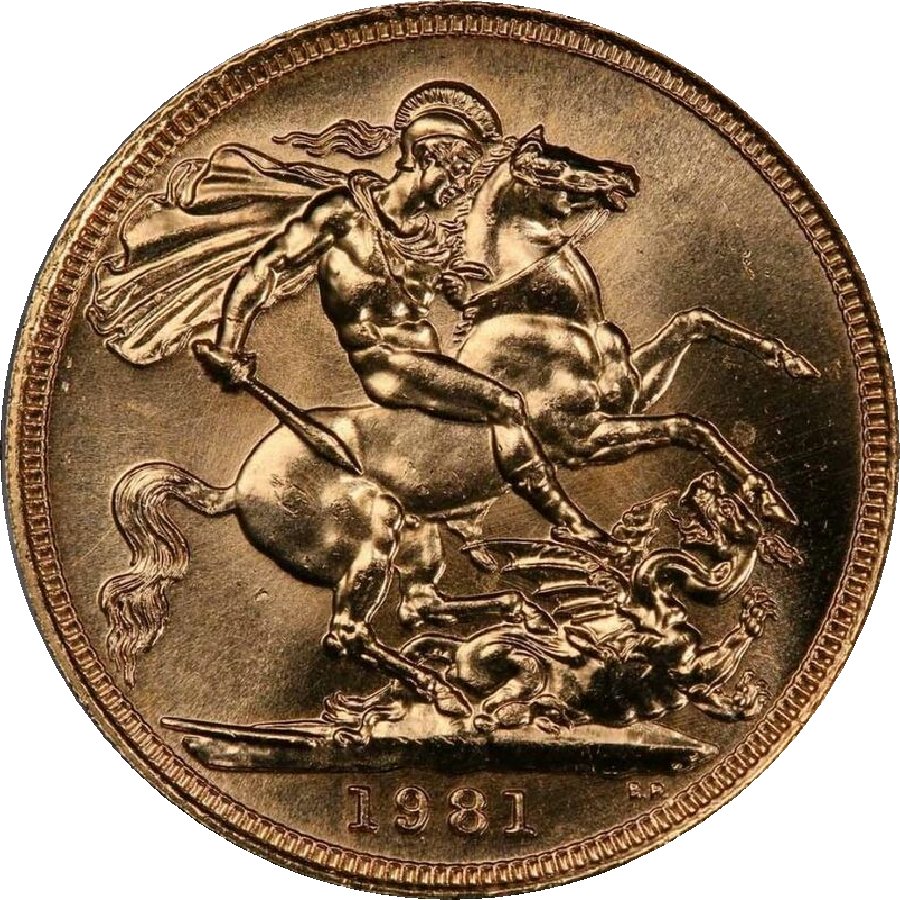
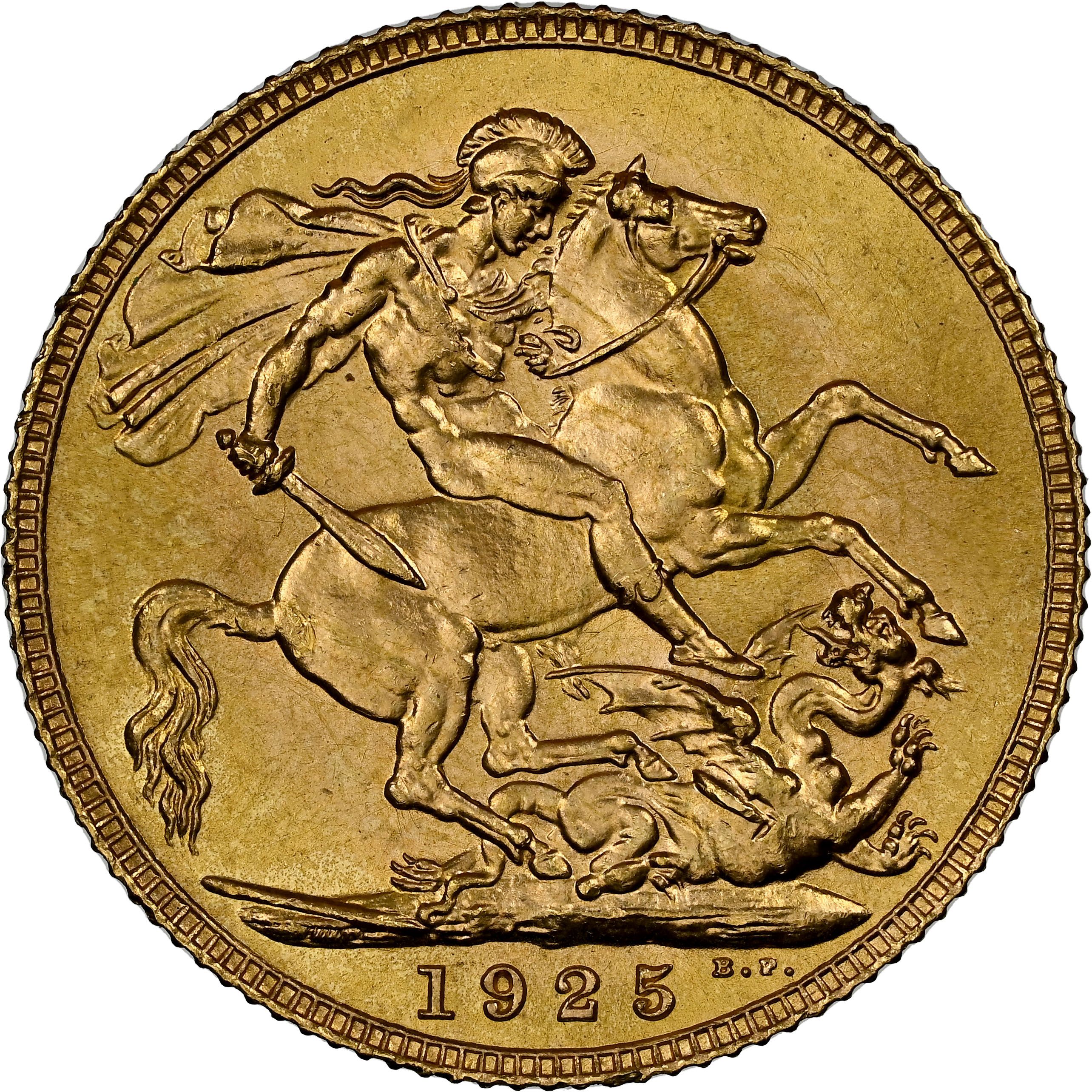
No coin design has carried a national identity for as long, or as recognisably, as Benedetto Pistrucci's St George and the Dragon. When Master of the Mint William Wellesley-Pole commissioned Pistrucci in 1816 to redesign British coinage as part of the Great Recoinage, the brief was both technical and political: produce a reverse that would mark the new gold sovereign as a clean break from the worn-out guinea, and signal a Britain stepping into the post-Napoleonic-Wars order. Pistrucci, a Roman cameo-engraver trained in classical relief, answered with a rearing horseman lifted directly from antique gem traditions and the Hellenistic bronze figures he had studied in the Vatican.
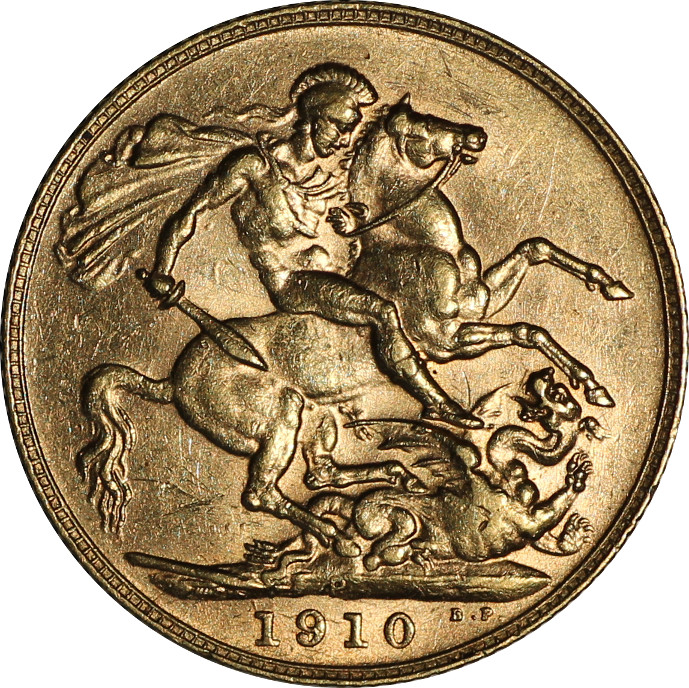
Three formal qualities make the design enduring rather than merely ornamental. Compositional unity: horse, rider and dragon occupy a single triangular envelope that locks into the round flan with no awkward void at the rim. Depth of relief: Pistrucci modelled the design with cameo depth, not just incised line, so even worn examples retain readable form. Narrative legibility: the figure of George, sword raised, dragon broken beneath, is unambiguous at a glance, you do not need a numismatic eye to understand what is happening, which is why the design works equally well on a 22 mm sovereign and a 36 mm five-pound piece.
The design is also a loaded symbol. St George had been patron of England since Edward III named him so in 1348; placing him on the new sovereign in 1817 deliberately invoked chivalric victory at a moment when Britain was finalising the post-Waterloo settlement. Pistrucci's decision to render George in Roman-style armour rather than medieval plate ties the British coin to a classical lineage that other European powers were also reaching for, and that no other major modern gold coin matches.
200+ years of Pistrucci St George reverses
The design has run, with two clear interruptions, across four centuries of British coinage. Each cluster has its own variant signature, key dates and typical realised range, and getting the cluster right is the first step in pricing a Pistrucci sovereign accurately.
| Year cluster | Years used | Reigns / context | Variants & key dates |
|---|---|---|---|
| 1817–1825 | 9 years | George III (1817–1820); George IV bare-head (1821–1825) | 1817 spear (broad-flan, large dragon); 1818–1820 transitional sword; 1820 closed-2 vs open-2; 1821 garnished sword reverse; 1825 final bare-head reverse before shield-back era |
| 1871–1887 | 17 years (parallel with shield) | Victoria Young Head, St George reintroduced alongside the shield reverse | 1871 first return year (London + Sydney S); 1879 London no-die-number; 1880–1887 standard Young Head Pistrucci; transitional die varieties recorded by Marsh |
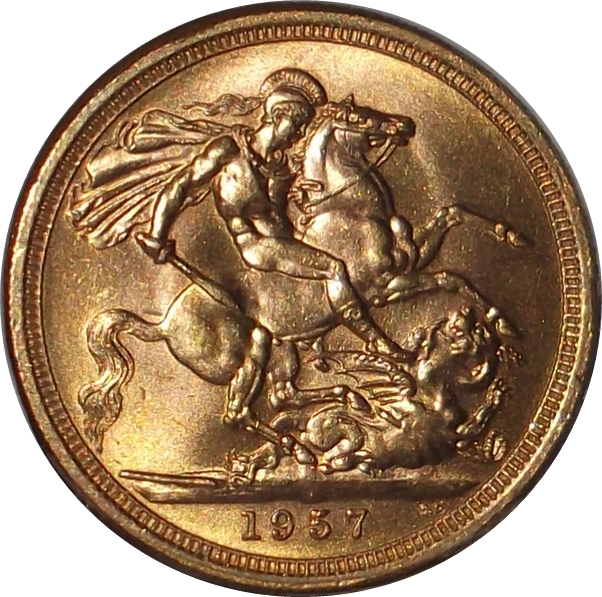
| 1957–2022 | 50+ years (intermittent) | Elizabeth II, bullion revival from 1957, decimal continuation 1974 onwards | 1957 first Elizabethan; 2002 shield reverse (Pistrucci absent); 2005 Timothy Noad redesign one-year; 2012 Paul Day Pistrucci-after redesign; 2022 Memorial |
| 2024–2026 | Charles III revival | Charles III definitive sovereign, Pistrucci St George restored after 2023 Coronation reverse one-off | 2024 first Charles III bullion Pistrucci; 2025 proof; 2026 standard year, faithful reproduction of the 1820 sword reverse |
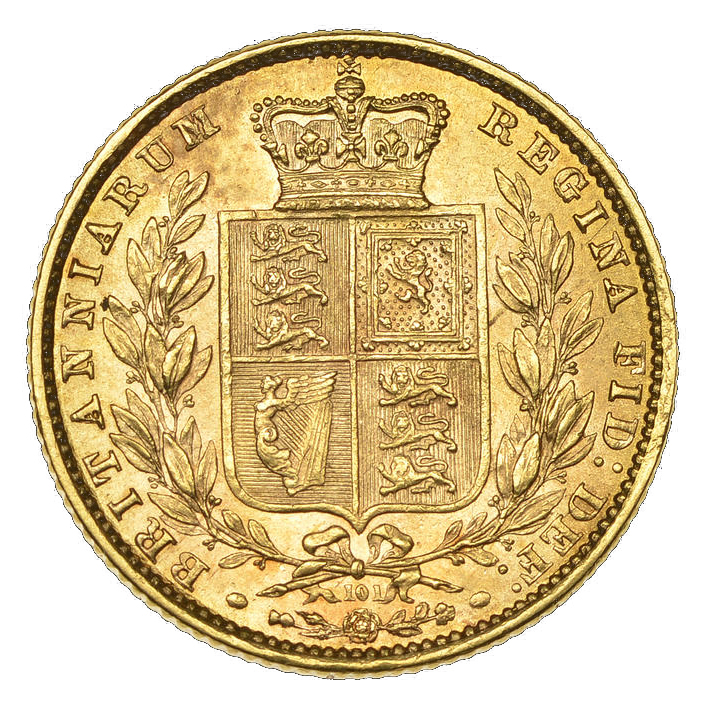
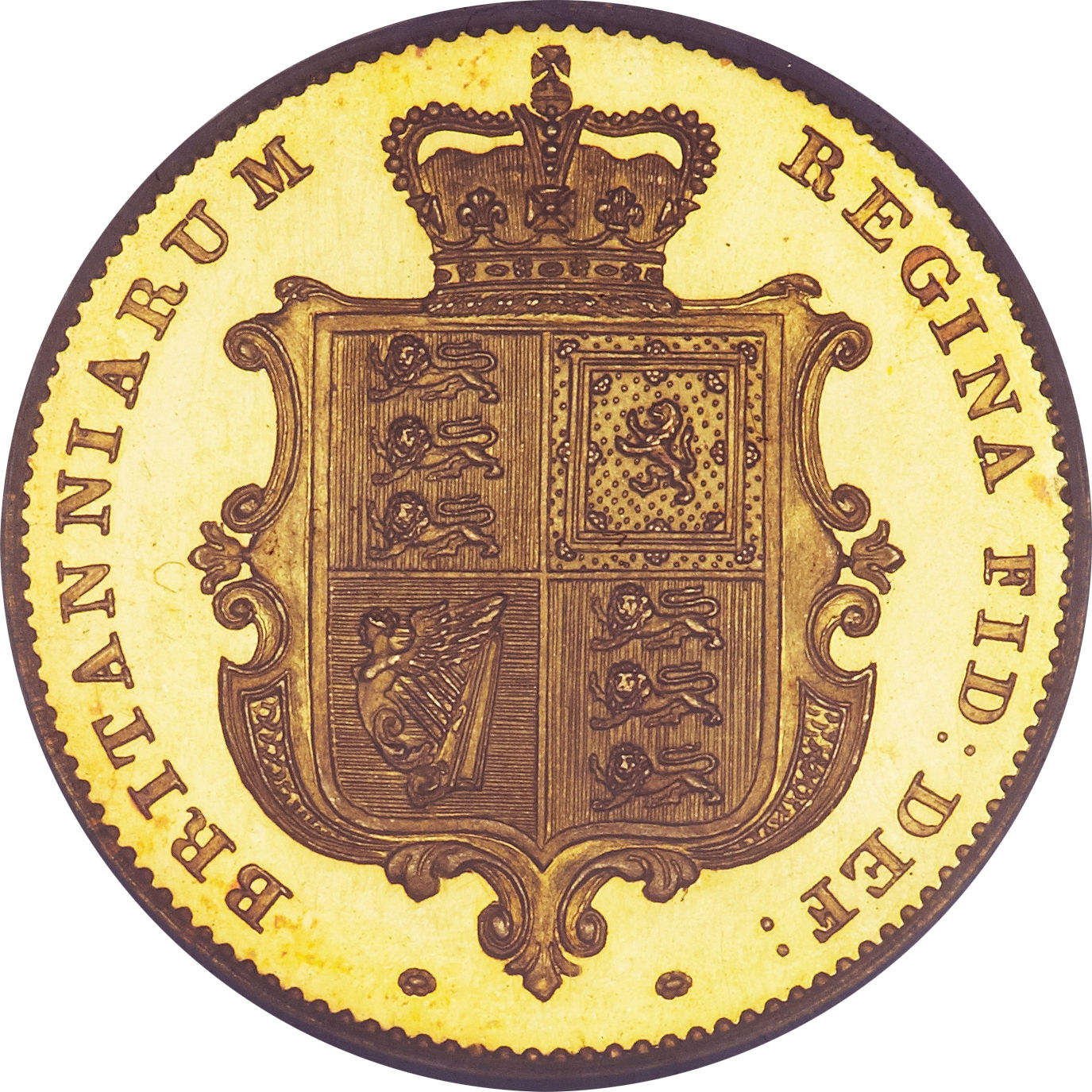
The two interruptions are worth understanding. The shield-back era (1825–1870) replaced Pistrucci with a heraldic royal-arms reverse engraved by Jean Baptiste Merlen, partly because Wellesley-Pole had left the Mint and partly because Pistrucci had refused to produce a portrait of George IV from another artist's model. The 2002 Golden Jubilee reverse used Timothy Noad's shield revival as a one-year homage. Outside those two windows, the Pistrucci design has been the default reverse for nearly every UK gold sovereign struck.
Identifying Pistrucci variants, broad-flan vs narrow-flan, WWP and BP initials
The early Pistrucci sovereigns are not a single coin. The 1817–1820 group contains at least four distinct reverse states that any serious buyer needs to be able to read on the coin itself.
- 1817 broad-flan, large dragon, spear. The first issue. The design fills almost the whole reverse field; the spear shaft runs diagonally across the dragon's body; St George wears a loosely flowing cloak. WWP (William Wellesley-Pole, the commissioning Master) is engraved into the band of the garter on the obverse on some examples. Realised range for clean EF examples sits at the top end of the early Pistrucci market.
- 1818–1820 narrow-flan, smaller dragon, sword. Pistrucci's 1820 redesign compressed the design slightly to leave more rim, replaced the spear with a Roman-style short sword, and tightened the dragon's coil. The 1820 alone has both a closed-2 and open-2 date variety, each with its own pricing structure.
- BP / B.P. initials in the exergue. Pistrucci's signature was placed on the ground line below the dragon. Early strikes show BP without stops; later strikes show B.P. with stops; some heavily polished proofs and certain branch-mint pieces show no signature at all because the die was reground. The presence, absence and form of the signature is a primary attribution point for any pre-1880 St George sovereign.
- Modern dies, faithful reproduction. The 2024-onwards Charles III Pistrucci reverse is cut from new dies based on the 1820 master, with the B.P. signature retained. The Royal Mint Museum confirms the modern dies are tooled to match the 1820 sword version geometrically; the relief is slightly lower because of modern circulating-strike pressure rather than 1820 hammered preparation.
Marsh's reference (The Gold Sovereign, Marsh, multiple editions) and Bentley's catalogue work remain the standard die-state guides; Spink's annual Standard Catalogue records the main varieties at trade level. Branch-mint Pistrucci sovereigns add a further attribution layer: a Sydney 1880 St George is geometrically identical to a London 1880 St George until you read the S mintmark in the exergue alongside the B.P.
Authentication: real Pistrucci vs counterfeit
Pistrucci St George sovereigns are the most counterfeited British gold coin. Two motivations drive the fakers: bullion-grade copies sold to retail buyers as if they were genuine modern bullion, and deceptive numismatic forgeries of early Pistrucci dates aimed at collectors. The same five-test framework that catches modern fakes also catches most early-Pistrucci forgeries, with two design-specific additions.
- Weight and diameter. 7.988 g ± 0.05 g; 22.05 mm. Cast counterfeits run light and slightly small from cooling shrinkage. Use a 0.01 g jewellery scale.
- Magnet test. Gold is non-magnetic. Any pull from a strong neodymium magnet rules the coin out; tungsten-cored fakes are too dense for a casual feel-test but show on a digital scale via a weight-vs-volume mismatch (specific gravity for gold is 19.32; tungsten 19.25; a precision SG test separates the two).
- Sword tip / wing clearance. On a genuine 1820-onwards Pistrucci, the tip of George's sword clearly clears the dragon's wing and there is daylight between them. Cast or transfer-die fakes routinely fill that gap because the casting medium pools.
- Horse mane and tail strands. Pistrucci modelled individual hair strands on the mane and tail. Genuine examples show separate strands even at well-circulated grades. Counterfeits show a smoothed, blurred mass.
- B.P. signature integrity. The signature should be sharp, level on the ground line, and consistent in font with known dies. A blurred, off-axis or partially missing B.P. on a coin that is supposed to be a regular issue is a strong red flag. Cross-reference against a graded reference image from PCGS CoinFacts or NGC.
- Edge. The reeded edge should be sharp and seam-free. Cast fakes often show a faint horizontal mould-line along the centre of the edge; pressed counterfeits show uneven reed spacing.
- Rim relief. Pistrucci's rims are square-shouldered and deep on early examples; spark-erosion copies typically show rounded, mushy rims because the EDM process cannot hold sharp edges.
Pistrucci proof and pattern coins
Beyond the business-strike series, Pistrucci's St George appears on a small but important body of proof and pattern pieces that sit at the very top of the British numismatic market.
- 1817 proof sovereign. A small number of presentation strikes were prepared from polished dies for the 1817 launch. Surfaces are mirror-bright; the design is rendered in cameo relief against deeply reflective fields. Realised hammer prices on PCGS or NGC PR62-PR64 examples are well into five figures, with PR65+ examples crossing into six-figure territory.
- 1820 pattern sovereign. Pistrucci's working trial pieces from the 1820 redesign survive in tiny numbers and carry both the new sword reverse and experimental obverse busts. These are catalogued in the Royal Mint Museum and rarely come to market; private-treaty sales rather than open auction are the norm.
- 1839 Una and the Lion five-pound. Although technically a quintuple sovereign, the 1839 Una is the most-photographed Pistrucci-era piece. The reverse is not St George but the Una and Lion allegory, also designed by Pistrucci. Realised prices over £500,000 in top grade.
- 1893 Veiled Head proof sovereign. First proof striking after the Pistrucci St George reverse was reinstated in 1871. Mintage of around 773. Trades at £3,000–£8,000 in PR63–PR65, more in PR66+.
- 1937 George VI proof sovereign. The cancelled coronation strike. No business strikes were issued in George VI's name; all surviving examples are from the 1937 proof set. Pistrucci reverse identical to the modern dies. Realised range £12,000–£25,000 depending on grade and provenance.
- 2017 200th-anniversary proof sovereign. Royal Mint anniversary issue celebrating the bicentenary of the modern Pistrucci sovereign. A faithful reproduction of the 1817 reverse, garter edition. Trades at significant premium over modern bullion.
Modern Royal Mint Pistrucci-reverse sovereigns to collect
For a collector building a modern Pistrucci set rather than chasing 1817–1820 originals, the Royal Mint has issued a number of accessible key dates over the Elizabeth II and Charles III reigns.
| Year | Issue | Why it matters | Realised range |
|---|---|---|---|
| 1957 | Elizabeth II first sovereign | First Elizabethan St George; bullion revival | Bullion + 5–15% |
| 1979 | First proof Elizabeth II sovereign | Proof revival; Pistrucci reverse on cameo dies | £700–£1,200 |
| 1989 | 500th anniversary sovereign | Tudor shield reverse (no St George), useful contrast piece | £800–£2,500 |
| 2002 | Golden Jubilee shield sovereign | One-year non-Pistrucci reverse | £700–£1,200 |
| 2005 | Timothy Noad redesign | One-year shield-and-cross interpretation | £700–£1,400 |
| 2012 | Paul Day Diamond Jubilee | Pistrucci reimagined; horse left-facing | £700–£1,500 |
| 2017 | 200th anniversary proof | Faithful reproduction of 1817 garter edition reverse | £700–£2,000 |
| 2022 | Memorial sovereign | Final Elizabeth II Pistrucci sovereign | £700–£1,500 |
| 2023 | Charles III Coronation reverse | Royal Arms one-year non-Pistrucci reverse | £700–£1,800 |
| 2024 | Charles III Pistrucci first year | First Charles III St George sovereign, new reign Pistrucci | Bullion + 5–15% |
| 2025 | Charles III proof Pistrucci | First proof St George sovereign of the reign | £700–£1,400 |
A workable modern Pistrucci set that costs less than a single early-Pistrucci EF would include the 1957 bullion, a 1979 proof, the 2017 anniversary, the 2022 Memorial, the 2024 first Charles III Pistrucci, and the 2025 proof. Six coins, all carrying the design Pistrucci cut in 1820, spanning 68 years and three monarchs.
Featured Pistrucci sovereigns on MyCoinage
Frequently asked questions
Who is Benedetto Pistrucci?
What does the St George and the Dragon design depict?
Which UK sovereigns carry the Pistrucci St George design?
What is the difference between Pistrucci's 1817 and 1820 designs?
How much is a Pistrucci sovereign worth?
Who is St George and why is he on a UK coin?
Are there sovereigns without the St George design?
How can I tell if my sovereign is the original Pistrucci design?
What was Pistrucci's relationship with the Royal Mint?
Where can I see the original Pistrucci St George?
How do Pistrucci sovereigns compare to modern bullion sovereigns for investment?
Related sovereign guides
- Gold sovereign values UK, the full 1817–2026 price guide and bullion calculator.
- 1817 first modern sovereign, the inaugural Pistrucci issue in detail.
- Shield-back sovereign, the 1825–1874 reverse that interrupted Pistrucci's run.
- Sovereign mint marks UK, the S, M, P, I, SA and C branch marks under the dragon.
- How to spot a fake sovereign, the counterfeit-pattern register for Pistrucci-era and modern fakes.
- Charles III sovereign values, the new-reign Pistrucci revival, year by year.