Shield-Back Sovereign: 1825–1874 Royal Arms Reverse
For 49 years, the UK gold sovereign carried a heraldic royal-arms shield on the reverse instead of Pistrucci's iconic St George and the Dragon. The shield-back era spans George IV (1825-1830), William IV (1831-1837) and the early Victorian Young Head reign (1838-1874), a one-era-only sub-category of British numismatic collecting that trades at substantial premiums over melt and has outperformed standard St George reverse sovereigns historically. This guide covers the design, the reasons for the era, key dates, and where the famous 1860/59 mule fits.
Featured sovereigns on MyCoinage
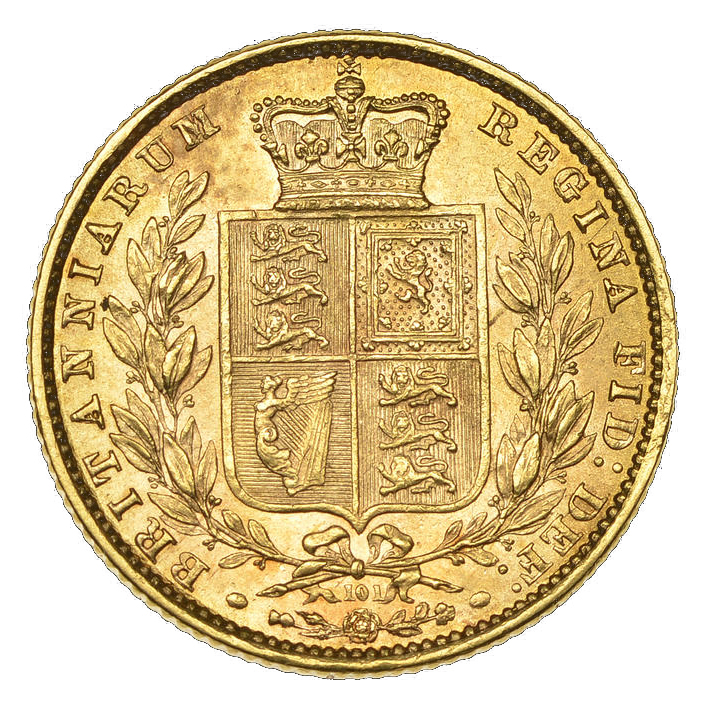
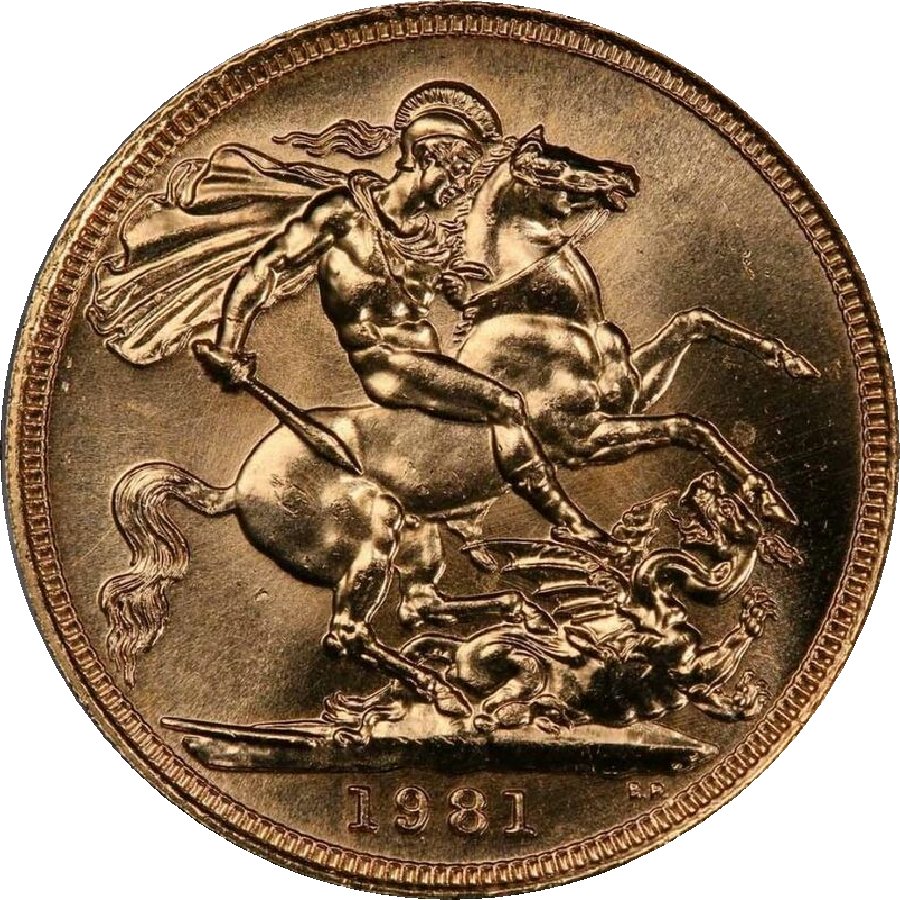
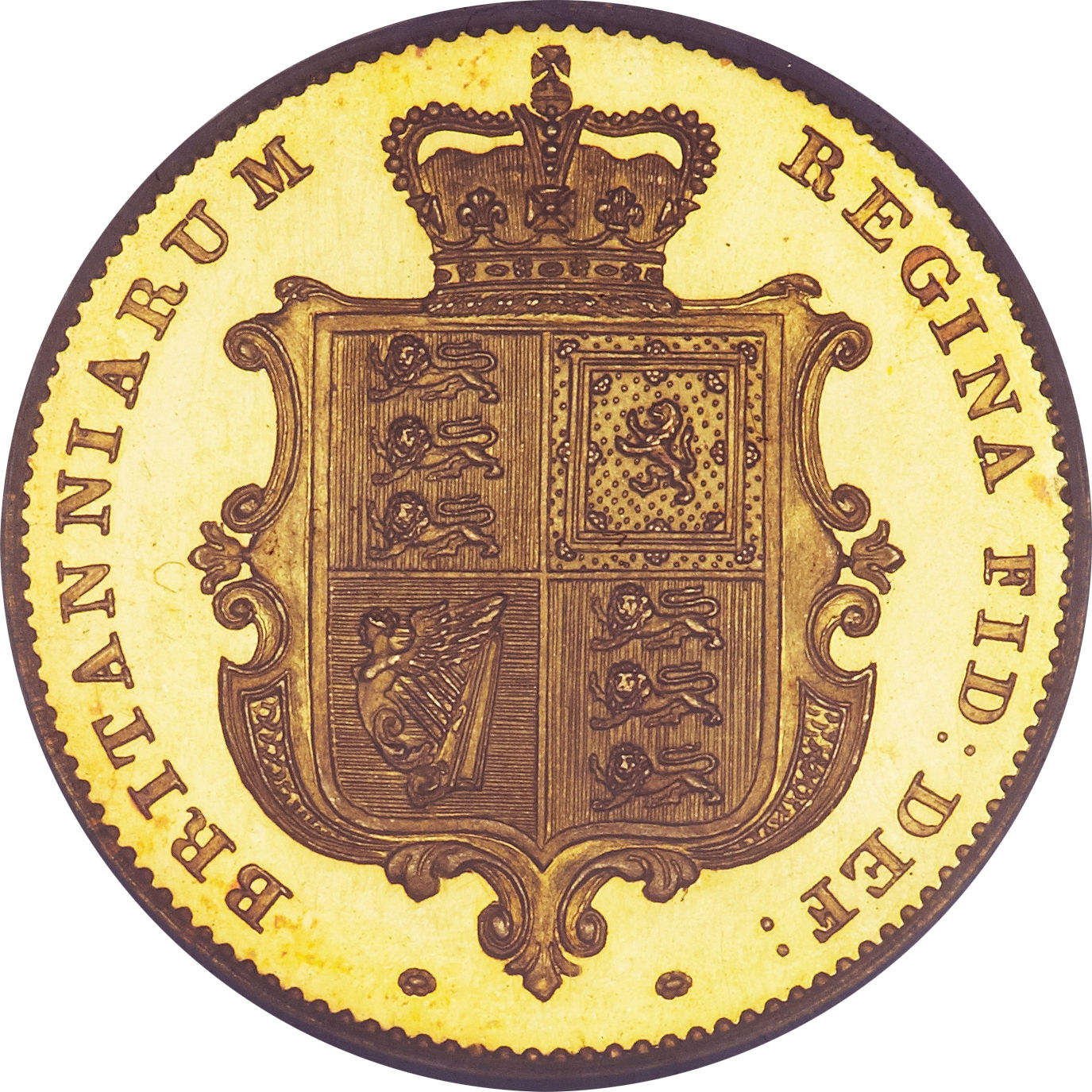
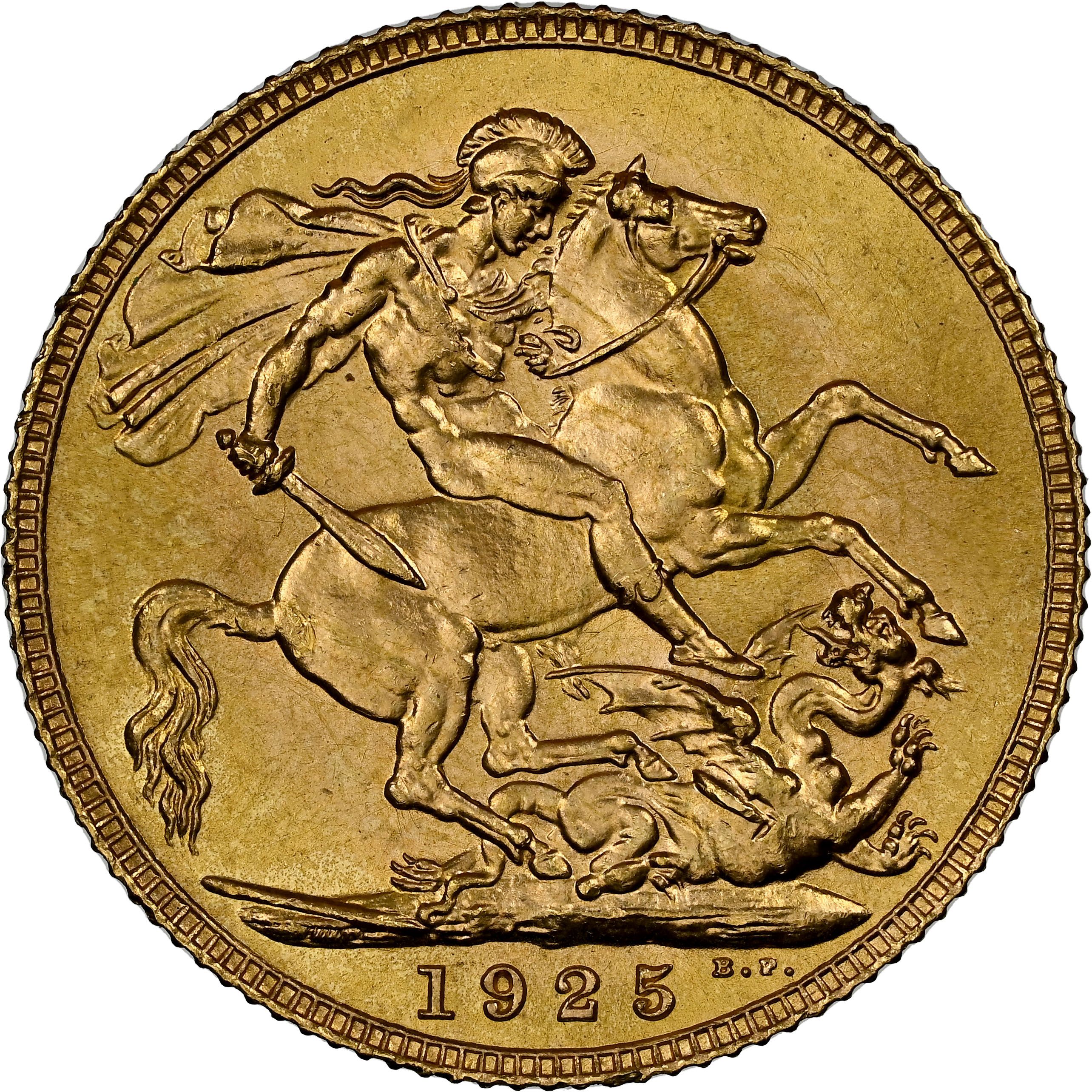
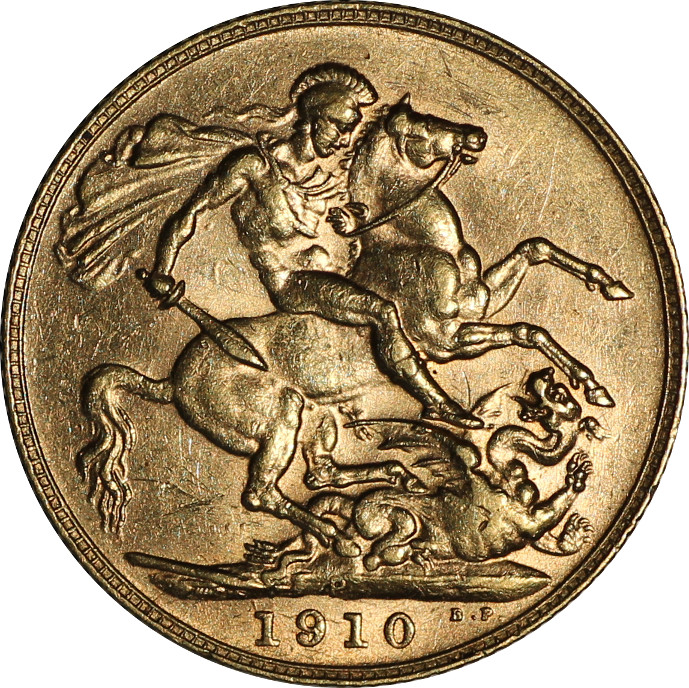
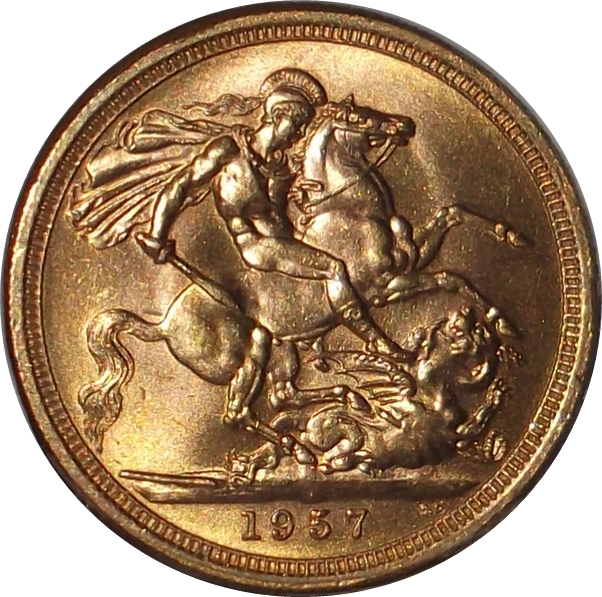
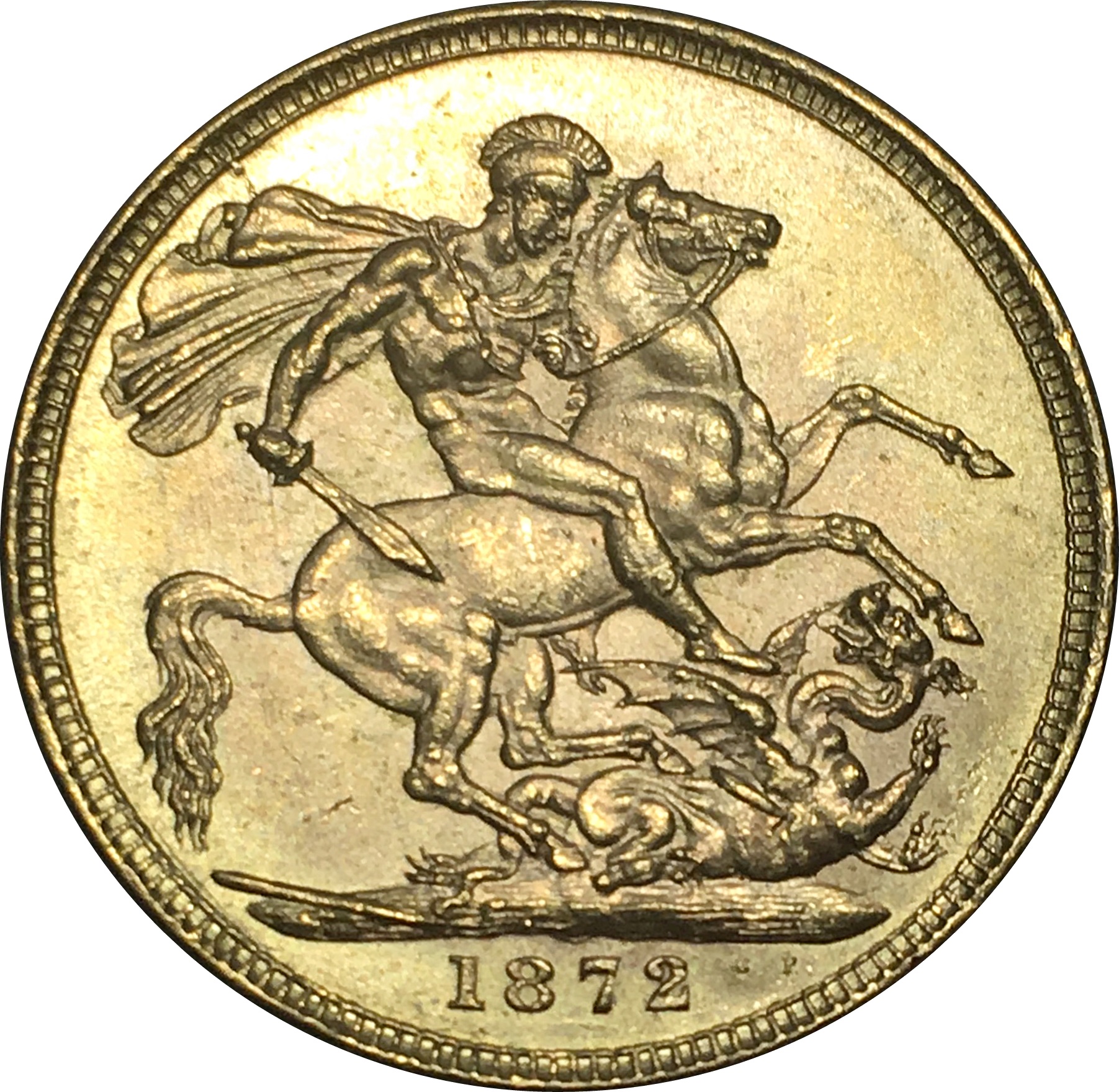
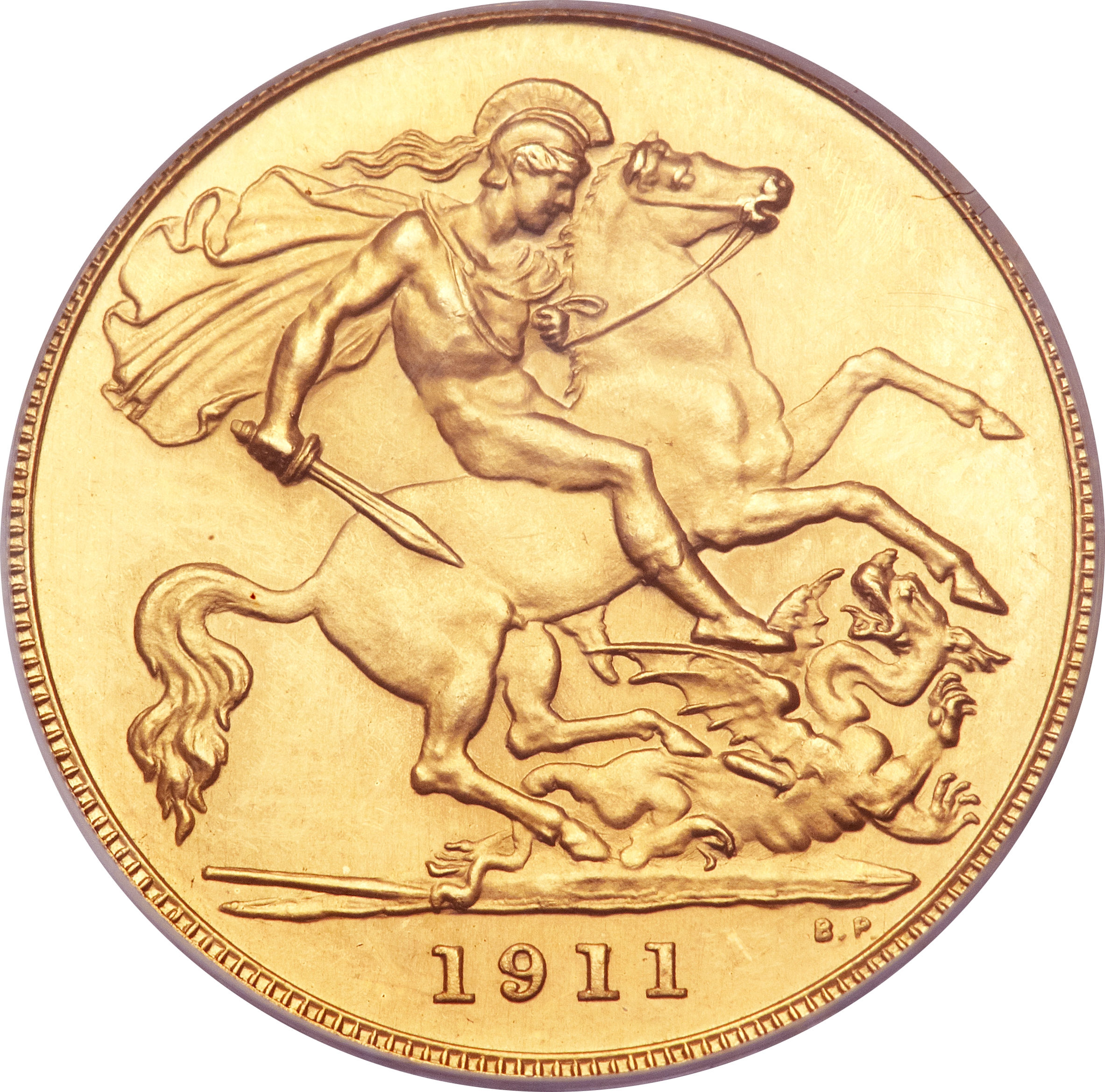
What is a shield-back sovereign?
A shield-back sovereign is a UK gold sovereign whose reverse carries a heraldic royal-arms shield within a wreath, instead of Benedetto Pistrucci's St George and the Dragon. The design is a direct continuation of the heraldic reverses used on British gold from the Tudor sovereigns of 1489 onwards, and on the modern sovereign series it ran from 1825 to 1887. The shield is quartered: lions of England top-left and bottom-right, the lion rampant of Scotland top-right, the harp of Ireland bottom-left, with a crown above and the inscription wrapping the shield's perimeter.
Three reigns produced shield-back full sovereigns: George IV (laureate, 1825–1830), William IV (1831–1837) and Victoria Young Head (1838–1887). Half sovereigns kept the shield reverse longer, into the 1890s. The full-sovereign shield-back era at the London Royal Mint effectively closed in 1874 as the Mint moved back to Pistrucci's St George for general issue, though the Sydney and Melbourne branch mints continued shield-back production through to 1887, when the Jubilee Head portrait and the universal St George reverse standardised the series.
Specifications match a standard sovereign throughout: 7.988 g of 22-carat gold (7.322 g pure), 22.05 mm diameter, milled edge. The shield-back is therefore differentiated by design and surviving population, not by gold content. For wider context across the sovereign series, see the gold sovereign values guide and the Victorian sovereign values reference.
Why shield-backs disappeared and came back
Pistrucci's St George reverse, modelled in 1816 and adopted on the first 1817 modern sovereigns, was an aesthetic triumph but a manufacturing headache. The high-relief mounted figure required specialist die-sinking and the dies wore out faster than simpler heraldic reverses. By the early 1820s, Royal Mint engravers under William Wyon were arguing for a simpler, cheaper-to-strike reverse that would let production catch up with the post-Recoinage demand for sovereigns. The 1825 transition from the Pistrucci St George back to the heraldic shield was a production decision more than an aesthetic one.
Pistrucci himself didn't take the demotion well. He had been brought to England as a celebrity engraver from Rome and his foreign-born status formally barred him from the Chief Engraver role, which went to William Wyon in 1828. Pistrucci continued at the Mint in a reduced capacity but never re-engraved his St George die for the sovereign during his lifetime; the masters held it in the archives. The St George reverse made periodic returns, the 1871 Sydney mint started using St George alongside shield-back, and the 1887 Jubilee Head reform standardised on St George across all mints, but shield-back held the line for half a century.
The 1989 anniversary sovereign (covered in our 1989 500th anniversary sovereign guide) is the modern callback, a one-year-only Tudor-arms reverse that explicitly references the pre-Pistrucci heraldic tradition the shield-back era preserved.
Shield-back sovereigns by year and rarity
The table below is a working rarity guide for the shield-back era, focused on the dates collectors most often look up. Mintage figures are drawn from Royal Mint annual reports and the Spink Standard Catalogue. Realised ranges reflect hammer plus standard 22–25% buyer premium across UK and international specialist sales over the past five years, in collectable mid-grade unless otherwise noted.
| Year | Mint | Mintage estimate | Realised range (collectable) |
|---|---|---|---|
| 1825 | London (George IV) | 3,793,000 | £1,200, £3,500 |
| 1828 | London (George IV) | 386,000 (very low survival) | £7,000, £15,000 |
| 1831 | London (William IV) | ~225,000 | £1,500, £5,000 |
| 1837 | London (William IV) | ~1,172,000 | £1,000, £3,500 |
| 1838 | London (Victoria, first Young Head) | 2,719,000 | £800, £1,500 |
| 1839 | London (Una and the Lion proof: separate £5) | ~503,000 (sovereign); 400 (Una proof) | £3,500, £9,000 (sovereign) |
| 1841 | London (Victoria) | c. 124,000 | £2,000, £8,000 |
| 1859 "Ansell" | London (Victoria, hardened-alloy variety) | ~167,539 | £1,800, £6,500 |
| 1860/59 mule | London (Victoria, transitional) | fewer than 50 known | £30,000, £60,000+ |
| 1871 | Sydney (S, first branch issue) | 2,814,000 | £700, £1,400 |
| 1879 | London (Victoria, no die number) | 20,013 | £700, £3,000 |
| 1879 | Sydney (S, scarce branch date) | 1,366,000 | £1,000, £4,000 |
| 1880 | London (Victoria, late shield-back) | 1,009,000 | £800, £1,800 |
| 1887 | Sydney (S, last shield-back year) | 1,002,000 | £700, £1,500 |
Specific mint-state slabbed examples regularly clear the upper bounds shown. The 1860/59 mule and the 1828 are the two most expensive single-date shield-backs and routinely sell as five-figure highlights of major numismatic sales.
Spotting genuine vs fake shield-backs
Shield-back sovereigns are a real counterfeit target, partly because surface details are simpler than St George and partly because high-grade examples carry strong premium. The standard sovereign tests apply, with one important wrinkle: the shield-back era predates the UK hallmark requirement for coinage, so the absence of a hallmark is not a counterfeit signal, genuine shield-backs never carried a hallmark. Authenticate by specification and design, not by hallmark.
- Weight. 7.988 g ± 0.05 g, measured on a jewellery scale resolving to 0.01 g. Any reading below 7.93 g or above 8.05 g is a strong fake signal. Cast counterfeits typically run light because the gold-plated brass or tungsten-cored cores have lower density than 22-carat gold.
- Diameter. 22.05 mm ± 0.05 mm with a vernier calliper. Cast forgeries shrink 0.1–0.3 mm during cooling, so an undersize reading is suspicious.
- Magnetism. Gold is non-ferrous. A strong neodymium magnet should not interact with the coin at all. Steel-cored gilt fakes will pull immediately. Tungsten-cored fakes pass the magnet test but fail on weight (tungsten is 19.25 g/cm³ vs gold's 19.32 g/cm³, close enough to fool a kitchen scale but not a 0.01 g jewellery scale).
- Edge. The reeded edge should be sharp, evenly spaced and continuous. Cast counterfeits often show a faint horizontal seam where the two halves of the mould met. A magnifying glass or 10× loupe makes the seam obvious if present.
- Design integrity. Compare against a known-good reference image. The shield should be sharply defined with clear quartering lines; the wreath leaves should show individual veins; the crown above the shield should have crisp pearling. The obverse legend should be evenly spaced and the portrait detail (Victoria's hair, William's laurel wreath, George IV's bare-head or laureate variant) should match the year. Soft, mushy or doubled detail suggests a cast or transfer-die copy.
For any shield-back sovereign worth more than £1,000, professional encapsulation by PCGS, NGC or CGS UK is the only fully reliable authentication. See the wider how to spot a fake sovereign guide for full technique.
Where shield-backs sit in a sovereign collection, collecting strategies
Shield-back sovereigns occupy a distinctive niche in a serious sovereign collection: a 49-year window of heraldic design between two long Pistrucci eras. There are three established collecting strategies.
- Reign set. One example each of George IV laureate shield, William IV, and Victoria Young Head shield. Three coins, £3,000–6,000 in collectable Fine–VF. The most accessible entry point and a complete representation of the era.
- Date run. One sovereign per year of the Victoria Young Head shield-back era (1838–1874 London, plus optional branch-mint dates). Roughly 36 dates for the London core, more if you include Sydney and Melbourne. Total cost of a respectable VF run runs to £25,000–40,000, with the 1841, 1859 Ansell, 1860/59 mule and 1879 no-die-number as the budget-stretching keys.
- Type set with the keys. One representative sovereign per design plus the headline rarities (1860/59 mule, Una and the Lion £5, the William IV proofs). This is the five-figure-and-up route and overlaps with general British coin collecting at the highest level.
Half sovereigns extend each of those strategies cheaply. The half-sovereign shield reverse ran longer than the full sovereign (to 1885), so a parallel half-sovereign set adds another decade of dates at roughly half the gold-content cost per coin. See the half-sovereign values UK guide for the half-shield calendar.
1989 shield reverse return, modern callback
The Royal Mint revisited the heraldic-shield idea exactly once in the modern era: the 1989 500th anniversary sovereign, designed by Bernard Sindall, replaced Pistrucci's St George with a Tudor royal-arms shield within a Garter motif as a deliberate quotation of the 1489 original. The 1989 issue is not a strict shield-back in the Victorian sense, the design is closer to the Henry VII Tudor shield than the Wyon-era sovereign reverse, but it sits naturally alongside a shield-back collection as the modern bookend to the heraldic reverse tradition. Adding a 1989 proof or piedfort to a Victorian shield-back run gives the collection a 500-year arc from the original Tudor sovereign to the late 20th century.
Related sovereign guides
- Gold sovereign values UK, the reference for date premiums and bullion mechanics across the whole series.
- Victorian sovereign values, full Young Head, Jubilee Head and Old Head context.
- Pistrucci St George sovereign, the design the shield-back era replaced and was eventually replaced by.
- Sovereign mint marks guide, how to read the S, M, P, I, SA and C mintmarks that distinguish shield-back branch issues.
- How to spot a fake sovereign, full authentication walk-through with shield-back-specific tells.