Tudor Beasts Coin Series: The Royal Mint's Heraldic Successor to Queen's Beasts
Launched in 2022, the Tudor Beasts series is the spiritual successor to the Queen's Beasts programme, depicting the ten heraldic statues that lined the Moat Bridge of Hampton Court Palace under Henry VIII. Four beasts released so far (Seymour Panther 2022, Yale of Beaufort 2023, Lion of England and Royal Dragon 2024) with the remaining six planned through 2030. Lower mintages than Queen's Beasts have made the proof variants among the strongest-performing modern Royal Mint bullion programmes.
What are the Tudor Beasts?
The Tudor Beasts are a set of ten heraldic creatures that originally stood guard along the Moat Bridge of Hampton Court Palace, the riverside seat that Cardinal Wolsey gifted to Henry VIII in 1529 and which Henry enlarged into one of the most ambitious royal palaces in Europe. The beasts were carved in stone and held painted heraldic shields representing the lineages and political alliances of the Tudor dynasty, Henry's parents, his wives, his House of York mother, his House of Lancaster grandmother, and the royal arms of England itself. The original Tudor stones were largely lost over the centuries; the carvings that line the bridge today are early 20th-century replacements (1909–1910) reconstructed from surviving fragments and contemporary heraldic records, working from the same heraldic specifications Henry himself approved.
The Tudor Beasts series is part of a longer Royal Mint tradition. The King's Beasts of Hampton Court are one of three famous heraldic-beast sets in English royal history; the other two are the Queen's Beasts commissioned for Elizabeth II's 1953 coronation (the inspiration for the Royal Mint's 2016–2021 Queen's Beasts coin series), and the Yale and Greyhound beasts that flanked St George's Chapel at Windsor. Each set served the same heraldic purpose: stating, in stone or wood, the bloodline and alliances of the reigning monarch.
The 10-coin Royal Mint plan. The Royal Mint announced the Tudor Beasts series in late 2021 as the bullion-and-numismatic successor to the Queen's Beasts, with a planned ten-coin run spread over roughly a decade and a finishing Completer Coin in the same format as the 2021 Queen's Beasts Completer. Each release is struck in the same denomination set as Queen's Beasts: quarter-ounce, half-ounce, one-ounce and two-ounce silver, plus tenth-, quarter-, half-, one-, two-, five- and ten-ounce gold proofs, with one- and two-kilo silver and gold proofs in tiny mintages at the apex of the range. Unlike the Queen's Beasts series, the Tudor Beasts proof tier carries deliberately constrained mintages, which is the central reason the proof variants have outperformed Queen's Beasts equivalents from issue.
The Tudor Beasts in order, from Seymour Panther to Yale of Beaufort
The release schedule is set by the Royal Mint and runs through to the Completer Coin around 2030. The ranges below cover the 1 oz silver bullion variant, which is the most-traded format and the cleanest benchmark for series performance.
| Beast | Heraldic owner | Launch | Mintage tiers | 1 oz silver realised |
|---|---|---|---|---|
| Seymour Panther | Jane Seymour, third wife of Henry VIII | 2022 | 5 oz gold proof: 125 / 5 oz silver proof: 300 / 1 oz silver bullion: open | £45–£75 |
| Lion of England | The English crown | 2022 | 5 oz gold proof: 125 / 5 oz silver proof: 300 / 1 oz bullion: open | £38–£68 |
| Yale of Beaufort | Lady Margaret Beaufort, mother of Henry VII | 2023 | 5 oz gold proof: 100 / 5 oz silver proof: 250 / 1 oz bullion: open | £40–£70 |
| Bull of Clarence | House of York lineage | 2023 | 5 oz gold proof: 100 / 5 oz silver proof: 250 / 1 oz bullion: open | £42–£72 |
| Seymour Unicorn | Jane Seymour's second beast | 2024 | 5 oz gold proof: 90 / 5 oz silver proof: 230 / 1 oz bullion: open | £42–£75 |
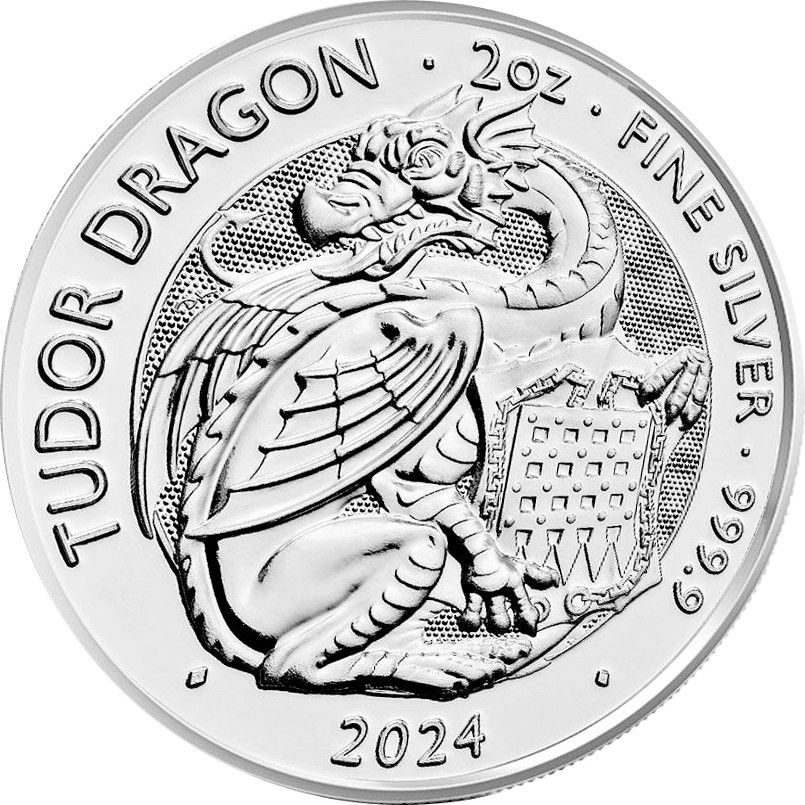
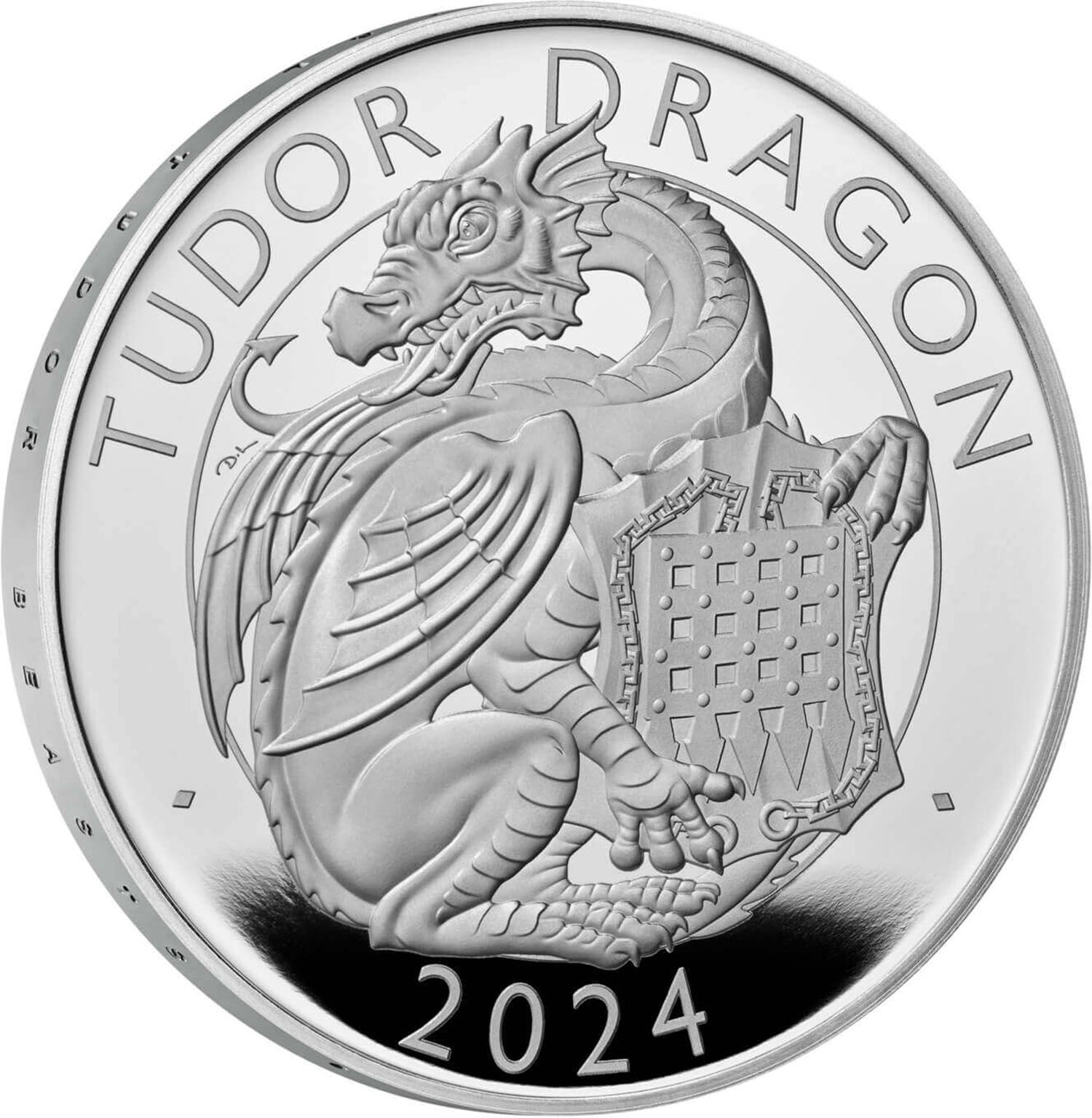
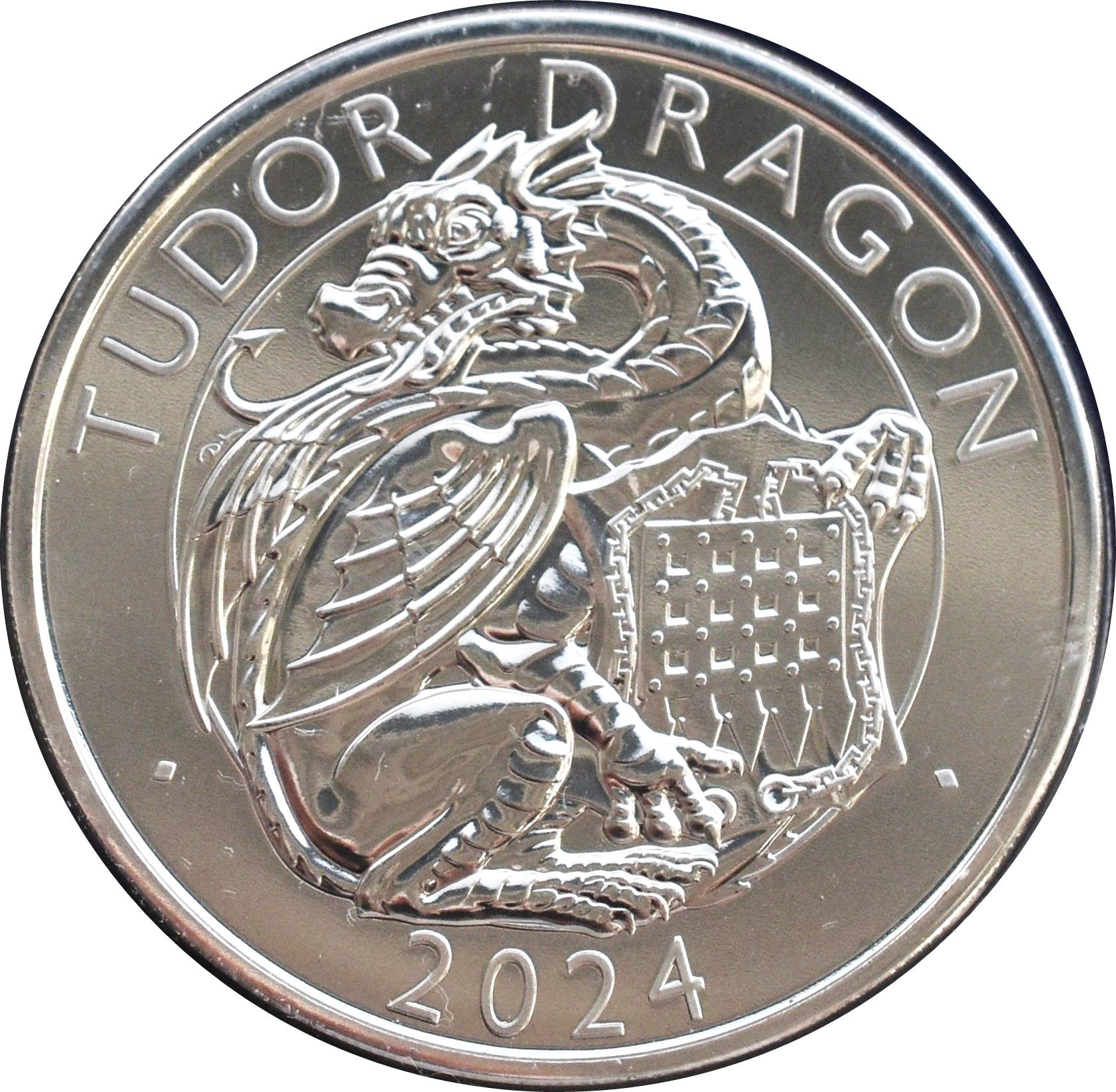
| Tudor Dragon | Royal Tudor emblem (red dragon of Wales / Tudor) | 2024 | 5 oz gold proof: 90 / 5 oz silver proof: 230 / 1 oz bullion: open | £40–£70 |
| Queen's Panther | Anne Boleyn / Queen's heraldry | 2025 (planned) | Mintages TBC at announcement | Bullion + premium TBC |
| Greyhound of Richmond | Henry VII via the Earls of Richmond | 2025 (planned) | Mintages TBC | TBC |
| Royal Dragon | Tudor royal arms supporter | 2026 (planned) | Mintages TBC | TBC |
| Queen's Lion (final) | Final beast / Completer Coin | 2026–2027 (planned) | Completer Coin format following 2021 Queen's Beasts Completer | TBC |
Mintage tiers shown are confirmed Royal Mint figures for proof variants where published; bullion variants are open mintage. Realised ranges are sample-traded ranges across UK bullion dealers and eBay sold listings. Release dates beyond 2024 are subject to Royal Mint scheduling.
Tudor Beasts vs Queen's Beasts, heritage and collector position
The two series are deliberately positioned as sister programmes, identical denomination ladder, identical heraldic-beast concept, both rooted in real stone or carved-wood originals at royal residences, both designed to run roughly a decade and finish with a Completer Coin. The differences sit on the market-economics side rather than the design side. Queen's Beasts (2016–2021) drew on the Coronation statues from 1953, designed by James Woodford and now held at Kew Gardens; the coin series was designed by Royal Mint engraver Jody Clark and ran through ten beasts plus the Completer. Mintages were generous on the proof tier (250–500 on 5 oz gold, 750–1,250 on 5 oz silver in most years) which kept secondary-market prices close to issue.
Tudor Beasts (2022 onwards) draws on the Hampton Court bridge statues and is designed by surrealist illustrator David Lawrence in collaboration with the Royal Mint. The mintage strategy was deliberately tighter: 5 oz gold proof at 90–125 per beast (about half the Queen's Beasts equivalent) and 5 oz silver proof at 230–300 (roughly a third). The result is a series in which the proof tier scarcity is doing real pricing work; 5 oz gold proofs from the Seymour Panther and Lion of England launches that issued at £7,250–£8,250 in 2022 trade in the £14,000–£22,000 range on the secondary market in 2026. Equivalent Queen's Beasts 5 oz gold proofs of comparable age have appreciated meaningfully but at a slower rate.
From a collector position, both series sit in the same wallet. The Queen's Beasts series is the older, fully-completed, more liquid sister; Tudor Beasts is the newer, scarcer, still-unfolding sister with stronger early-stage performance. Many collectors hold both and treat them as bookends, the Elizabethan coronation set and the Henrician palace set, two snapshots of British royal heraldry separated by 400 years. See our parallel write-up at Queen's Beasts coin series for the full sister-programme analysis.
Buying Tudor Beasts, Royal Mint vs secondary market
Two different acquisition routes, two very different premium structures.
Royal Mint at issue. The Royal Mint sells Tudor Beasts variants directly on launch day. Bullion-grade pieces (1 oz and 2 oz silver, 1/4 oz and 1 oz gold) are typically available for several weeks at issue premium. Proof variants, especially 5 oz, 10 oz and 1 kilo gold, sell out in minutes to hours, with the Royal Mint's online queue routinely running into thousands of waiting buyers. Buying at issue is the only way to acquire proof tier pieces at the original mint-set price; once sold out, the secondary market sets the price. Sign up for Royal Mint launch alerts and have payment pre-loaded; the Tudor Beasts proof releases are among the fastest-selling UK numismatic launches.
Secondary market. For sold-out beasts and any post-launch acquisition, the right venues are: specialist UK bullion dealers (Atkinsons, BullionByPost, Chards, Baird & Co) for bullion-grade pieces at small premium over Royal Mint resale; numismatic auction houses (Spink, Baldwin's, Noonans) for high-grade slabbed proof pieces; and eBay UK for bullion variants where sold-listings prices are transparent. The market to avoid is direct-mail vendors such as the Westminster Collection or Bradford Exchange, who typically retail Tudor Beasts at 50–80% over realised secondary-market prices, a premium that is not recoverable on resale.
For the proof tier specifically, a practical route is to buy graded on the secondary market, PCGS or NGC slabs at PR70 or MS70 carry a small further premium (typically 5–15% over a raw equivalent) but remove authentication risk and add resale liquidity. PCGS Population Reports and NGC Census are public and can be cross-referenced before purchase.
Investment performance, early Tudor Beasts vs Queen's Beasts price growth
Looking at the same denomination across both series gives a clean head-to-head. The 5 oz gold proof variant is the most useful comparison because it is the headline numismatic format in both programmes and has the deepest secondary-market liquidity.
| Coin (5 oz gold proof) | Issue price | Mintage | Realised range 2026 | Approx growth |
|---|---|---|---|---|
| Queen's Beasts Lion of England (2017) | ~£7,250 | 250 | £14,000–£19,000 | ~150% |
| Queen's Beasts Unicorn of Scotland (2018) | ~£7,500 | 250 | £14,000–£18,000 | ~130% |
| Queen's Beasts Completer (2021) | ~£8,250 | 250 | £13,000–£17,000 | ~80% |
| Tudor Seymour Panther (2022) | ~£7,500 | 125 | £16,000–£22,000 | ~170% |
| Tudor Lion of England (2022) | ~£7,500 | 125 | £15,000–£20,000 | ~135% |
| Tudor Yale of Beaufort (2023) | ~£8,250 | 100 | £15,000–£19,000 | ~110% |
Realised ranges sourced from Spink, Baldwin's, Noonans, Heritage and UK dealer sold-listings over the trailing 18 months. Growth percentages are approximate and depend heavily on grade and slab. Past performance is not indicative of future results, the data describes how the market has priced the series so far, not how it will price future releases.
Two patterns matter. First, the Tudor Beasts 5 oz gold proofs have outpaced the equivalent Queen's Beasts pieces despite being newer issues, almost entirely because of the tighter mintages. Second, the growth on early issues is partly an issue-bias artefact, the Seymour Panther was the first release, attracted the broadest collector demand, and was bought by collectors who have not yet brought examples back to market. As the series matures and more material moves through auction, the realised spread on early issues typically widens before stabilising. The Queen's Beasts pattern over 2016–2024 supports that read.
How to display Tudor Beasts, full set vs single beast collecting
There are three sensible collecting approaches and one that does not work as well as it sounds.
- Full denomination set. Buy one example of each beast in a single denomination , usually 1 oz silver bullion or 1/4 oz gold, the two most accessible tiers. Ten coins, complete when the Completer arrives. Display in a Royal Mint hardwood case (the Mint sells a dedicated Tudor Beasts display tray) or a Lighthouse album with circular slots. This is the canonical collecting format and the one with the strongest liquidity if you ever sell as a lot.
- Type set across denominations. One beast in each available denomination, for example, the Seymour Panther in 1 oz silver, 2 oz silver, 1/4 oz gold, 1 oz gold and 5 oz silver proof. Five coins, one heraldic theme, every format. Visually distinctive and lets you display a cross-section of the Royal Mint's technical capability (varying relief, polish and finish).
- Single-beast deep collection. Pick one beast and acquire every variant, bullion and proof, all denominations and all years (some beasts are reissued in piedfort, BU and reverse proof). Best for collectors with a particular heraldic affinity (Tudor Dragon for Welsh collectors, Yale of Beaufort for those with an interest in Lady Margaret's lineage). Requires the largest capital outlay because the proof tier is a meaningful share of the collection.
- Bullion-only stacking. Treat the series purely as silver or gold bullion and ignore the proof tier. Works as a stacking strategy but discards most of the numismatic upside. The Tudor Beasts proof variants are doing the heavy lifting on series performance; a bullion-only approach captures the series aesthetic but matches generic bullion returns.
Whichever route you pick, store the coins in original Royal Mint capsules where possible and avoid handling without cotton or nitrile gloves, finger oils on a proof field show up under loupe within weeks. For high-value pieces, slabbing through PCGS, NGC or CGS UK is the right call: it removes authentication risk for a future buyer and adds resale liquidity. See our coin collection insurance UK guide for cover at this price tier.
Featured Tudor Beasts coins on MyCoinage
Frequently asked questions
What is the Tudor Beasts coin series?
How does Tudor Beasts compare to Queen's Beasts?
How much is a Tudor Beasts coin worth?
Are Tudor Beasts CGT-exempt?
How many Tudor Beasts have been released so far?
Where can I buy Tudor Beasts coins?
Related guides
- Queen's Beasts coin series, the 2016–2021 sister programme and its full ten-beast run.
- Britannia bullion £2 guide, the other major UK CGT-exempt bullion series.
- CGT-exempt coins UK, the full qualifying list under HMRC manual CG78308.
- Sovereign vs Krugerrand, how UK CGT-exempt gold compares to international competitors.
- Coin collection insurance UK, cover for high-value Tudor Beasts proof variants.
- Upcoming UK coins, the full Royal Mint release pipeline including remaining Tudor Beasts.