Sir Isaac Newton 50p Value: 2017 Mintage & 2026 Realised Prices
The 2017 Sir Isaac Newton 50p marks the 375th anniversary of Newton’s birth and his 28-year tenure as Master of the Royal Mint, the longest in the role’s history. Designer Aaron West chose Proposition 11 from the Principia Mathematica — elliptical planetary orbits with the Sun at the focus — for the reverse, making it one of the most visually distinctive modern UK commemoratives. Circulating mintage was 1,801,500 (12th-rarest UK 50p in change). This guide covers every variant, current realised prices, and how to spot one in your change.
The design: Proposition 11 from the Principia
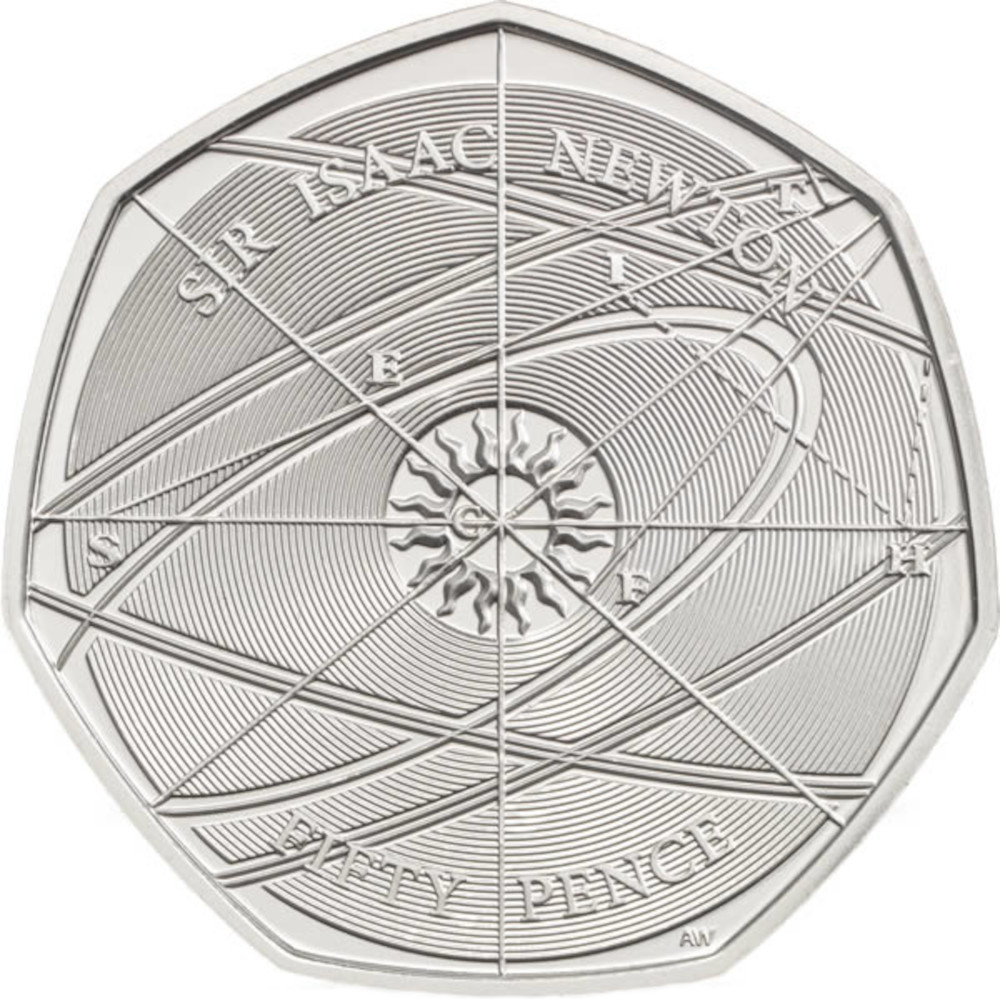
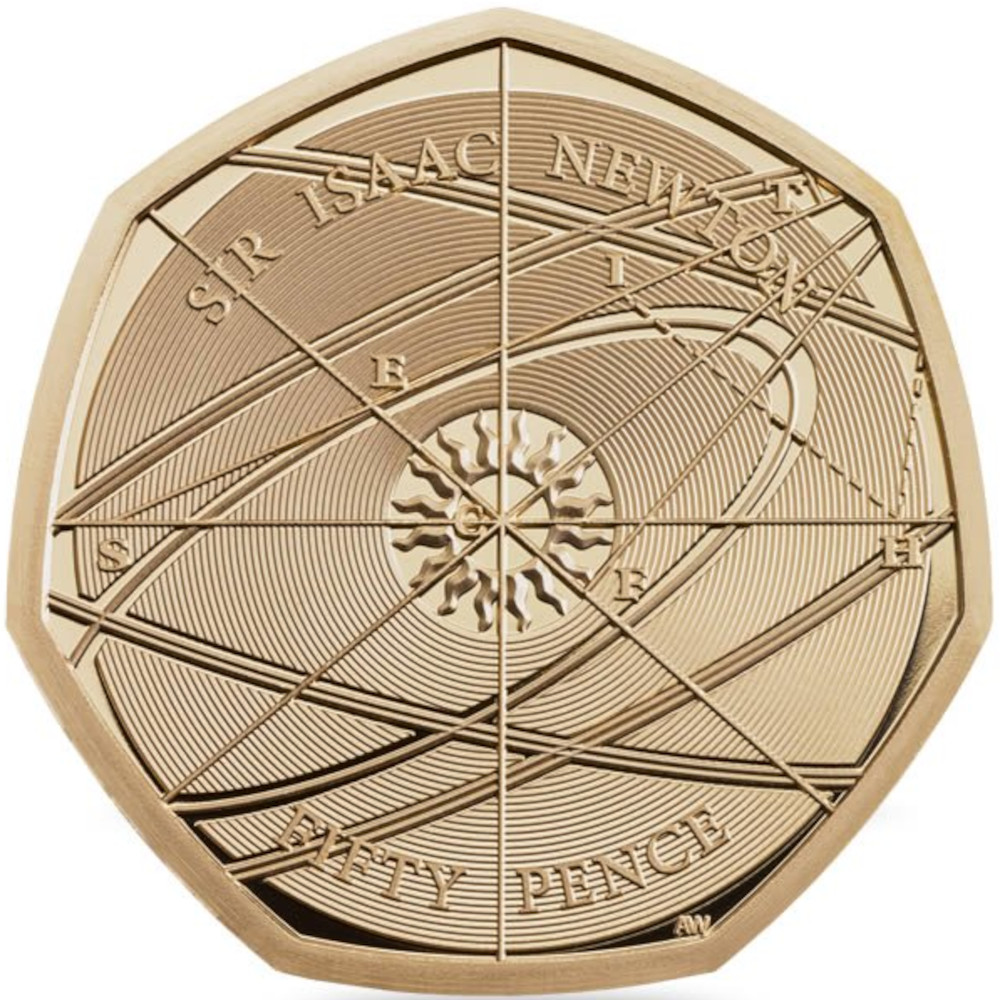
The reverse of the 2017 Newton 50p was designed by Royal Mint engraver Aaron West. Rather than a portrait or simple legend, West chose to render a diagram from Newton’s 1687 Philosophiæ Naturalis Principia Mathematica, the founding text of classical mechanics. The specific reference is Proposition 11 of Book I: “If a body revolves in an ellipse, it is required to find the law of the centripetal force directed to a focus of the ellipse.”
West’s rendering shows a planetary ellipse with the Sun positioned at the focus — not the geometric centre — which is the geometric breakthrough Newton used to derive Kepler’s laws from the inverse-square law of gravity. Around the elliptical orbit, the legend reads SIR ISAAC NEWTON. The obverse carries the Jody Clark fifth-portrait effigy of Elizabeth II (used 2015–2022). Specifications: 27.30 mm flat-to-flat, 8.00 g, plain edge, cupronickel.
Mintage and rarity in context
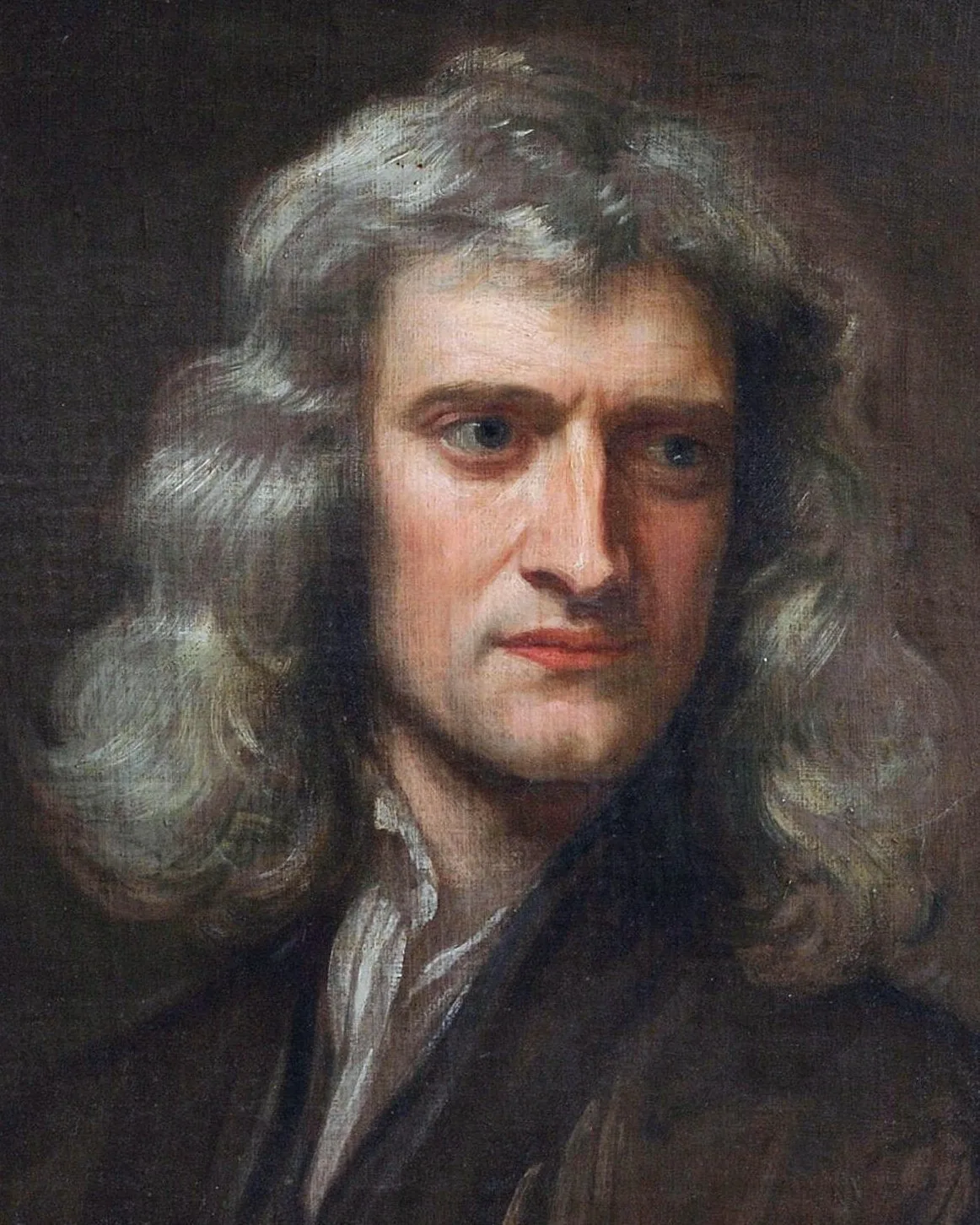
The 2017 Newton 50p has a circulating mintage of 1,801,500 — rarer than the 2018 Peter Rabbit (1.4 million is the rarest of that series) but slightly more common than the 2011 Olympic Football (1,125,500). It sits at 12th on our top-25 rare 50p list, behind the 2009 Kew Gardens (210,000), 2023 Atlantic Salmon (200,000), 1992–93 EU Presidency (109,000), the Olympic Football, Wrestling and Judo, the 2018 Peter Rabbit and Flopsy Bunny, the 2011 Olympic Triathlon and Tennis, and the 2018 Mrs Tittlemouse.
In practice, by 2026 Newton 50ps in change are noticeably scarcer than mintage figures suggest — collectors removed examples in 2017 and 2018, and the typical UK change-finder spots roughly 1 Newton 50p per 200–500 50ps inspected. The most common 2017 50p in change today is the seated Britannia definitive.
Every variant and current price
| Variant | Mintage | Original retail | 2026 realised |
|---|---|---|---|
| Circulating (cupronickel) | 1,801,500 | Face value | £5–£10 |
| BU in Royal Mint card | ~19,000 | £10 | £12–£20 |
| Silver proof | ~7,500 | £52.50 | £55–£90 |
| Silver Piedfort | 1,800 | £105 | £180–£280 |
| Gold proof | 400 | £1,065 | £1,600–£2,200 |
Sources: realised eBay UK sold listings (last 12 months) and dealer asking prices from Change Checker and Royal Mint historical retail.
Newton’s real role at the Royal Mint
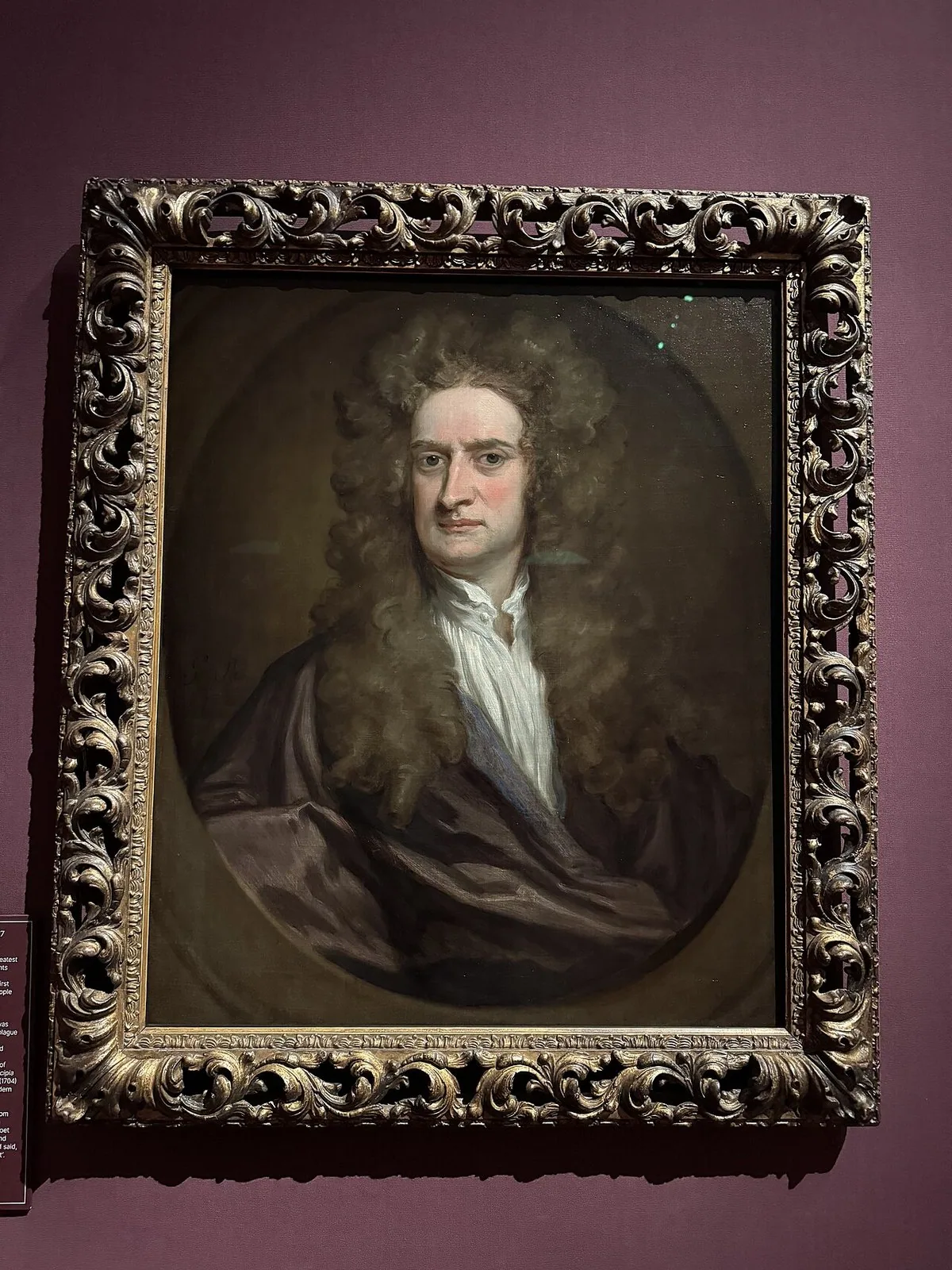
Newton’s career as Master of the Royal Mint is often treated as a curio (the great scientist’s retirement job), but it was substantial and consequential. He took office as Warden in April 1696 at the height of the Great Recoinage, was promoted to Master in 1699, and served until his death in March 1727 — a 28-year tenure that remains the longest in the Mint’s history.
Three concrete achievements stand out. First, Newton drove the final phase of the Great Recoinage, replacing hammered silver coinage (vulnerable to clipping) with milled-edge machine-struck coinage that ended clipping fraud essentially overnight. Second, his 1717 ratio of gold to silver (set at the Master’s discretion) effectively put Britain on a de facto gold standard at £3 17s 10.5d per troy ounce of gold — a figure that anchored sterling for nearly 200 years until World War I. Third, he personally investigated and prosecuted coin counterfeiters, including the ring led by William Chaloner who was hanged at Tyburn in March 1699 largely on Newton’s evidence.
Newton was knighted in 1705 by Queen Anne — the first scientist so honoured — partly for his Mint service. He died in 1727 having accumulated significant personal wealth (much of it inflation-adjusted from the South Sea Bubble, which he famously bought into late and lost on). The 2017 50p is the first UK coin to honour him.
Authentication
Five quick checks catch every counterfeit and altered Newton 50p:
- Weight: 8.00 g ± 0.05 g on a digital jewellery scale. Resin replicas fall well short; printed-metal fakes are typically 0.2 g+ off.
- Diameter: 27.30 mm flat-to-flat across the heptagon. Counterfeits typically read 0.1–0.4 mm low.
- Shape: a true heptagonal Reuleaux polygon (constant width when rotated against callipers).
- Edge: plain, un-reeded, sharp. Cast counterfeits show seam lines or rounding.
- Relief: the elliptical orbit and Sun rays at the focal point should be sharply defined; soft “cast-look” details on these features indicate a fake.
Forgery risk for the cupronickel circulating coin is negligible — the economics don’t work. Silver Piedfort and gold proof variants warrant professional grading via CGS UK, PCGS or NGC if the realised price is above the £200 mark; slabbing fees are easily justified at that threshold.
Featured Newton 50ps on MyCoinage
Frequently asked questions
How much is the 2017 Sir Isaac Newton 50p worth?
Why was the Newton 50p designed?
What is the mintage of the Newton 50p?
Is the 2017 Newton 50p rare?
Was Sir Isaac Newton actually Master of the Royal Mint?
How do I tell a real Newton 50p from a fake?
Where should I sell a Newton 50p?
What other 2017 50ps were issued?
Are Newton 50ps a good investment?
Further reading
- Rare 50p coins UK — the top 25 list (Newton is #12).
- Is my 50p rare? — decision tree for any UK 50p.
- London 2012 Olympic 50p guide — the 29-coin reference.
- How to grade a coin — the prerequisite for accurate pricing.
- Where to sell rare coins UK — venue comparison.