How to Read a Coin Date: Where the Year Sits on UK Coins
Identifying the year on a British coin sounds simple until you actually try it. The 2008 Royal Mint redesign moved most circulating dates from obverse to reverse, hammered coinage routinely omits the year entirely, Maundy Money uses Roman numerals, and a worn Victorian penny can hide its last two digits beneath thirty years of pocket wear. This reference covers every common case so you can confidently date any coin you find.
Where the date appears on UK coins
There are two reliable rules for any UK coin you pick up. First, identify the monarch, the bust direction, crown style and engraver’s initial place the coin within a 30- to 70-year window. Second, locate the date using the convention for that issuing period:
- Pre-decimal milled coinage (1816–1971): date sits on the obverse, in the legend running around the monarch’s portrait. On bronze pennies, halfpennies and farthings it is at the bottom of the obverse beneath the bust. On silver shillings, florins and crowns it sits to the right of the bust along the rim.
- Decimal coinage 1971–2007: date stays on the obverse beneath the Queen’s portrait, slightly inset from the legend. The pre-decimal convention carried straight through.
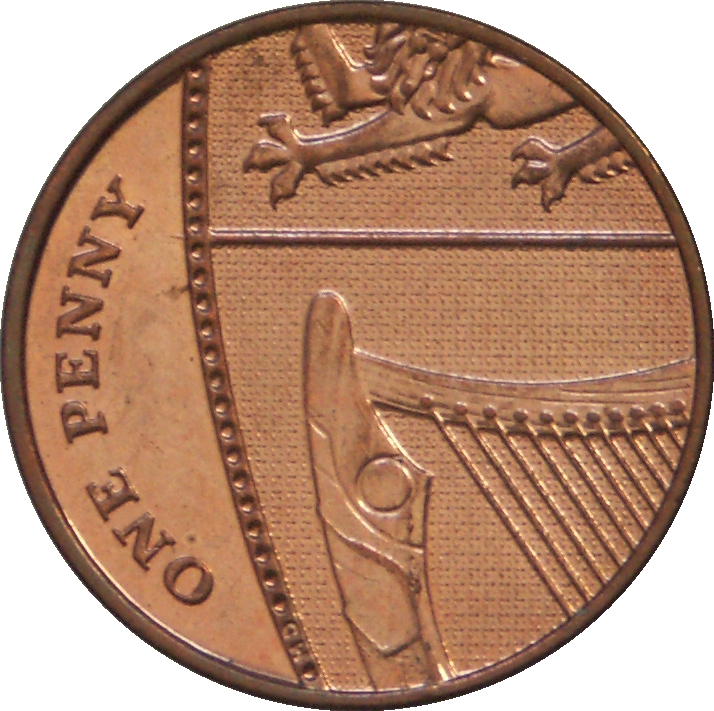
- Decimal coinage 2008 onwards: Matthew Dent’s shield-jigsaw reverses moved the year from the obverse to the reverse on every circulating denomination 1p–£1. The £2 and 50p commemoratives keep their own conventions, date can sit on either face depending on design.
- Royal Mint proof and commemorative crowns: date placement varies by issue. Always check both sides; the “design year” in the legend is sometimes a different year from the issue year struck on the rim or in the field.
The 2008 Matthew Dent redesign
In 2008 the Royal Mint commissioned Matthew Dent to redesign the reverses of all six circulating decimal denominations 1p–50p plus the £1. The result was the “shield jigsaw”: when the six coins are placed together they form the full Royal Arms, with each individual coin carrying a slice of the shield. The redesign was the first time a single artist had been responsible for every UK circulating coin reverse since decimalisation, and it shipped with one consequential side-effect: the year of issue moved from the obverse to the reverse on all six coins.
The most famous consequence of this transition was the undated 2008 20p mule. A small batch of 20p coins was struck pairing the new Dent reverse die with the previous Ian Rank-Broadley obverse die that had carried the date. The result was a circulating coin with no year at all on either face, the first since the milled era began. Estimated mintage is between 50,000 and 200,000; confirmed examples sell for £50–£100 in worn grade and over £120 in Brilliant Uncirculated.
Pre-decimal coins (1816–1971)
The 155-year run from the Great Recoinage of 1816 through to decimalisation on 15 February 1971 is the largest single block of British coinage by volume. Date placement is overwhelmingly consistent: year on the obverse, in the legend or beneath the bust. The conventions by denomination:
| Denomination | Period | Date location | Notes |
|---|---|---|---|
| Farthing | 1821–1956 | Obverse, beneath bust | Last farthing struck 1956 |
| Halfpenny | 1817–1967 | Obverse, beneath bust | Britannia reverse most years |
| Penny | 1816–1970 | Obverse, beneath bust | Bronze from 1860 |
| Threepence (silver) | 1817–1944 | Obverse, beneath bust | Replaced by brass 12-sided 1937 |
| Threepence (brass) | 1937–1967 | Obverse, right of bust | 12-sided shape |
| Sixpence | 1817–1967 | Obverse, right of bust | Last shipped 1970 |
| Shilling | 1816–1966 | Obverse, right of bust | English / Scottish reverses 1937+ |
| Florin (2 shilling) | 1849–1967 | Obverse, right of bust | Becomes 10p in 1968 |
| Half crown | 1816–1967 | Obverse, right of bust | No half-crown decimal equivalent |
| Crown | 1818–1965 | Obverse, right of bust; some Roman | Jubilee 1887 uses Roman year |
| Sovereign | 1817–present | Obverse, beneath bust | St George reverse from 1817 |
Roman numerals on Maundy and crown coins
A handful of UK issues carry Roman-numeral years instead of Arabic digits. The convention is the standard I=1, V=5, X=10, L=50, C=100, D=500, M=1000 with subtractive pairs (IV=4, IX=9, XL=40, XC=90, CD=400, CM=900). Roman dates appear in three contexts on UK coinage:
- Maundy Money, every year since the 17th century. The annual silver penny, twopence, threepence and fourpence handed out by the monarch on Maundy Thursday carries a Roman year (e.g. MMXXIV for 2024). This is the longest unbroken Roman-numeral coinage in the world. See our Maundy Money guide.
- Victorian Jubilee crowns 1887. The Golden Jubilee crown carries the year as MDCCCLXXXVII. The Diamond Jubilee 1897 crown uses MDCCCXCVII.
- Modern commemorative crowns. Occasional special issues use Roman-numeral years for design reasons. The 2002 Golden Jubilee £5 carries the Latin legend AMOR POPULI PRAESIDIUM REGINAE but uses an Arabic-numeral year.
A worked example: MDCCCLXXXVII = M (1000) + D (500) + CCC (300) + LXXX (80) + VII (7) = 1887. Read each numeral block left to right and add, applying subtractive rules where a smaller numeral precedes a larger one.
Worn or illegible dates: what to do
A circulated copper or bronze penny can lose its last digit in 30–50 years of pocket wear. Before you write a worn coin off as undateable:
- Tilt under raking light. A 30-degree side angle under a single bright bulb (5000K LED works best) will cast shadows in the residual relief that flat overhead lighting hides. Many “worn smooth” dates become readable this way.
- Identify the reign first. The bust silhouette places the coin within a 30- to 70-year window. George VI (1937–1952) is 16 years; Elizabeth II (1953–2022) is 70 years; Charles III is 2023+. The reverse design then narrows further (Britannia variants, brass-thrupence, shield 50p etc).
- Check the obverse legend. The legend wording changed multiple times within long reigns: VICTORIA D G (1838–1860) vs VICTORIA DEI GRA (1860–1887) vs VICTORIA D G BRITT REGINA (1887–1893) vs VICTORIA DEI GRA BRITT REGINA FID DEF IND IMP (1893–1901). A wholly worn-smooth date may still leave one or two of these legend variants to identify the design type and narrow the year.
- Compare against known specimens. The PCGS, NGC and CGS UK photo-grade libraries are free; pair your worn coin with a clean specimen of each candidate type until the design details match.
- Accept the loss when needed. A coin worn smooth enough that the date cannot be recovered is graded Poor (PO-1) on the Sheldon scale. For common dates that means face-value or melt only. Our grading guide covers Poor / Fair / About Good coins in full.
Year, date of issue, date of mint, what each means
Three dates can attach to a single coin. They’re usually the same, but not always:
- Year on the coin. The Arabic or Roman digits struck into the obverse or reverse. This is the “date” in 99% of conversations.
- Date of issue. When the Royal Mint released the coin into circulation or to subscribers. For circulation coins the issue year matches the year on the coin; for proof and commemorative issues the coin can be released up to a year either side.
- Date of mint. When the coin was physically struck. Royal Mint commemorative crowns are sometimes struck a year ahead of issue date; a 2024-dated proof might have been pressed in November 2023. For circulation coins, mint date and issue date are the same year.
Why this matters: when a Royal Mint catalogue or auction lot says “1953 Elizabeth II proof crown,” that is the year on the coin and the year of issue. When a Spink lot says “dated 1953, struck 1954,” that is a separate, much rarer scenario where the Mint produced a frozen-date strike for a special purpose.
Hammered coins: dates often absent before 1551
English hammered coinage, struck by hand from c. AD 600 through to 1662 when the Tower Mint switched to milled production, rarely carries a year. Dates begin to appear sporadically under Edward VI in 1551 and become semi-regular only on Tudor and Jacobean gold. The penny, groat, half-groat and farthing of the medieval period carry the monarch’s name in legend but no year.
Sequencing hammered coins into a date order requires identifying:
- Reign. Read the legend; cross-check against the bust style.
- Mintmark. A small symbol (cross, sun, rose, lis, escallop) at the start of the legend indicates a specific issue period within the reign. The mintmark sequence is published in Spink’s Coins of England.
- Type. Subtle changes to bust, lettering style and reverse cross help further narrow.
- Privy mark. A small letter, dot or symbol within the design that indicates working die or assayer.
For pre-1816 coins more generally, see our pre-1816 British coins reference.
“Two date” coins: mules and dual-date errors
Occasionally a UK coin appears to carry two different years. Three explanations cover almost every case:
- Commemorative dual-dating. Some commemorative crowns carry both the original event year and the year of issue (e.g. a 1973 EEC entry 50p with both “1973” in the design and the year of issue). This is intentional; not an error.
- Mule errors. A genuine die-pair mismatch where one year’s obverse die is paired with another year’s reverse. Extremely rare on circulating UK coinage; commands significant premium when authenticated. See our dual-date coins error guide.
- Re-engraving and overdates. On older hand-engraved dies the engraver sometimes corrected a digit by punching the new number over the old. Victorian bronze pennies show 1860/59, 1865/3 and similar overdates that are individually catalogued and trade at premium.
Common misreadings to watch for
A few patterns trip up beginners more often than the rest. Treat the following as a flagged-list to double-check before you assume you’ve found something rare:
| What it looks like | What it actually is | Why |
|---|---|---|
| 1855Q penny | 1855 penny with worn 0 | Die fill on the “0” mimics a Q under wear |
| 1856 vs 1858 | Often the 6 confused with 8 | Both digits round; identical when worn |
| 1968 vs 1958 | Worn 6 reads as 5 | Common on Elizabeth II shillings |
| £2 with no year | Year on the inner field, not the rim | Some bimetallic £2 carry year inside |
| 1933 penny | Pattern only, four known | Most “1933 pennies” are misread 1938 or 1932 |
| Charles III year | 2023+ shows year on reverse | Continued Dent shield convention |
The “1855Q penny” misreading appears in roughly one in fifty found-a-rare-coin queries we receive. There is no such variant.
Featured coins on MyCoinage
Related guides
- How to Grade a Coin (Sheldon scale & UK descriptive)
- Are My Old Coins Worth Anything?
- I Found a Rare Coin: What To Do Next
- Dual-Date Coin Errors UK
- How to Authenticate a Coin
- How to Spot Fake British Coins
- Coin Collecting Glossary