Royal Maundy Money: UK Values Guide
Royal Maundy money is the small set of silver coins, penny, twopence, threepence and fourpence , given personally by the British monarch on Maundy Thursday, the day before Good Friday, to elderly recipients chosen for service to their community. The tradition has run without interruption under every monarch since Charles II in the 1660s. The number of recipients equals the sovereign\'s age in years, paired man-and-woman, so the size of the distribution grows with the reign. Maundy coins are the only official UK silver penny still struck, and complete cased Maundy sets are among the most quietly desirable items in modern British numismatics.
1. What is Maundy money?
Maundy money is a four-coin set of small silver coins, a silver penny (1d), twopence (2d), threepence (3d) and fourpence (4d), struck by the Royal Mint specifically for distribution by the reigning monarch at the annual Maundy Thursday service. Each recipient receives one complete set inside a small white purse, alongside a red purse containing modern coinage to a fixed value. The Maundy coins are the ceremonial almsgiving currency of the Crown.
Maundy coins are not circulation pieces. They are minted to proof or proof-like quality, in .925 sterling silver, and exist almost exclusively in the hands of recipients\' descendants and specialist collectors. From decimalisation in 1971, the face value of each Maundy coin was preserved, a Maundy penny, originally worth 1d in old money (1/240 of a pound), became 1p decimal, a useful uplift that the Treasury accepted as the cost of preserving the tradition. The coins remain legal tender today at their decimal face value, but no recipient ever spends them: the silver content alone is worth many times the face, and the numismatic premium far more again.
2. The Maundy ceremony, historical and modern
The word "Maundy" comes from the Latin mandatum, the new commandment Christ gave at the Last Supper. From the early medieval period, English monarchs personally washed the feet of poor people on Maundy Thursday in re-enactment of the gospel, and gave alms in food, clothing and money. The foot-washing element was last performed by James II in 1685; from William III onwards it was the alms distribution that survived as the central act.
Charles II in the 1660s reformed the alms into the four-denomination silver coin set we know today, and the Maundy purse-and-set format has been fixed since. The ceremony rotated around Westminster (the Chapel Royal, then Westminster Abbey) until the late 20th century, when Queen Elizabeth II began rotating the service around UK cathedrals to take it out beyond London. Charles III continued the rotation: the 2023 Maundy service was at York Minster, the 2024 at Worcester Cathedral.
The ceremony itself is short and dignified. The monarch processes through the cathedral accompanied by the Yeomen of the Guard, who carry the Maundy purses on silver salvers. As each recipient is named, the monarch hands them their two purses personally. The recipients have been nominated by their parishes and dioceses for service to church and community over many years; the ceremony is one of the most personal forms of royal recognition available in the UK honours system.
3. The four denominations, specs at a glance
Each Maundy set contains four small silver coins struck to identical fineness but differing in weight and diameter. The whole set adds up to ten pence (1 + 2 + 3 + 4) of old-money face value, which after decimalisation became ten new pence.
| Denomination | Weight | Diameter | Fineness | Reverse design |
|---|---|---|---|---|
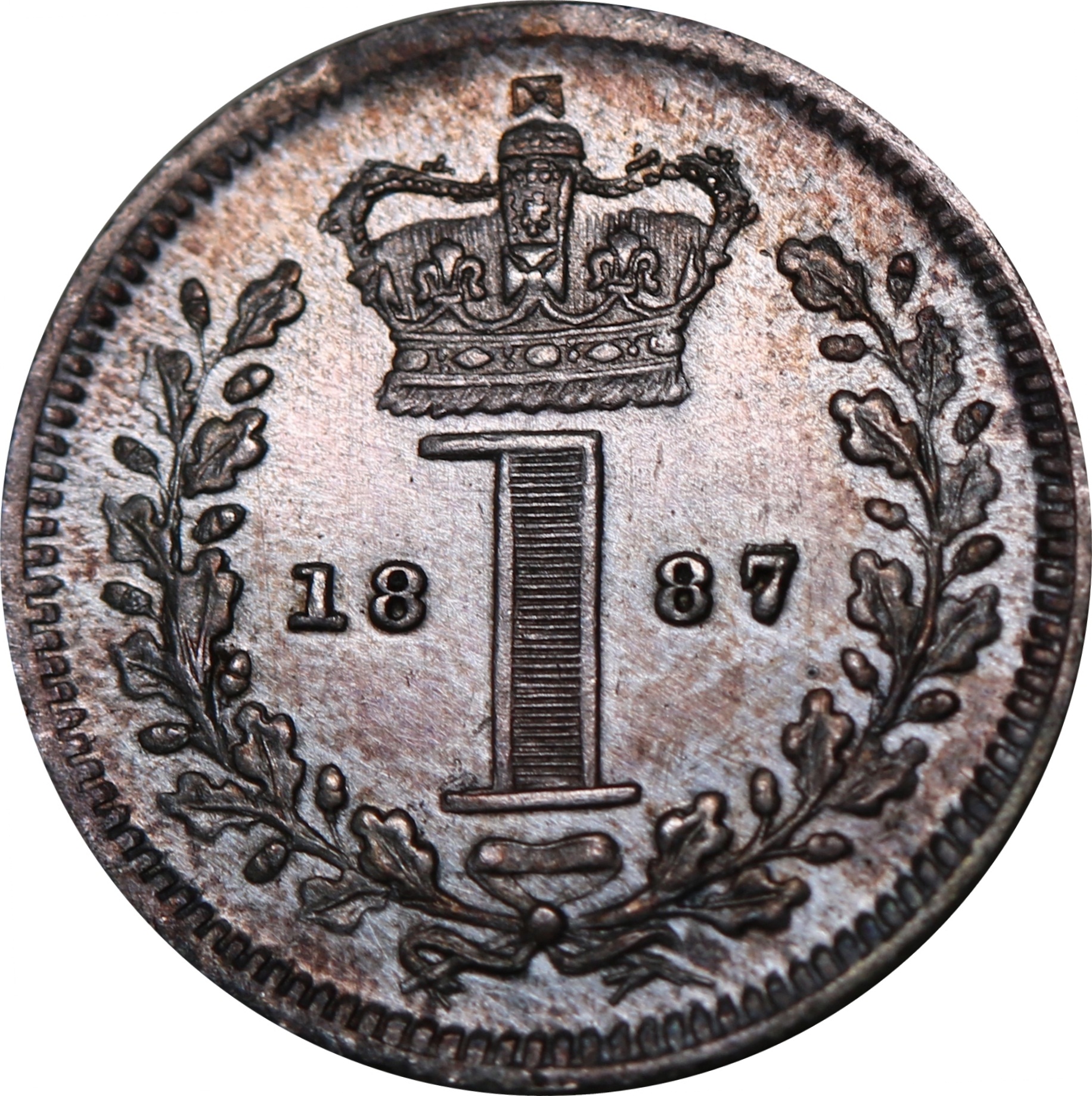
| Maundy penny (1d) | 0.47 g | 11 mm | .925 sterling | Crowned "1" in oak wreath |
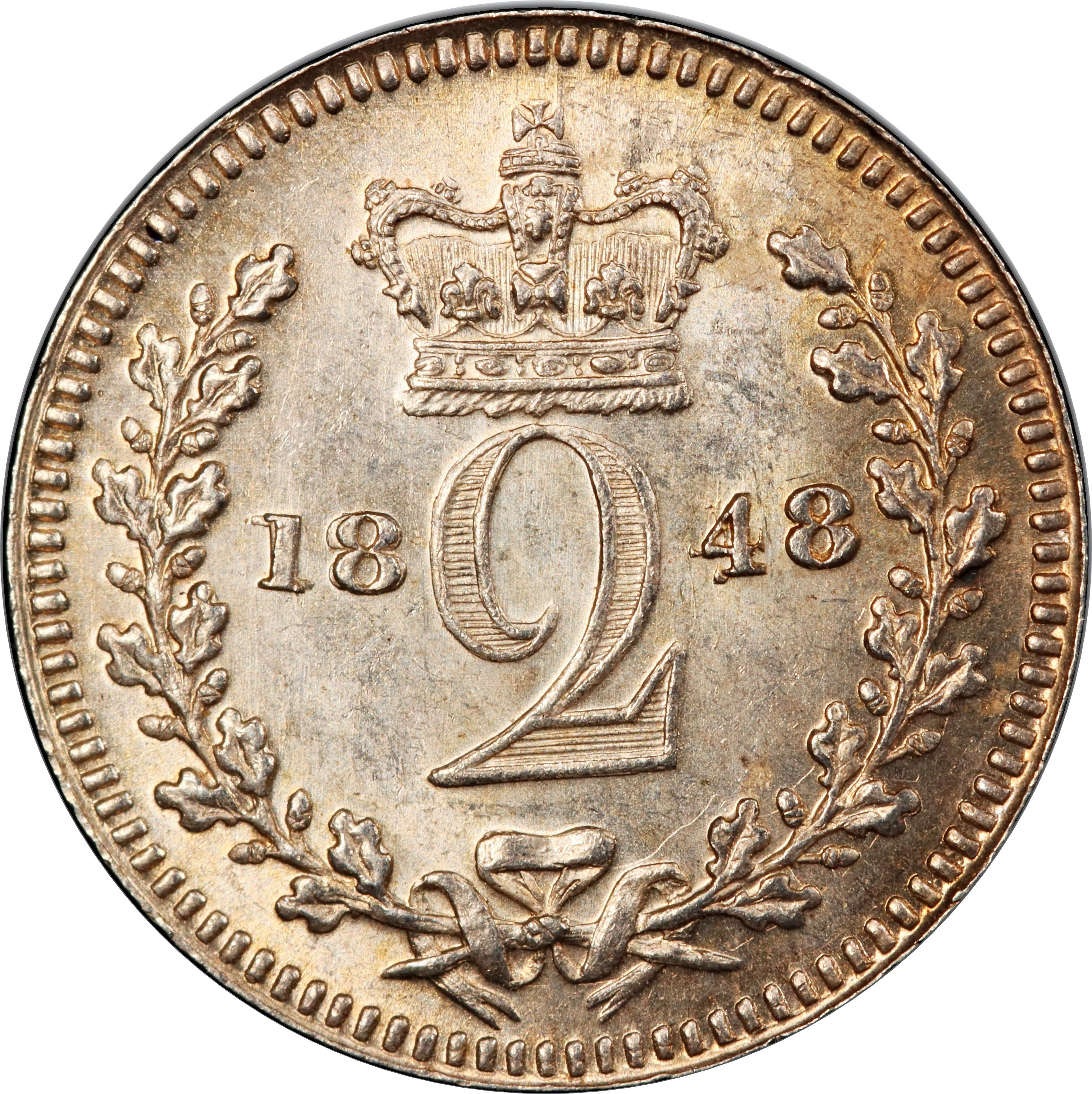
| Maundy twopence (2d) | 0.94 g | 13 mm | .925 sterling | Crowned "2" in oak wreath |
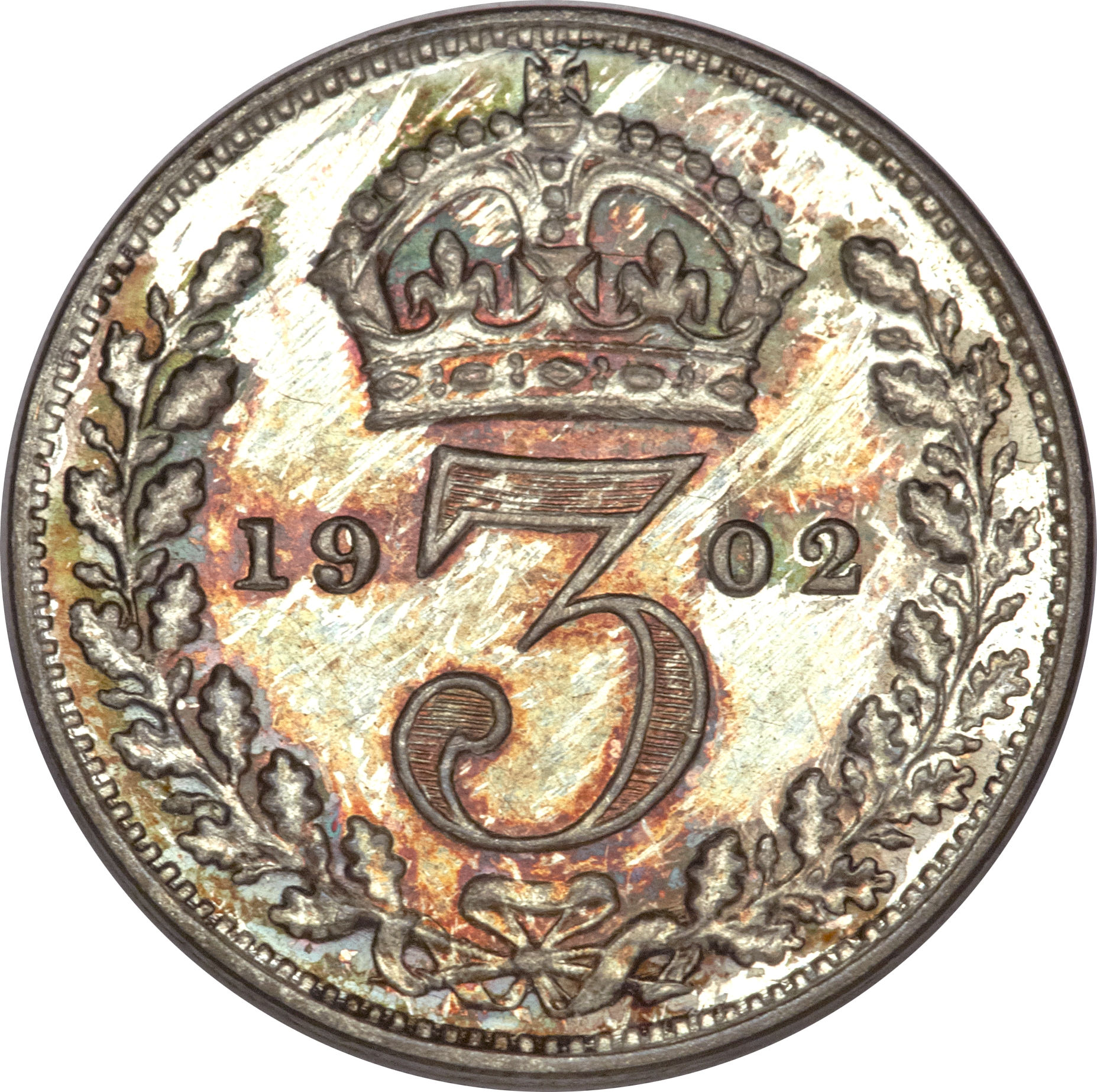
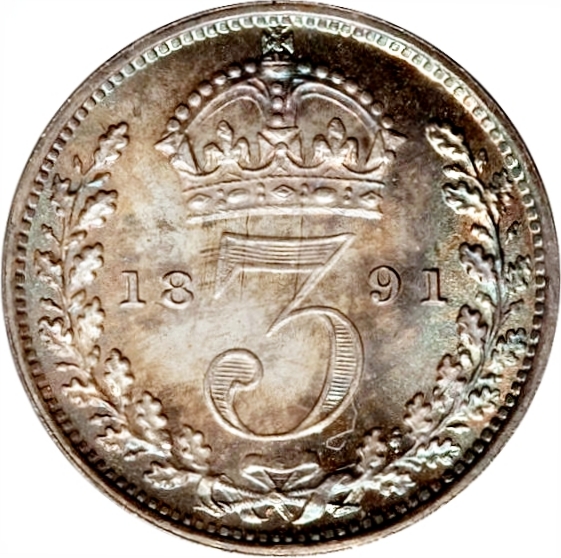
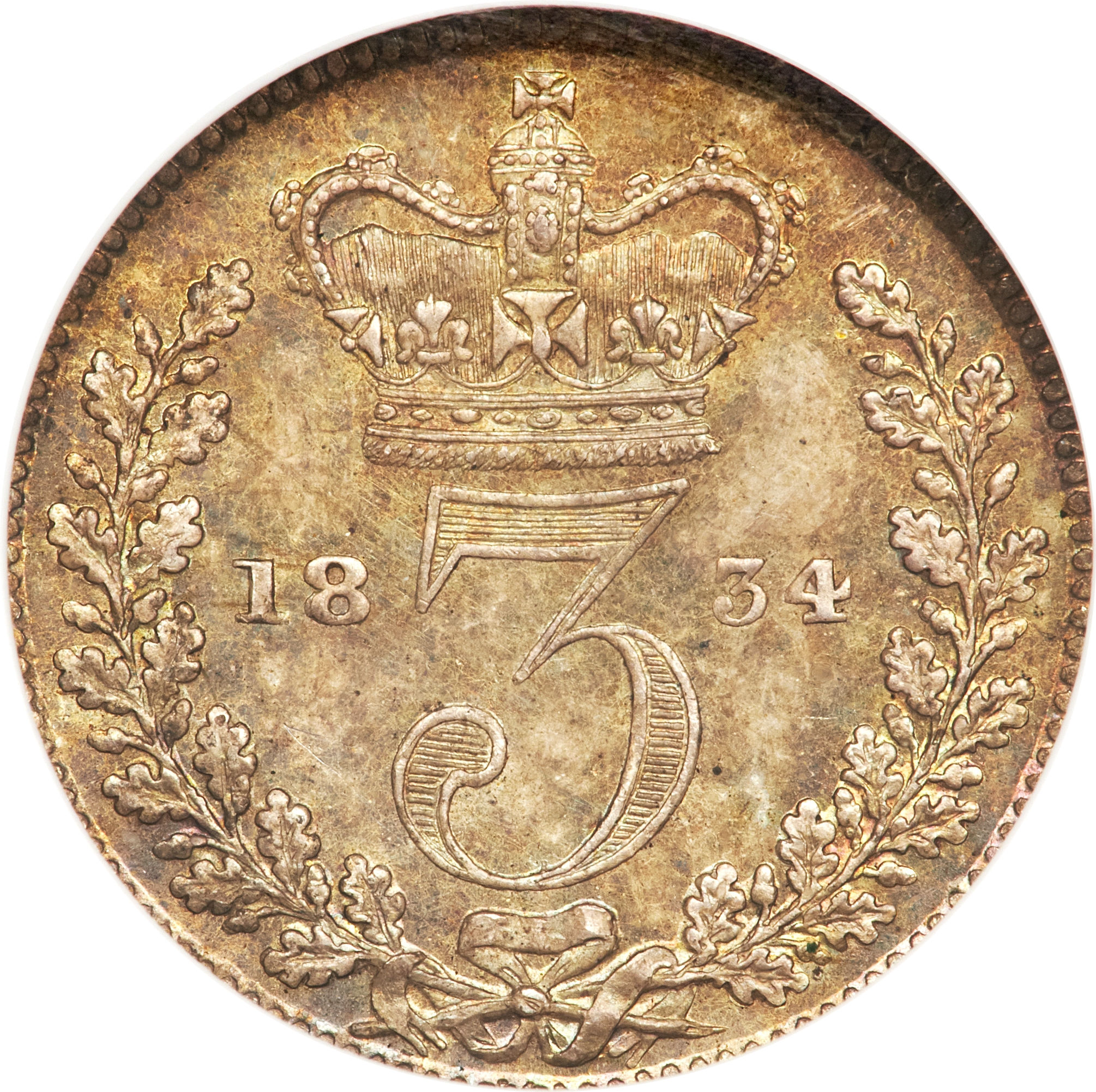
| Maundy threepence (3d) | 1.41 g | 16 mm | .925 sterling | Crowned "3" in oak wreath |
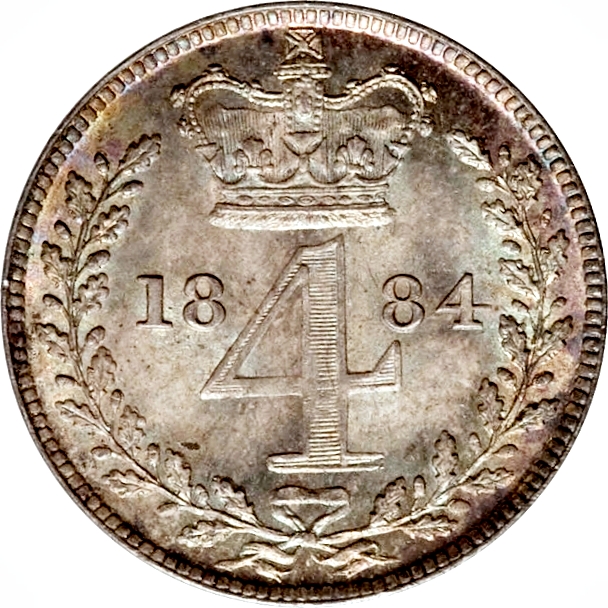
| Maundy fourpence (4d) | 1.88 g | 17 mm | .925 sterling | Crowned "4" in oak wreath |
The crowned-numeral-in-wreath reverse was standardised under William Wyon in the 1820s and has been used essentially unchanged on every Maundy issue since. The obverse follows the reigning monarch\'s standard portrait.
4. Distribution numbers, how the count works
The number of Maundy recipients each year is set by an old rule that links the ceremony directly to the monarch\'s age:
- One man is selected for each completed year of the sovereign\'s life.
- One woman is selected for each completed year of the sovereign\'s life.
- Each recipient receives one complete four-coin Maundy set (1d + 2d + 3d + 4d).
So when Queen Elizabeth II distributed Maundy money in 2022 at age 95, there were 95 men and 95 women, totalling 190 recipients and 190 Maundy sets. When Charles III distributed Maundy in 2024 at age 75, there were 75 men and 75 women, totalling 150 sets. The Royal Mint scales annual Maundy production to the recipient count plus a small overage for ceremonial and museum purposes. Total mintage of any one year\'s Maundy set is therefore small, typically 1,500 to 2,500 sets in modern reigns, and even smaller for short-reign monarchs where the count never had time to climb.
The value in each white purse is fixed by tradition at the sum of the four denominations: 10 pence (now 10p decimal). The red purse, containing modern coinage, was historically intended to cover the cost of food and clothing, and its value has been periodically uplifted by Treasury order. As of 2024 the red purse contains £5.50 in modern coin.
5. Maundy money by monarch
Every monarch from Charles II onwards has issued Maundy money. The realised-value ranges below are typical for complete four-coin sets in original Royal Mint case, sourced from recent Spink, Baldwin\'s, Noonans and eBay UK realisations.
| Monarch | Reign | Typical annual sets | Realised range (cased set) |
|---|---|---|---|
| Charles II | 1660–1685 | ~1,000 (estimated) | £1,200, £3,500 |
| James II | 1685–1688 | ~1,000 (estimated) | £1,500, £4,500 |
| William & Mary / William III | 1689–1702 | ~1,000 (estimated) | £800, £2,500 |
| Anne | 1702–1714 | ~1,000 (estimated) | £800, £2,500 |
| George I | 1714–1727 | ~1,200 | £700, £2,000 |
| George II | 1727–1760 | ~1,200 | £500, £1,800 |
| George III | 1760–1820 | ~1,500 | £400, £1,500 |
| George IV | 1820–1830 | ~1,500 | £350, £1,200 |
| William IV | 1830–1837 | ~1,500 | £400, £1,200 |
| Victoria | 1837–1901 | ~1,500–2,000 | £200, £800 |
| Edward VII | 1902–1910 | ~1,800 | £180, £500 |
| George V | 1911–1936 | ~1,500 | £150, £400 |
| George VI | 1937–1952 | ~1,500–2,000 | £180, £450 |
| Elizabeth II | 1953–2022 | ~1,500–2,500 | £150, £400 |
| Charles III | 2023– | ~1,500–1,800 | £250, £500 |
Realised prices vary widely by year within each reign. Coronation-year and accession-year sets typically command 30–50% premium. Original Royal Mint case condition affects value substantially: a broken-up set of loose coins is worth roughly 60–70% of a complete cased set.
6. Pre-decimalisation context
The Maundy series occupies a unique place in pre-decimal British coinage as the last surviving silver penny. The silver penny had been the backbone of English currency from the Anglo-Saxon period through the medieval centuries, with the silver fourpence (groat), threepence and twopence joining it under Edward I and Edward III. By the 1660s, silver was becoming uneconomic for everyday coinage and Charles II began the long transition to copper for small change. The silver penny gradually retreated until it survived only as a Maundy issue.
By the time of Victoria, the silver Maundy penny was a curiosity even to most collectors: a coin with no everyday counterpart, struck in tiny numbers each year for a single ceremonial purpose. The same was true of the Maundy twopence (the silver twopence had vanished from circulation in the 18th century) and largely true of the Maundy fourpence (the circulating groat was abolished in 1855). Only the Maundy threepence had a circulating sister coin throughout, since silver threepences were struck for everyday use until 1944. Once the brass threepence took over in 1937, the Maundy threepence too became a purely ceremonial coin.
7. Spotting genuine Maundy vs everyday silver pence
The reverse design is the single best test. Maundy coins from the 1820s onward carry a distinctive crowned numeral within an oak wreath on the reverse, with the date below. Silver threepences struck for circulation in the same era carry one of several other reverses (ornate cipher, Britannia, etc.) but never the crowned numeral. If you have a small silver coin with the crowned-numeral reverse, it is almost certainly Maundy.
Five further checks for authentication:
- Silver fineness. Maundy is .925 sterling silver across the whole series. A silver-plated counterfeit will pass a magnet test but fail a specific-gravity check.
- Weight precision. The four denominations have known weights (0.47, 0.94, 1.41, 1.88 g respectively). Tolerance on a calibrated jewellery scale is ±0.05 g.
- Surface finish. Maundy is proof or proof-like with mirror fields and frosted devices. Circulation strikes show full lustre but no mirror.
- Original case pairing. Genuine Maundy sets come in a small Royal Mint case (red leather for older issues, dark blue or burgundy for modern). The case alone adds confidence and, for high-value issues, value.
- Third-party authentication. Any Maundy set worth over £500 should be sent to PCGS, NGC or CGS UK for slabbing.
8. Where Maundy fits in a UK collection
Maundy is a forgiving topic to collect because the four denominations always come together. Three typical strategies:
- Single-set strategy. Buy one complete cased Maundy set, ideally from your birth year or a personally meaningful date. Budget £200–400 for a 20th-century set in original case. This is the cleanest entry point and works as a stand-alone display item.
- Reign-set strategy. Acquire one Maundy set per monarch, a 14-piece collection covering Charles II through Charles III. Total cost £5,000–15,000 depending on the early monarchs you choose; the Charles II, James II and William & Mary sets are the cost drivers. This is a serious medium-term project and tends to appreciate well because it spans every reign.
- Century-set strategy. One Maundy set from each decade of a chosen century. A 20th-century run (1900s through 1990s) is achievable for under £3,000 and ties together the Edward VII, George V, George VI and Elizabeth II reigns in a single coherent display.
9. Where to buy and sell Maundy money
Buying
- Specialist auction houses. Baldwin\'s of St James\'s, Spink, Noonans Mayfair and DNW regularly catalogue Maundy material. Look in the British Coins sections of routine catalogues and in the dedicated Maundy sections of larger sales.
- BNTA dealers. Members of the British Numismatic Trade Association carry stock at fair retail and offer authentication-backed buybacks. Ask any dealer at the London Coin Fair (Holiday Inn Bloomsbury) or the Coinex annual show for current Maundy stock.
- The Royal Mint. The Royal Mint does not sell Maundy directly to the public, but occasional surplus stock from very recent years appears in their secondary catalogue. Most modern Maundy you see for sale has been through one collector before reaching the open market.
- eBay UK. Works for modern Elizabeth II and Charles III sets in original case under £500. Avoid Edwardian or earlier Maundy on eBay unless the seller is a known BNTA member, counterfeit and replica risk is real.
Selling
- Pre-Victorian Maundy sets, high-value individual coins and complete reign runs → specialist auction (Spink, Baldwin\'s, Noonans). Hammer commission 15–20%.
- Modern Elizabeth II and Charles III cased sets → eBay UK or BNTA dealer, depending on time horizon.
- Loose individual Maundy coins → BNTA dealer, expecting roughly 70% of cased-set per-coin retail.
- Avoid bullion dealers entirely, they price by silver weight, which is £2–3 per coin and ignores all numismatic premium.
10. Maundy proof sets and modern issues
From 1953 onward, the Royal Mint has occasionally issued Maundy material outside the recipient distribution as part of Coronation, Jubilee or other commemorative sets. The 1953 Coronation Maundy issue in Royal Mint plastic-cased proof set is a particularly accessible Elizabeth II Maundy, with secondary-market trade typically £180–320. The 2002 Golden Jubilee and 2012 Diamond Jubilee Maundy issues are both available outside ceremonial distribution and command a 20–40% premium over standard cased Maundy years of the same period.
Charles III\'s 2023 inaugural Maundy set is, as of writing, the strongest-performing modern Maundy issue: original-issue cased sets have already established a £250–500 secondary market on eBay UK and Spink, in part because the Charles III obverse is itself a recent collectable item. See our Charles III coin guide for full context on the new reign.
11. Famous Maundy years and rarities
- 1662 Charles II Maundy, the inaugural set. The first formal four-coin Maundy issue under the standardised denomination structure. Surviving examples are scarce and trade well into four figures, often above £3,500 for a complete original case.
- 1685 James II Maundy, final year of foot-washing. The last Maundy service at which the monarch personally washed feet. Sets from this year carry meaningful historical premium.
- 1727 George I Maundy, transitional year. George I died in June 1727; a small number of George I-dated Maundy coins were struck for the truncated 1727 service.
- 1837 William IV / Victoria Maundy, reign change. William IV died on 20 June 1837 and Victoria succeeded immediately. The 1837 Maundy set was struck under William IV but distributed by Victoria, making it a unique reign-overlap piece.
- 1902 Edward VII Coronation Maundy. Issued as part of the 1902 matt proof set and also distributed at the Coronation Maundy service. Cased examples in the original Royal Mint matt-proof case are the standard reference and trade at £400–700.
- 1953 Elizabeth II Coronation Maundy. First Elizabeth II Maundy, paired with the wider 1953 Coronation proof set. A natural bookend to any Elizabeth II reign-set strategy.
- 2022 Elizabeth II final Maundy. The last Maundy struck under Elizabeth II before her death in September 2022. Already trades at a premium because of its end-of-reign status.
- 2023 Charles III inaugural Maundy. The first Charles III Maundy, distributed at York Minster. The strongest-performing modern Maundy issue at the time of writing.
Featured Maundy-related coins on MyCoinage
Related guides
- Threepence values UK, full comparison of silver, brass and Maundy threepence types.
- Sixpence values UK, sister silver denomination, lucky-sixpence wedding tradition.
- Elizabeth II coins value guide, the full 70-year reign that contains most modern Maundy.
- Charles III coin guide, the new reign\'s coinage including the 2023 inaugural Maundy.
- Gold sovereign values UK, the other major CGT-exempt UK collectable.
- CGT-exempt coins UK, tax treatment of Maundy and sister legal-tender issues.
- Where to buy rare coins UK, channel comparison: BNTA, auctions, Royal Mint, eBay.
- UK auction house comparison, Spink, Baldwin\'s, Noonans, DNW commission and realised data.