Common: 10,000,000 or more minted. Sells occasionally: 9 verified sales in the last 12 months.
1 Penny - Elizabeth II 3rd portrait magnetic (1992–1997)
| Country | United Kingdom |
| Year | 1992–1997 |
| Denomination | 1 Penny |
| Face value | 1p |
| Mintage by year |
Scarcest year: 253,867,000 struck
|
| Mint | Royal Mint · Llantrisant |
| Circulation | Circulating |
| Composition | Copper plated steel |
| Weight | 3.560g |
| Diameter | 20.3mm |
| Thickness | 1.65mm |
| Shape | Round |
| Edge | Plain |
| Orientation | Medal alignment ↑↑ |
| Obv. artist | Raphael Maklouf |
| Rev. artist | Christopher Ironside |
| Grade scale | UK (EF/UNC) |
Third crowned portrait of Queen Elizabeth II right, wearing the George IV State Diadem, legend around.
ELIZABETH II D G REG F D
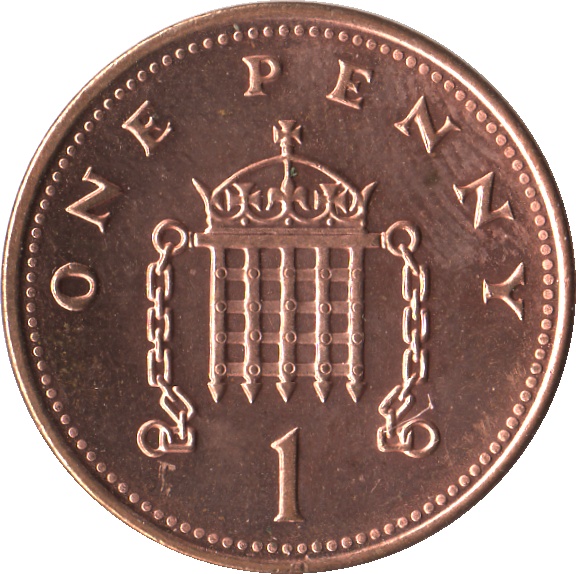
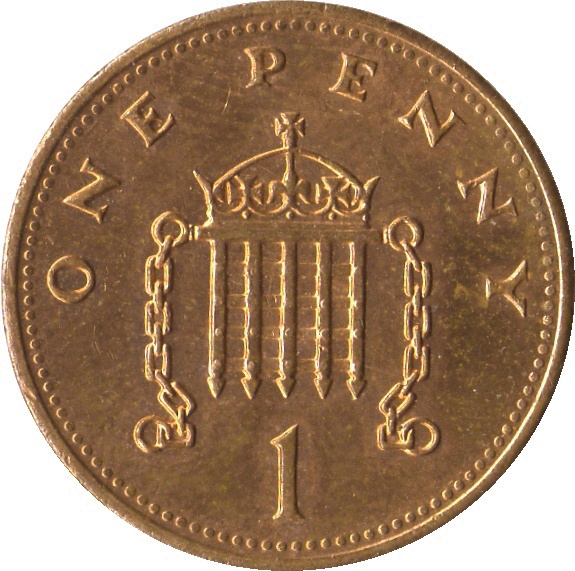
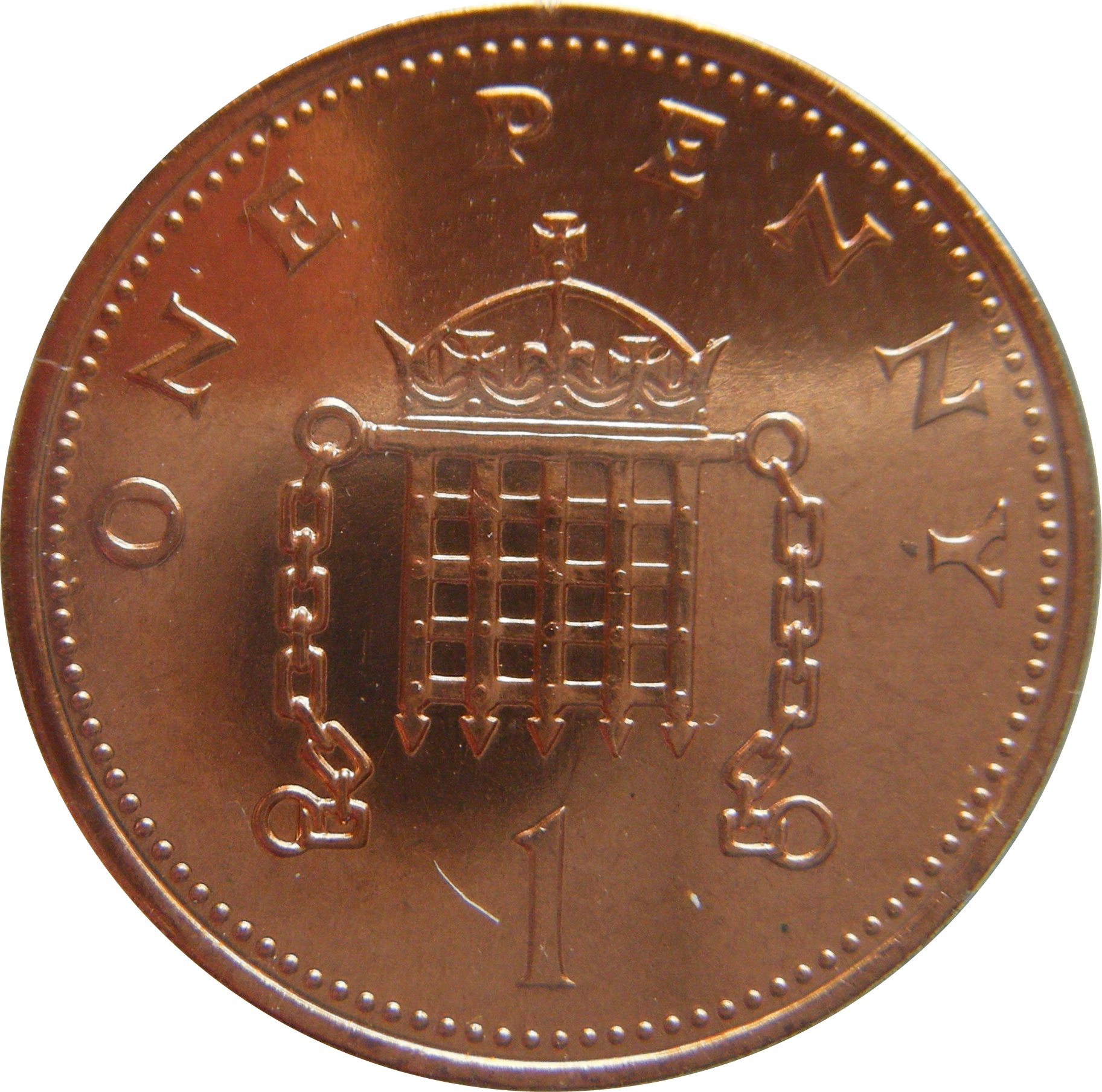
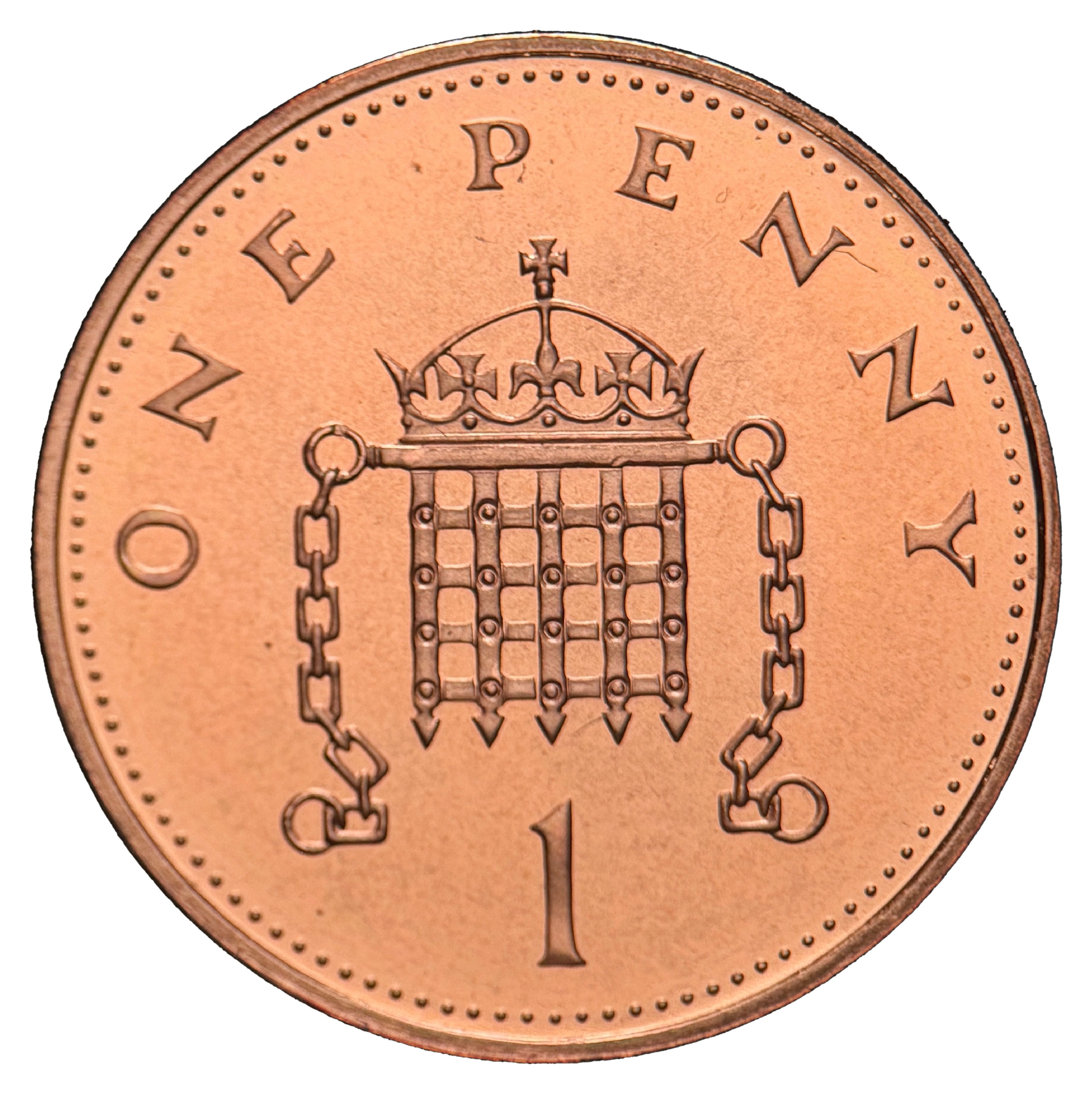
A crowned portcullis with chains (an adaptation of the Badge of Henry VII, now the Badge of the Palace of Westminster) with legend above and denomination below.
magnetic 1p market value
Find this on eBay
Affiliatemagnetic 1p price history
Daily limit reachedmagnetic 1p value by year
1992 to 1997 · median sold prices| Year | Mintage | Circulated | Uncirculated | Sales | |
|---|---|---|---|---|---|
| 1992 scarcest | 253,867,000 | £1.69 (1) | £5.50 (1) | 2 | |
|
VF£12.50EF£28.00UNC£95.00
⭐ Pro: the 1992 coin's sales by grade, and the chart filtered to one year
Start 7-day free trial
|
|||||
| 1993 | 602,590,000 | £3.05 (2) | £3.00 type | 2 | |
|
VF£12.50EF£28.00UNC£95.00
⭐ Pro: the 1993 coin's sales by grade, and the chart filtered to one year
Start 7-day free trial
|
|||||
| 1994 | 843,834,000 | £1.97 type | £3.00 type | ||
| 1995 | 303,314,000 | £1.97 type | £1.87 (1) | 1 | |
|
VF£12.50EF£28.00UNC£95.00
⭐ Pro: the 1995 coin's sales by grade, and the chart filtered to one year
Start 7-day free trial
|
|||||
| 1996 | 723,840,000 | £1.69 (1) | £3.00 type | 1 | |
|
VF£12.50EF£28.00UNC£95.00
⭐ Pro: the 1996 coin's sales by grade, and the chart filtered to one year
Start 7-day free trial
|
|||||
| 1997 | 396,874,000 | £1.97 type | £3.00 | 3 | |
|
VF£12.50EF£28.00UNC£95.00
⭐ Pro: the 1997 coin's sales by grade, and the chart filtered to one year
Start 7-day free trial
|
|||||
One row for each year the 1 Penny - Elizabeth II 3rd portrait – magnetic was struck. Prices are medians of verified sold listings matched to that year from the listing: circulated is worn condition up to Extremely Fine, uncirculated is About Uncirculated or better. A count in brackets means fewer than three sales behind the figure; a grey figure marked "type" is the median across every year, shown where that year has no sale of its own yet; years with no sales yet fill in as sales are recorded. Most types have been searched year by year only since October 2026, so later years are still filling in. Use the grade table below for a price by condition across all years.
magnetic 1p value by grade
Realised auction prices · ⭐ Pro Expand rows for individual sale records| Grade | Latest | Median | 30d Δ | All-time range | Sales (1yr) | Total sales | Last sale | |
|---|---|---|---|---|---|---|---|---|
| BU | £5.50 🔒 eBay | £3.69 (2) | – | £1.87 – £5.50 | 2 | 2 | 23-08-2026 | |
|
Loading…
|
||||||||
| VF | £3.84 🔒 eBay | £1.97 | – | £1.69 – £3.84 | 4 | 4 | 14-10-2026 | |
|
Loading…
|
||||||||
| PR-65 | £3.00 🔒 eBay | £3.00 | – | £1.60 – £3.50 | 3 | 3 | 11-10-2026 | |
|
Loading…
|
||||||||
About the 1992 1 Penny - Elizabeth II – magnetic
The 1992 1 Penny - Elizabeth II – magnetic is a circulating 1 penny coin issued from 1992 to 1997, struck in copper plated steel. It weighs 3.56g and measures 20.3mm across. Reverse design: A crowned portcullis with chains (an adaptation of the Badge of Henry VII, now the Badge of the Palace of Westminster) with legend above and denomination below.
Mintage figures are recorded for 6 years between 1992 and 1997, 3,124,319,000 coins in all. 1992 is the scarcest date, with 253,867,000 struck.
Common questions
How much is the 1992 1 Penny - Elizabeth II – magnetic worth?
Verified sold prices for the 1992 1 Penny - Elizabeth II – magnetic run from £1.97 to £3.69 across 3 grades, taking the median for each grade. Condition makes the difference, so check the grade table above before pricing one.
Why is my 1p magnetic?
Since September 1992 the 1p has been made of copper-plated steel, and the steel core is attracted to a magnet. The Royal Mint says the change was made because of the rising price of metals on world markets. Bronze pennies struck before that are not magnetic.
Is a magnetic 1992 penny rare?
No. Copper-plated steel was the normal metal for circulating pennies from September 1992. The Royal Mint's figure for 1992 is 253,867,000, and Tony Clayton's reference states that the bronze 1992 pennies are the ones confined to that year's Mint and proof sets.
How many 1p coins were made from 1992 to 1997?
The Royal Mint's figures are 253,867,000 for 1992, 602,590,000 for 1993, 843,834,000 for 1994, 303,314,000 for 1995, 723,840,060 for 1996 and 396,874,000 for 1997, a total of 3,124,319,060. The 1992 figure is not divided by metal.
Who designed the 1992 to 1997 penny?
The crowned portcullis reverse is by Christopher Ironside and was used on the 1p from 1971 to 2008. The portrait of the Queen is by Raphael Maklouf, which the Royal Mint dates to 1985 to 1997 on the 1p.
How do I identify the 1992 1 Penny - Elizabeth II – magnetic?
Check the weight 3.56g and diameter 20.3mm and the metal (copper plated steel) against the specification table on this page. The reverse design is described above.
History and design
In September 1992 the penny changed metal. The Royal Mint says rising prices for base metals on world markets led it to replace bronze with copper-plated steel: a mild steel core coated in copper. The new coins kept the same colour, weight, diameter and design and circulated alongside the bronze ones.
The catalogue treats the steel coins of 1992 to 1997, all with Raphael Maklouf's portrait, as one type. The Royal Mint's figures give 253,867,000 for 1992, 602,590,000 for 1993, 843,834,000 for 1994, 303,314,000 for 1995, 723,840,060 for 1996 and 396,874,000 for 1997.
The Mint's 1992 figure is a single number and is not divided by metal. Tony Clayton's reference states that the bronze pennies dated 1992 are found only in the Mint sets and proof sets of that year, which would make the circulating 1992 coins steel.
The reverse is Christopher Ironside's design for the decimal penny, a portcullis with chains royally crowned, with ONE PENNY above and the figure 1 below. It had read NEW PENNY until 1982, when the Royal Mint dropped the word NEW from the decimal bronze coins.
The obverse carries the Maklouf portrait with the legend ELIZABETH II D G REG F D and the date. The edge is plain. Because steel is less dense than bronze, the coin is slightly thicker at the same weight: 1.65mm against 1.52mm.
Varieties and errors
Tony Clayton records two versions of the portcullis reverse. On Die A the bolts where the bars cross are raised dots, and on Die B they are incuse circles. He lists both dies for 1992, 1993 and 1994 and only Die B for 1995 to 1997, along with small differences in the number of border beads. These are die varieties for specialists, not errors.
Collecting notes
A magnet settles the type at once: copper-plated steel is attracted to it and bronze is not. That matters only for 1992, the one date of this portrait found in both metals. A non-magnetic 1992 penny belongs to the bronze type of 1985 to 1992.
All six dates were made in the hundreds of millions and remain legal tender, for amounts up to 20 pence. In the Royal Mint's figures 1992 is the lowest and 1994 the highest.
The same reverse continues from 1998 with a new portrait on the 1998 to 2008 penny.
Sources
The history, design, varieties and collecting notes on this page are drawn from these sources. Prices come from recorded sales, not from them.
- UK coin mintage figures (data file), The Royal Mint (read 9 Oct 2026)
- 1p Coin Designs and Specifications, The Royal Mint (read 9 Oct 2026)
- What are 'bronze' coins made from? Why are some magnetic and some not?, The Royal Mint (read 9 Oct 2026)
- UK Decimal Coins: One Penny, Coins of the UK (Tony Clayton) (read 9 Oct 2026)
More 1 Penny coins from nearby years