Track your first 25 coins free.Live realised auction prices, no card needed. Pro (£1.99/month) adds unlimited tracking, price history and alerts.No card needed.
Sign up →
Guide
Bee £1 Coin Value: Is the King Charles Bees £1 Actually Rare?
The Bee £1 is the pound coin with bees on it: two honey bees on the reverse of the first
King Charles III pound coin. It started appearing in tills through 2024 and 2025,
and the rumour mill immediately declared it rare. It is not: the Royal Mint struck
10,030,000 of the 2023-dated coin, with another 9 million dated 2025
behind it. A Bee £1 from change is worth £1, sometimes £2–£4 to
a collector. This guide shows the real sold prices, explains where the rarity myth came from, and points you
at the £1 coins that genuinely are worth hunting.
Reviewed by Connor Jones, EditorLast updated:
· mintage per Royal Mint published figures; prices from verified realised sales
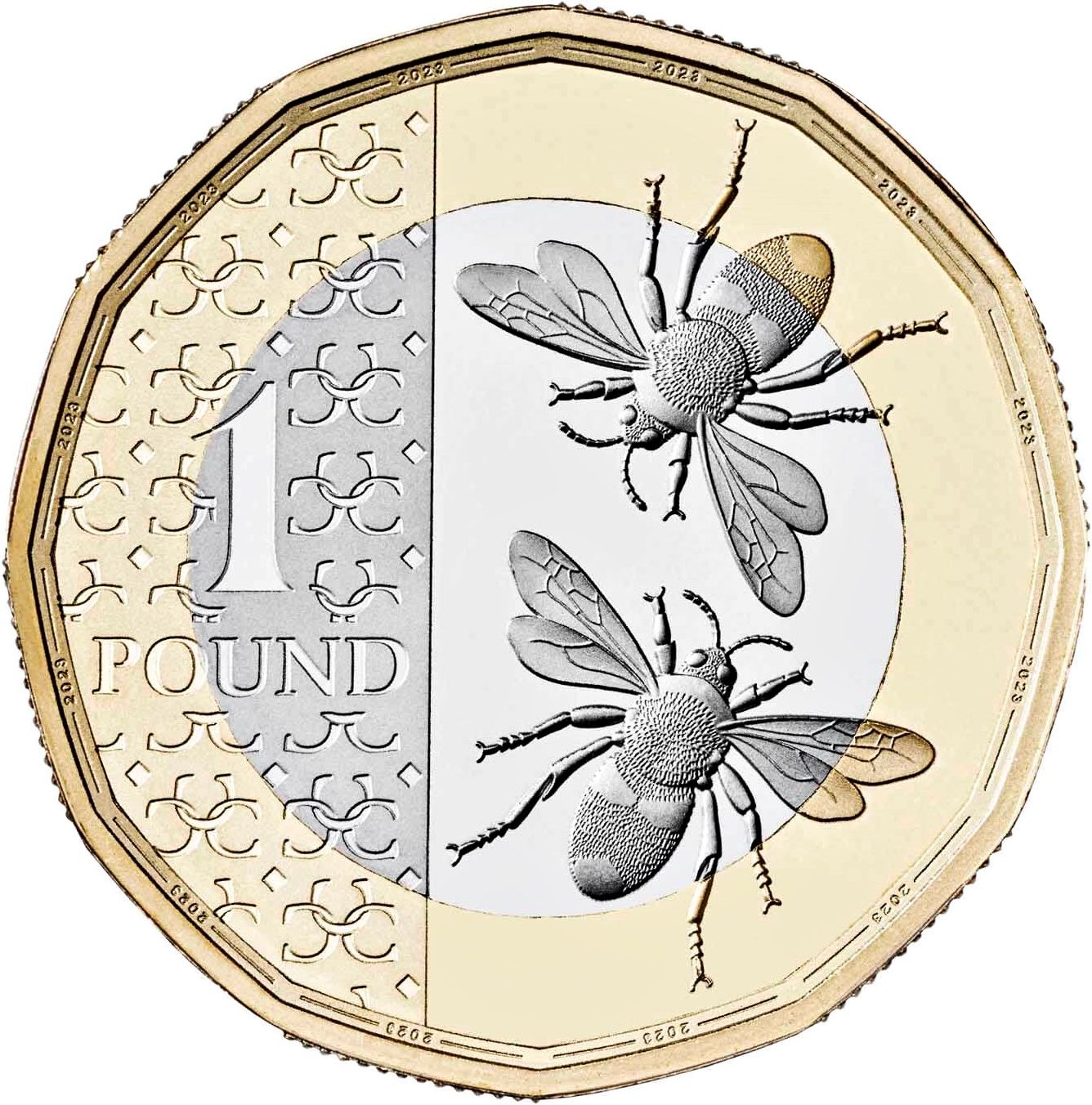
The Bee £1 reverse. Two honey bees over interlocking Cs — the first King Charles III definitive £1, part of the October 2023 redesign of all eight denominations.
In brief. Circulating mintage 10,030,000 (2023-dated)
plus 9,010,000 dated 2025. From change: £1–£4. BU in Royal Mint pack:
£8–£15. Silver proof: £40–£80. Gold proof:
several hundred pounds. Not rare — but a nice free start to the Charles III era if one lands in your change.
WatchERROR £1 COIN 2025 2 BEES + ALL NEW £1 COIN VALUES2025 bee £1 error and all new £1 values (Dans Dollars) Video: Dans Dollars on YouTube
Where the “rare Bee £1” rumour came from
A honey bee, the insect shown on the bee pound coin.Image: 20200530 Apis mellifera 08 by Flocci Nivis, Wikimedia Commons, licensed under CC BY 4.0
Three things collided. First, the coin is dated 2023 but only entered circulation in August 2024
— the Royal Mint strikes to demand and releases dated stock as banks order it, so by the time Bee £1s
reached most pockets the date already looked “old”. Second, distribution is regional and slow:
whole towns went months without seeing one, and a coin you never see feels rare. Third, early eBay listings
asked £20–£50, and asking prices get screenshotted into “check your change!”
posts far faster than sold prices correct them.
The arithmetic says otherwise. At 10,030,000 coins, the 2023 Bee £1 out-numbers the
rarest circulating £1 — the 2011 Edinburgh round pound, 935,000 — more than ten to one,
and the famous Kew Gardens 50p (210,000) almost fifty to
one. Rarity is a number, and this number is big.
Our realised-sales feed — actual completed transactions from eBay UK sold listings, never asking prices —
has verified 1 sale(s) of the circulating 2023 Bee £1,
averaging £2.77
(range £2.77–£2.77).
Mintage figures published by The Royal Mint;
circulating figures also tracked by Change Checker.
Values are realised sold-listing ranges, not asking prices.
The 2023 redesign: why the bees are there
In October 2023 the Royal Mint unveiled the first complete redesign of Britain’s circulating coinage
since 2008 — eight denominations, each carrying a British nature theme in support of the King’s
conservation interests: a hazel dormouse on the 1p,
red squirrel on the 2p, oak leaves on the 5p, capercaillie on the
10p, puffin on the 20p, Atlantic salmon on the
50p, red kite on the
£2 — and two honey bees on the £1,
over a pattern of interlocking Cs. The obverse is Martin Jennings’ portrait of King Charles III.
A full set pulled from change costs face value and makes the easiest starter collection in British numismatics —
our Change Hunter tracks which you still need.
The £1 coins that actually are rare
Image: One Pound Coin-P 1010041 by Tkbwikmed, Wikimedia Commons, CC0
If the Bee sent you checking your pound coins, aim at these instead: the
2011 Edinburgh (935,000 — the only circulating £1 under a million) and its sibling
2011 Cardiff (1.6M), the 2010 London (2.6M), and among 12-sided coins the
low-mintage later years. Full rankings, with realised prices for each, are in our
£1 coin values guide and
is my £1 rare? checker.
Identifying a Bee £1 (and telling the dates apart)
Reverse: two honey bees over a lattice of interlocking Cs; denomination ONE POUND.
Obverse: King Charles III facing left (Martin Jennings portrait) — Elizabeth II faces right, so the portrait direction alone separates the reigns at a glance.
Date: below the portrait — 2023-dated coins entered change from August 2024; 2025-dated coins followed. Neither date is scarcer in any meaningful way yet; keep whichever is crisper.
Spec: standard 12-sided bimetallic £1 — 23.43 mm, 8.75 g, nickel-brass ring with a nickel-plated centre, hidden hologram and micro-lettering as on every 12-sided £1 since 2017. A “Bee £1” that is round, single-metal or the wrong weight is a novelty or a fake.
Frequently asked questions
Is the Bee £1 coin rare?
No. The 2023-dated Bee £1 has a circulating mintage of 10,030,000 — more than ten times the 935,000 of the rarest circulating £1 (the 2011 Edinburgh) and nearly fifty times the 210,000 Kew Gardens 50p. A further 9,010,000 dated 2025 have been struck for circulation. The "rare Bee £1" rumour spread because the coins reached tills slowly through 2024–25, so they felt scarce — but feeling scarce in your town and being scarce nationally are different things.
What is the pound coin with bees on it?
The pound coin with bees is the King Charles III £1, usually called the Bee £1. Its reverse shows two honey bees and it is dated 2023 or 2025. The Royal Mint struck 10,030,000 of the 2023 coin, so a pound coin with bees from your change is worth £1, sometimes £2 to £4 to a collector.
How much is a Bee £1 coin worth?
A Bee £1 from change is worth £1 — occasionally £2–£4 to a collector wanting an early example. Our verified realised-sales feed shows 1 confirmed sale(s) averaging £2.77 (range £2.77–£2.77) — real transactions, not asking prices. Brilliant Uncirculated examples in Royal Mint packaging trade at £8–£15. The collector strikes are different animals: the silver proof realises £40–£80 and the gold proof several hundred pounds.
Why do eBay sellers ask £50 or more for a Bee £1?
Asking prices are not sale prices. Any listing can ask any figure; the sold-listings filter shows what buyers actually pay, and for a circulated Bee £1 that is face value to a few pounds. This is the same pattern seen with every new circulating design — the 2016 Beatrix Potter 50ps, the 2017 12-sided £1, the Brexit 50p — high asking prices at launch, settling to modest premiums once supply reaches everyone's change.
What is the design on the King Charles £1 coin?
Two honey bees, with a pattern of interlocking letter Cs for Charles III. It is part of the October 2023 redesign of all eight circulating denominations — the first complete definitive redesign since 2008 — with each coin carrying a British nature theme: a dormouse on the 1p, red squirrel on 2p, oak leaves on 5p, capercaillie on 10p, puffin on 20p, Atlantic salmon on 50p, red kite on £2 and the bees on £1. The obverse carries Martin Jennings' first crowned-uncrowned portrait of King Charles III.
When did the Bee £1 enter circulation?
August 2024, despite the 2023 date on the coin — the Royal Mint strikes to demand, and dated stock is released as banks order it. That lag is why many people only started finding them through 2025, and why the scarcity rumour took hold: date on coin and date in your change are rarely the same thing.
Should I keep a Bee £1 if I find one?
Keep one for the collection — it is the first King Charles III £1 and the start of a new definitive era, and a pristine early example costs you exactly £1 today. But keep it as a collectable, not an investment: with 10,030,000 minted and more coming, the supply is deep. If a low-mintage year appears later in the series (as happened with the 2011 Edinburgh round pound), that year — not 2023 — will be the one to hunt.
Should I keep a 2023-dated or 2025-dated Bee £1?
Condition beats date. With 10 million of the 2023 and 9 million of the 2025 struck, neither is scarce, and no mintage gap yet justifies preferring one. A crisp, unmarked example of either is the right keep; a worn 2023 has no premium over a worn 2025. The date worth watching is whichever future year gets a short striking run — that is how the 2011 Edinburgh became the key round pound, and it will only be visible once the Royal Mint publishes each year's figure.
Will there be a rare year of the Bee £1?
Possibly — that is how definitive series work. Striking volumes follow cash demand, and with card payments shrinking coin orders, a low-mintage year at some point is plausible. When the Royal Mint publishes each year's figures we fold them into our £1 mintage table, which is the page to check rather than social-media rumours.
Are there error Bee £1 coins?
No confirmed mint errors specific to the Bee £1 have been verified at auction as of 2026. Listings claiming "error" Bee coins are usually normal die variation, post-mint damage, or the standard bimetallic misalignment tricks of the light. Treat any error claim without a grading-company attribution with scepticism — see our UK coin errors list for what genuine errors look like.