Brilliant Uncirculated vs Uncirculated vs Proof: The Royal Mint Grade System
“BU” sits on every Royal Mint commemorative pack. “UNC” appears in dealer descriptions. “Proof” commands £30+ above face value. “Specimen” and “Piedfort” occasionally surface on auction lots. Understanding which is which is the difference between paying £5 above face value and £500. This reference walks through every Royal Mint and slabbing-firm grade designation, the finishes behind them, and the realistic premium each commands.
The five non-circulated finishes
Once a coin leaves the Royal Mint without entering circulation, it can fall into one of five distinct finish categories. They’re not strictly “grades” in the Sheldon sense (which measures wear) but rather finish types defined by the striking process. Each commands its own premium tier:
| Finish | Striking method | Typical mintage | Premium over face |
|---|---|---|---|
| Uncirculated (UNC) | Standard die, single strike | Mass production | Face to +20% |
| Brilliant Uncirculated (BU) | Polished die, single strike, special blank | 50k–1m | +£5 to +£15 |
| Specimen | Polished die, single strike, special blank in presentation set | 5k–50k | +£15 to +£40 |
| Proof | Highly polished die, double or triple strike, polished blank | 3k–20k | +£30 to +£100 |
| Piedfort Proof | Proof method on double-thickness blank | 1k–5k | +£100 to +£500 |
The five finishes form a quality ladder. Each rung up the ladder requires more die preparation, more strikes per coin, more controlled handling and a smaller print run, which is why the premium per coin grows so steeply.
What “Uncirculated” technically means
An uncirculated coin has never been used in commerce. It carries no wear from handling transactions, retains its original mint lustre, and shows only the contact marks acquired in the Royal Mint’s own bagging and shipping process. On the Sheldon scale UNC covers grades MS-60 to MS-70:
- MS-60 / MS-61. No wear, but heavily bag-marked. The lowest acceptable UNC.
- MS-62 / MS-63. Scattered bag marks; full lustre. “Choice BU.”
- MS-64 / MS-65. Minor marks only, attractive eye appeal. “Gem BU.”
- MS-66 / MS-67. Very minor marks, exceptional lustre. “Premium Gem.”
- MS-68 / MS-69. Near-perfect, minimal imperfection visible only under magnification.
- MS-70. Flawless under 5× magnification. “Perfect.”
The crucial point: every coin from MS-60 through MS-70 is uncirculated. The differences within the band are surface quality, not wear. A coin with so much as a hint of friction on the highest design point drops to AU-58 or lower, no matter how lustrous the rest of the surface looks.
What “Brilliant Uncirculated” adds, the Royal Mint product
The “Brilliant Uncirculated” designation is a Royal Mint trademark for a specific commemorative product line. Every BU coin is uncirculated, but not every uncirculated coin is BU. Three production differences separate a Royal Mint BU coin from a circulating uncirculated coin of the same year:
- Polished dies. The dies used to strike BU coins are hand-polished to a higher mirror finish than circulating dies. Field areas of the resulting coins are noticeably brighter and reflect light more cleanly.
- Specially-prepared blanks. The blank coin discs (planchets) used for BU strikes are burnished and inspected before striking, removing the small bag marks that come with mass-produced circulating blanks.
- Capsule packaging. Each BU coin is sealed in an air-tight plastic capsule directly after striking, then mounted in a presentation card or folder. The coin never touches another coin, never enters a bag, and never sees a hand without gloves.
The result is typically a Sheldon MS-65 to MS-67 strike, with strong eye appeal, sharp design detail, and immaculate fields. BU packs are sold at £5–£15 above face value depending on denomination and mintage; secondary market values for low-mintage BU packs (under 100,000) often run £30–£200+.
Proof vs BU vs Specimen vs Piedfort
The clearest way to distinguish the four Royal Mint finishes is by the visual and tactile features of each:
| Feature | UNC (circulating) | BU | Specimen | Proof | Piedfort Proof |
|---|---|---|---|---|---|
| Field finish | Lustrous | Bright lustrous | Strong lustre | Mirror | Mirror |
| Device finish | Lustrous | Lustrous | Lustrous | Frosted | Frosted |
| Strike count | 1 | 1 | 1 | 2–3 | 2–3 |
| Blank prep | Standard | Burnished | Burnished | Polished | Polished, double thickness |
| Capsule | No | Yes | Yes | Yes | Yes |
| Typical retail | Face value | Face + £5–15 | +£15–40 | +£30–100 | +£100–500 |
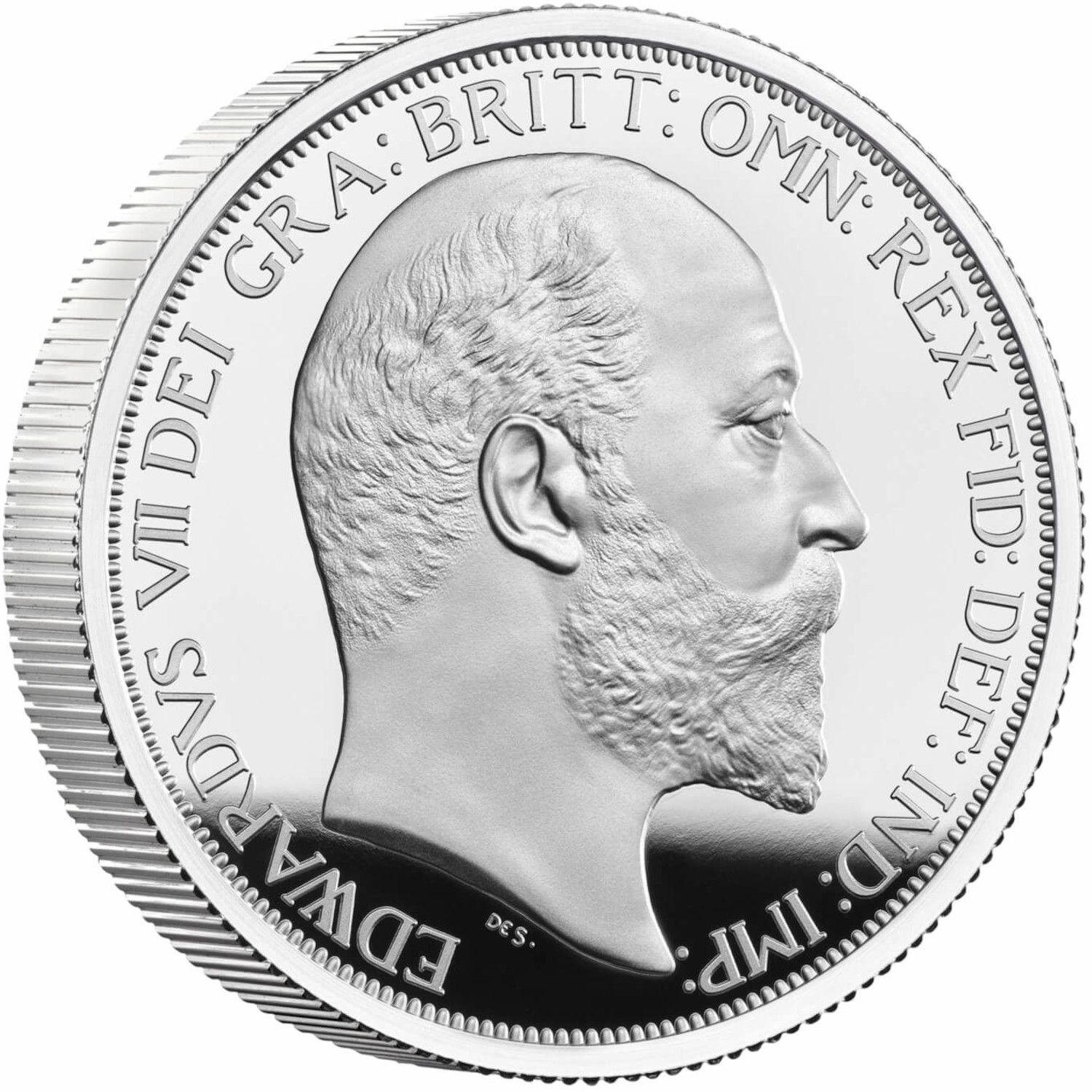
The single biggest visual difference: a proof coin has cameo contrast, a deep mirror in the field area against frosted devices (the bust, design and lettering). A BU coin lacks this contrast; both field and device are lustrous but neither is mirror or frosted. Place a 2022 Britannia BU £2 next to a 2022 Britannia Silver Proof £2 under raking light and the difference is immediately obvious.
Royal Mint pack types: BU, Proof and Specimen
The Royal Mint sells commemorative coins through several distinct pack formats. Each maps onto one of the finish types above:
- Brilliant Uncirculated pack. Single coin in a capsule, mounted on a presentation card with a certificate of authenticity. Retail £10–£25. Mintages 50k–500k. The standard commemorative product.
- Annual proof set. The full year’s circulating denominations plus commemoratives in proof finish, in a presentation box with certificate. Retail £100–£200. Mintages 3,000–15,000 typically.
- Silver proof. Single coin in sterling silver, struck to proof finish. Retail £60–£100 for a 50p; £100–£200 for a £2. Mintages 2k–10k.
- Gold proof. Single coin in 22-carat gold, proof finish. Retail £800–£3,000 depending on weight. Mintages 250–1,500.
- Piedfort silver proof. Sterling silver double-thickness blank, proof finish. Retail £120–£250. Mintages 1,000–3,500.
- Specimen set. Rare modern usage; a presentation set struck to a finish above BU but below proof, sold for milestone events (1972 silver wedding, 1981 royal wedding).
For a deeper review of Royal Mint subscription products, see our Royal Mint subscription review.
When the BU label commands a real premium
Three factors drive the secondary-market value of a Royal Mint BU pack:
- Mintage. Below 100,000 packs, BU premium is usually meaningful. Above 1 million packs, the BU label is mostly marketing, the coin trades at face value or slightly above. The Kew Gardens 50p BU pack (mintage 210,000) trades at £180+; the 2012 Olympic 50p BU pack (mintage 1.4 million across the series) trades at £5–£10 each.
- Theme strength. Cross-over collector interest pushes prices regardless of mintage. Beatrix Potter, Harry Potter, Paddington and Olympic series carry premium because they attract buyers from outside numismatics. See Peter Rabbit 50p, Harry Potter 50p and Paddington 50p.
- Sealed condition. An opened BU pack loses 30–50% of premium versus a sealed pack, because the seal is the authentication. Once opened, the coin must be authenticated independently (PCGS / NGC slab) to recover liquidity at the BU price.
The BU premium is real for low-mintage coins; the BU premium is minimal or zero for mass-issue coins. Always check our database for the actual realised auction prices before assuming a BU pack is “worth” the Royal Mint asking price.
Spotting a damaged BU coin vs a genuine BU coin
Once a BU pack is opened the coin can be damaged in seconds. Five tells will identify a degraded BU coin masquerading as fresh:
- Lustre breaks. Tilt the coin under raking light. The cartwheel reflection should be unbroken across the entire field. A break indicates either wear (the coin has touched cloth or skin) or cleaning damage.
- Hairlines. Under 10× magnification, look for thin parallel scratches on the field. Hairlines come from cleaning with a cloth, jewellery polish, or any abrasive contact. They are irreversible and cap the grade at “Details, Cleaned.”
- Fingerprints. Faint oval marks where skin oils have toned the surface. Common on opened BU packs handled without gloves. Light prints can sometimes be reduced by professional restoration; heavy prints are permanent.
- Tone ring. A circular discoloration where the capsule edge has trapped moisture. Indicates the pack has been stored in a humid environment.
- Edge marks. Reeded edges should be sharp and unblemished. A flat spot or ding on the rim signals the coin has been dropped onto a hard surface.
PCGS / NGC / CGS UK mapping for BU and UNC
All three major slabbing services use a 1–70 numeric scale (CGS UK uses 1–100). Here’s how Royal Mint descriptive grades map to slabbed numeric grades:
| Royal Mint label | PCGS / NGC (Sheldon) | CGS UK (1–100) | Description |
|---|---|---|---|
| UNC (basic) | MS-60 to MS-62 | UNC-78 to UNC-82 | Uncirculated, scattered bag marks |
| BU pack standard | MS-63 to MS-65 | UNC-82 to UNC-88 | Choice / Gem BU |
| BU pack premium | MS-66 to MS-67 | UNC-88 to UNC-92 | Premium Gem BU |
| Specimen / top BU | MS-68 | UNC-92 to UNC-94 | Near-perfect, sharp strike |
| Proof standard | PR-65 to PR-68 | PR-88 to PR-94 | Mirror with cameo |
| Proof premium | PR-69 DCAM | PR-94 to PR-96 | Deep cameo, near-flawless |
| FDC / Perfect Proof | PR-70 DCAM | PR-98 to PR-100 | Flawless under 5× |
For a full breakdown of which grading service to choose, see our PCGS vs NGC vs CGS UK comparison. For when slabbing makes economic sense, see should I grade my coins UK.
Featured coins on MyCoinage
Related guides
- How to Grade a Coin (Sheldon scale & UK descriptive)
- PCGS vs NGC vs CGS UK Comparison
- Slabbed vs Raw Coins UK
- Should I Grade My Coins UK?
- Coin Collecting Glossary
- Royal Mint Subscription Review