The 2016 Shakespeare £2 Trilogy: Histories, Comedies, Tragedies
The Royal Mint marked the 400th anniversary of William Shakespeare’s death on 23 April 2016 with a three-coin £2 trilogy covering the three principal genres of his plays. John Bergdahl designed the histories (crown and sword); Stephen Taylor designed both the comedies (jester’s hat) and the tragedies (skull and rose). This guide covers every coin with mintages, realised prices in all formats, the trilogy collector premium and the wider Shakespeare numismatic context.
The 400th anniversary
William Shakespeare died on 23 April 1616 in Stratford-upon-Avon, aged 52. The 400th anniversary in 2016 was a major UK cultural moment: the British Museum, the Royal Shakespeare Company, the British Library and the BBC ran year-long programmes; cinemas screened restored historical productions; theatrical events spanned the country and the Commonwealth. Coverage extended internationally, festivals in Tokyo, Berlin, New York and São Paulo all marked the centenary in their own theatrical traditions.
The Royal Mint’s commemorative response was unusually substantial. Rather than the more common single-coin issue, the Mint chose a three-coin trilogy structured around the three principal genres of Shakespeare’s output: histories (the chronicle plays from King John through Henry VIII), comedies (the romantic and pastoral plays from Twelfth Night to The Tempest), and tragedies (Hamlet, Othello, King Lear, Macbeth, Romeo and Juliet, the Roman plays). It is one of the most thematically ambitious UK £2 series ever issued.
The three coins
Histories, crown and sword (John Bergdahl)
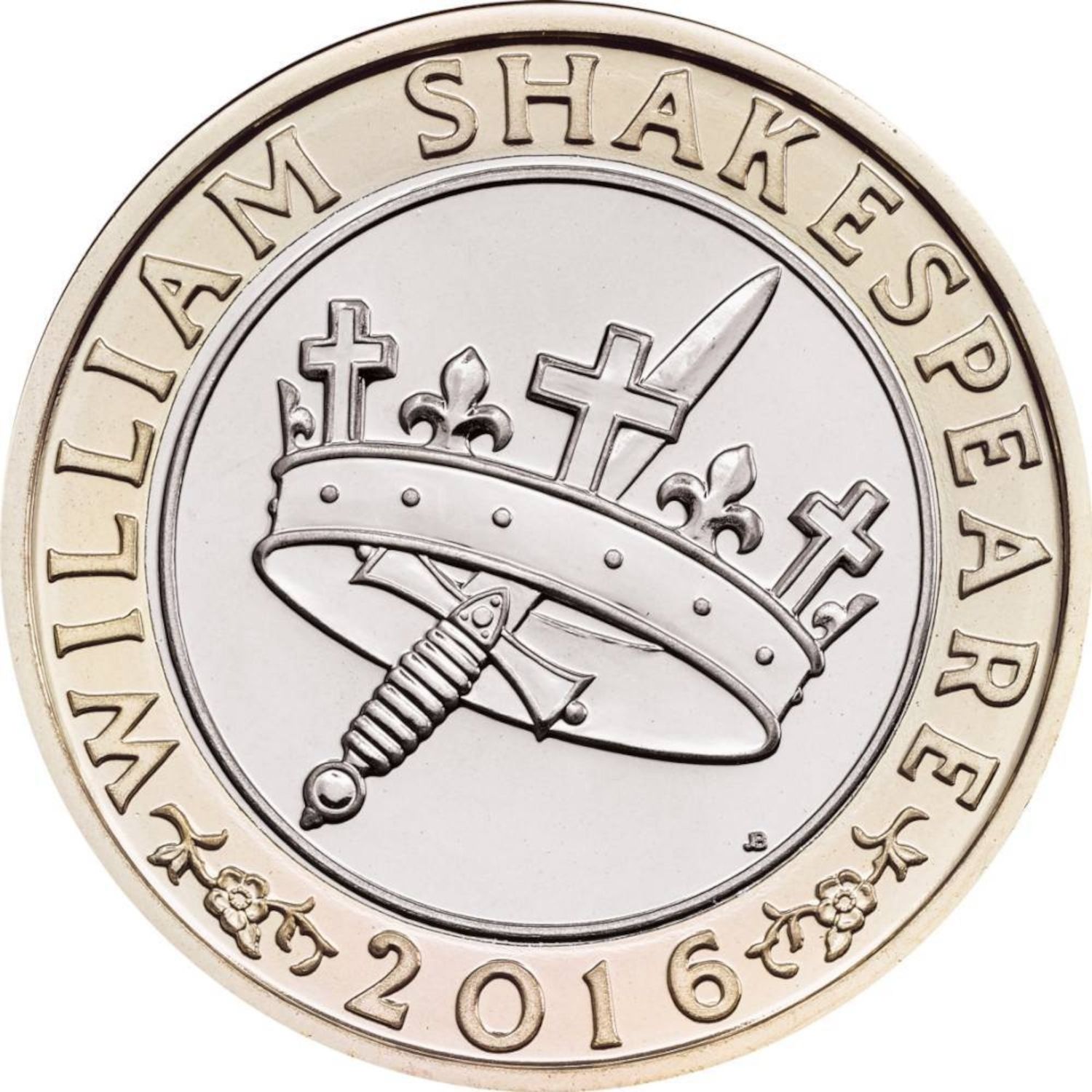
The histories £2 was designed by John Bergdahl, a leading commercial numismatic designer with previous Royal Mint and Pobjoy commissions to his name. The reverse depicts a crown placed atop a sword, the two objects representing the political and military themes that thread through plays like Henry V, Richard III, the Henriad (Henry IV Parts 1 & 2 and Henry V), King John and Henry VIII. The crown sits at centre-top of the field; the sword runs vertically through the composition. The edge inscription reads “FOR KING AND COUNTRY”.
Comedies, jester's hat (Stephen Taylor)
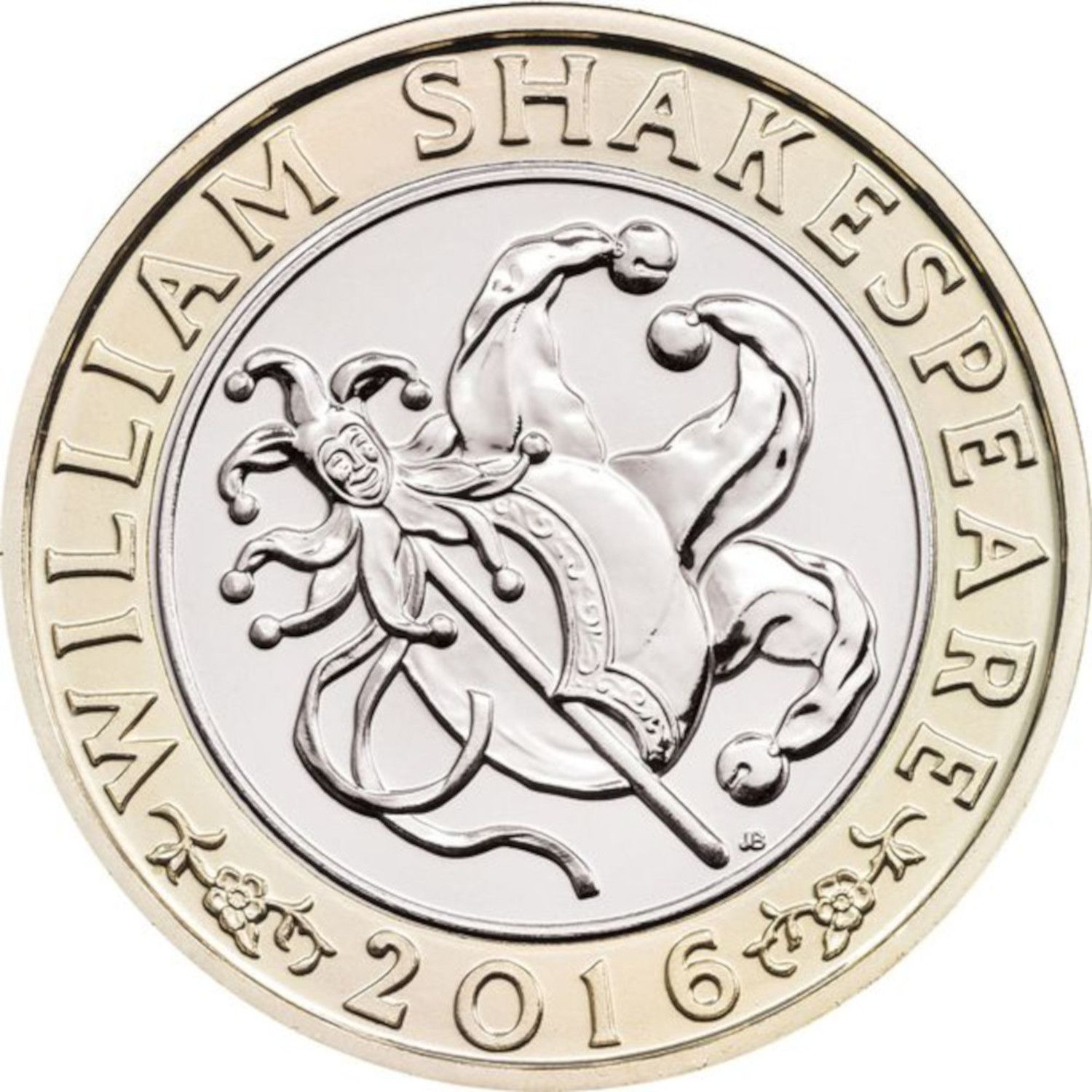
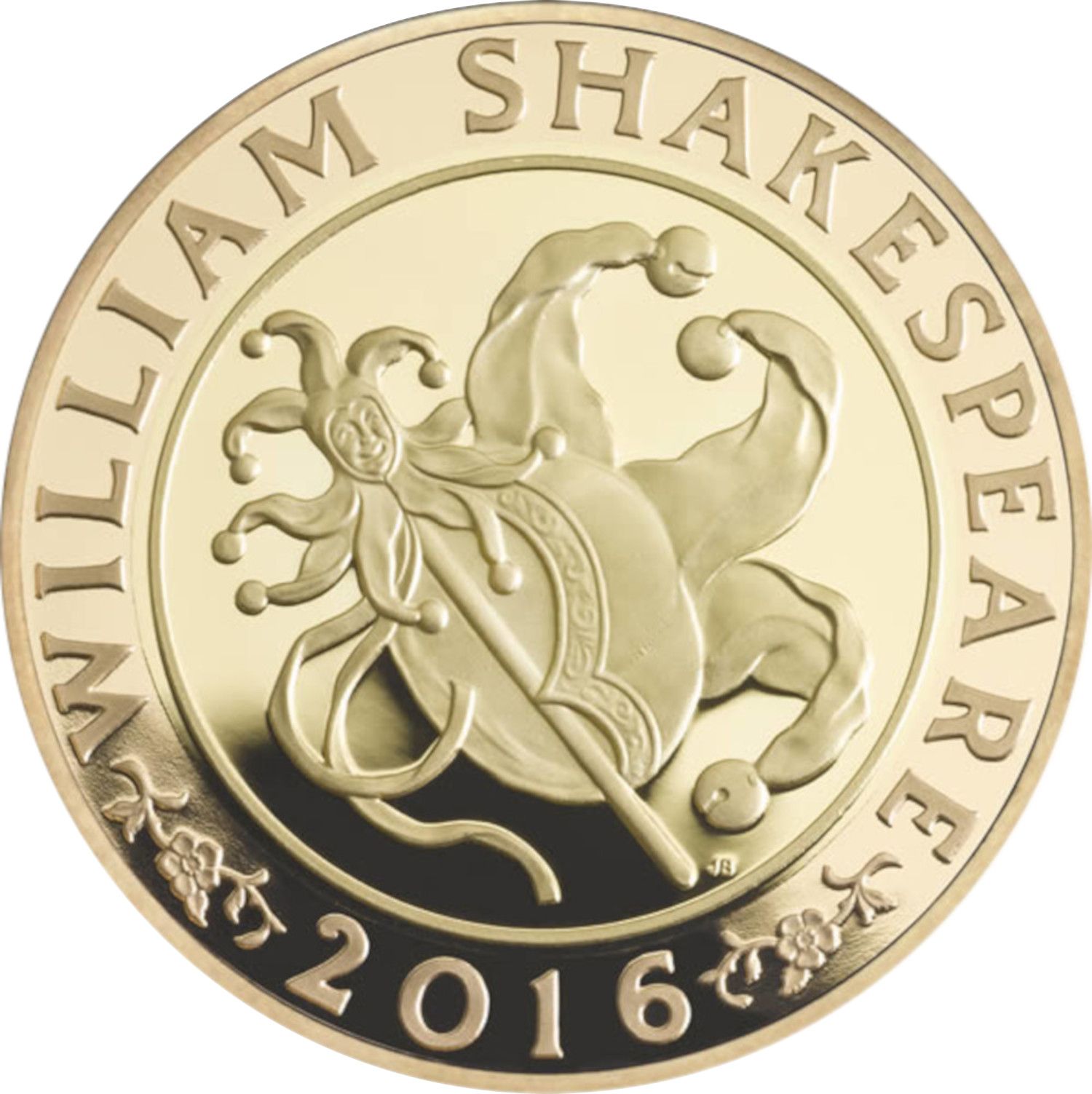
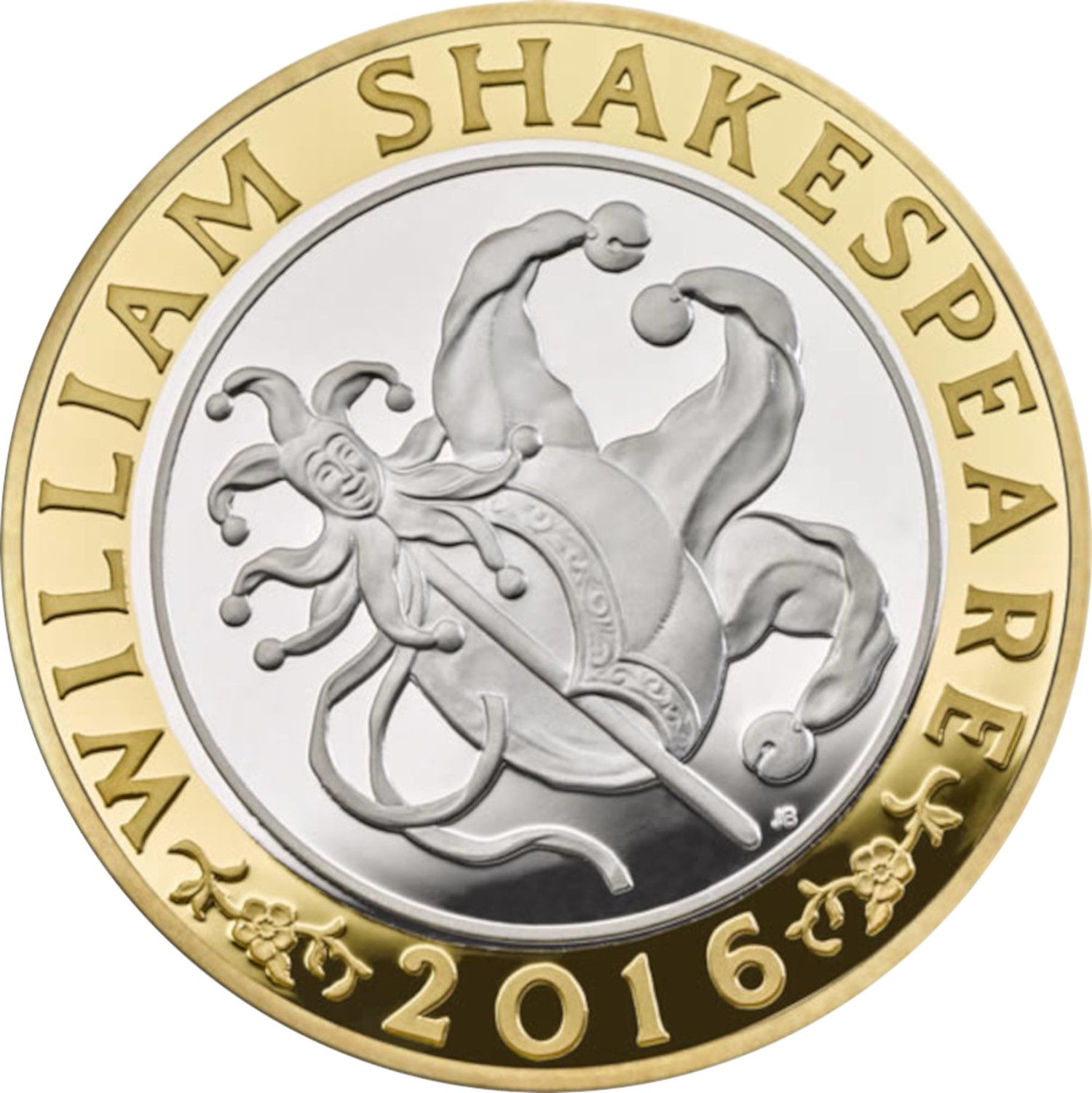
The comedies £2 was designed by Stephen Taylor. The reverse depicts a jester’s hat with bells, the iconic visual shorthand for the fool-figures who animate so many of Shakespeare’s comedies, Touchstone in As You Like It, Feste in Twelfth Night, the Fool in King Lear (a tragic counterpart), Trinculo in The Tempest. The hat sits at centre, bells dangling. The edge inscription reads “ALL THE WORLD’S A STAGE”, the famous Jaques speech from As You Like It, Act II Scene VII.
Tragedies, skull and rose (Stephen Taylor)
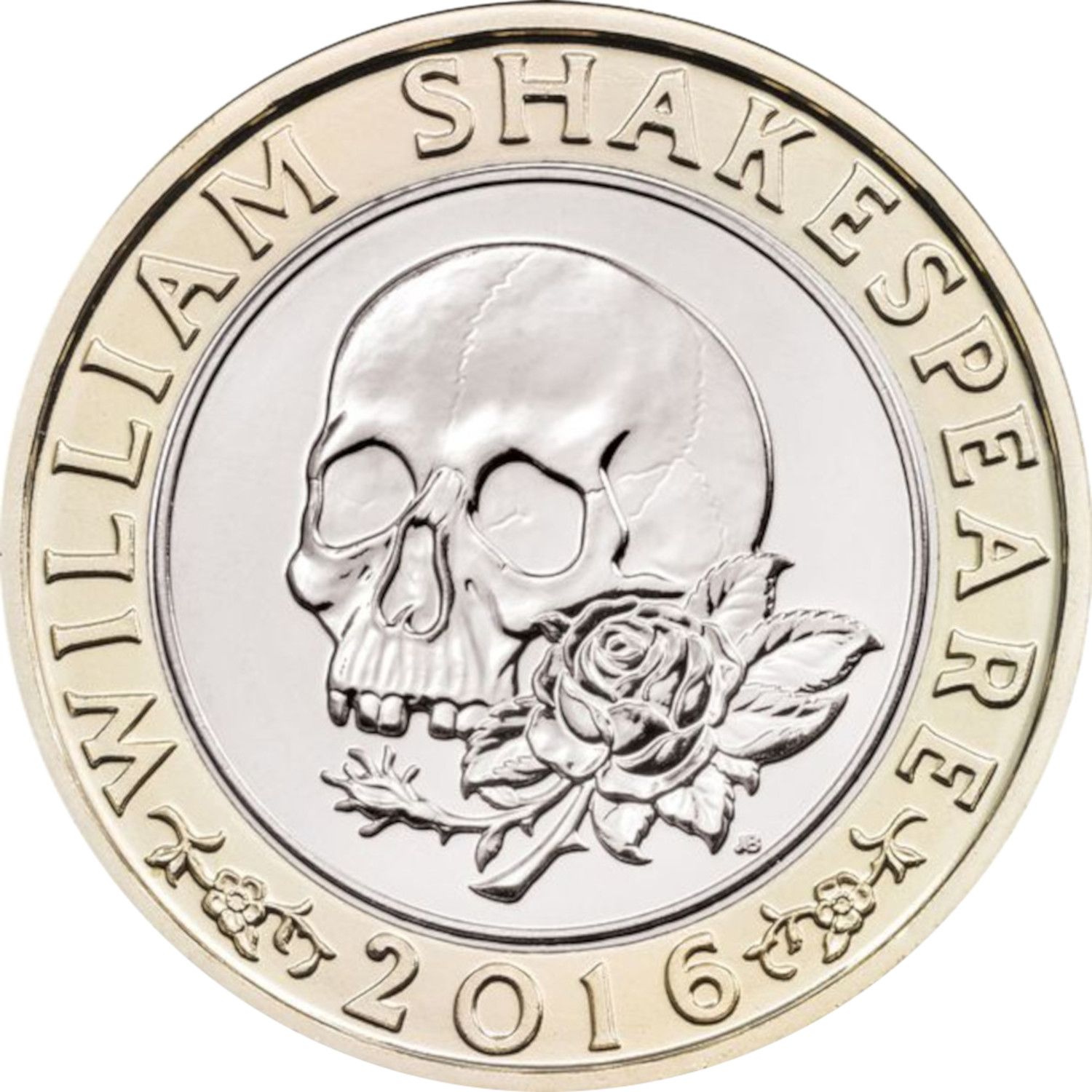
The tragedies £2 was also designed by Stephen Taylor. The reverse depicts a skull resting on a single rose. The skull alludes directly to the Yorick scene in Hamlet (Act V Scene I, the gravedigger’s field, “Alas, poor Yorick”); the rose threads through the rose-imagery of Romeo and Juliet (“a rose by any other name”) and the broader symbolism of mortality and beauty that runs through King Lear, Othello and Macbeth. The composition is the most arresting of the three and has been the most consistent collector favourite. The edge inscription reads “THE LADY DOTH PROTEST TOO MUCH” from Hamlet, Act III Scene II.
Mintages and circulation
| Coin | Designer | Mintage (circulation) | Edge inscription |
|---|---|---|---|
| Histories | John Bergdahl | 5,655,000 | “FOR KING AND COUNTRY” |
| Comedies | Stephen Taylor | 4,355,000 | “ALL THE WORLD’S A STAGE” |
| Tragedies | Stephen Taylor | 4,615,000 | “THE LADY DOTH PROTEST TOO MUCH” |
| Trilogy total | , | 14,625,000 | , |
None of the three are individually rare in modern UK £2 terms, even the lowest-mintage comedies coin is far above the 485,500 threshold of the 2002 Commonwealth Games Northern Ireland £2. But all three sit modestly below the 1997–2025 bimetallic £2 series average of 7–9 million per design. Premium-format mintages are substantially lower: silver proofs at roughly 2,500 each, silver Piedforts at 1,500 each, gold proofs at approximately 350 each.
Realised prices by format
| Format | Per coin | Complete trilogy |
|---|---|---|
| Circulated (Fine to EF) | £2 – £5 | £6 – £15 |
| Brilliant Uncirculated (BU sealed) | £6 – £15 | £25 – £45 |
| Silver proof (sterling, mintage ~2,500) | £55 – £95 | £180 – £280 |
| Silver Piedfort (mintage ~1,500) | £140 – £220 | £480 – £720 |
| Gold proof (22ct, mintage ~350) | £1,800 – £3,500 | £5,500 – £10,000 |
Realised prices aggregated from eBay UK sold listings, Noonans, Spink and Baldwin’s over the past 24 months. Gold proof tier price tracks gold spot, current 22-carat gold premium drives the upper bound.
The complete trilogy collector premium
A defining feature of the Shakespeare £2 series is the complete-trilogy premium: buying the three coins together in original Royal Mint packaging consistently realises more than the sum of three individual purchases. The premium is most pronounced in the silver Piedfort tier, where the trilogy in original deluxe case with intact certificates trades at £480–£720 against £420–£660 for three loose Piedforts (about a 10–15 per cent uplift).
Two factors drive this:
- Original Royal Mint trilogy packaging is harder to find than three loose coins. Many trilogy sets were broken up by collectors over the past decade; intact original packaging is now genuinely scarce in the silver Piedfort and gold proof tiers.
- The trilogy presentation amplifies the underlying narrative. Histories, comedies and tragedies as the structure of Shakespeare’s output is genuinely meaningful; the three coins displayed together tell that story far better than any single coin in isolation.
Spotting counterfeits
£2 counterfeits are common in UK numismatics, with the bimetallic format being relatively easy to imitate at lower quality tiers. The Shakespeare £2 trilogy is a popular target because of its strong collector demand and recognisable designs. Five tests catch most fakes:
| Test | Genuine reading | Counterfeit failure |
|---|---|---|
| Weight | 12.00 g ± 0.05 g | Often 11.6–11.9 g (zinc / tin alloy) |
| Diameter | 28.4 mm | 0.1–0.3 mm undersize on cast fakes |
| Bimetallic seam | Sharp join, no glue line | Visible halo or glue residue |
| Disc + ring colours | Silver-grey inner, yellow-brass outer | Single-tone or painted-on bimetallic effect |
| Edge inscription | Sharp, correct quote (varies by design) | Misspelled, wrong quote, or generic milled edge |
Sister Shakespeare commemoratives
The 2016 Shakespeare trilogy sits within a wider Shakespeare-themed numismatic micro-series spanning six decades:
- 1964 Shakespeare 5/- crown, struck for the 400th anniversary of his birth, mintage approximately 19.5 million, the most-collected pre-decimal commemorative crown of the Elizabeth II era. Realised prices in BU: £15 – £35.
- 2016 Shakespeare £2 trilogy, this guide’s subject, marking the 400th of his death.
- 2016 Royal Mint Shakespeare collector set, bundling all three Shakespeare £2s with a tribute 50p in deluxe silver-proof presentation. Approximately 500 sets issued; trades at £320 – £480 today.
- 2024 Shakespeare 460th-anniversary collector piece, a smaller numismatic run released for the 460th anniversary of his death. Continues the Shakespeare theme into the Charles III era.
400th anniversary in numismatic context
The 400th anniversary of Shakespeare’s death sits alongside a small group of 400th-anniversary commemoratives the Royal Mint has issued in the modern era: the 2011 King James Bible £2 (400th of the 1611 KJV translation), the 2016 Great Fire of London £2 (350th of 1666, technically a different anniversary cycle but issued the same year), and the 2017 Sapphire Jubilee £5 (the 65th of Elizabeth II’s accession).
Among these the Shakespeare trilogy is the most ambitious in scope, three coins instead of one, with each coin standing alone as a complete piece while contributing to a larger narrative arc. It set a template the Royal Mint has not yet repeated for any subsequent cultural anniversary, making the 2016 issue something of a historical one-off in UK commemorative coinage.
Related £2 coins on MyCoinage
Browse every £2 in our database →
Frequently asked questions
What are the 2016 Shakespeare £2 coins?
How much are 2016 Shakespeare £2 coins worth?
Who designed the Shakespeare £2 coins?
What are the mintages of the Shakespeare £2 coins?
How much is a Shakespeare £2 silver Piedfort worth?
How do I tell if a Shakespeare £2 is genuine?
Why was the 400th anniversary chosen?
What is the "complete trilogy" collector premium?
Are Shakespeare £2 coins still in circulation?
Which Shakespeare £2 should I buy first?
Are there other Shakespeare commemorative coins?
Where can I buy Shakespeare £2 coins?
Further reading
- £2 coin values UK, the full reference for bimetallic £2 values.
- Best £2 coins to buy, the top 10 collectable £2s in 2026.
- Rare £2 coins UK, the top 15 by mintage and realised price.
- £2 edge inscription errors, orientation errors and how to spot them.
- Elizabeth II coins value guide, the wider Jody Clark portrait era 2015–2022.
- UK coins by decade, chronological browse including the 2010s.
- CGT-exempt coins UK, tax treatment of UK legal-tender commemoratives.