Quick answer
Silver threepence coins from the reigns of George V and George VI typically sell for £2-£15 in circulated grades, with scarce dates like 1925, 1930 and 1946 reaching £40-£200 in higher grades. Earlier Victorian and Edwardian examples can bring £20-£500+ depending on date and condition.
TL;DR
- Silver threepences were struck from 1551 to 1944; the final 1945 issues were Maundy-only
- George V dates 1925, 1926 and 1930 are the scarcest of the 20th century milled issues
- 1946 and 1947 threepences look silver but are 50% silver/50% copper alloy, technically the last silver circulating issue is 1945 Maundy
- Maundy threepences exist for every year from 1670 onwards and remain legal tender
- Condition is everything, a common 1935 in BU can outsell a rare 1925 in Fair
Table of contents
- A brief history of the silver threepence
- Victorian silver threepences
- 20th century key dates
- Mintages and values table
- Maundy threepences
- How to grade a silver threepence
- Common questions
- FAQ
A brief history of the silver threepence
The silver threepence was one of Britain's longest-running denominations, first struck under Edward VI in 1551 and issued almost continuously until 1944. From 1937 the Royal Mint began producing a nickel-brass twelve-sided threepence alongside the silver version, effectively two threepences circulating at once. The silver coin was retired from circulation after 1944, with only Maundy issues continuing in sterling silver.
These small, thin coins weighed just 1.41 g (from 1816 onwards) and measured 16 mm across, easy to miss in change, easier still to lose down the back of a sofa.
Victorian silver threepences
Victorian silver threepences fall into three head types: Young Head (1838-1887), Jubilee Head (1887-1893) and Old/Veiled Head (1893-1901). The Young Head series runs to many dates and sub-varieties; the 1893 Jubilee Head "no BP" obverse is one of the rarer modern threepences, with examples reaching £150-£400 in extremely fine.
Browse our full coin catalogue for a date-by-date rundown with images and auction prices.
Key Victorian dates
- 1870, scarce; £25-£80 in EF
- 1877, low mintage; £20-£60 in EF
- 1893 Jubilee Head, transitional year; £150-£400
- 1893 Old Head, common in proof sets; £15-£40
20th century key dates
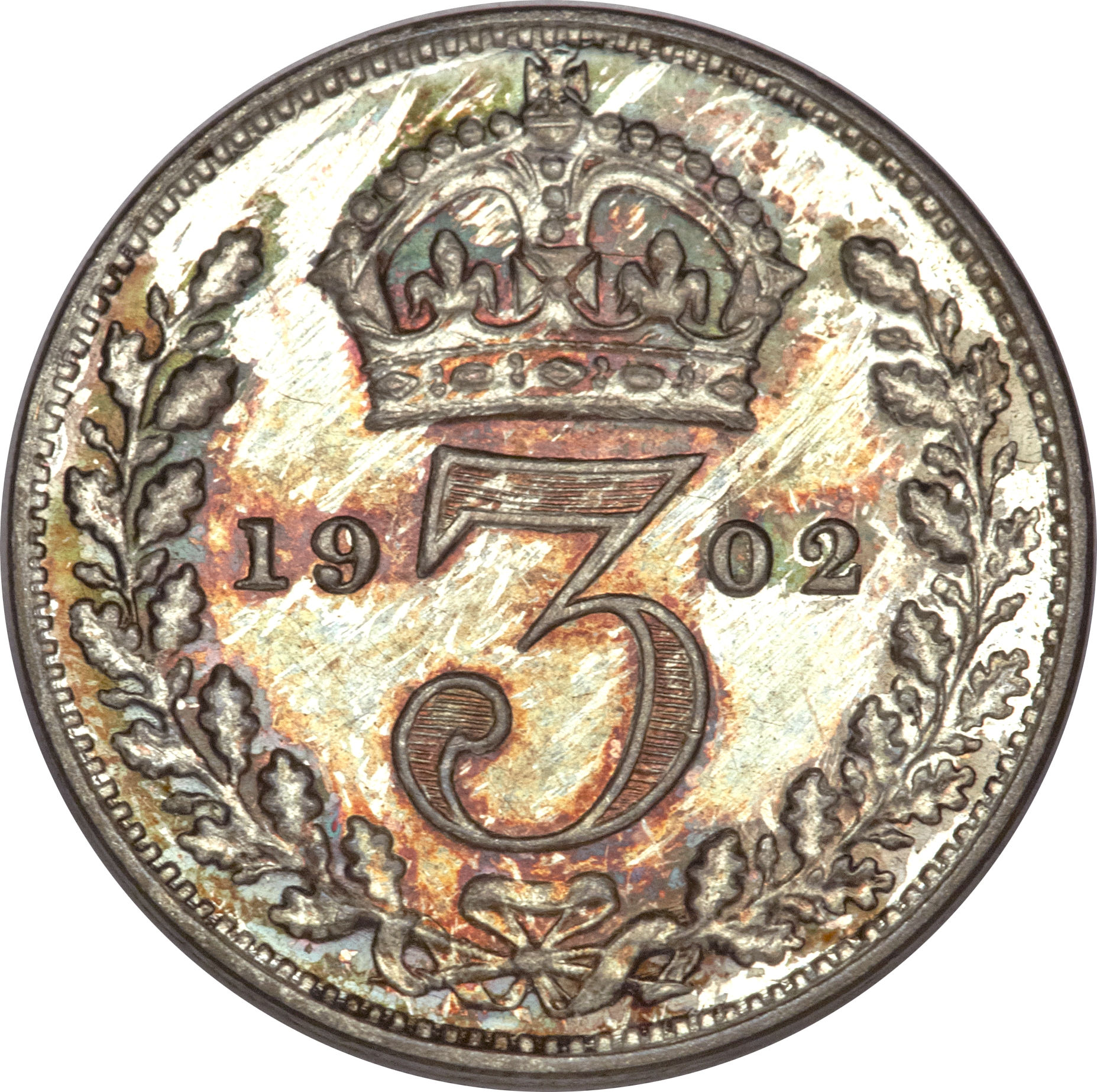
Edward VII threepences (1902-1910) are mostly common but the 1902 matt-proof from the coronation set is distinctive and worth £40-£90. George V threepences are where the real scarcities sit:
- 1925, mintage 1,438,000; £40-£150 in EF, £200+ BU
- 1926 modified effigy, £25-£80 in EF
- 1930, mintage 1,320,000; £30-£120 in EF
- 1946 silver, the final year of the circulating silver threepence; £20-£50 in EF
George VI threepences (1937-1944) are mostly common, apart from the 1945 issue which was almost entirely melted, a handful of survivors have reached £50,000+ at auction.
Mintages and values table
| Year | Monarch | Mintage | Fine | EF | UNC |
|---|---|---|---|---|---|
| 1893 | Victoria Jubilee | Very low | £60 | £200 | £400 |
| 1902 Matt Proof | Edward VII | 15,123 | , | £60 | £90 |
| 1925 | George V | 1,438,000 | £15 | £100 | £200 |
| 1930 | George V | 1,320,000 | £12 | £80 | £150 |
| 1935 | George V | 7,027,654 | £2 | £10 | £25 |
| 1937 | George VI proof | 26,402 | , | £15 | £30 |
| 1944 | George VI | 2,005,553 | £2 | £10 | £20 |
| 1945 | George VI | 371,000 (most melted) | £20,000+ | £40,000+ | £60,000+ |
Maundy threepences
Maundy money is the small-denomination silver distributed by the monarch each year on Maundy Thursday. The threepence is part of every set, 1d, 2d, 3d and 4d, and has been struck continuously in sterling silver since 1670. Most Maundy threepences sell for £10-£40 individually; complete sets bring £80-£300+ depending on year and monarch.
The Charles III coin guide covers the modern Maundy issues in detail.
How to grade a silver threepence
Silver threepences wear primarily on:
- The monarch's hair and cheek on the obverse
- The oak branches or crowned "3" on the reverse
- The rim and lettering
Uncirculated coins show full original mint lustre; a coin with any rub on the high points is Extremely Fine at best. See how to grade a coin for the full Sheldon-scale walkthrough.
If you're cataloguing a larger pre-decimal collection, the coin collecting glossary explains every term you'll encounter, and the metals page tracks live silver spot prices that feed into minimum silver values across the catalogue.
Common questions
Are silver threepences worth more than their silver value?
Usually yes, for any date pre-1920. From 1920 onwards the silver content dropped from 92.5% to 50%, making the silver value roughly 40p at current spot, so numismatic value dominates almost every date.
What year silver threepences are valuable?
The standout 20th-century dates are 1925, 1930 and 1945 (the near-mythical last year). In the 19th century, 1893 Jubilee Head and several Young Head low-mintage years stand out.
Are 1946 and 1947 threepences silver?
1946 is the last circulating silver threepence (50% silver). 1947 and 1948 threepences look silver but are actually cupro-nickel, no silver content at all.
How can I tell a Maundy threepence from a circulating one?
Maundy coins are struck to a higher finish, often look proof-like, and almost always show no wear. They also tend to have sharper lettering and field surfaces.
FAQ
Q: What is a 1935 silver threepence worth?
A: Typically £2-£10 circulated, £20-£30 uncirculated. Not rare, survived in large numbers.
Q: Are silver threepences legal tender?
A: Maundy coins technically remain legal tender. Circulating silver threepences lost legal tender status in 1971 at decimalisation.
Q: How much silver is in a pre-1920 threepence?
A: 1.31 g of fine silver (92.5% of 1.41 g total weight). At current spot, that's roughly 70-85p of silver.
Q: Can I still find silver threepences in Christmas puddings?
A: Yes, it's a surviving tradition. Many families use old George V threepences specifically for this purpose.
Q: Where can I see live silver prices?
A: Check our metals page for live spot and historical charts across all precious metals.