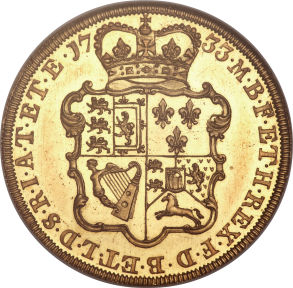
2 Guineas - George I (1717–1726)
Circulating version: 1717 1 Farthing - George I 'Dump' issue
| Country | United Kingdom |
| Year | 1717–1726 |
| Denomination | 2 Guineas |
| Face value | £2.1 |
| Mint | Royal Mint · Llantrisant |
| Circulation | Circulating |
| Demonetised | Yes |
| Composition | Gold (.9167) (917/1000 fine) |
| Weight | 16.800g · 0.4951 t oz |
| Diameter | 32.0mm |
| Shape | Round |
| Edge | Milled |
| Orientation | Coin alignment ↑↓ |
| Obv. artist | John Croker |
| Grade scale | UK (EF/UNC) |
Laureate portrait of King George I right, legend around.
GEORGIVS D G M BR FR ET HIB REX F D
Crowned cruciform shields around central Garter star with sceptres bearing national emblems in angles, divided date above, legend around.
BRVN ET L DVX S R I A TH ET EL
Find this on eBay
AffiliateAbout the 1717 2 Guineas - George I
The 1717 2 Guineas - George I is a circulating 2 guineas coin issued from 1717 to 1726, struck in 91.67% gold. It weighs 16.8g and measures 32mm across. Reverse design: Crowned cruciform shields around central Garter star with sceptres bearing national emblems in angles, divided date above, legend around.
It is no longer legal tender, so its value is to collectors only.
Common questions
How much is the 1717 2 Guineas - George I worth?
No verified sale of the 1717 2 Guineas - George I has been logged on MyCoinage yet. Its gold content is worth about £1,488 at today's spot price, which puts a floor under its value.
Which years were George I two guinea coins struck?
Only three: 1717, 1720 and 1726. Wikipedia and CoinVarieties agree on these dates. The double guinea was issued irregularly under George I, unlike the guinea, which was struck in every year of the reign.
How many George I two guinea coins were made?
No mintage is recorded for any of the three dates. CoinVarieties lists the 1717 issue as 'recorded mintage: unknown'. The Royal Mint Museum holds a 1717 example weighing 16.71 g.
What was a two guinea coin worth?
Twice the guinea. A royal proclamation of December 1717 fixed the guinea at 21 shillings, so the two guinea piece passed for 42 shillings. Before that the guinea's value floated with the price of gold.
Who designed the George I two guineas?
The dies were the work of John Croker, Chief Engraver of the Royal Mint from 1705 until 1741. The Royal Mint Museum credits him with the coins of Anne and George I, and Hocking's 1906 catalogue gives the two guineas the same types as the five guineas.
How is the 1717 2 Guineas - George I different from the circulating coin?
This is a collector version of the 1717 1 Farthing - George I 'Dump' issue, not the coin found in change. At 16.8g of 91.67% gold it is heavier than the 5.4g copper circulating coin, so weighing it is the quickest check.
How do I identify the 1717 2 Guineas - George I?
Check the weight 16.8g and diameter 32mm and the metal (91.67% gold) against the specification table on this page. The reverse design is described above.
History and design
The two guinea piece was the middle member of the guinea family, between the guinea and the five guineas. Under George I it was struck only irregularly, in 1717, 1720 and 1726, while the guinea itself was coined in every year of the reign. The Royal Mint Museum holds a 1717 example from the Tower mint weighing 16.71 g.
The first date coincides with the settling of the guinea's value. Isaac Newton's report as Master of the Mint in September 1717 led to a proclamation that December fixing the guinea at 21 shillings, and so the two guinea piece at 42 shillings. No mintage is recorded for any of the three dates.
Hocking's 1906 catalogue of the Royal Mint collection gives the two guineas the same types and inscriptions as the five guineas, with an obliquely grained edge in place of the larger coin's lettering. The obverse is a laureate bust of the king to the right with long hair, by John Croker, the Chief Engraver who cut almost all of George I's dies. The legend reads GEORGIVS D G M BR FR ET HIB REX F D.
The reverse has four crowned shields in a cross for England and Scotland, France, Ireland and the Electorate of Hanover, with sceptres between them topped by an orb, a thistle, a lis and a harp, and the Star of the Garter in the centre. The legend BRVN ET L DVX S R I A TH ET EL with the date names the king Duke of Brunswick and Lüneburg, Arch-Treasurer and Elector of the Holy Roman Empire.
Collecting notes
All three dates are scarce, and Heritage described a 1717 coin graded MS63 by NGC in 2021 as the single finest certified of the three-year series. Heritage noted a few annealing flaws even on that coin, so small flaws in the gold are not necessarily damage. Check the graining all round for filing. A genuine coin should weigh close to 16.7 g to 16.8 g.
The two guinea denomination continued under George II until 1753, and the guinea was replaced by the sovereign after the Coinage Act of 1816. The smaller companion is the fourth portrait guinea.
Sources
The history, design, varieties and collecting notes on this page are drawn from these sources. Prices come from recorded sales, not from them.
- Two guineas (British coin), Wikipedia (read 12 Oct 2026)
- Catalogue of the Coins, Tokens, Medals, Dies and Seals in the Museum of the Royal Mint, Vol. I Part I (Hocking, 1906), George I pages, Royal Mint Museum library (read 12 Oct 2026)
- George II, Royal Mint Museum (read 12 Oct 2026)
- John Croker (engraver), Wikipedia (read 12 Oct 2026)
- George I two guineas, 1717 (RMM 289), The Royal Mint Museum, via Museum Data Service (read 12 Oct 2026)
- Great Britain 1717 2 guineas, CoinVarieties (read 12 Oct 2026)
- Guinea (coin), Wikipedia (read 12 Oct 2026)
- Isaac Newton, Royal Mint Museum (read 12 Oct 2026)
More 2 Guineas coins from nearby years