
Mythic: a key date.
2 Guineas - George II Pattern (1733)
| Country | United Kingdom |
| Year | 1733 |
| Denomination | 2 Guineas |
| Face value | £2.1 |
| Mintage | 10 |
| Mint | Royal Mint · Llantrisant |
| Circulation | Non-circulating |
| Demonetised | Yes |
| Composition | Gold |
| Shape | Round |
| Edge | Plain |
| Orientation | Coin alignment ↑↓ |
| Obv. artist | John Croker |
| Grade scale | UK (EF/UNC) |
Left effigy of King George II surrounded by the inscription "GEORGIVS-II - DEI-GRATIA-" (George II by the grace of God).This is an automatic translation. The original text is:Effigie gauche du roi George II entourée par l'inscription "GEORGIVS·II · DEI·GRATIA·" (George II par la grâce de Dieu).
GEORGIVS II DEI GRATIA
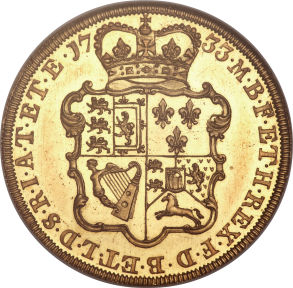
Coat of arms of the United Kingdom during the reign of George II.This is an automatic translation. The original text is:Armoiries du Royaume-Uni durant le règne de George II.
M B F ET H REX F D B ET L D S R I A T ET E
Find this on eBay
Affiliate2 Guineas - George II Pattern price history
Daily limit reachedAbout the 1733 2 Guineas - George II Pattern
The 1733 2 Guineas - George II Pattern is a collector 2 guineas coin, struck in gold. Reverse design: Coat of arms of the United Kingdom during the reign of George II.This is an automatic translation. The original text is:Armoiries du Royaume-Uni durant le règne de George II.
10 were struck. It is no longer legal tender, so its value is to collectors only.
Common questions
How much is the 1733 2 Guineas - George II Pattern worth?
No verified sale of the 1733 2 Guineas - George II Pattern has been logged on MyCoinage yet.
Is the 1733 two guineas a pattern?
Yes. Clayton lists it as a pattern, Wikipedia calls it John Croker's pattern struck before the first currency issue, and Spink describes it as the first undisputed pattern for the denomination. No two guineas were struck for circulation in 1733; the first currency coins are dated 1734.
How many 1733 pattern two guineas exist?
No number struck is recorded. A Spink cataloguer traced only eight examples. CoinVarieties, citing the Wilson and Rasmussen catalogue, gives the rarity as R5, and Clayton's value list marks the 1733 proof 'ex rare'.
How can you tell the 1733 pattern from a currency two guineas?
By the date and the edge. The pattern is dated 1733, which no currency two guineas carries, and Spink and CoinVarieties both describe a plain edge, where currency pieces are grained. Spink also notes die rust and ghosting of reworked letters on the obverse.
Why was a two guineas pattern made in 1733?
The reason is not recorded. Spink points out that 1733 was the year old hammered gold was finally called in; the Royal Mint Museum says a proclamation of February 1733 prohibited its circulation, and it was recoined into guineas and half guineas.
History and design
George II came to the throne in 1727, but his first two guineas for circulation are dated 1734. This piece, dated 1733, is a pattern struck the year before, a carefully made proof showing how the new coin would look. Clayton lists it as a pattern, and Spink describes it as the first undisputed pattern for the denomination and a model for the currency issue struck from 1734 to 1753.
Why it was made is not documented. Spink notes that 1733 was the year old hammered gold was finally withdrawn, and the Royal Mint Museum records that a proclamation of February 1733 prohibited its circulation and that the Mint recoined the metal into guineas and half guineas. No number struck is recorded, and Spink's cataloguer traced only eight examples.
The obverse is John Croker's young laureate head of the king facing left with the legend GEORGIVS II DEI GRATIA. Croker had been Chief Engraver since 1705 and, according to the Royal Mint Museum, cut the young head used on George II's coins.
The reverse is the crowned and garnished shield of the new reign, quartering the arms of England and Scotland, France, Hanover and Ireland, with the date split 17 33 either side of the crown and the legend M B F ET H REX F D B ET L D S R I A T ET E. Spink notes a shield with a straight top, a crown with rounded arches and eight strings to the Irish harp. Spink and CoinVarieties both describe a plain edge.
Collecting notes
Every example should be dated 1733 and have a plain edge; a grained edge or a 1734 date means a currency coin. Spink records die rust in the obverse fields and the ghosting of reworked letters above the laurel wreath, with the bar of the A in GRATIA floating between the hair curls, which are useful points of comparison.
The currency coin that followed is the young head two guineas, first dated 1734 and known for that year only as an overdate, 1734/3.
Sources
The history, design, varieties and collecting notes on this page are drawn from these sources. Prices come from recorded sales, not from them.
- Two guineas (British coin), Wikipedia (read 12 Oct 2026)
- The Sensational Pattern Proof 1733 2-Guineas by Croker (The Piccadilly List, lot 23), Spink (read 12 Oct 2026)
- Great Britain 1733 2 guineas, CoinVarieties (read 12 Oct 2026)
- Double Sovereign and Two Guineas, Tony Clayton, Coins of the UK (read 12 Oct 2026)
- Values of Two Pounds and Two Guineas, Tony Clayton, Coins of the UK (read 12 Oct 2026)
- George II, Royal Mint Museum (read 12 Oct 2026)


