2 Guineas - George II Young portrait (1734–1739)
| Country | United Kingdom |
| Year | 1734–1739 |
| Denomination | 2 Guineas |
| Face value | £2.1 |
| Mint | Royal Mint · Llantrisant |
| Circulation | Circulating |
| Demonetised | 1891 |
| Composition | Gold (.9167) (917/1000 fine) |
| Weight | 16.800g · 0.4951 t oz |
| Diameter | 32.0mm |
| Shape | Round |
| Edge | Milled |
| Orientation | Coin alignment ↑↓ |
| Obv. artist | John Croker |
| Rev. artist | John Sigismund Tanner |
| Grade scale | UK (EF/UNC) |
Young laureate portrait of King George II left, legend around.
GEORGIVS II DEI GRATIA
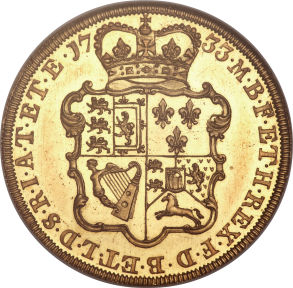
Crowned quartered shield of arms, divided date above, legend around.
M B F ET H REX F D B ET L D S R I A T ET E
Find this on eBay
Affiliate2 Guineas - George II Young portrait price history
Daily limit reachedAbout the 1734 2 Guineas - George II Young portrait
The 1734 2 Guineas - George II Young portrait is a circulating 2 guineas coin issued from 1734 to 1739, struck in 91.67% gold. It weighs 16.8g and measures 32mm across. Reverse design: Crowned quartered shield of arms, divided date above, legend around.
It is no longer legal tender (withdrawn 1891), so its value is to collectors only.
Common questions
How much is the 1734 2 Guineas - George II Young portrait worth?
No verified sale of the 1734 2 Guineas - George II Young portrait has been logged on MyCoinage yet. Its gold content is worth about £1,483 at today's spot price, which puts a floor under its value.
How many George II young head two guineas were made?
No mintage is published for any date, and CoinVarieties records the figure as unknown. The Royal Mint notes that 283,854 pounds' worth of gold was coined in 1739, but that total covers every gold denomination struck that year.
Which dates have the young head?
Clayton lists 1734 (as 1734/3), 1735, 1738 and 1739. CoinVarieties calls 1734 the scarcest of the four and says it is known only as the overdate. The 1739 two guineas was also struck with the new intermediate head.
Are there forgeries of George II two guineas?
Yes. Clayton warns of modern forgeries of the George II two guineas, naming 1738 and 1739 among the dates most affected, along with 1748. Weight, edge graining and the fine detail of the lettering should all be checked against a known genuine example.
Who designed the young head two guineas?
The Royal Mint credits John Croker with the obverse and John Tanner with the reverse. The Royal Mint Museum says Croker cut George II's young head and Tanner, his assistant from 1729, made the reverse dies, while it credits the shield design itself to John Ochs.
How do I identify the 1734 2 Guineas - George II Young portrait?
Check the weight 16.8g and diameter 32mm and the metal (91.67% gold) against the specification table on this page. The reverse design is described above.
History and design
George II's first two guineas for circulation are dated 1734, a year after John Croker's pattern. Wikipedia notes that the reign's two guineas were the last of the denomination struck for currency. With the guinea fixed at 21 shillings since 1717, the coin was worth 42 shillings, and Clayton observes that very few were issued once that value was set.
Clayton lists the young head for 1734, 1735, 1738 and 1739, and the 1734 is known only as an overdate, 1734/3, which CoinVarieties calls the scarcest of the four dates. CoinVarieties describes the type as probably the most common George II two guineas. No mintage is published for any year.
The obverse is Croker's young laureate head of the king facing left with GEORGIVS II DEI GRATIA. Croker, born in Dresden, had been Chief Engraver since 1705 and had cut the coins of Anne and George I. The Royal Mint Museum holds a 1738 example weighing 16.75 g.
The reverse is a single crowned shield quartering England and Scotland, France, Hanover and Ireland, with the date split by the crown and M B F ET H REX F D B ET L D S R I A T ET E around. This replaced the four cruciform shields of earlier reigns. The Royal Mint Museum credits the shield to John Ochs and says John Sigismund Tanner, Croker's assistant from 1729, made the reverse dies. Clayton separates a first reverse on 1734/3 from a second on 1735 to 1739. Early coins have diagonal edge graining; from 1739, after a gang of guinea filers was active, it was changed to a chevron pattern.
Varieties and errors
Besides the 1734/3 overdate, the Royal Mint describes a 1739 young head die with a stop above the centre of the head, the rarest young head die for that year, struck from the obverse die otherwise used only in 1734. The 1739 two guineas was also struck with the intermediate head, so both portraits share that date.
Collecting notes
Clayton warns of modern forgeries, naming 1738 and 1739, so buy from a reliable source and check weight, graining and lettering closely. On a 1739 coin, confirm the head before anything else. The type was followed by the intermediate head two guineas.
Sources
The history, design, varieties and collecting notes on this page are drawn from these sources. Prices come from recorded sales, not from them.
- George II, Royal Mint Museum (read 12 Oct 2026)
- 1739 George II Gold Two Guineas XF45, The Royal Mint (read 12 Oct 2026)
- Two guineas (British coin), Wikipedia (read 12 Oct 2026)
- Double Sovereign and Two Guineas, Tony Clayton, Coins of the UK (read 12 Oct 2026)
- Values of Two Pounds and Two Guineas, Tony Clayton, Coins of the UK (read 12 Oct 2026)
- Great Britain 1734 2 guineas, CoinVarieties (read 12 Oct 2026)
- George II two guineas, 1738 (RMM 463), The Royal Mint Museum, via Museum Data Service (read 12 Oct 2026)
- Sovereign (British coin), Wikipedia (read 12 Oct 2026)
- Great Britain 1739 2 guineas Fr-336b, CoinVarieties (read 12 Oct 2026)