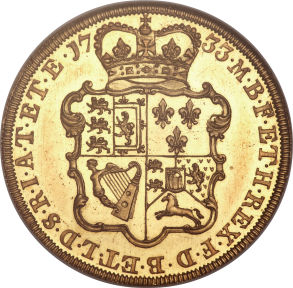
2 Guineas - George III Pattern (1768–1773)
| Country | United Kingdom |
| Year | 1768–1773 |
| Denomination | 2 Guineas |
| Face value | £2.1 |
| Mint | Royal Mint · Llantrisant |
| Circulation | Non-circulating |
| Demonetised | Yes |
| Composition | Gold |
| Weight | 17.980g |
| Diameter | 33.0mm |
| Shape | Round |
| Edge | Plain |
| Orientation | Medal alignment ↑↑ |
| Grade scale | UK (EF/UNC) |
Young, long-haired laureate portrait of King George III facing right, legend around.
GEORGIVS III DEI GRATIA
Crowned quartered shield of arms on ornate scroll, divided date above, legend around.
M B F ET H REX F D B ET L D S R I A T ET E
Find this on eBay
Affiliate2 Guineas - George III Pattern price history
Daily limit reachedAbout the 1768 2 Guineas - George III Pattern
The 1768 2 Guineas - George III Pattern is a collector 2 guineas coin issued from 1768 to 1773, struck in gold. It weighs 17.98g and measures 33mm across. Reverse design: Crowned quartered shield of arms on ornate scroll, divided date above, legend around.
It is no longer legal tender, so its value is to collectors only.
Common questions
How much is the 1768 2 Guineas - George III Pattern worth?
No verified sale of the 1768 2 Guineas - George III Pattern has been logged on MyCoinage yet. Its gold content is worth up to £1,732 at today's spot price, which puts a floor under its value.
Were two guineas struck for George III?
Only as patterns. The Royal Mint Museum states that no two-guinea pieces were issued in the reign, although patterns exist. Wikipedia lists trial pieces by John Sigismund Tanner dated 1768, 1770 and 1773, and a later one of 1777.
How rare is the 1768 pattern two guineas?
No number struck is recorded. Heritage's cataloguers, quoted by CoinVarieties, describe it as reportedly one of 11 to 20 known; Wilson and Rasmussen rate it R4. The Royal Mint Museum holds examples of both 1768 and 1773.
Why were no two guineas issued under George III?
The large gold pieces had little practical use. Heritage's cataloguers note that two and five guineas carried too much purchasing power for everyday trade, and no two guineas had been struck for circulation since 1753, under George II.
How do I identify the 1768 2 Guineas - George III Pattern?
Check the weight 17.98g and diameter 33mm and the metal (gold) against the specification table on this page. The reverse design is described above.
History and design
No two guineas had been struck for circulation since 1753, and the Royal Mint Museum confirms that none were issued under George III, although patterns exist. These pieces, dated 1768 and 1773, are trials of a two guinea coin for the new reign, struck from polished dies with plain edges. Wikipedia credits them to the Chief Engraver John Sigismund Tanner, who also made a trial dated 1770.
Why the coin never went further is not documented by the Mint. Heritage's cataloguers, quoted by CoinVarieties, suggest that a 42 shilling piece simply carried too much value to be useful when the guinea and its fractions already met the need for gold. No number struck is recorded; Heritage says the 1768 is reportedly one of 11 to 20 known.
The obverse shows a laureate head of George III facing right with GEORGIVS III DEI GRATIA. WildWinds describes the 1773 piece as carrying the laureate fourth head. The reverse is a crowned shield of arms with the legend M B F ET H REX F D B ET L D S R I A T ET E, the full title used on the gold of the reign.
The attribution to Tanner has a complication. The Royal Mint Museum records that his eyesight was failing by 1768, when he retired on a pension, and that his assistant Richard Yeo had already been acting as Chief Engraver in practice.
Varieties and errors
The two dates are distinct patterns, Wilson and Rasmussen 79 (1768) and 80 (1773). The Royal Mint Museum's examples weigh 16.41 g and 18.29 g, both with plain edges.
Collecting notes
Check the date first, since this entry covers two different patterns, and confirm a plain edge. Heritage notes thick die polish lines and some die rust on its 1768 example, which are features of the dies rather than damage. The later pattern by Yeo is the 1777 two guineas.
Sources
The history, design, varieties and collecting notes on this page are drawn from these sources. Prices come from recorded sales, not from them.
- Two guineas (British coin), Wikipedia (read 12 Oct 2026)
- George III, Royal Mint Museum (read 12 Oct 2026)
- Great Britain 1768 2 guineas, CoinVarieties (read 12 Oct 2026)
- Great Britain 1773 2 guineas, CoinVarieties (read 12 Oct 2026)
- George III coins, Seaby 3724A, WildWinds (read 12 Oct 2026)
- Spade guinea of George III, 1787 (V&A 1624-1902), Science Museum Group, via Museum Data Service (read 12 Oct 2026)
- George III pattern two guineas, 1768 (RMM 938), The Royal Mint Museum, via Museum Data Service (read 12 Oct 2026)
- George III pattern two guineas, 1773 (RMM 939), The Royal Mint Museum, via Museum Data Service (read 12 Oct 2026)