Sells occasionally: 5 verified sales in the last 12 months.
1 Guinea - George III 6th portrait (1813)
"Military guinea"
| Country | United Kingdom |
| Year | 1813 |
| Denomination | 1 Guinea |
| Face value | £1.05 |
| Mint | Royal Mint · Llantrisant |
| Circulation | Circulating |
| Demonetised | 1891 |
| Composition | Gold (.9167) (917/1000 fine) |
| Weight | 8.400g · 0.2476 t oz |
| Diameter | 24.0mm |
| Shape | Round |
| Edge | Milled |
| Orientation | Medal alignment ↑↑ |
| Obv. artist | Nathaniel Marchant |
| Rev. artist | Lewis Pingo |
| Grade scale | UK (EF/UNC) |
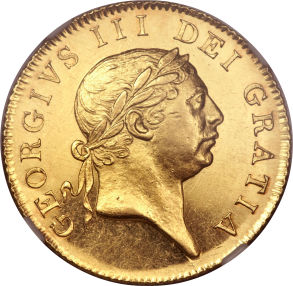
Sixth laureate portrait of King George III right, legend around.
GEORGIVS III DEI GRATIA
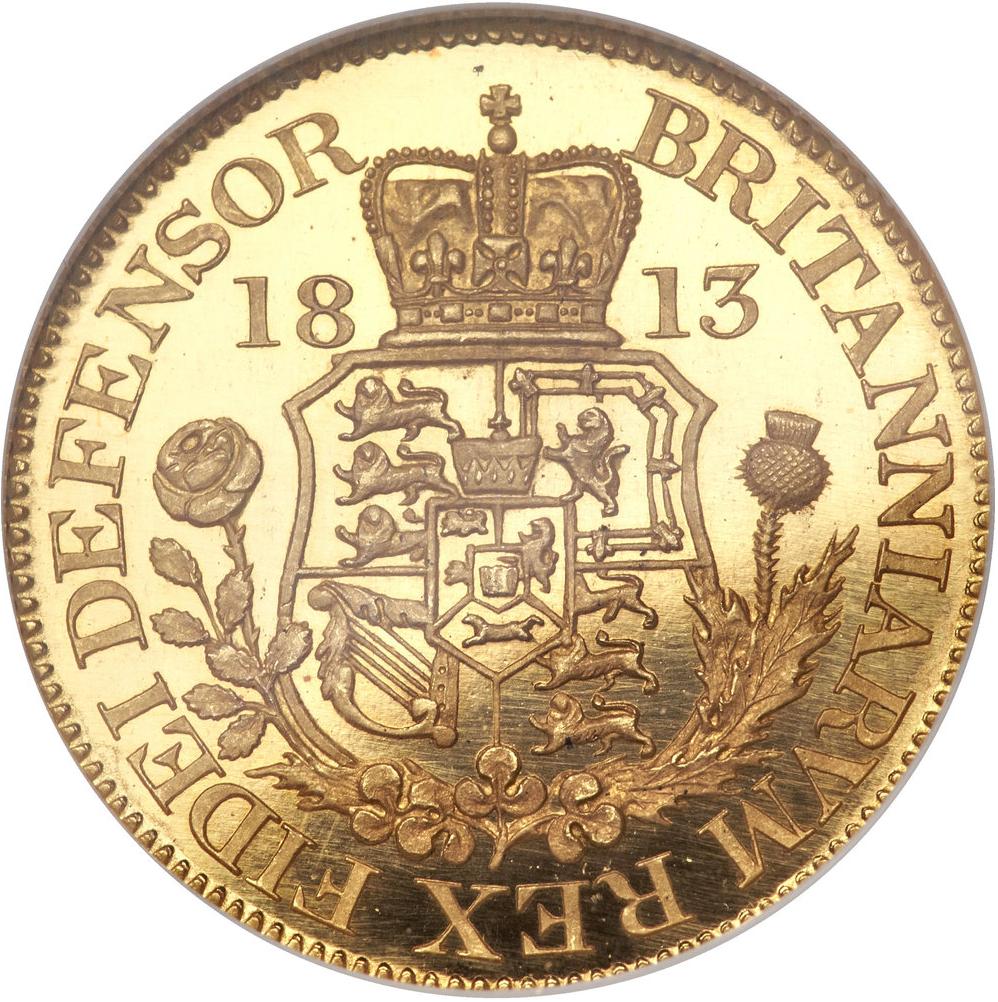
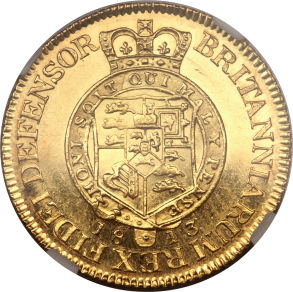
Crowned shield of arms within garter, legend around, divided date below.
1 Guinea - George III market value
Find this on eBay
Affiliate1 Guinea - George III price history
Daily limit reached1 Guinea - George III value by grade
Realised auction prices · ⭐ Pro Expand rows for individual sale records| Grade | Latest | Median | 30d Δ | All-time range | Sales (1yr) | Total sales | Last sale | |
|---|---|---|---|---|---|---|---|---|
| UNC | £5,000.00 🔒 | £5,500.00 (2) | – | £5,000.00 – £6,000.00 | 0 | 2 | 18-03-2018 | |
|
Loading…
|
||||||||
| EF | £1,500.00 🔒 | £1,500.00 | – | £950.00 – £3,200.00 | 0 | 5 | 05-09-2021 | |
|
Loading…
|
||||||||
| VF | £10,000.00 🔒 | £5,900.00 | – | £850.00 – £10,000.00 | 2 | 16 | 23-09-2026 | |
|
Loading…
|
||||||||
| F | £1,100.00 🔒 | £800.00 | – | £750.00 – £1,100.00 | 0 | 3 | 01-03-2020 | |
|
Loading…
|
||||||||
| AU-53 | £3,170.53 🔒 | £3,170.53 (1) | – | £3,170.53 – £3,170.53 | 1 | 1 | 04-05-2026 | |
|
Loading…
|
||||||||
| AU-58 | £4,500.00 🔒 | £4,500.00 | – | £3,000.00 – £5,500.00 | 0 | 4 | 30-09-2025 | |
|
Loading…
|
||||||||
| MS-62 | £6,416.55 🔒 | £6,416.55 (1) | – | £6,416.55 – £6,416.55 | 1 | 1 | 06-09-2026 | |
|
Loading…
|
||||||||
| MS-63 | £8,303.77 🔒 | £8,303.77 (1) | – | £7,000.00 – £8,303.77 | 1 | 2 | 06-09-2026 | |
|
Loading…
|
||||||||
| MS-64 | £11,000.00 🔒 | £11,000.00 | – | £8,303.77 – £11,700.76 | 0 | 3 | 30-09-2025 | |
|
Loading…
|
||||||||
About the 1813 1 Guinea - George III
The 1813 1 Guinea - George III is a circulating 1 guinea coin, struck in 91.67% gold. It weighs 8.4g and measures 24mm across. Reverse design: Crowned shield of arms within garter, legend around, divided date below.
It is no longer legal tender (withdrawn 1891), so its value is to collectors only.
Common questions
How much is the 1813 1 Guinea - George III worth?
Verified sold prices for the 1813 1 Guinea - George III run from £800 to £11,000 across 9 grades, taking the median for each grade. Condition makes the difference, so check the grade table above before pricing one. Its gold content is worth about £742 at today's spot price, which puts a floor under its value.
Why is it called the military guinea?
Because it was struck to pay the army. The Royal Mint says the 1813 guineas were shipped to the Duke of Wellington for the Peninsular War, and Wikipedia adds that local people in the Pyrenees would accept only gold. It was the first guinea for 14 years and the last ever made.
How many 1813 guineas were made?
The Royal Mint and the Royal Mint Museum both say about 360,000. Wikipedia gives 80,000, struck to pay Wellington's army. The Royal Mint's figure is preferred, but the two have not been reconciled.
Who designed the military guinea?
The Royal Mint Museum says the portrait of George III was the only meaningful contribution to the coinage of the gem engraver Nathaniel Marchant. The Royal Mint's shop page credits Lewis Pingo with both sides; Pingo is the usual attribution for the reverse.
Is the military guinea still legal tender?
No. Wikipedia's Sovereign article records that all gold coins from before Victoria's reign were called in by Royal Proclamation on 22 November 1890 and demonetised from 28 February 1891.
How do I identify the 1813 1 Guinea - George III?
Check the weight 8.4g and diameter 24mm and the metal (91.67% gold) against the specification table on this page. The reverse design is described above.
History and design
Gold coinage stopped in 1799, and for the next 14 years no guineas were struck. By 1813 Wellington's army, advancing towards France, needed gold: Wikipedia records that local people in the Pyrenees would accept nothing else. The Royal Mint says the coins were struck only between February and June 1813 and shipped to Wellington, which is why they became known as military guineas.
The Royal Mint and the Royal Mint Museum both put the total at about 360,000; Wikipedia gives 80,000. The Royal Mint Museum notes it was the first and only guinea struck at the new Mint on Tower Hill. It was also the last guinea of all, since the 20 shilling sovereign replaced it in the recoinage of 1816 to 1817.
The Royal Mint Museum credits the portrait to Nathaniel Marchant, an Assistant Engraver from 1797 to 1815 and a gem engraver of note, calling it his only meaningful contribution to the coinage. The Royal Mint's own shop page names Lewis Pingo for both sides. The obverse reads GEORGIVS III DEI GRATIA around a laureate head facing right.
The reverse is unlike any earlier guinea. The crowned shield of arms sits inside the Garter, inscribed HONI SOIT QUI MAL Y PENSE, with the date 1813 below and BRITANNIARUM REX FIDEI DEFENSOR around the edge. The Royal Mint Museum explains that the shorter legend followed the change in the king's titles in 1801, when the claim to the throne of France was dropped. The edge is grained.
Collecting notes
The single date and the Garter reverse make the military guinea easy to identify. Clayton notes it was issued to supply Wellington with gold for the Peninsular War. The Royal Mint Museum records its own example as struck from clashed dies, so faint traces of the other side's design can be a striking flaw rather than damage.
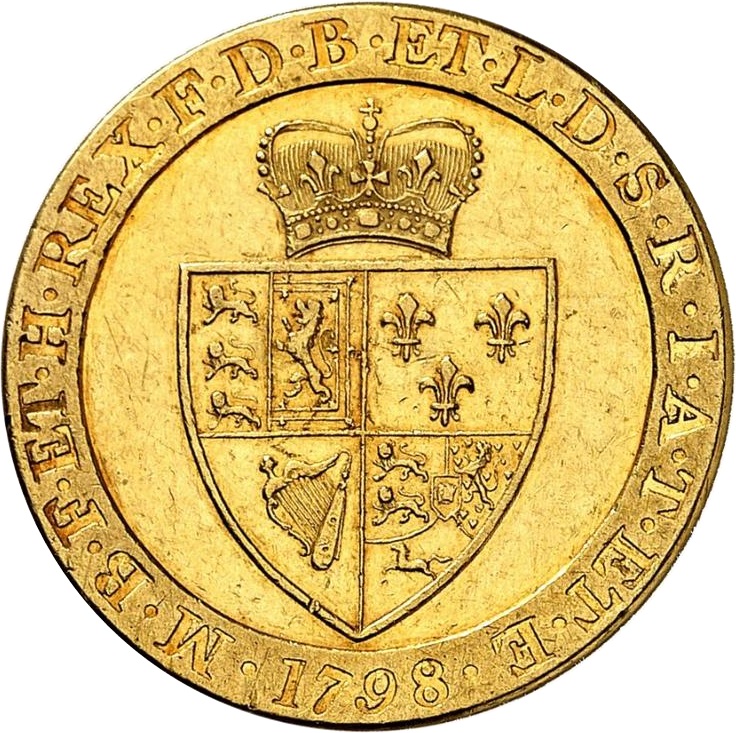
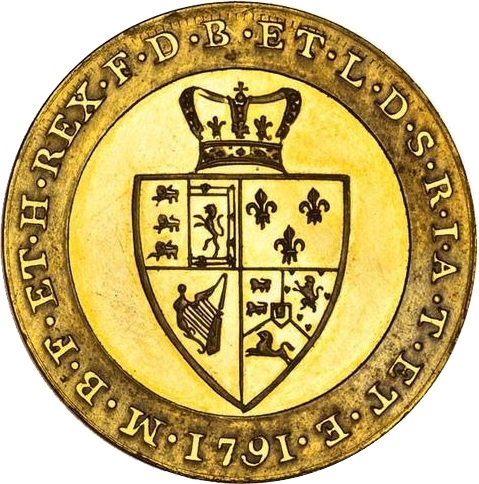
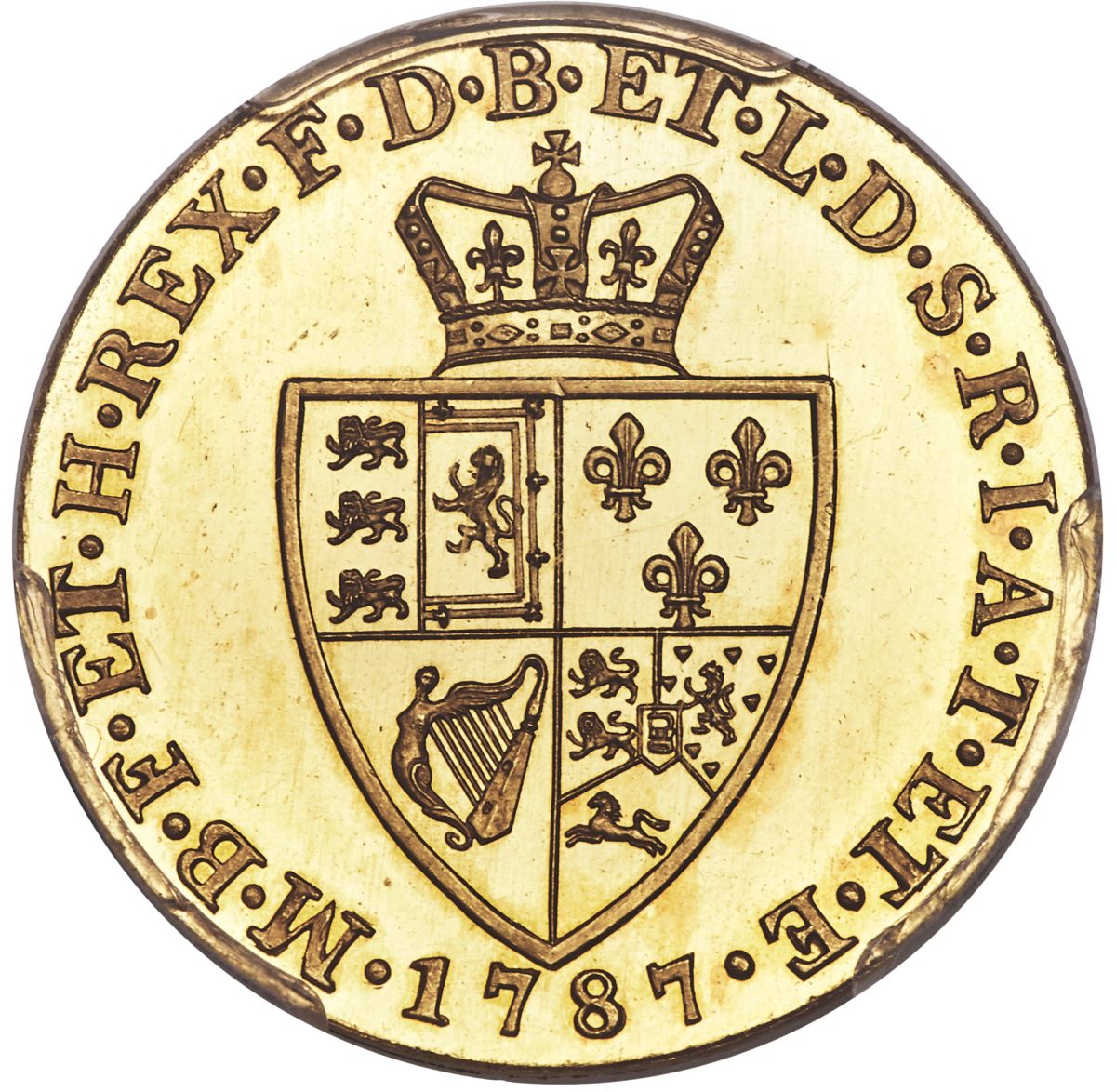
Proofs were also struck, and CoinVarieties quotes Heritage noting that only a handful have been certified. Separate patterns dated 1813 exist, covered under the 1813 pattern guinea. The earlier type is the spade guinea.
Sources
The history, design, varieties and collecting notes on this page are drawn from these sources. Prices come from recorded sales, not from them.
- 1813 George III 'Military' Guinea, The Royal Mint (read 12 Oct 2026)
- George III, Royal Mint Museum (read 12 Oct 2026)
- Guinea (coin), Wikipedia (read 12 Oct 2026)
- Sovereign (British coin), Wikipedia (read 12 Oct 2026)
- George III guinea, 1813 (RMM 947), The Royal Mint Museum, via Museum Data Service (read 12 Oct 2026)
- George III coins, Seaby 3730, WildWinds (read 12 Oct 2026)
- Great Britain 1813 guinea, CoinVarieties (read 12 Oct 2026)
- One Pound (The Sovereign or Guinea), Tony Clayton, Coins of the UK (read 12 Oct 2026)
More 1 Guinea coins from nearby years