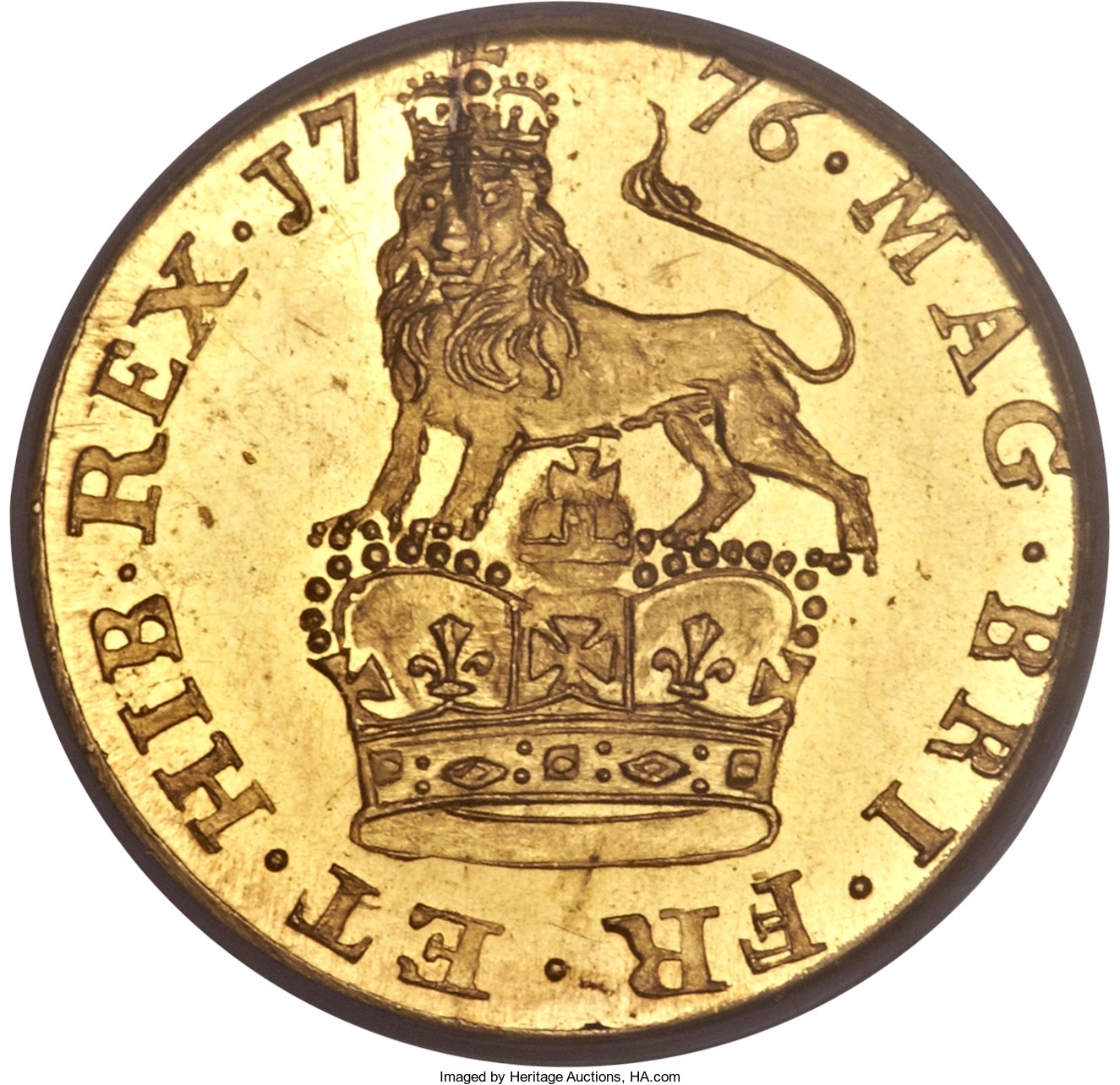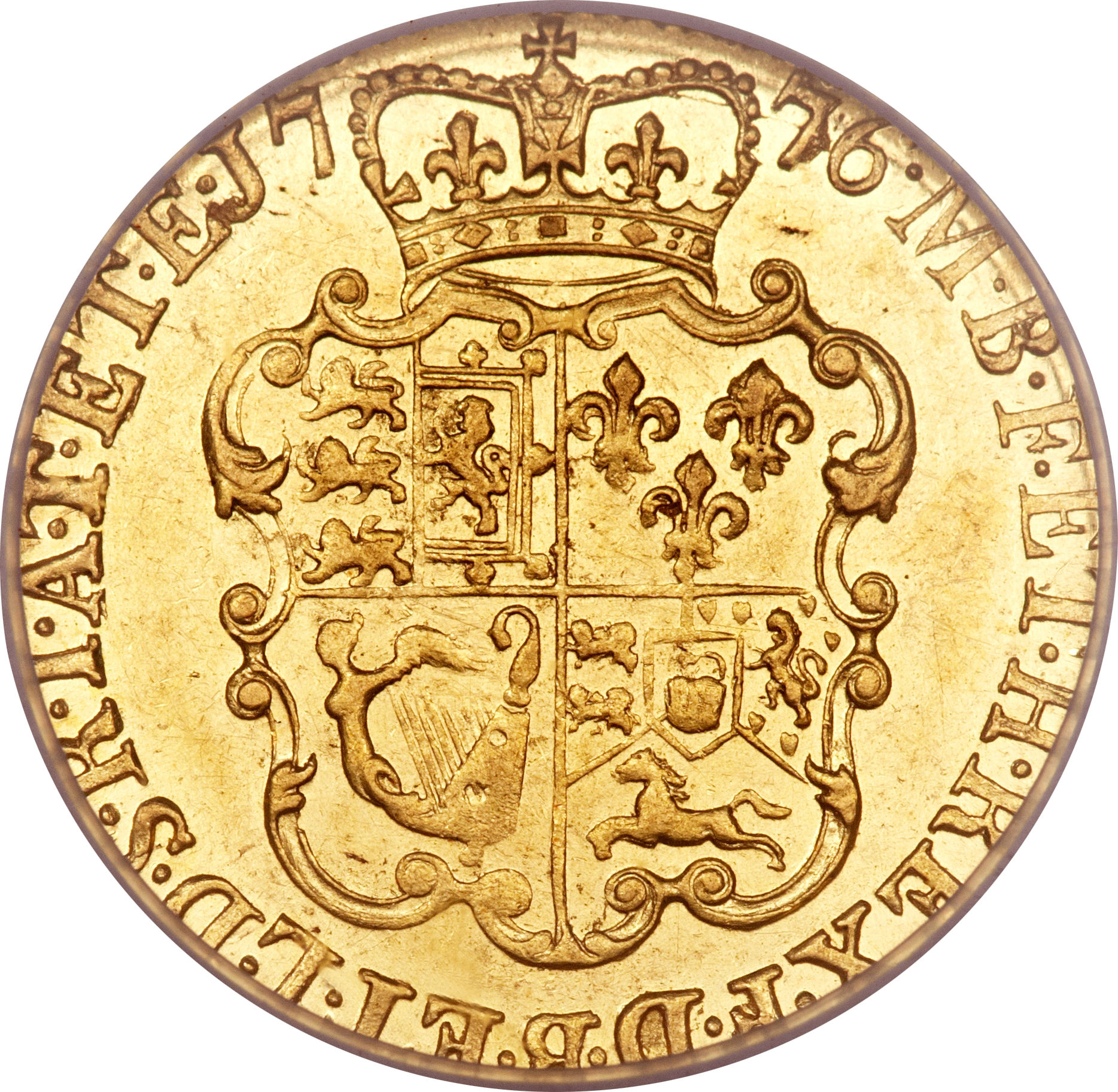
1 Guinea - George III 5th portrait 'Spade' Guinea (1787–1799)
"Spade guinea"
| Country | United Kingdom |
| Year | 1787–1799 |
| Denomination | 1 Guinea |
| Face value | £1.05 |
| Mint | Royal Mint · Llantrisant |
| Circulation | Circulating |
| Demonetised | 1891 |
| Composition | Gold (.9167) (917/1000 fine) |
| Weight | 8.350g · 0.2461 t oz |
| Diameter | 24.0mm |
| Shape | Round |
| Edge | Milled |
| Orientation | Medal alignment ↑↑ |
| Obv. artist | Lewis Pingo |
| Rev. artist | Lewis Pingo |
| Grade scale | UK (EF/UNC) |
© Heritage Auctions –
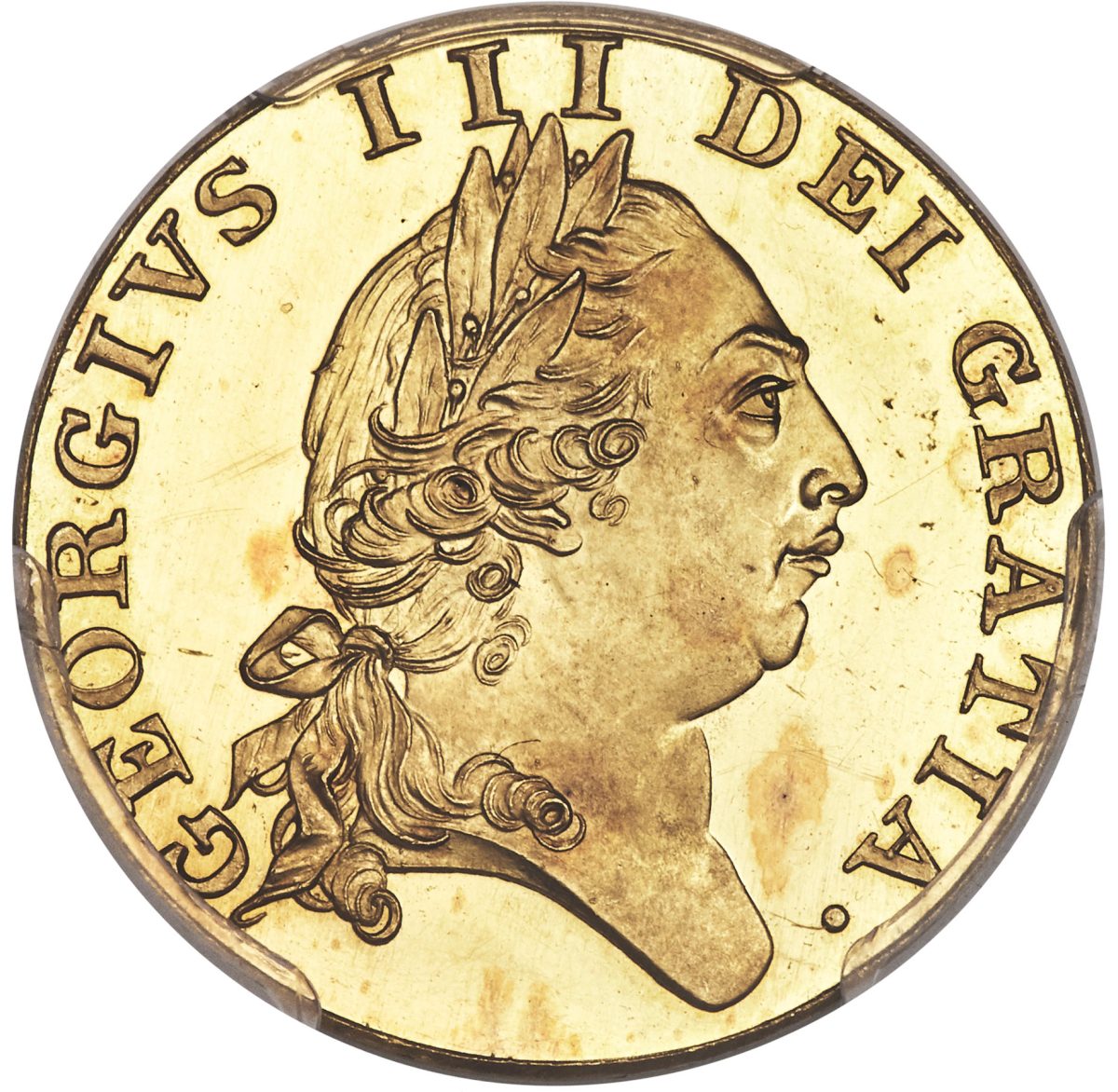
GEORGIVS III DEI GRATIA
© Heritage Auctions Europe
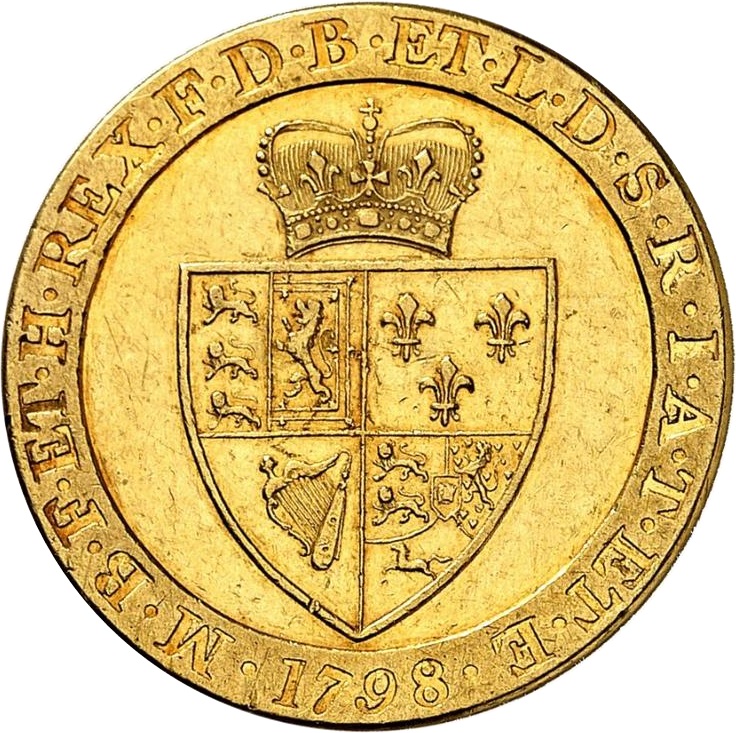
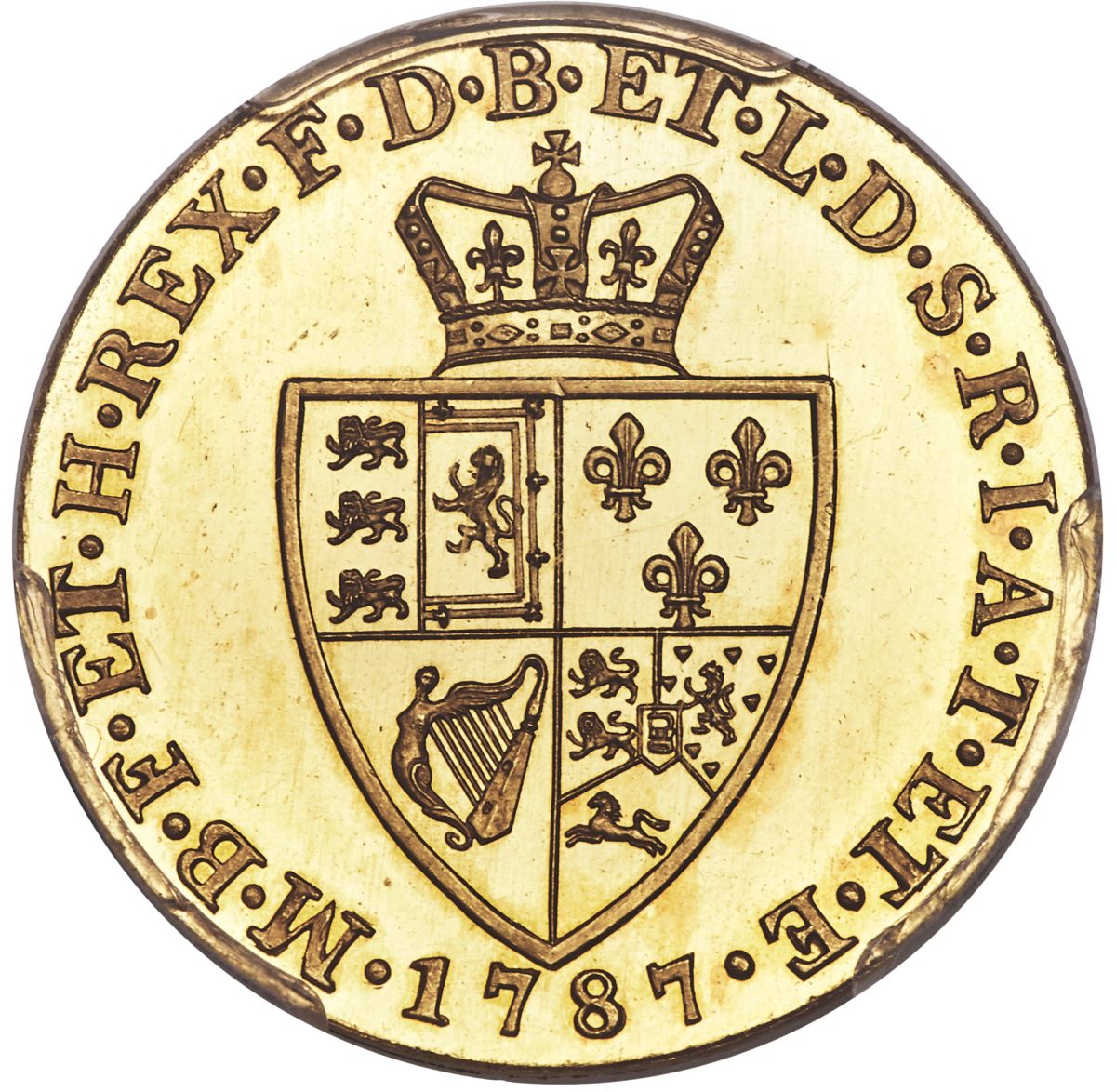
M B F ET H REX F D B ET L D S R I A T ET E
Find this on eBay
Affiliate'Spade' Guinea 1 Guinea price history
Daily limit reachedAbout the 1787 1 Guinea - George III – 'Spade' Guinea
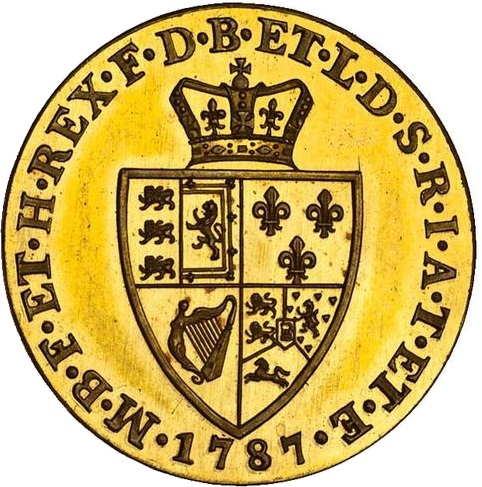
The 1787 1 Guinea - George III – 'Spade' Guinea is a circulating 1 guinea coin issued from 1787 to 1799, struck in 91.67% gold. It weighs 8.35g and measures 24mm across. Reverse design: © Heritage Auctions Europe.
It is no longer legal tender (withdrawn 1891), so its value is to collectors only.
Common questions
How much is the 1787 1 Guinea - George III – 'Spade' Guinea worth?
No verified sale of the 1787 1 Guinea - George III – 'Spade' Guinea has been logged on MyCoinage yet. Its gold content is worth about £740 at today's spot price, which puts a floor under its value.
Why is it called the spade guinea?
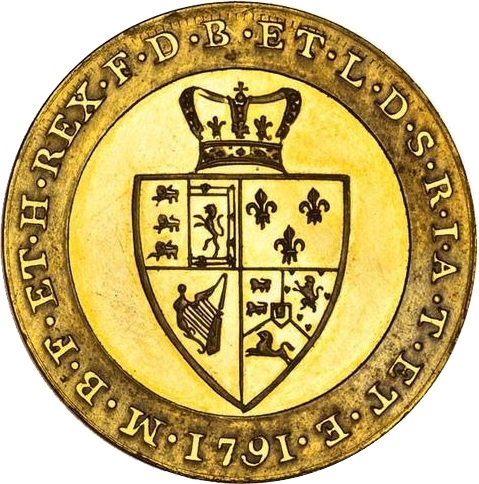
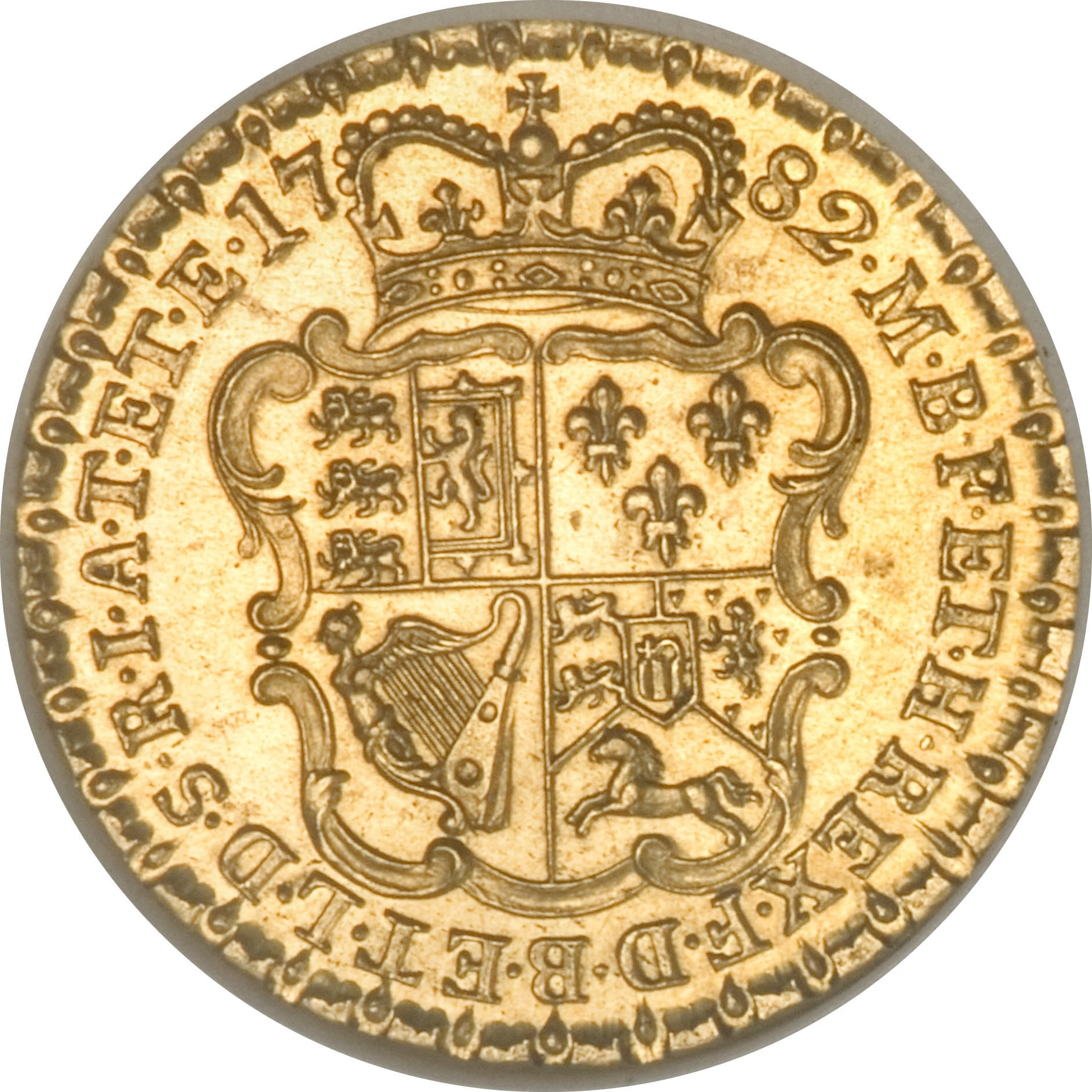
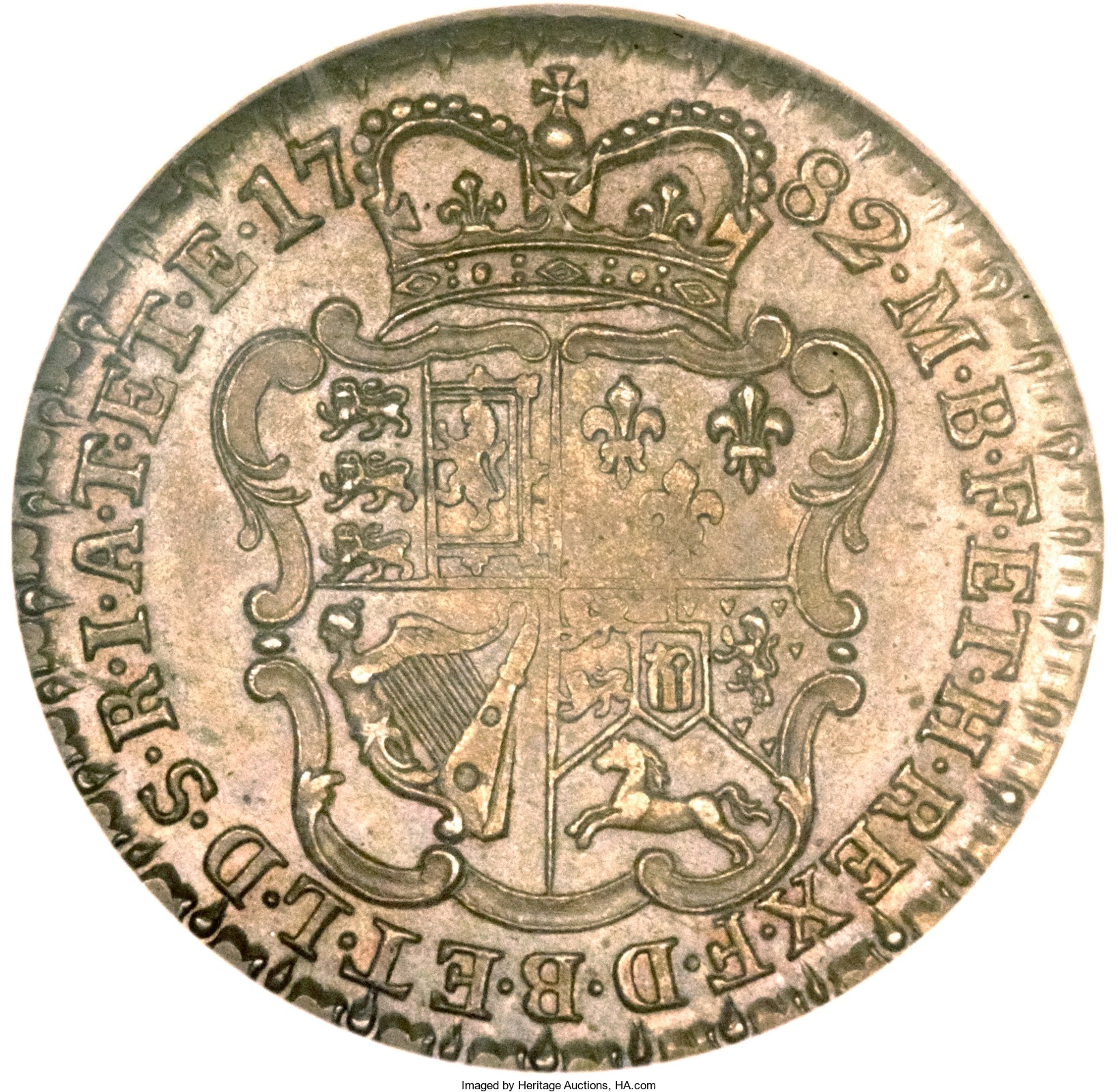
Because of the reverse. In 1787 the ornate shield used on earlier guineas of George III was replaced by a plain shield with a pointed base, and its likeness to the old-fashioned spade gave the coin its name. The Royal Mint Museum notes the earlier type was sometimes called the rose guinea.
How many spade guineas were made?
No mintage is recorded for any date. CoinVarieties gives the figure as unknown for 1787, 1791, 1798 and 1799. Clayton calls the spade guinea the cheapest of all the guineas, and Heritage's cataloguers, quoted by CoinVarieties, describe 1799 as much scarcer than 1798.
Why did the spade guinea stop in 1799?
The war with France made gold hard to import. The Royal Mint Museum says striking of gold was halted in 1799 and that the 1798 and 1799 guineas may have been held at the Bank of England until as late as 1813. The next guinea, the military guinea, is dated 1813.
Is my spade guinea a gaming token?
Brass imitations were made in large numbers after 1790 as gaming counters. Clayton notes they are easily told apart because their legends are wrong; a genuine coin reads M B F ET H REX F D B ET L D S R I A T ET E around the shield. Many imitations are holed for a watch chain.
Is a spade guinea still legal tender?
No. Wikipedia's Sovereign article records that all gold coins from before Victoria's reign were called in by Royal Proclamation on 22 November 1890 and demonetised from 28 February 1891.
How do I identify the 1787 1 Guinea - George III – 'Spade' Guinea?
Check the weight 8.35g and diameter 24mm and the metal (91.67% gold) against the specification table on this page. The reverse design is described above.
History and design
The spade guinea was the last long-running guinea type. In 1787 the elaborately garnished shield used on George III's guineas since 1761 gave way to a plain crowned shield with a pointed base, and the coin was soon named for its likeness to a spade. Clayton gives its run as 1787 to 1799, and a matching half guinea was struck alongside it.
No mintage figure survives for any date. Clayton calls it the cheapest of all the guineas today, which reflects how many were struck. Gold coinage stopped in 1799 because the war with France made bullion hard to import, and the Royal Mint Museum suggests the guineas of 1798 and 1799 may have stayed in the Bank of England until as late as 1813. The guinea itself only returned for a single issue in 1813.
Both sides are credited to Lewis Pingo, the son of the Mint engraver Thomas Pingo. The obverse shows the fifth laureate head of the king facing right with the legend GEORGIVS III DEI GRATIA. The Royal Mint Museum counts the spade guinea among his best-remembered work.
The reverse is the crowned spade-shaped shield quartering England and Scotland impaled, France, Ireland and the arms of Hanover, with the date below and the legend M B F ET H REX F D B ET L D S R I A T ET E. The Royal Mint Museum translates it as King of Great Britain, France and Ireland, Defender of the Faith, Duke of Brunswick and Luneburg, Arch-Treasurer and Elector of the Holy Roman Empire. The edge is grained.
Collecting notes
The Royal Mint Museum records that after the guinea was called in, spade guineas stayed popular and were worn as watch-chain pendants and copied as tokens and toy coins. Brass gaming counters made in Birmingham after 1790 are common; Clayton says they are easily spotted because the legends are wrong, and some carry an impossible date. Check the reverse legend letter by letter, and look for a hole or a removed mount.
Among genuine dates, CoinVarieties quotes Heritage describing 1799 as much scarcer than 1798, which seems to have been hoarded in small numbers. The fractional companion is the spade half guinea, and the type was followed in 1813 by the military guinea.
Sources
The history, design, varieties and collecting notes on this page are drawn from these sources. Prices come from recorded sales, not from them.
- 1787-1800 George III Gold 'Spade' Guinea, The Royal Mint (read 12 Oct 2026)
- Great Britain 1798 guinea, CoinVarieties (read 12 Oct 2026)
- Token or gaming counter, imitation spade guinea (CHIYH:2017.130.12), Chippenham Museum, via Museum Data Service (read 12 Oct 2026)
- Guinea (coin), Wikipedia (read 12 Oct 2026)
- One Pound (The Sovereign or Guinea), Tony Clayton, Coins of the UK (read 12 Oct 2026)
- George III, Royal Mint Museum (read 12 Oct 2026)
- Great Britain 1799 guinea, CoinVarieties (read 12 Oct 2026)
- Sovereign (British coin), Wikipedia (read 12 Oct 2026)
- Spade guinea of George III, 1787 (V&A 1624-1902), Science Museum Group, via Museum Data Service (read 12 Oct 2026)
- George III guinea, 1798 (RMM 945), The Royal Mint Museum, via Museum Data Service (read 12 Oct 2026)
- Great Britain 1787 guinea, CoinVarieties (read 12 Oct 2026)
More 1 Guinea coins from nearby years