1 Guinea - George II Pattern (1729)
| Country | United Kingdom |
| Year | 1729 |
| Denomination | 1 Guinea |
| Face value | £1.05 |
| Mint | Royal Mint · Llantrisant |
| Circulation | Non-circulating |
| Demonetised | Yes |
| Composition | Gold (.9167) (917/1000 fine) |
| Weight | 8.400g · 0.2476 t oz |
| Diameter | 25.0mm |
| Shape | Round |
| Edge | Plain |
| Orientation | Coin alignment ↑↓ |
| Obv. artist | John Croker |
| Rev. artist | John Ochs |
| Grade scale | UK (EF/UNC) |
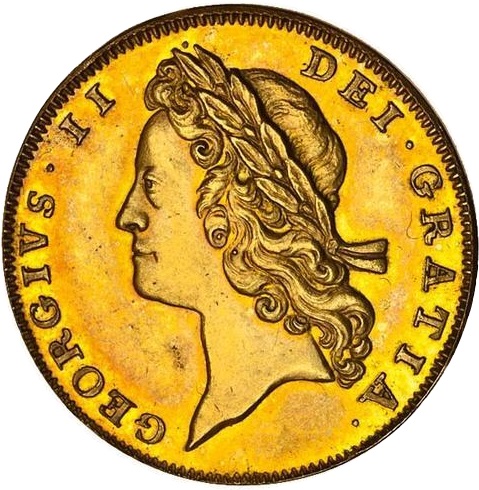
Second, young laureate portrait of King George II left, legend around.
GEORGIVS II DEI GRATIA
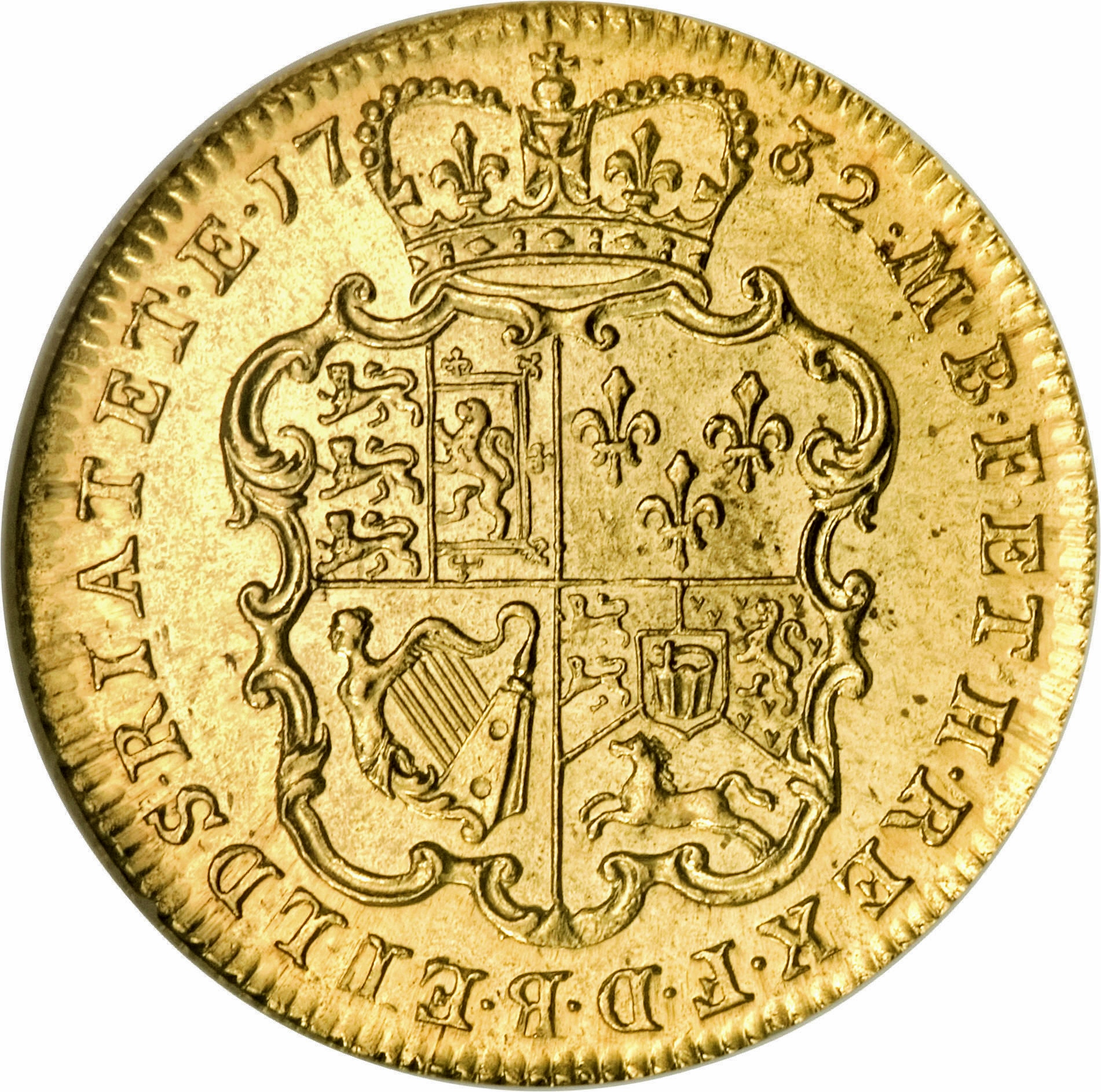
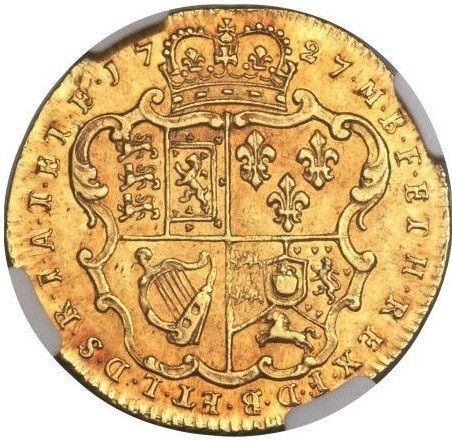
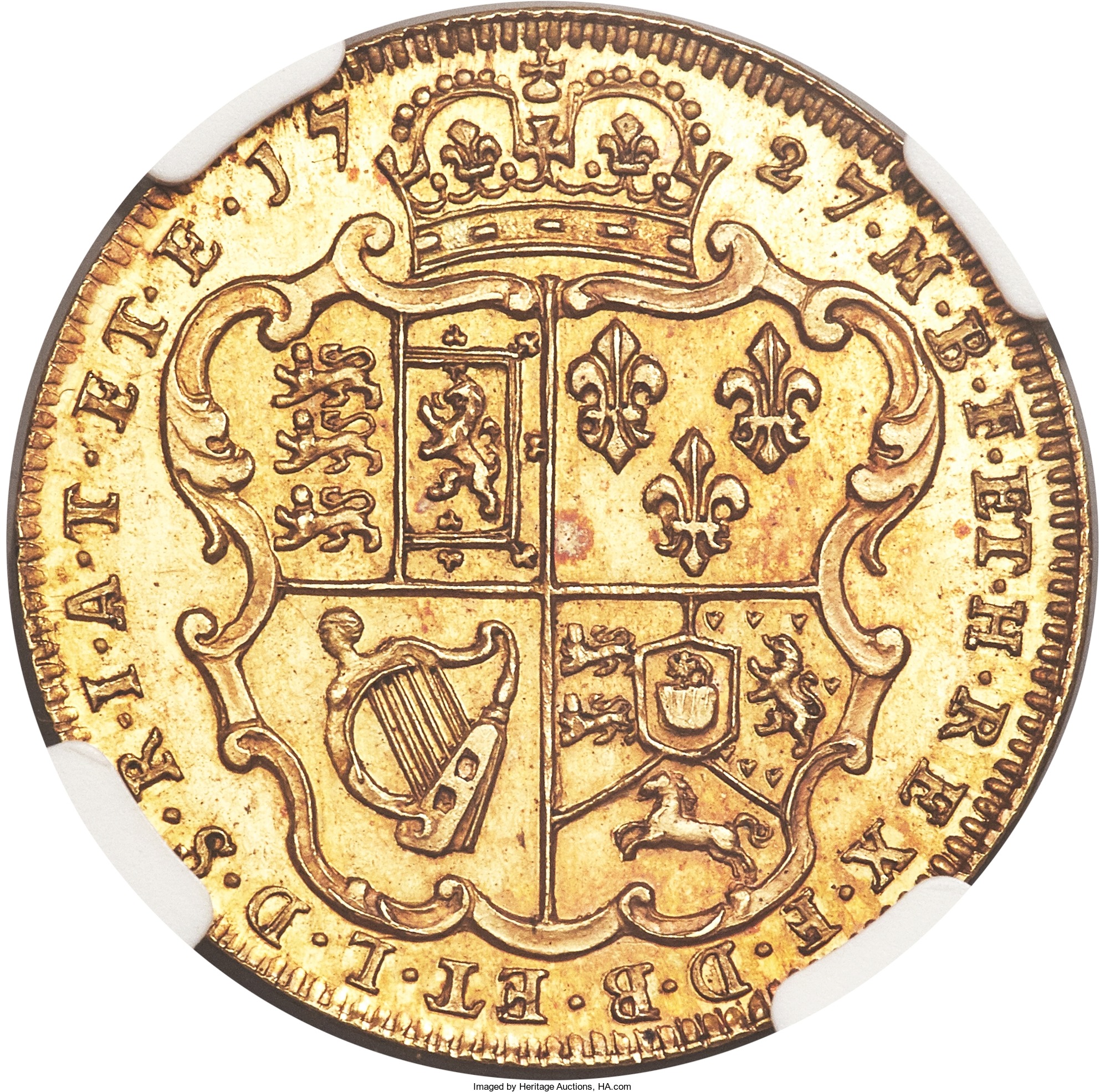
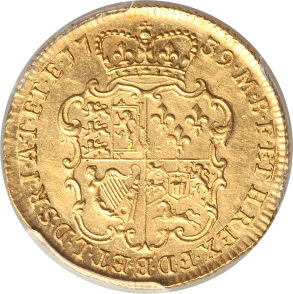
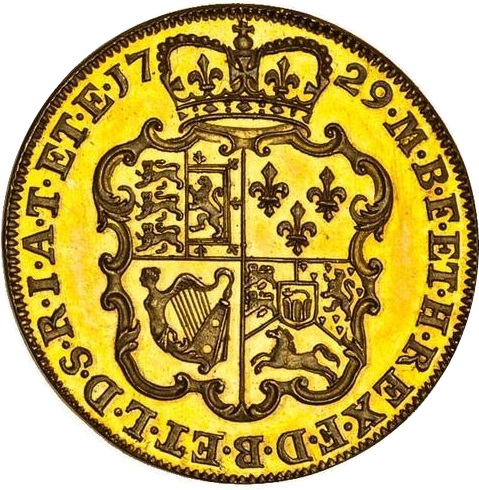
Crowned, quartered and garnished shield of arms with divided date above and legend around.
M B F ET H REX F D B ET L D S R I A T ET E
Find this on eBay
Affiliate1 Guinea - George II Pattern price history
Daily limit reachedAbout the 1729 1 Guinea - George II Pattern
The 1729 1 Guinea - George II Pattern is a collector 1 guinea coin, struck in 91.67% gold. It weighs 8.4g and measures 25mm across. Reverse design: Crowned, quartered and garnished shield of arms with divided date above and legend around.
It is no longer legal tender, so its value is to collectors only.
Common questions
How much is the 1729 1 Guinea - George II Pattern worth?
No verified sale of the 1729 1 Guinea - George II Pattern has been logged on MyCoinage yet. Its gold content is worth about £742 at today's spot price, which puts a floor under its value.
What is the 1729 George II proof guinea?
A proof striking of the guinea with George II's second young head, dated 1729 and made with a plain edge instead of the oblique graining of the currency coins. The Royal Mint Museum holds one, and its 1906 catalogue lists it among the proofs of the reign.
How rare is the 1729 proof guinea?
No number struck is recorded. Sincona catalogued the example it sold in 2022, graded NGC PF61, as äusserst selten (exceptionally rare). The Royal Mint Museum's specimen, catalogued as Wilson and Rasmussen 73, has been in the Mint's collection since at least 1874.
How can you tell a 1729 proof guinea from a currency coin?
Check the edge first: the proof has a plain edge, while ordinary 1729 guineas are grained obliquely. The proof also has proof surfaces, and the Royal Mint Museum's example is struck with the dies aligned the same way up, where its currency guineas are recorded with the reverse inverted.
How do I identify the 1729 1 Guinea - George II Pattern?
Check the weight 8.4g and diameter 25mm and the metal (91.67% gold) against the specification table on this page. The reverse design is described above.
History and design
Proofs exist for several of George II's early gold coins, and the 1729 guinea is one of them. It uses the second young head, which replaced the first head in 1729, and was struck with a plain edge rather than the oblique graining of the coins made for use. Hocking's 1906 catalogue of the Royal Mint's collection lists it as No. 1682 among the proofs of the reign, alongside a five guineas of 1731 and a half guinea of 1728.
The Royal Mint Museum's example (RMM 467) is gold, weighs 8.3 g and is catalogued as Wilson and Rasmussen 73; it was already in the Mint's 1874 catalogue. Another, graded NGC PF61 and weighing 8.39 g, was sold by Sincona in Zurich in 2022 and catalogued as äusserst selten (exceptionally rare). No number struck is recorded.
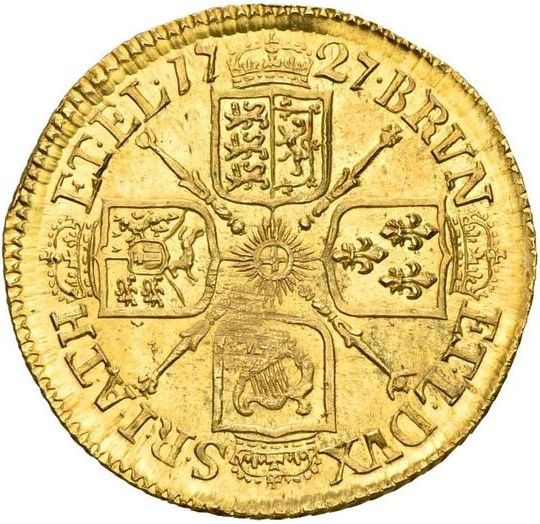
The obverse is John Croker's young laureate head of George II facing left, in its second, narrower form, with GEORGIVS II DEI GRATIA. Hocking credits the young bust to Croker and the later old bust to John Sigismund Tanner, who joined Croker as assistant in 1729. The reverse is the ornate crowned shield that the Royal Mint Museum credits to John Ochs, quartering England and Scotland, France, Ireland and Hanover, with M B F ET H REX F D B ET L D S R I A T ET E and the date. The museum's example has the two sides aligned the same way up.
Collecting notes
The plain edge is the first test, since currency guineas of 1729, including those with E.I.C. below the head, are grained obliquely. Proof surfaces should show as mirrored fields with sharp lettering. Spink's cataloguers compare the regular, E.I.C. and proof issues of 1729 in their notes on a 1730 guinea, so all three should be considered when attributing a 1729 date. The currency coin of this type is the second young head guinea.
Sources
The history, design, varieties and collecting notes on this page are drawn from these sources. Prices come from recorded sales, not from them.
- George II proof guinea, 1729 (RMM 467), The Royal Mint Museum, via Museum Data Service (read 12 Oct 2026)
- Catalogue of the Coins, Tokens, Medals, Dies and Seals in the Museum of the Royal Mint, Vol. I Part I (Hocking, 1906), page 163, proofs of George II, Royal Mint Museum library (read 12 Oct 2026)
- Catalogue of the Coins, Tokens, Medals, Dies and Seals in the Museum of the Royal Mint, Vol. I Part I (Hocking, 1906), page 158, George II introduction, Royal Mint Museum library (read 12 Oct 2026)
- George II, Royal Mint Museum (read 12 Oct 2026)
- Great Britain 1729 guinea, CoinVarieties (read 12 Oct 2026)
- George II guinea, 1727 (RMM 466), The Royal Mint Museum, via Museum Data Service (read 12 Oct 2026)
- George II 1730 guinea, lot 2962, Spink (read 12 Oct 2026)
More 1 Guinea coins from nearby years