1 Guinea - George II 2nd young portrait (1729–1738)
| Country | United Kingdom |
| Year | 1729–1738 |
| Denomination | 1 Guinea |
| Face value | £1.05 |
| Mint | Royal Mint · Llantrisant |
| Circulation | Circulating |
| Demonetised | 1891 |
| Composition | Gold (.9167) (917/1000 fine) |
| Weight | 8.400g · 0.2476 t oz |
| Diameter | 25.4mm |
| Shape | Round |
| Edge | Milled |
| Orientation | Coin alignment ↑↓ |
| Obv. artist | John Croker |
| Rev. artist | John Ochs |
| Grade scale | UK (EF/UNC) |
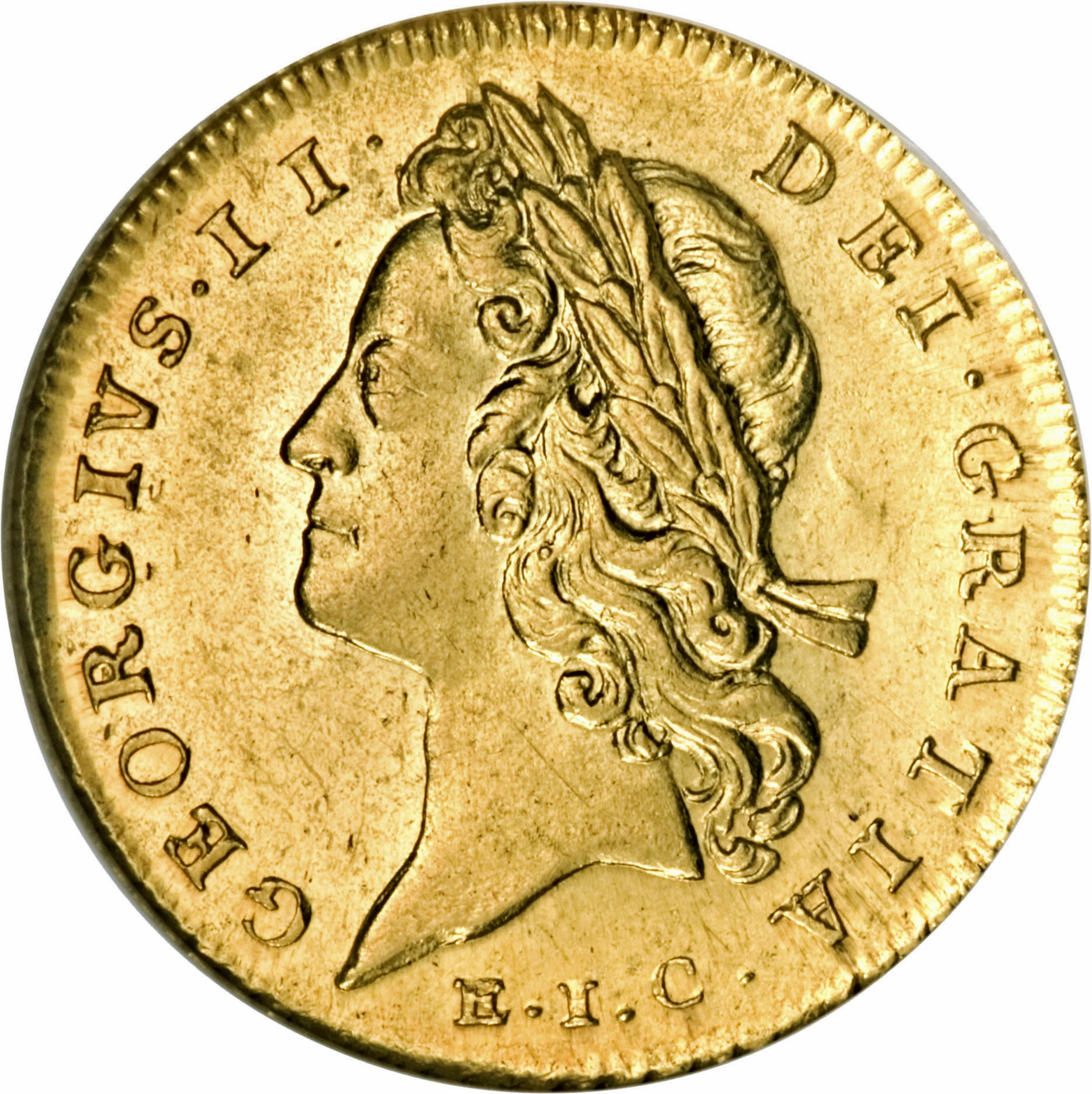
Second (narrower) young laureate portrait of King George II left, legend around.
GEORGIVS II DEI GRATIA
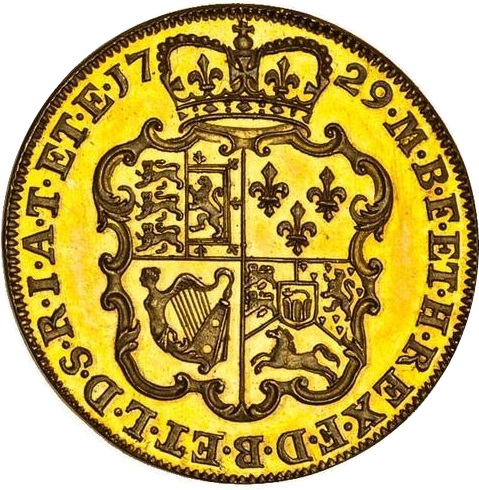
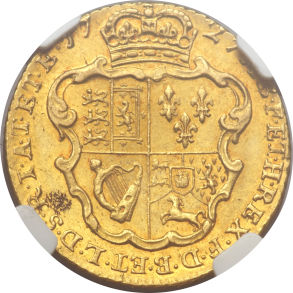
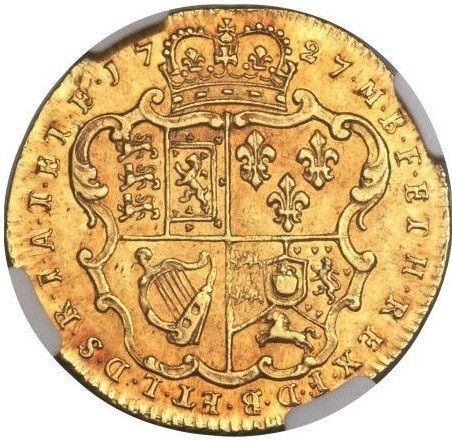
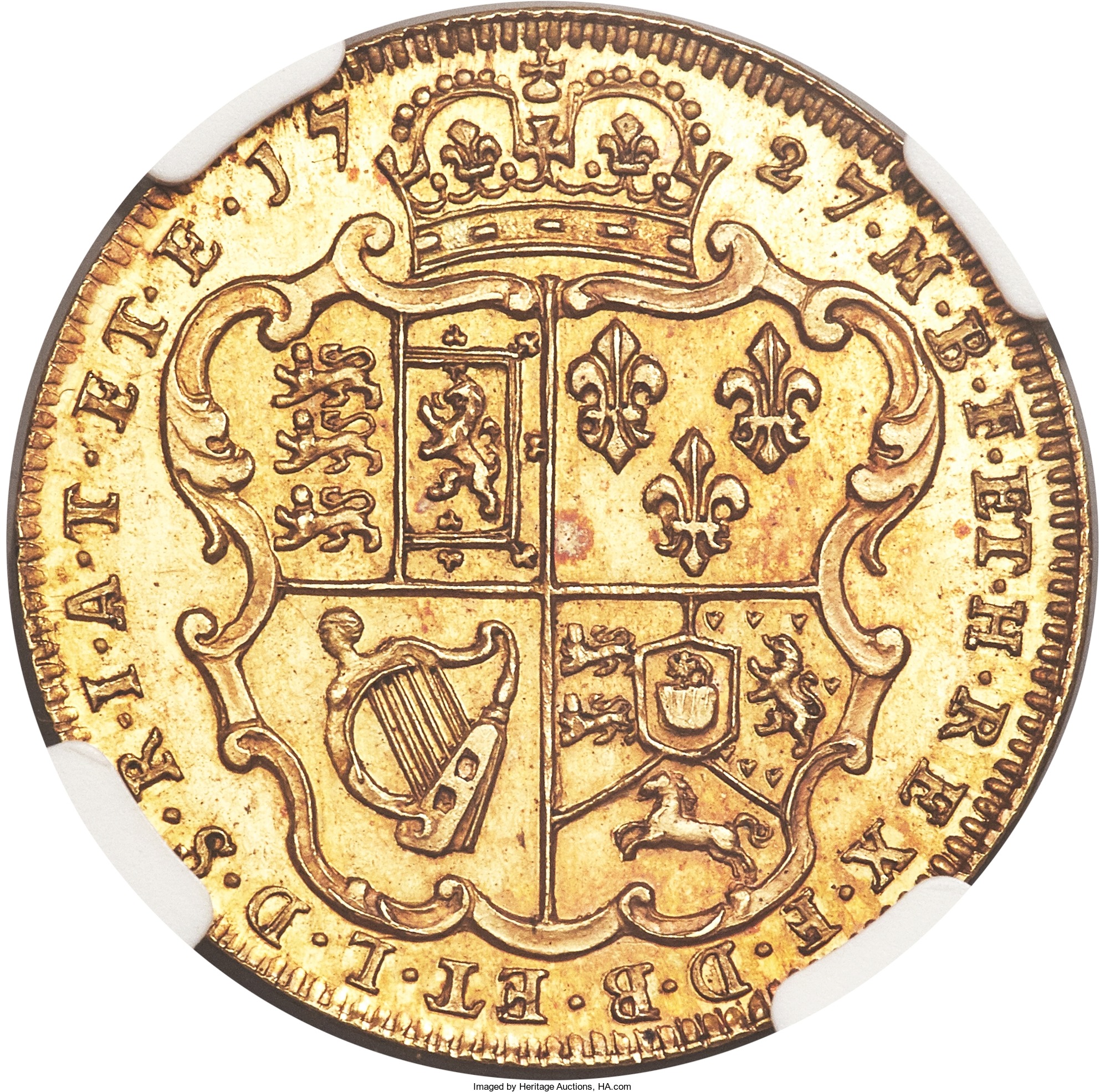
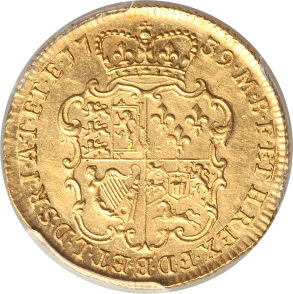
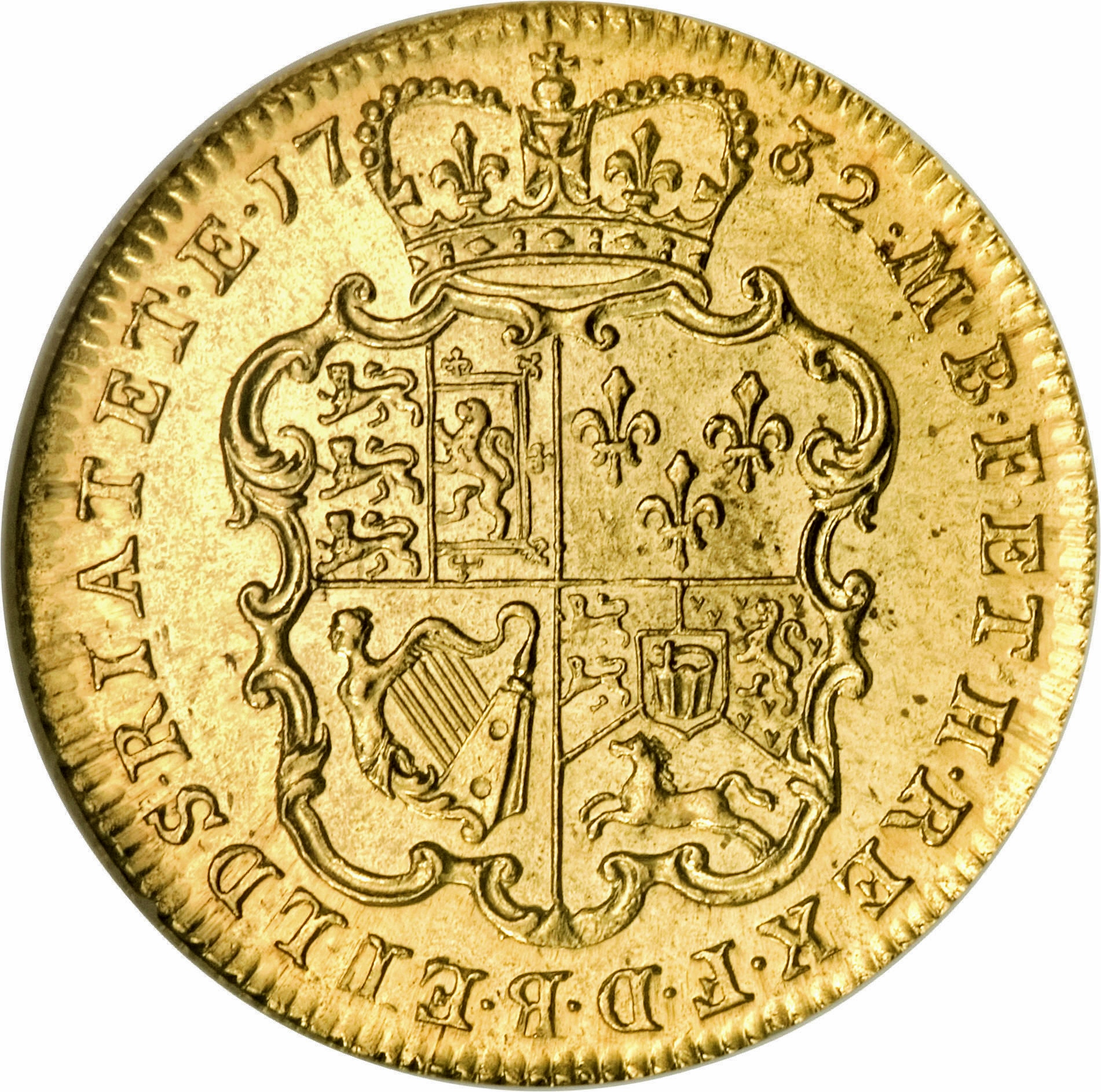
Crowned quartered shield of arms, divided date above, legend around.
M B F ET H REX F D B ET L D S R I A T ET E
Find this on eBay
Affiliate1 Guinea - George II 2nd young portrait price history
Daily limit reachedAbout the 1729 1 Guinea - George II 2nd young portrait
The 1729 1 Guinea - George II 2nd young portrait is a circulating 1 guinea coin issued from 1729 to 1738, struck in 91.67% gold. It weighs 8.4g and measures 25.4mm across. Reverse design: Crowned quartered shield of arms, divided date above, legend around.
It is no longer legal tender (withdrawn 1891), so its value is to collectors only.
Common questions
How much is the 1729 1 Guinea - George II 2nd young portrait worth?
No verified sale of the 1729 1 Guinea - George II 2nd young portrait has been logged on MyCoinage yet. Its gold content is worth about £742 at today's spot price, which puts a floor under its value.
What does E.I.C. mean on a George II guinea?
It stands for the East India Company, which supplied gold to the Royal Mint from 1729 to 1739. A royal warrant of November 1729 allowed the letters to be placed under the king's head on coins struck from its gold. Guineas of this type carry it in 1729, 1731 and 1732.
Which dates of the second young head guinea are scarce?
No mintages survive, so scarcity comes from the catalogues. Spink's cataloguers single out 1730 as a rare date, first reported in 1941, and CoinVarieties notes that 1732 is rare in the larger-lettered form. The E.I.C. coins are scarcer than the plain issues.
How do I tell the narrow and larger busts apart?
The earlier coins of 1729 to 1732 have a narrower head with small lettering. From 1732 to 1738 a larger head was used, and the Royal Mint's 1906 catalogue describes the 1733 guinea as having larger letters in the legends and a smaller shield on the reverse.
Is a George II guinea legal tender?
No. A royal proclamation of November 1890 called in all gold coins from before Queen Victoria's reign, and they were demonetised from 28 February 1891. The guinea had already been replaced by the sovereign after the recoinage of 1816.
How do I identify the 1729 1 Guinea - George II 2nd young portrait?
Check the weight 8.4g and diameter 25.4mm and the metal (91.67% gold) against the specification table on this page. The reverse design is described above.
History and design
In 1729 a narrower young head replaced the first portrait on George II's guinea, and it remained in use, with a change of size and lettering, until 1738. These were busy years for the gold coinage. The East India Company supplied gold bullion to the Mint from 1729 to 1739, and in 1733 a proclamation finally prohibited the old hammered gold, some of it dating back to Elizabeth I; the Royal Mint Museum records that 700,000 pounds' worth was recoined into guineas and half guineas.
No mintage survives for any date. Wikipedia records guineas for every year of the reign except 1742, 1744, 1754 and 1757, so this type exists for each year from 1729 to 1738. Spink's cataloguers call 1730 an extremely scarce date, first reported in Seaby's Coin Bulletin in May 1941.
The obverse is John Croker's young laureate head facing left with GEORGIVS II DEI GRATIA. Up to 1732 the head is narrower with small lettering; from 1732 a larger head was used, and the Royal Mint's 1906 catalogue describes the 1733 guinea as having larger letters and a smaller shield. In 1729 John Sigismund Tanner was appointed Croker's assistant, and from then he cut the reverse dies.
The reverse is the crowned, garnished shield that the Royal Mint Museum credits to John Ochs, quartering England and Scotland, France, Ireland and Hanover, with M B F ET H REX F D B ET L D S R I A T ET E and the date. The edge is grained obliquely. Coins struck from East India Company gold carry E.I.C. below the head, authorised by a Royal Warrant of November 1729.
Varieties and errors
The recognised varieties are the narrow and larger busts and the E.I.C. coins of 1729, 1731 and 1732, including an E.I.C. coin with the larger bust in 1732. Spink notes die differences such as the number of hearts in the Hanoverian quarter on a 1730 coin (nine against eight on other known dies).
Collecting notes
Attribute by date, then bust and lettering, then look below the truncation for E.I.C. Heritage's cataloguer notes that 1729 E.I.C. guineas seem always to be weakly struck, so softness there need not mean wear. Check the oblique edge graining for filing and weigh the coin. The 1729 proof with a plain edge is the separate 1729 pattern guinea; the intermediate head guinea followed in 1739.
Sources
The history, design, varieties and collecting notes on this page are drawn from these sources. Prices come from recorded sales, not from them.
- Guinea (coin), Wikipedia (read 12 Oct 2026)
- George II 1735 guinea, lot 178, Spink (read 12 Oct 2026)
- Great Britain 1730 guinea, CoinVarieties (read 12 Oct 2026)
- Sovereign (British coin), Wikipedia (read 12 Oct 2026)
- Great Britain 1736 guinea, CoinVarieties (read 12 Oct 2026)
- George II, Royal Mint Museum (read 12 Oct 2026)
- Catalogue of the Coins, Tokens, Medals, Dies and Seals in the Museum of the Royal Mint, Vol. I Part I (Hocking, 1906), pages 158 to 159, Royal Mint Museum library (read 12 Oct 2026)
- British gold coin, guinea 1732 with E I C (HCR8159), Ashmolean Museum, via Museum Data Service (read 12 Oct 2026)
- Great Britain 1729-EIC guinea, CoinVarieties (read 12 Oct 2026)
- Great Britain 1731-EIC guinea, CoinVarieties (read 12 Oct 2026)
- Great Britain 1732 guinea, CoinVarieties (read 12 Oct 2026)
- Great Britain 1738 guinea, CoinVarieties (read 12 Oct 2026)
- George II 1730 guinea, lot 2962, Spink (read 12 Oct 2026)
More 1 Guinea coins from nearby years