1 Guinea - George II 1st young portrait (1727)
| Country | United Kingdom |
| Year | 1727 |
| Denomination | 1 Guinea |
| Face value | £1.05 |
| Mint | Royal Mint · Llantrisant |
| Circulation | Circulating |
| Demonetised | 1891 |
| Composition | Gold (.9167) (917/1000 fine) |
| Weight | 8.400g · 0.2476 t oz |
| Diameter | 25.0mm |
| Shape | Round |
| Edge | Milled |
| Orientation | Coin alignment ↑↓ |
| Obv. artist | John Croker |
| Rev. artist | John Ochs |
| Grade scale | UK (EF/UNC) |
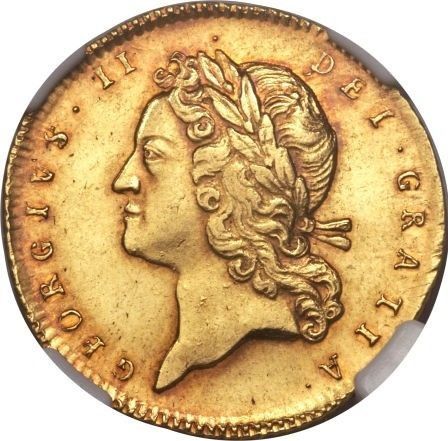
First young laureate portrait of King George II left, legend around.
GEORGIVS II DEI GRATIA
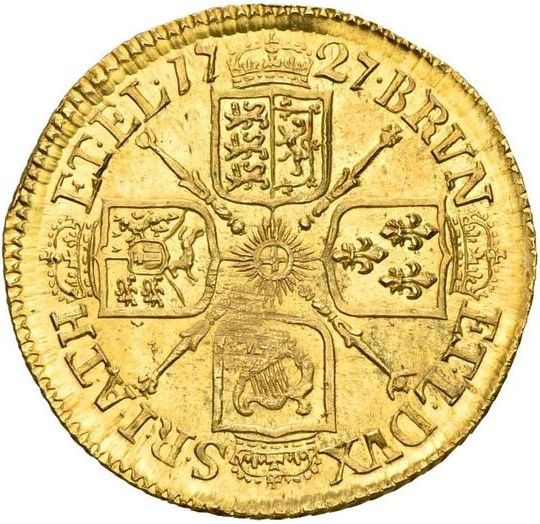
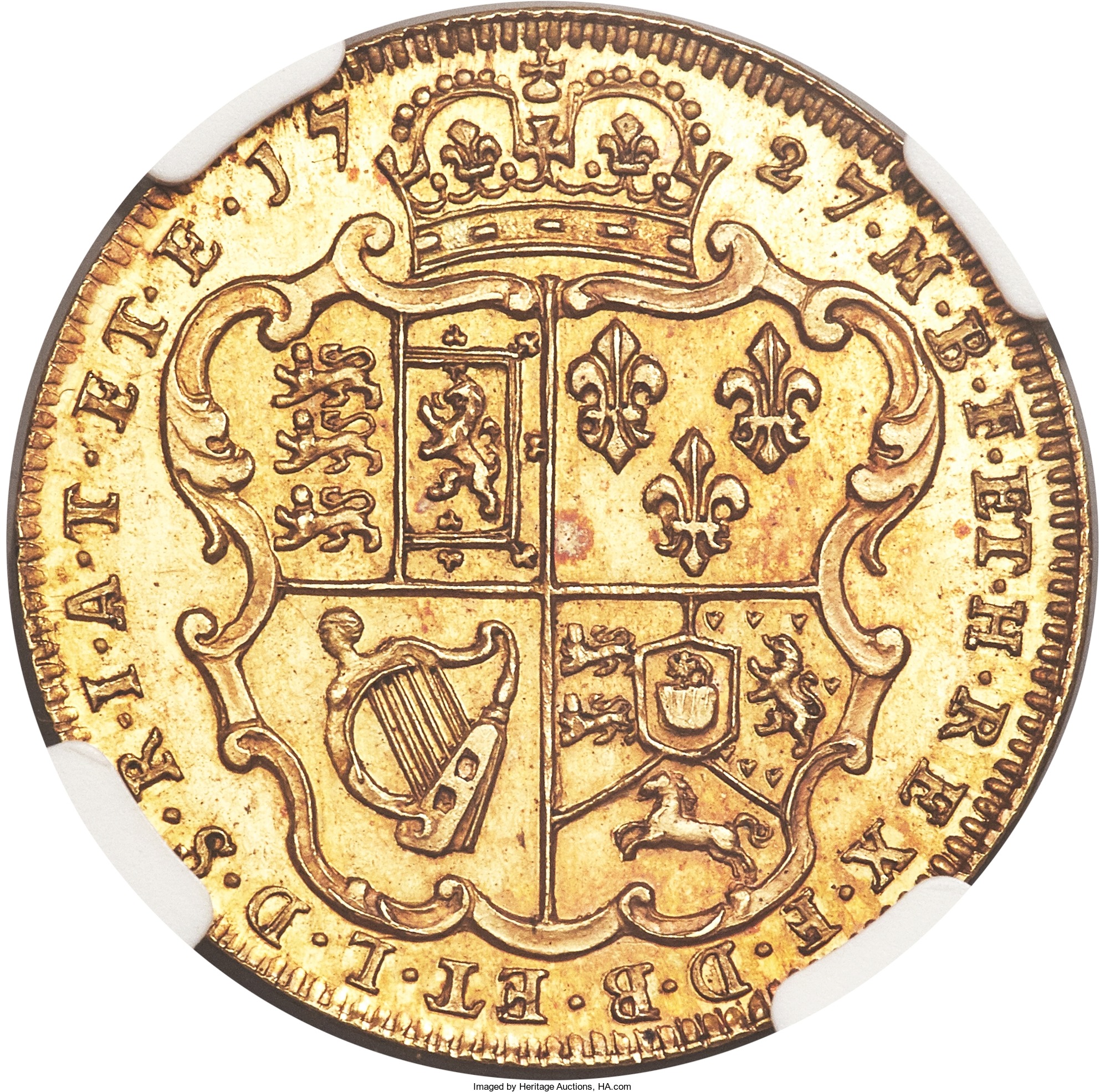
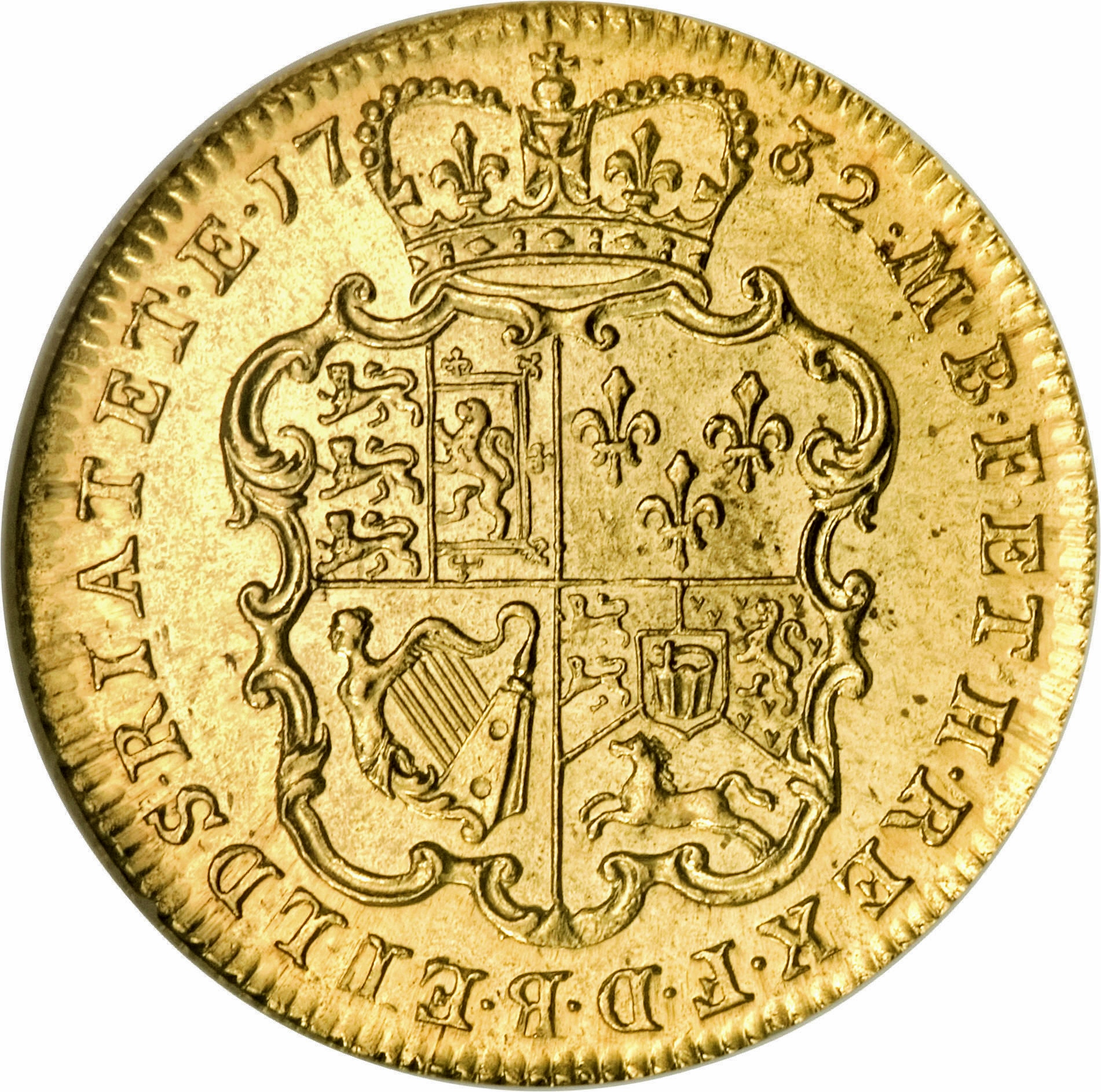
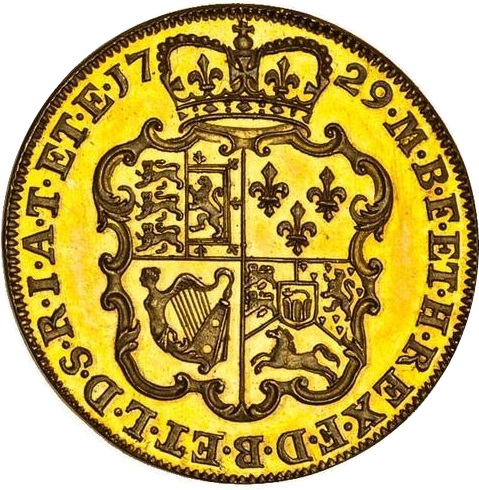
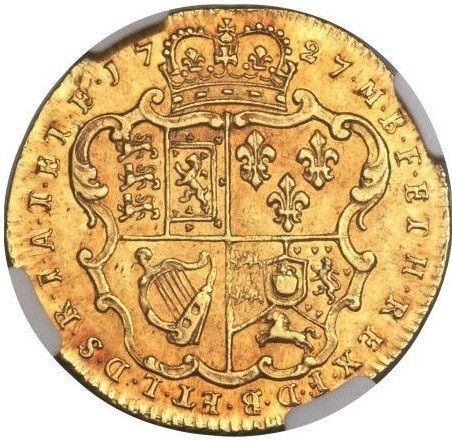
Crowned quartered shield of arms, divided date above, legend around.
M B F ET H REX F D B ET L D S R I A T ET E
Find this on eBay
Affiliate1 Guinea - George II 1st young portrait price history
Daily limit reachedAbout the 1727 1 Guinea - George II 1st young portrait
The 1727 1 Guinea - George II 1st young portrait is a circulating 1 guinea coin, struck in 91.67% gold. It weighs 8.4g and measures 25mm across. Reverse design: Crowned quartered shield of arms, divided date above, legend around.
It is no longer legal tender (withdrawn 1891), so its value is to collectors only.
Common questions
How much is the 1727 1 Guinea - George II 1st young portrait worth?
No verified sale of the 1727 1 Guinea - George II 1st young portrait has been logged on MyCoinage yet. Its gold content is worth about £742 at today's spot price, which puts a floor under its value.
How many 1727 George II guineas were made?
No mintage is recorded. CoinVarieties gives the recorded mintage as unknown, as it does for every George II guinea, because the Mint's surviving accounts do not give figures by date and type. Scarcity is judged from surviving examples instead.
How do I tell the first 1727 guinea from the second?
Look at the lettering. This first type has small letters in the legends and a large shield under a small crown, as the Royal Mint's 1906 collection catalogue describes it. A second obverse with larger lettering was used in 1727 and 1728.
Who designed the George II young head guinea?
John Croker, Chief Engraver of the Royal Mint from 1705, made the young head. The Royal Mint Museum credits the new single crowned shield on the reverse to John Ochs. Croker had also cut the coins of Anne and George I.
Is a 1727 guinea still legal tender?
No. In 1890 a royal proclamation called in all gold coins struck before Queen Victoria's reign, and they ceased to be legal currency from 28 February 1891. The guinea itself had been replaced by the sovereign after the recoinage of 1816.
How do I identify the 1727 1 Guinea - George II 1st young portrait?
Check the weight 8.4g and diameter 25mm and the metal (91.67% gold) against the specification table on this page. The reverse design is described above.
History and design
George II came to the throne in 1727, and guineas in his name were struck in the same year that George I's last guineas were dated. This is the first of his guinea types: a young laureate head that was used for 1727 only. A second obverse with different lettering was used in 1727 and 1728. The guinea was then fixed at 21 shillings, the rate set in 1717.
No mintage is recorded for this or any other George II guinea. Wikipedia notes that the reign used eight obverses and five reverses, and that some 1727 guineas were struck slightly smaller, 24 to 25 mm rather than the usual 25 to 26 mm. The Royal Mint Museum holds an example of this type weighing 8.35 g.
The obverse is John Croker's young head of George II, laureate and facing left, with GEORGIVS II DEI GRATIA. The Royal Mint's 1906 collection catalogue describes this 1727 guinea as having the legends in small letters. Croker had been Chief Engraver since 1705 and had cut almost all the dies of Anne and George I.
The reverse dropped the four shields and Garter star of the previous reign for a single ornate crowned shield, which the Royal Mint Museum credits to John Ochs. The quarters show England and Scotland impaled, France, Ireland and the Electorate of Hanover. On this type the shield is large and the crown small. The legend M B F ET H REX F D B ET L D S R I A T ET E gives the king's titles as King of Great Britain, France and Ireland, Defender of the Faith, Duke of Brunswick and Luneburg, Arch-Treasurer and Elector of the Holy Roman Empire. The edge is grained obliquely.
Collecting notes
Attribution rests on the lettering: small letters with a large shield point to this type, while larger letters mean the commoner 1727 to 1728 obverse. The date alone does not settle it, and a George I fifth-portrait guinea can also be dated 1727, so check that the head faces left. The Royal Mint Museum's coin, catalogued as Spink 3670, is a useful reference for both features.
Check the oblique edge graining for filing, a common fault on gold of this period, and the weight against the 8.35 g museum example. Look for mount marks and smoothed fields. A proof striking of this type is recorded and is catalogued separately as the 1727 pattern guinea.
Pre-Victorian gold was called in by proclamation in 1890 and ceased to be legal currency from 28 February 1891.
Sources
The history, design, varieties and collecting notes on this page are drawn from these sources. Prices come from recorded sales, not from them.
- Guinea (coin), Wikipedia (read 12 Oct 2026)
- George II, Royal Mint Museum (read 12 Oct 2026)
- Catalogue of the Coins, Tokens, Medals, Dies and Seals in the Museum of the Royal Mint, Vol. I Part I (Hocking, 1906), pages 158 to 159, Royal Mint Museum library (read 12 Oct 2026)
- George II guinea, 1727 (RMM 466), The Royal Mint Museum, via Museum Data Service (read 12 Oct 2026)
- Great Britain 1727 guinea Fr-339, CoinVarieties (read 12 Oct 2026)
- Great Britain 1728 guinea, CoinVarieties (read 12 Oct 2026)
- Great Britain 1727 guinea Fr-327 (George I), CoinVarieties (read 12 Oct 2026)
- Sovereign (British coin), Wikipedia (read 12 Oct 2026)
- John Croker (engraver), Wikipedia (read 12 Oct 2026)
More 1 Guinea coins from nearby years