1 Cent - Elizabeth II Decimal Pattern (1961)
| Country | United Kingdom |
| Year | 1961 |
| Denomination | 1 Penny |
| Mint | Royal Mint · Llantrisant |
| Circulation | Non-circulating |
| Composition | Bronze |
| Weight | 2.910g |
| Shape | Round |
| Edge | Plain |
| Grade scale | UK (EF/UNC) |
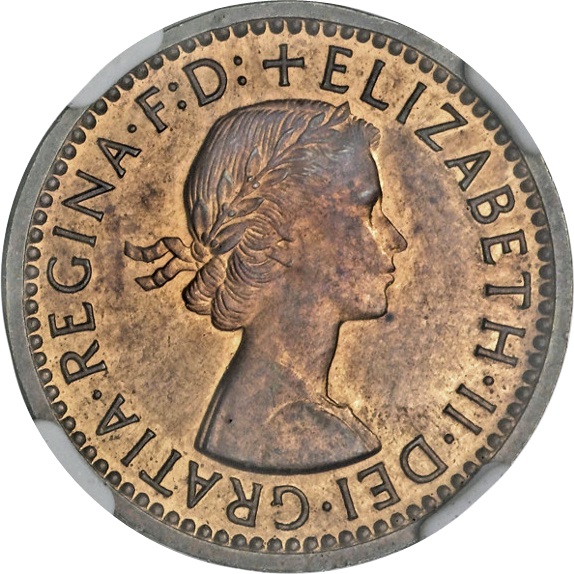
Young laureate bust of Queen Elizabeth II facing right, legend around
+ ELIZABETH · II · DEI · GRATIA · REGINA · F: D:
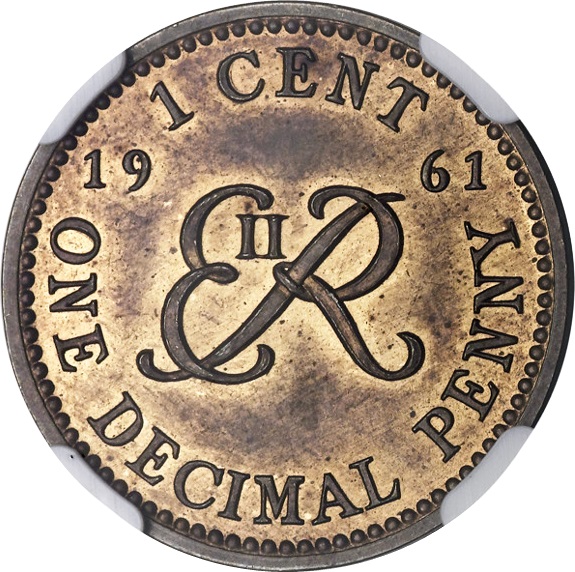
Central Royal monogram dividing date, denomination above and around
Find this on eBay
Affiliate1 Cent - Elizabeth II Decimal Pattern price history
Daily limit reachedAbout the 1961 1 Cent - Elizabeth II Decimal Pattern
The 1961 1 Cent - Elizabeth II Decimal Pattern is a collector 1 penny coin, struck in bronze. It weighs 2.91g. Reverse design: Central Royal monogram dividing date, denomination above and around.
Common questions
How much is the 1961 1 Cent - Elizabeth II Decimal Pattern worth?
No verified sale of the 1961 1 Cent - Elizabeth II Decimal Pattern has been logged on MyCoinage yet.
Was the 1961 cent ever legal tender?
No. It is a pattern, a trial piece struck by the Royal Mint while decimal currency was being considered. Britain never adopted a cent: the decimal coinage introduced on 15 February 1971 kept the pound and divided it into 100 new pence.
How many 1961 pattern cents exist?
No mintage has been published. The Royal Mint Museum holds an example, and London Coins, selling a cased six-coin set in 2022, stated that only two to five sets are believed to exist. That is an auctioneer's estimate, not an official figure.
Why is a coin dated 1961 described as struck in 1962 and 1963?
According to London Coins, the set was struck in the winter and spring of 1962 to 1963 for the Decimal Coinage Committee formed in December 1961 under the Earl of Halsbury. The date 1961 appears on the coins, but the striking followed the committee's creation.
What does the 1961 pattern cent show?
The Royal Mint Museum's record describes a wreathed portrait of the Queen facing right on the obverse, and a royal cipher with the inscription 1 CENT on the reverse. London Coins describes the cipher as an EIIR monogram. The edge is plain and the coin weighs about 2.9g.
How do I identify the 1961 1 Cent - Elizabeth II Decimal Pattern?
Check the weight 2.91g and the metal (bronze) against the specification table on this page. The reverse design is described above.
History and design
In 1961 the government set up the Committee of Inquiry on Decimal Currency under the Earl of Halsbury, which reported in 1963. This bronze cent belongs to a set of six pattern coins, 50 cents down to 1 cent, that the Royal Mint prepared while the question was open. London Coins, which sold a cased set in 2022, records that the coins were struck in the winter and spring of 1962 to 1963 for the Decimal Coinage Committee formed in December 1961, and that the Deputy Master of the Mint circulated them at its meetings.
The coins were never issued. Wikipedia records that Halsbury decided the pound should remain the main unit, and the decimal coinage of 1971 used new pence rather than cents. No mintage has been published. London Coins states that only two to five sets are believed to exist, and the Royal Mint Museum holds an example of the cent as RMM 3062.
The Royal Mint Museum's record describes a wreathed portrait of the Queen facing right, with the legend + ELIZABETH · II · DEI · GRATIA · REGINA · F: D:, without the BRITT OMN that appeared on the 1953 coinage. The reverse carries a royal cipher, described by London Coins as an EIIR monogram, with the inscription 1 CENT. The edge is plain and the museum gives the weight as 2.9g.
The rest of the set drew on older designs: London Coins lists Una and the Lion on the 50 cents, a standing Britannia on the 20 cents, a crowned shield in the Garter on the 10 cents, a lion on a crown on the 5 cents and a crowned trident head on the 2 cents.
Collecting notes
This is a pattern, not a coin that was ever in anyone's change. London Coins notes that it found no other record of the set in a Royal Mint case, and that the Freeman, Krause and Coincraft catalogues do not mention one. Catalogue references are Peck 2530 and Freeman 793. The companion 2 cents pattern carries the trident design.
Sources
The history, design, varieties and collecting notes on this page are drawn from these sources. Prices come from recorded sales, not from them.
- Coin; pattern; one cent (RMM 3062), Royal Mint Museum, via Museum Data Service (read 10 Oct 2026)
- Royal Mint Pattern Decimal Set 1961, a 6-coin set 50 Cents to One Cent (Auction 178, lot 1244), London Coins (read 10 Oct 2026)
- Decimal Day, Wikipedia (read 10 Oct 2026)
- Proclamation determining new designs for gold, silver, cupro-nickel, mixed metal and bronze coins, London Gazette issue 39703, The London Gazette (read 10 Oct 2026)
More 1 Penny coins from nearby years