Elite: fewer than 10,000 minted.
1 Penny - George VI 3rd Maundy issue (1949–1952)
"Maundy penny"
| Country | United Kingdom |
| Year | 1949–1952 |
| Denomination | 1 Penny |
| Mintage | 1,407 |
| Mint | Royal Mint · Llantrisant |
| Series | Maundy Money |
| Circulation | Non-circulating |
| Composition | Silver (.925) (925/1000 fine) |
| Weight | 0.470g · 0.0140 t oz |
| Diameter | 11.0mm |
| Shape | Round |
| Edge | Plain |
| Orientation | Medal alignment ↑↑ |
| Obv. artist | Thomas Humphrey Paget |
| Rev. artist | Jean Baptiste Merlen |
| Grade scale | UK (EF/UNC) |
Uncrowned portrait of King George VI left, legend around.
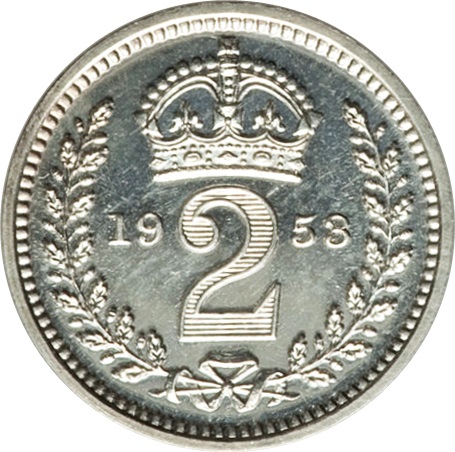
Crowned denomination dividing date within oak wreath.
Crowned numeral 1 in an oak wreath, date across the figure
Find this on eBay
Affiliate1 Penny - George VI 3rd Maundy issue price history
Daily limit reachedAbout the 1949 1 Penny - George VI 3rd Maundy issue
The 1949 1 Penny - George VI 3rd Maundy issue is a collector 1 penny coin issued from 1949 to 1952 in the Maundy Money series, struck in 92.5% silver. It weighs 0.47g and measures 11mm across. Reverse design: Crowned denomination dividing date within oak wreath.
A mintage of 1,407 is recorded for one date of this type; figures for each year are not held.
Common questions
How much is the 1949 1 Penny - George VI 3rd Maundy issue worth?
No verified sale of the 1949 1 Penny - George VI 3rd Maundy issue has been logged on MyCoinage yet.
What changed on the Maundy penny in 1949?
Only the legend. After India's independence a royal proclamation of 22 June 1948 removed Indiae Imperator from the King's titles, so from 1949 the legend ends FIDEI DEF instead of F:D:IND:IMP. The coins stayed in sterling silver, adopted for Maundy money in 1947.
How many 1952 Maundy pennies were made?
Coinstrail's catalogue gives 1,024, the lowest of George VI's reign, against 1,407 to 1,527 for 1949 to 1951. The site currently shows 1,012. The King died on 6 February 1952, but Maundy coins dated that year still carry his portrait.
Did George VI change the Maundy design?
He kept it. Wikipedia records that in 1950 the Royal Mint proposed going back to the pre-1888 style of numeral 2 on the twopence. George VI refused, feeling the existing numeral matched those on the other Maundy coins.
Is a George VI Maundy penny still legal tender?
Technically yes. Wikipedia notes Maundy coins are legal tender though they do not circulate. The Royal Mint Museum says the face values changed from old to new pence at decimalisation in 1971, so the penny now counts as 1p.
How do I identify the 1949 1 Penny - George VI 3rd Maundy issue?
Check the weight 0.47g and diameter 11mm and the metal (92.5% silver) against the specification table on this page. The reverse design is described above.
History and design
Royal Maundy money is given by the sovereign on Maundy Thursday to elderly men and women, as many of each as the monarch's years. The Royal Mint Museum notes that the white purse holds silver Maundy coins worth the same number of pence, made up of fourpences, threepences, twopences and pennies.
This last George VI type followed the change to the King's title. The Gazette records that a proclamation of 22 June 1948, issued after Indian independence, directed that Indiae Imperator be omitted from the royal style, and from 1949 the coinage legend ends FIDEI DEF. Tony Clayton lists the 1949 to 1952 Maundy sets as a separate third type for this reason. Coinstrail's catalogue gives 1,407 pennies for 1949, 1,527 for 1950, 1,480 for 1951 and 1,024 for 1952. Clayton records that the King died on 6 February 1952.
The obverse is Thomas Humphrey Paget's left-facing portrait of George VI, credited to him by the Royal Mint, now with GEORGIVS VI D:G:BR:OMN:REX FIDEI DEF. The coins remained in sterling .925 silver, to which Maundy money had returned in 1947.
The reverse is the figure 1 with the date across it, in an oak wreath under the Royal Crown, as laid down in 1937. Wikipedia credits the wreath design to Jean Baptiste Merlen in 1822 and the crown to Leonard Charles Wyon's 1888 revision. It also records that in 1950 the King turned down a Mint proposal to restore the pre-1888 numeral 2 on the twopence. The edge is plain.
Collecting notes
The 1952 date has the lowest figure of the reign's Maundy pennies. Check the legend to separate this type from the 1947 and 1948 pennies, which still read IND IMP; the 1947 to 1948 Maundy penny has its own page. Tony Clayton notes that the four coins of a year are not always equally easy to find, so single pennies and full sets both appear.
Maundy coins remain legal tender, revalued at decimalisation, so this penny counts as 1p.
Sources
The history, design, varieties and collecting notes on this page are drawn from these sources. Prices come from recorded sales, not from them.
- Penny 1937 to 1952, George VI (silver penny list), Coinstrail (read 10 Oct 2026)
- Values of Coins of the UK, Maundy Sets, Tony Clayton, Coins of the UK (read 10 Oct 2026)
- History of the British penny (1901 to 1970), Wikipedia (read 10 Oct 2026)
- 1942 George VI Maundy Set, The Royal Mint (read 10 Oct 2026)
- Maundy money, Royal Mint Museum (read 10 Oct 2026)
- Royal Maundy, Wikipedia (read 10 Oct 2026)
- Maundy Money, Tony Clayton, Coins of the UK (read 10 Oct 2026)
- UK Coins of George VI, Tony Clayton, Coins of the UK (read 10 Oct 2026)
- Proclamation giving currency to a new threepenny piece and determining new designs for gold, silver and bronze coins (London Gazette issue 34381), The Gazette (read 10 Oct 2026)
- Succession to the Crown: King George VI, The Gazette (read 10 Oct 2026)
- Humphrey Paget, Royal Mint Museum (read 10 Oct 2026)
More from Maundy Money