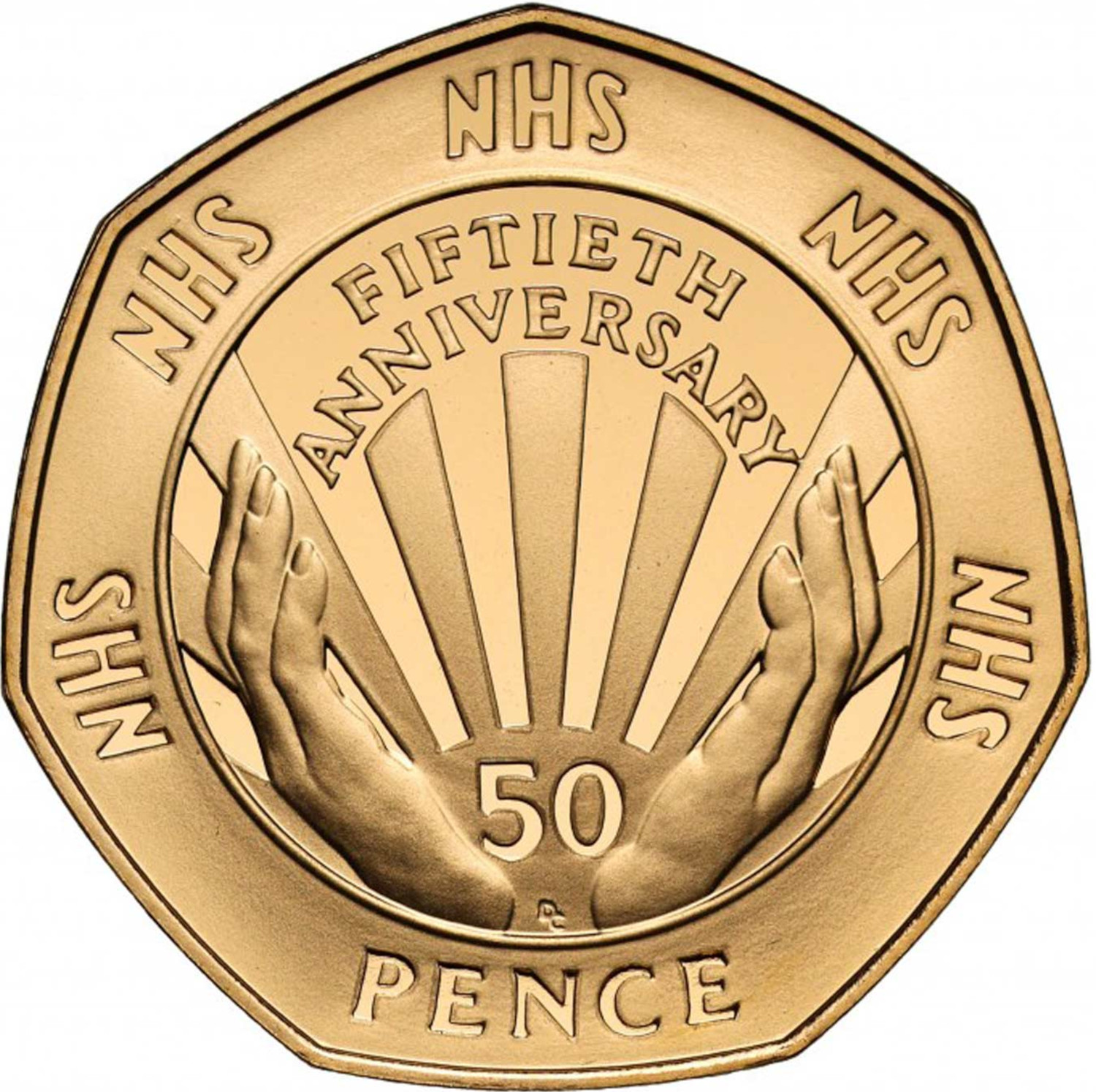
<p>Introduced 14 October 1969, the 50p was the first heptagonal (seven-sided) coin in any major world currency. Over 55 years it has had three major redesigns, hosted more than 90 reverse designs, and become the UK's most-collected circulating denomination.</p>
<h2>1969: Pre-decimal foundations</h2>
<p>The original 50p replaced the 10-shilling note as part of decimalisation preparation. Why seven-sided? The shape, more precisely a Reuleaux heptagon, gives constant diameter regardless of the angle measured, so it still works in coin-operated machines designed for round coins, while being instantly distinguishable by touch from the 10p.</p>
<p>The debut 1969 reverse carried a seated Britannia design by Christopher Ironside, the same designer responsible for much of the decimal coinage.</p>
<h2>1973: Britain joins the EEC</h2>
<p>The first commemorative 50p marked Britain's 1 January 1973 entry into the European Economic Community. Designer David Wynne depicted clasped hands in a circle, the nine hands representing the EEC's nine member states. Circulating mintage: 90 million.</p>
<h2>1997: The "small 50p" redesign</h2>
<p>In September 1997 the 50p was reduced from 30mm to 27.3mm and 13.5g to 8g, the same redesign that shrunk the 5p, 10p and similar. Older "large" 50ps ceased being legal tender on 28 February 1998. Designs to that date: 1973 EEC entry, 1992 EEC presidency (109,000 mintage, the rare old large), 1994 D-Day 50th, and 1997 Britannia.</p>
<h2>2004 onwards: the commemorative explosion</h2>
<p>From 2004 the Royal Mint adopted a strategy of regular themed reverses. By 2024 more than 70 distinct designs had entered circulation. Key milestones:</p>
<ul>
<li><strong>2009 Kew Gardens 50p</strong>, the rarest modern circulating 50p (210,000 mintage). See our <a href="/guides/50p-coin-values-uk">50p values guide</a>.</li>
<li><strong>2011 London 2012 Olympic series</strong>, 29 different sports-themed coins. The largest single-year 50p series ever issued.</li>
<li><strong>2016–2018 Beatrix Potter</strong>, 13 circulating designs; see <a href="/guides/peter-rabbit-50p-series">our Peter Rabbit 50p series guide</a>.</li>
<li><strong>2018–present Paddington Bear</strong>, six designs to date; see <a href="/guides/paddington-50p-guide">our Paddington guide</a>.</li>
<li><strong>2022 Elizabeth II memorial</strong>, the first Charles III circulating coin.</li>
<li><strong>2022–present Harry Potter 50p</strong>, see <a href="/guides/harry-potter-50p-guide">our Harry Potter guide</a>.</li>
</ul>
<h2>The design constraints</h2>
<p>Every 50p reverse has to meet Royal Mint specifications: the design must "read" at arm's length, not clash with seven-sided edge geometry, and be technically strikeable. Edwina Ellis's 2018 A-Z 10p series (not 50p but the same principle) was famously criticised for cramming too much detail into a small field, a lesson the 50p designs have generally heeded.</p>
<h2>Looking ahead</h2>
<p>Under Charles III, the Royal Mint has continued the commemorative 50p programme at pace, Gruffalo, Snowman and Platinum Jubilee designs have all appeared since 2022. Expect the series to continue indefinitely. For now, the 50p remains the British collector's coin of choice.</p>
A Brief History of the British 50p Coin
👤
Editor, MyCoinage
·
Published 22 May 2026