½ Sovereign - George IV Pattern (1825)
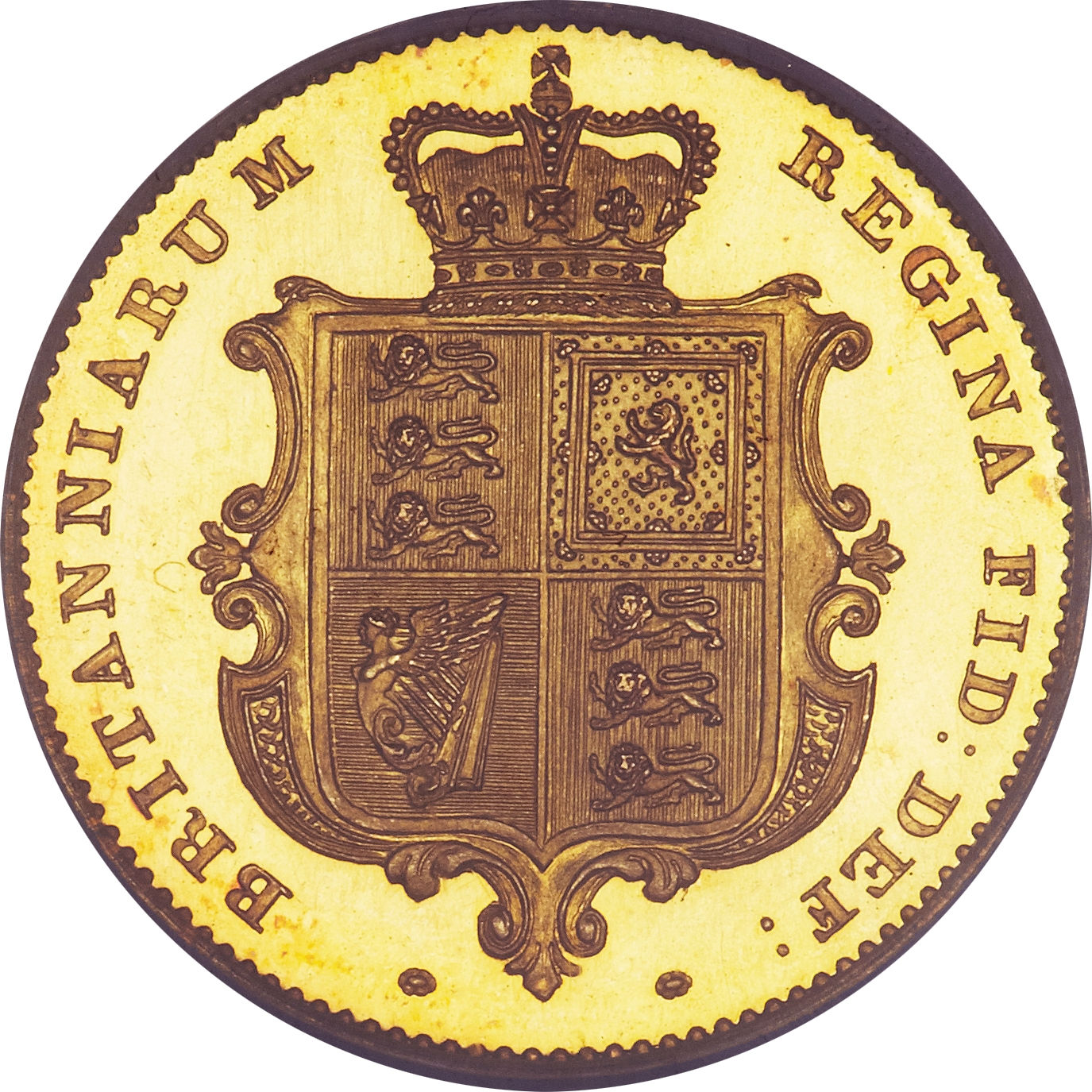
Circulating version: 1825 1 Crown - George IV Uniface Pattern
| Country | United Kingdom |
| Year | 1825 |
| Denomination | ½ Sovereign |
| Face value | 50p |
| Mint | Royal Mint · Llantrisant |
| Series | Half Sovereign |
| Circulation | Non-circulating |
| Demonetised | Yes |
| Composition | Gold (.9167) (917/1000 fine) |
| Shape | Round |
| Edge | Plain |
| Orientation | Medal alignment ↑↑ |
| Obv. artist | Francis Chantrey (model); William Wyon (engraver) |
| Rev. artist | Jean Baptiste Merlen |
| Grade scale | UK (EF/UNC) |
Left effigy of King George IV surrounded by the inscription "- GEORGIUS IV DEI GRATIA -" (George IV by the grace of God) and the vintage.This is an automatic translation. The original text is:Effigie gauche du roi George IV entourée de l'inscription "· GEORGIUS IV DEI GRATIA ·" (George IV par la grâce de Dieu) et le millésime.
GEORGIUS IV DEI GRATIA
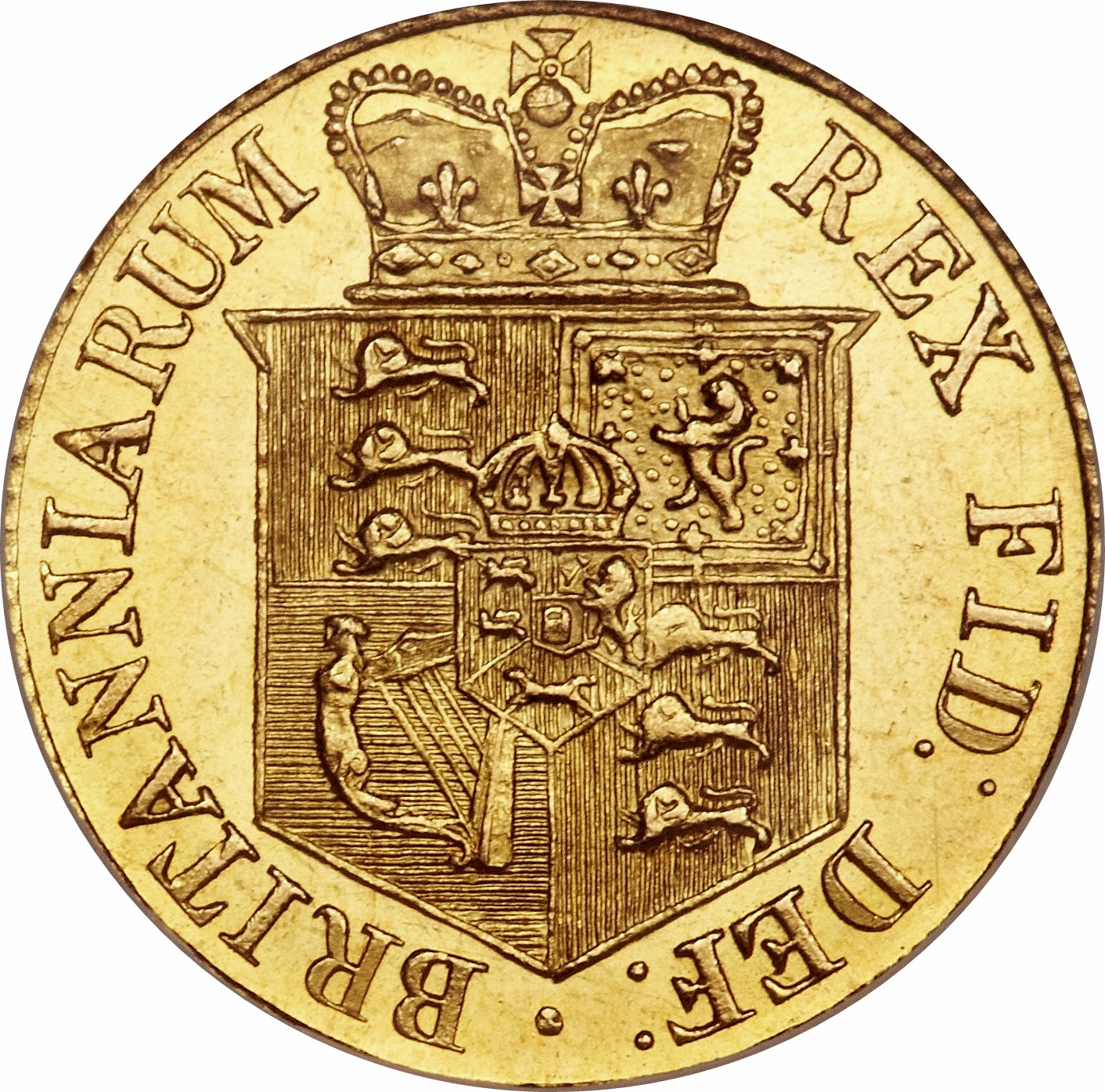
Royal coat of arms.
BRITANNIARUM REX FID: DEF:
Find this on eBay
AffiliateHalf Sovereign - George IV Pattern price history
Daily limit reachedAbout the 1825 Half Sovereign - George IV Pattern
The 1825 Half Sovereign - George IV Pattern is a collector ½ sovereign coin in the Half Sovereign series, struck in 91.67% gold. Reverse design: Royal coat of arms.
It is no longer legal tender, so its value is to collectors only.
Common questions
How much is the 1825 Half Sovereign - George IV Pattern worth?
No verified sale of the 1825 Half Sovereign - George IV Pattern has been logged on MyCoinage yet.
What is the 1825 George IV pattern half sovereign?
A trial striking of the bare head half sovereign, dated 1825, a year before the type was issued for circulation. It pairs William Wyon's bare head of the king after Chantrey with Merlen's crowned shield. It is not a currency coin.
How many 1825 pattern half sovereigns were made?
No number struck is recorded. Sovereign Rarities catalogues it as Wilson and Rasmussen 248 with a rarity rating of R5. Clayton and Coin Hunter list no 1825 bare head half sovereign at all.
How is the pattern different from the 1826 half sovereign?
The design is the same bare head and shield type. The pattern is dated 1825, and the example described by Sovereign Rarities has a plain edge, where the issued coins and the Royal Mint Museum's 1826 proof have milled edges.
Who designed the bare head of George IV?
William Wyon engraved it from a bust by the sculptor Francis Chantrey, after the king rejected Benedetto Pistrucci's laureate head and Pistrucci declined to copy Chantrey's bust, as Wikipedia and the Royal Mint Museum record.
How is the 1825 Half Sovereign - George IV Pattern different from the circulating coin?
This is a collector version of the 1825 1 Crown - George IV Uniface Pattern, not the coin found in change. It is struck in 91.67% gold rather than copper.
History and design
George IV disliked Benedetto Pistrucci's laureate portrait and asked for a new one based on a bust by the sculptor Francis Chantrey. The Royal Mint Museum records that Pistrucci declined to copy it, which ended his work on the coinage, and William Wyon engraved the new head instead. On the half sovereign the bare head type was issued for circulation from 1826.
This piece is a pattern for that coinage, dated 1825. Sovereign Rarities, describing an example it sold, calls it a rare pattern prototype struck a year ahead of the more plentiful proof set coins dated 1826, and notes that 1825 proofs or patterns exist for most denominations, all in small numbers. No number struck is recorded.
The obverse shows Wyon's bare head of the king facing left, after Chantrey, with GEORGIUS IV DEI GRATIA around it and the date below between two rosettes. The Royal Mint Museum notes that Wyon's portraits of George IV were not entirely his own work, being based on Chantrey's busts.
The reverse, engraved by Jean Baptiste Merlen, shows the crowned, quartered shield of the royal arms with a crowned escutcheon of the arms of Hanover, and the legend BRITANNIARUM REX FID: DEF:, which Sovereign Rarities translates as King of the Britons, Defender of the Faith. The example described by Sovereign Rarities has a plain edge, raised rims and the dies inverted, and is catalogued as Wilson and Rasmussen 248.
Collecting notes
Any example should be compared with the issued coin of 1826 to 1828: the date is the first check, since no currency bare head half sovereign is dated 1825, and the edge the second. The Royal Mint Museum's 1826 proof (RMM 1309) weighs 3.98 g and has a milled edge.
The issued version is the bare head half sovereign of 1826 to 1828.
Sources
The history, design, varieties and collecting notes on this page are drawn from these sources. Prices come from recorded sales, not from them.
- Half sovereign, Wikipedia (read 12 Oct 2026)
- George IV 1825 proof Half-Sovereign PR62 DEEP CAMEO, Sovereign Rarities (read 12 Oct 2026)
- William Wyon, Royal Mint Museum (read 12 Oct 2026)
- George IV proof half-sovereign, 1826 (RMM 1309), The Royal Mint Museum, via Museum Data Service (read 12 Oct 2026)
- Ten Shillings: Half Sovereign, Tony Clayton, Coins of the UK (read 12 Oct 2026)
- Benedetto Pistrucci, Royal Mint Museum (read 12 Oct 2026)
More from Half Sovereign