½ Sovereign - Victoria Pattern (1869)
| Country | United Kingdom |
| Year | 1869 |
| Denomination | ½ Sovereign |
| Face value | 50p |
| Mint | Royal Mint · Llantrisant |
| Series | Half Sovereign |
| Circulation | Non-circulating |
| Demonetised | Yes |
| Composition | Palladium (Palladium-Hydrogenium) |
| Weight | 2.300g |
| Diameter | 19.3mm |
| Shape | Round |
| Orientation | Coin alignment ↑↓ |
| Grade scale | UK (EF/UNC) |
Young uncrowned portrait of Queen Victoria left
Lettering: PALLADIUM-HYDROGENIUM GRAHAM 1869
PALLADIUM-HYDROGENIUM GRAHAM 1869
Find this on eBay
AffiliateHalf Sovereign - Victoria Pattern price history
Daily limit reachedAbout the 1869 Half Sovereign - Victoria Pattern
The 1869 Half Sovereign - Victoria Pattern is a collector ½ sovereign coin in the Half Sovereign series, struck in palladium (Palladium-Hydrogenium). It weighs 2.3g and measures 19.3mm across. Reverse design: Lettering: PALLADIUM-HYDROGENIUM GRAHAM 1869.
It is no longer legal tender, so its value is to collectors only.
Common questions
How much is the 1869 Half Sovereign - Victoria Pattern worth?
No verified sale of the 1869 Half Sovereign - Victoria Pattern has been logged on MyCoinage yet. Its palladium content is worth up to £56.53 at today's spot price, which puts a floor under its value.
Is the 1869 palladium half sovereign a real coin?
No. It is a small medal or trial piece of half sovereign size, struck in 1869 from palladium charged with hydrogen. The Science Museum Group catalogues one example as a pattern half-sovereign or trial piece and another as a medal; neither was ever legal tender.
What does Palladium-Hydrogenium mean?
It was Thomas Graham's name for what he took to be an alloy of palladium with a metal called hydrogenium. Graham believed hydrogen gas was the vapour of a volatile metal, and he had pieces struck from palladium that had absorbed hydrogen to demonstrate the idea.
Who was Graham on the 1869 palladium piece?
Thomas Graham, the chemist, who was Master of the Mint from 1855 until his death on 16 September 1869. Wikipedia records that he was the last holder of the office before it passed to the Chancellor of the Exchequer.
How do I identify the 1869 Half Sovereign - Victoria Pattern?
Check the weight 2.3g and diameter 19.3mm and the metal (palladium (Palladium-Hydrogenium)) against the specification table on this page. The reverse design is described above.
History and design
Thomas Graham, the chemist, was Master of the Mint from 1855 until his death on 16 September 1869, the last person to hold that office. In his research he showed that hydrogen passes readily into certain metals, palladium above all, a process he called occlusion. He believed hydrogen gas was the vapour of a very volatile metal, which he named hydrogenium, and that palladium charged with it formed an alloy.
To demonstrate the idea, Graham had small pieces struck from this supposed palladium-hydrogenium alloy in 1869, the year of his death. The Science Museum Group holds one that Graham presented to Sir John Herschel, his predecessor as Master of the Mint, and another catalogued as a pattern half-sovereign or trial piece. They are scientific keepsakes of half sovereign size, not coins, and were never legal tender.
One side carries the Young Head of Queen Victoria facing left, the portrait then in use on the gold coinage. The other side is lettered PALLADIUM-HYDROGENIUM, GRAHAM and the date 1869. Both recorded examples measure 19 mm.
The cases are part of the story. A label in the Herschel example's leather case says the piece holds 900 volumes of hydrogen, and the mount of the second example records that palladium can absorb up to 900 times its own volume of the gas.
Collecting notes
These are chemistry pieces first and numismatic items second, and they turn up rarely. An example should be in palladium, not gold, about 19 mm across, with the Queen's head on one side and the Palladium-Hydrogenium inscription on the other; an original case adds to its interest.
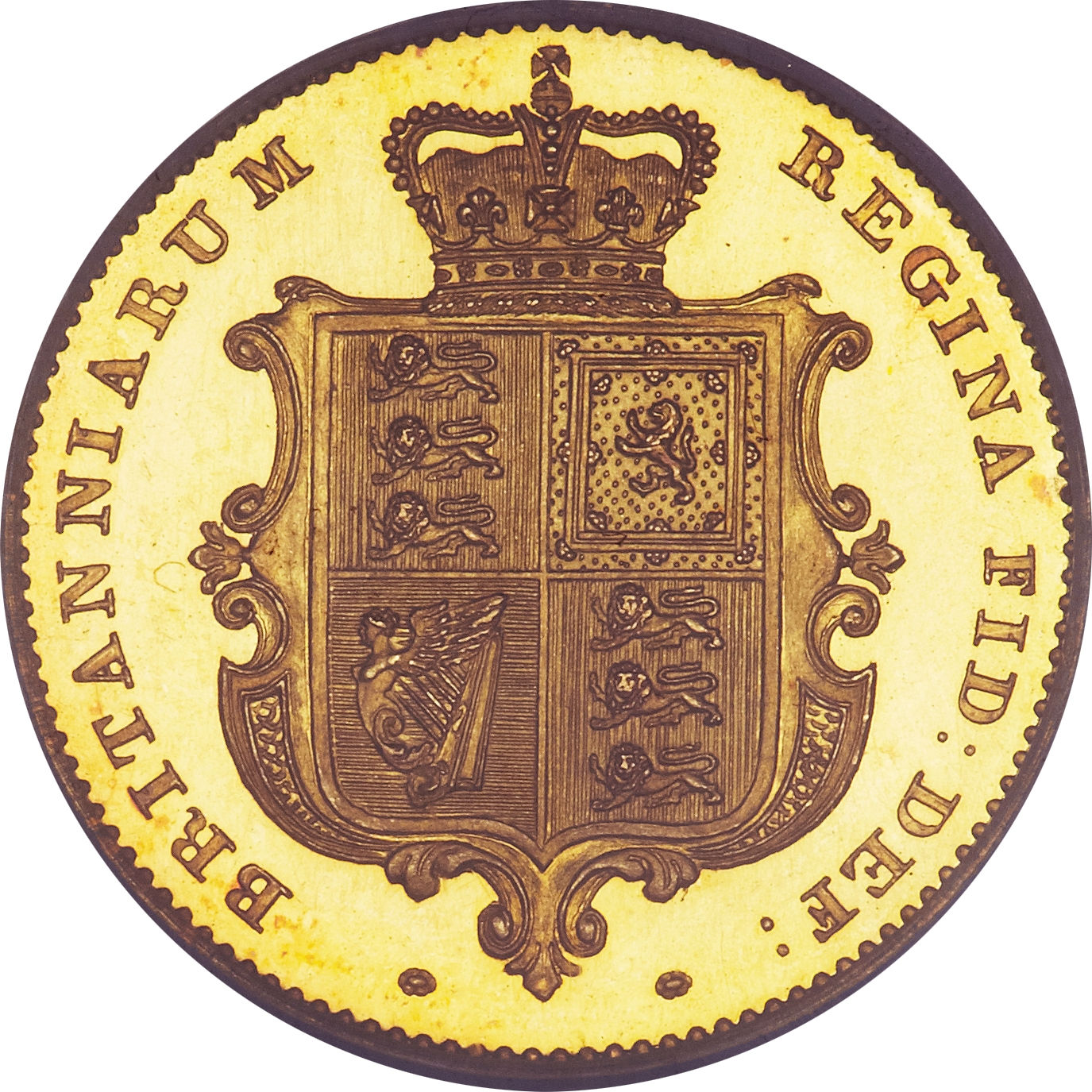
Do not confuse it with the gold half sovereign of the same date. Ordinary Young Head half sovereigns with the shield reverse were struck in London most years from 1838 to 1885 and are listed as the Young Head half sovereign.
Sources
The history, design, varieties and collecting notes on this page are drawn from these sources. Prices come from recorded sales, not from them.
- Half sovereign or trial piece, inscribed Palladium Hydrogenium (Science Museum Group 1973-416/2), Science Museum Group, via Museum Data Service (read 10 Oct 2026)
- Palladium Hydrogenium medal presented to Sir J.F.W. Herschel (Science Museum Group 1943-53), Science Museum Group, via Museum Data Service (read 10 Oct 2026)
- Alloy of palladium and hydrogenium. Discovered by Graham (Science Museum Group 1889-164/2033), Science Museum Group, via Museum Data Service (read 10 Oct 2026)
- Thomas Graham (chemist), Wikipedia (read 10 Oct 2026)
- Medal commemorating Thomas Graham (Science Museum Group 1964-490), Science Museum Group, via Museum Data Service (read 10 Oct 2026)
- Half sovereign, Wikipedia (read 10 Oct 2026)
More from Half Sovereign