Very Rare: fewer than 100,000 minted.
½ Sovereign - William IV small type (1831–1834)
| Country | United Kingdom |
| Year | 1831–1834 |
| Denomination | ½ Sovereign |
| Face value | 50p |
| Mint | Royal Mint · Llantrisant |
| Series | Half Sovereign |
| Circulation | Circulating |
| Demonetised | 1891 |
| Composition | Gold (.9167) (917/1000 fine) |
| Weight | 3.990g · 0.1176 t oz |
| Diameter | 17.9mm |
| Shape | Round |
| Orientation | Coin alignment ↑↓ |
| Obv. artist | William Wyon, after a bust by Francis Chantrey |
| Rev. artist | Jean Baptiste Merlen |
| Grade scale | UK (EF/UNC) |
Uncrowned portrait of King William IV right, legend around.
GULIELMUS IIII D: G: BRITANNIAR: REX F: D:
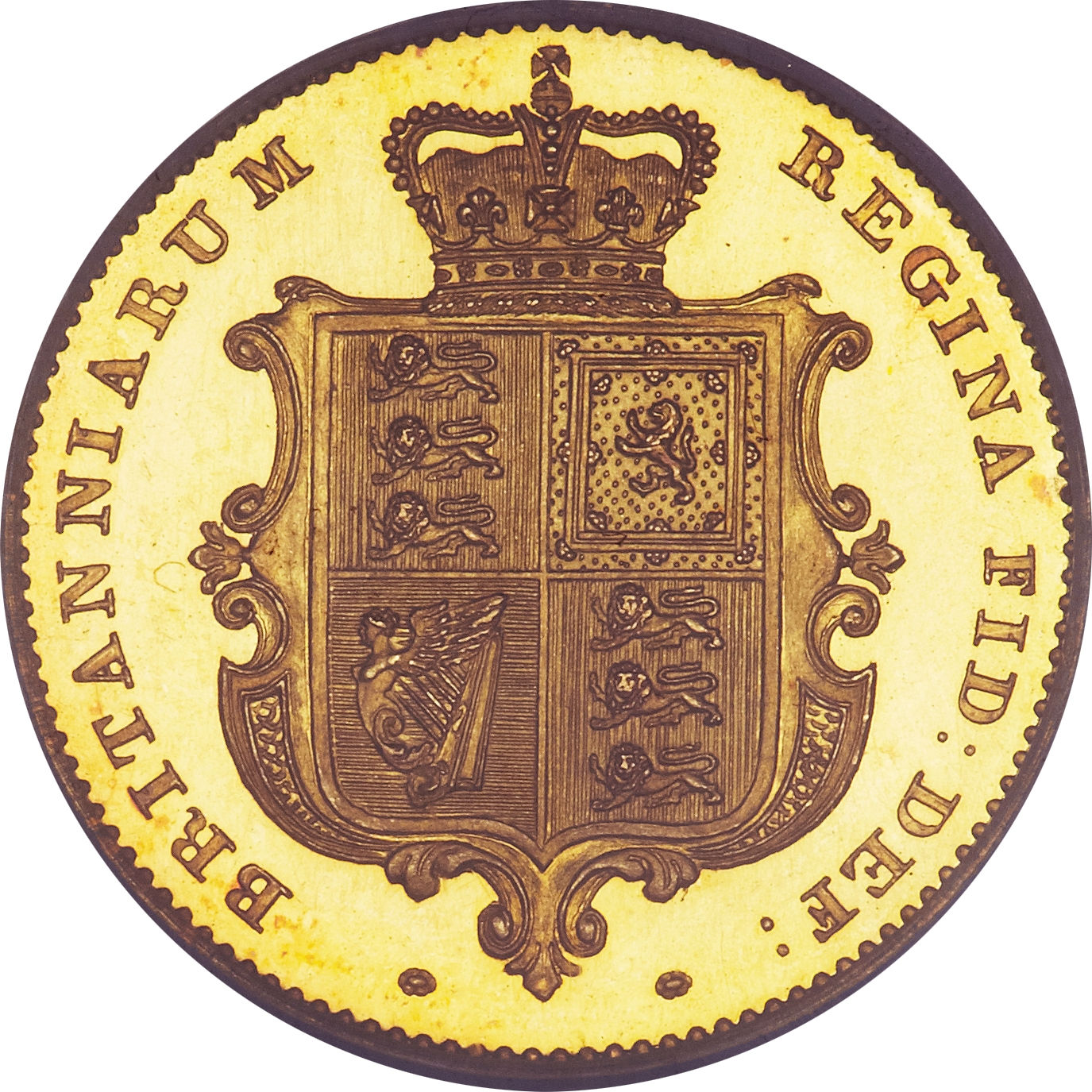
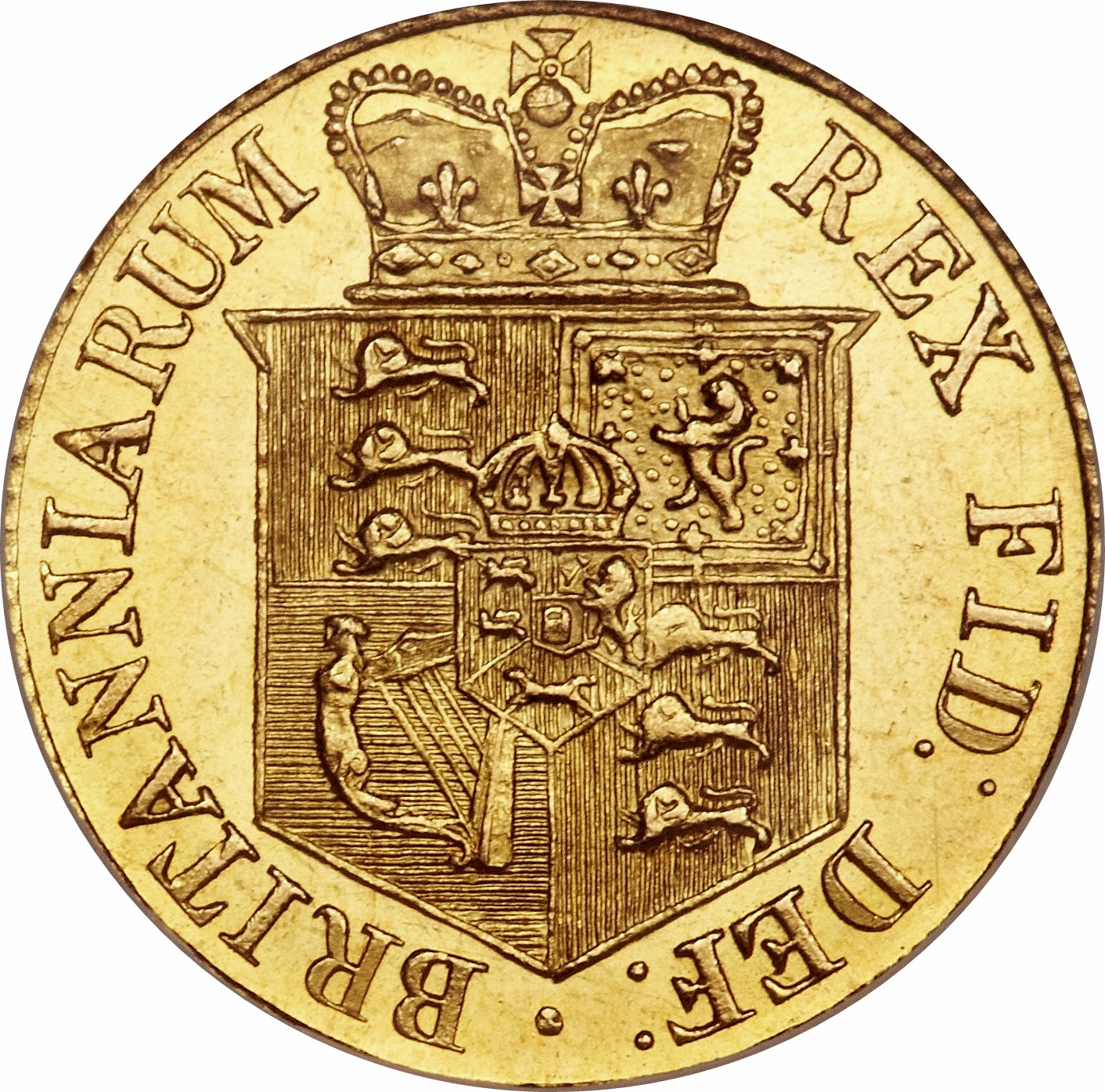
Crowned shield of arms and mantle, legend and date below.
ANNO and the date
Half Sovereign - William IV small type market value
Find this on eBay
AffiliateHalf Sovereign - William IV small type price history
Daily limit reachedHalf Sovereign - William IV small type value by year
1831 to 1834 · median sold prices| Year | Mintage | Circulated | Uncirculated | Sales | |
|---|---|---|---|---|---|
| 1831 | Not recorded | £1,700.00 | 6 | ||
|
VF£12.50EF£28.00UNC£95.00
⭐ Pro: the 1831 coin's sales by grade, and the chart filtered to one year
Start 7-day free trial
|
|||||
| 1834 | 133,800 | £1,700.00 type | |||
One row for each year the ½ Sovereign - William IV small type was struck. Prices are medians of verified sold listings matched to that year from the listing: circulated is worn condition up to Extremely Fine, uncirculated is About Uncirculated or better. A count in brackets means fewer than three sales behind the figure; a grey figure marked "type" is the median across every year, shown where that year has no sale of its own yet; years with no sales yet fill in as sales are recorded. Most types have been searched year by year only since October 2026, so later years are still filling in. Use the grade table below for a price by condition across all years.
Half Sovereign - William IV small type value by grade
Realised auction prices · ⭐ Pro Expand rows for individual sale records| Grade | Latest | Median | 30d Δ | All-time range | Sales (1yr) | Total sales | Last sale | |
|---|---|---|---|---|---|---|---|---|
| PR-61 | £3,100.00 🔒 | £3,100.00 (1) | – | £3,100.00 – £3,100.00 | 0 | 1 | 01-09-2019 | |
|
Loading…
|
||||||||
| PR-65 | £7,000.00 🔒 | £4,350.00 (2) | – | £1,100.00 – £7,000.00 | 0 | 5 | 30-09-2025 | |
|
Loading…
|
||||||||
About the 1831 Half Sovereign - William IV small type
The 1831 Half Sovereign - William IV small type is a circulating ½ sovereign coin issued from 1831 to 1834 in the Half Sovereign series, struck in 91.67% gold. It weighs 3.99g and measures 17.9mm across. Reverse design: Crowned shield of arms and mantle, legend and date below.
It is no longer legal tender (withdrawn 1891), so its value is to collectors only.
Common questions
How much is the 1831 Half Sovereign - William IV small type worth?
Verified sold prices for the 1831 Half Sovereign - William IV small type run from £3,100 to £4,350 across 2 grades, taking the median for each grade. Condition makes the difference, so check the grade table above before pricing one. Its gold content is worth about £352 at today's spot price, which puts a floor under its value.
Why is the 1834 half sovereign smaller?
The half sovereign and sixpence were the same size, which made gilded sixpences easy to pass off. The 1834 coin was struck on a smaller flan, 17.9 mm instead of about 19.4 mm, with no change to weight or fineness. Wikipedia also cites Lobel's suggestion that Maundy fourpence tooling was reused.
How many 1834 half sovereigns were made?
Coin Hunter gives 133,899. Wikipedia, citing Marsh, says Mint ledgers record that 120,000 half sovereigns dated 1834 were recalled because they looked too much like the old third guinea, so far fewer than the mintage may have survived.
Were half sovereigns struck in 1831?
Only as proofs. Wikipedia says no half sovereigns were issued for circulation under William IV until 1834, though proofs were made in 1831. Clayton records the 1831 proof on the same small flan as the 1834 coin.
Is the William IV half sovereign legal tender?
No. Wikipedia records that all gold coins from before Victoria's reign were called in by proclamation on 22 November 1890 and demonetised from 28 February 1891. The coin is collected for its rarity and gold content, not spent.
How do I identify the 1831 Half Sovereign - William IV small type?
Check the weight 3.99g and diameter 17.9mm and the metal (91.67% gold) against the specification table on this page. The reverse design is described above.
History and design
Half sovereigns were not issued for circulation under William IV until 1834, though proofs were struck for the 1831 set. Wikipedia's account of the reign says the sixpence and half sovereign were the same size, and a gilded sixpence could be passed as gold, so the half sovereign was made smaller. Clayton gives the reason the same way. Kenyon, writing in 1884, records a Treasury order of 14 April 1835 for a half sovereign of the same weight and type but reduced in size, and notes that the only coins answering that description are dated 1834.
Coin Hunter gives 133,899 for 1834. The smaller coin proved unpopular. Wikipedia, citing Marsh, says Mint ledgers record that 120,000 half sovereigns dated 1834 were recalled because they were too close to the old seven shilling piece, or third guinea, and from 1835 the coin returned to its normal size.
The obverse is William Wyon's bare head of the king, engraved after a bust by Francis Chantrey, with GULIELMUS IIII D: G: BRITANNIAR: REX F: D: around. Jean Baptiste Merlen's reverse shows the royal arms on a crowned, garnished shield, with the arms of Hanover in the centre and ANNO and the date below.
The coin is 17.9 mm across rather than the usual 19.4 mm, with no change to weight or fineness. Wikipedia cites Lobel's suggestion that the size was chosen so that tools and dies for the Maundy fourpence could be used. The Royal Mint Museum's 1831 proof weighs 3.95 g and has a plain edge.
Varieties and errors
The 1831 proof, made for the proof set of that year, is on the same small flan as the 1834 currency coin, according to Clayton. The Royal Mint Museum example is plain-edged and is recorded in the Mint's 1874 and 1906 collection catalogues.
Collecting notes
Measure the coin: about 18 mm separates this type from the full-size 1835 to 1837 half sovereign. With most of the 1834 striking recalled, survivors are fewer than the mintage suggests. Gilded sixpences were the fraud this size change was meant to stop, so weigh any piece offered and check that the reverse shows the shield, not a sixpence reverse.
Sources
The history, design, varieties and collecting notes on this page are drawn from these sources. Prices come from recorded sales, not from them.
- Half sovereign, Wikipedia (read 12 Oct 2026)
- William IV's British coinage, Wikipedia (read 12 Oct 2026)
- Ten Shillings: Half Sovereign, Tony Clayton, Coins of the UK (read 12 Oct 2026)
- William IV proof half-sovereign, 1831 (RMM 88), The Royal Mint Museum, via Museum Data Service (read 12 Oct 2026)
- 1834 Coin Values, William IV, Coin Hunter (read 12 Oct 2026)
- The Gold Coins of England (1884): William IV, Robert Lloyd Kenyon, via TreasureRealm (read 12 Oct 2026)
- Sovereign (British coin), Wikipedia (read 12 Oct 2026)
- Values of Half Sovereigns, Tony Clayton, Coins of the UK (read 12 Oct 2026)
More from Half Sovereign