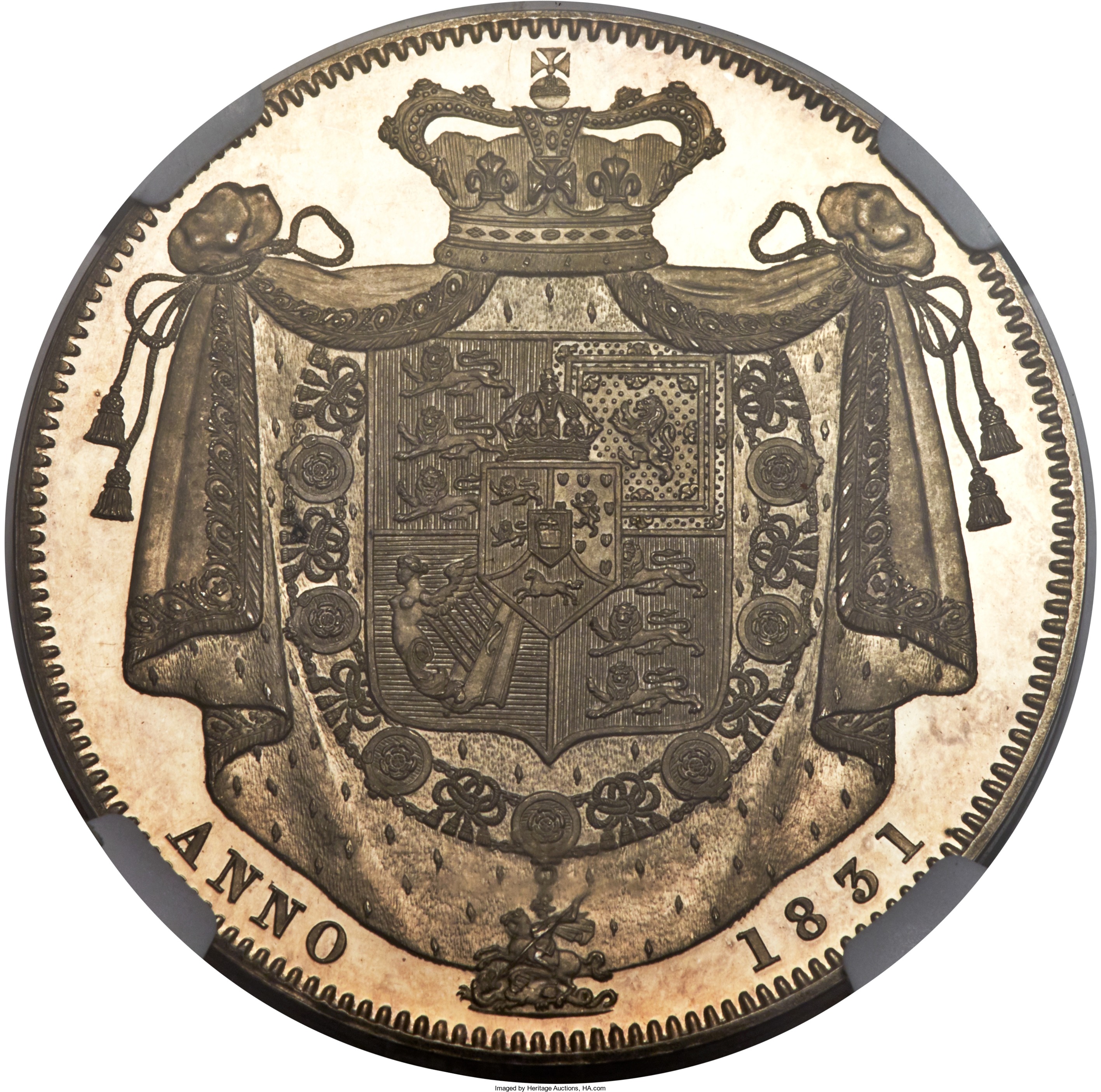
1 Crown - George IV Uniface Pattern (1825)
| Country | United Kingdom |
| Year | 1825 |
| Denomination | 1 Crown |
| Face value | 25p |
| Mint | Royal Mint · Llantrisant |
| Circulation | Non-circulating |
| Composition | Gold plated copper |
| Diameter | 38.6mm |
| Shape | Round |
| Edge | Plain |
| Orientation | Medal alignment ↑↑ |
| Grade scale | UK (EF/UNC) |
Crowned Garnished shield of arms with crest, legend around, banner below.
Plain
Find this on eBay
Affiliate1 Crown - George IV Uniface Pattern price history
Daily limit reachedAbout the 1825 1 Crown - George IV Uniface Pattern
The 1825 1 Crown - George IV Uniface Pattern is a collector 1 crown coin, struck in gold plated copper. It measures 38.6mm across. Reverse design: Plain.
Common questions
How much is the 1825 1 Crown - George IV Uniface Pattern worth?
No verified sale of the 1825 1 Crown - George IV Uniface Pattern has been logged on MyCoinage yet.
What is the George IV reverse uniface crown?
A trial striking of the reverse die of George IV's second crown, showing the crowned shield of arms and BRITANNIARUM REX FID: DEF: on one side, with the other side left blank. It is struck in Barton's metal, a gilded copper, and was never money.
Is the reverse uniface crown dated?
No. The date of this crown type sits on the obverse, under the King's head, so the reverse trial carries none. Heritage lists it as undated in a set of trials otherwise dated 1825, and the Royal Mint Museum record gives no date.
Where can you see one?
The Royal Mint Museum holds one (RMM 1314), weighing 25.71 g with a plain edge and a turned back. It appears in the Mint's 1906 collection catalogue by Hocking as number 1916.
How do I identify the 1825 1 Crown - George IV Uniface Pattern?
Check the diameter 38.6mm and the metal (gold plated copper) against the specification table on this page. The reverse design is described above.
History and design
When George IV's coinage was redesigned in the mid-1820s, the silver crown received a new bare-head obverse and a crowned shield of arms in place of Benedetto Pistrucci's St George. The redesigned crown never circulated. It was struck only as proofs, dated 1825 and 1826.
Before that, the Mint struck trials of the new dies one side at a time. Heritage Auctions sold a cased set of six such uniface trials, for the crown, double sovereign and sovereign, in Barton's metal, and dates the set to 1825. The reverse uniface crown in that set is undated and catalogued as ESC 2334. The Royal Mint Museum holds its own example, RMM 1314, recorded in the Mint's 1906 collection catalogue.
The struck side shows the crowned shield of the royal arms with the legend BRITANNIARUM REX FID: DEF:, the same wording as the reverse of the 1826 proof crown. The Royal Mint Museum describes the back of its example as turned and records a plain edge and a weight of 25.71 g, a little lighter than the 28.23 g of its silver proof crown.
Barton's metal is described by Heritage as gold-electrolysed copper. The trial therefore looks like gold but is copper underneath.
Collecting notes
No number struck is recorded. The Heritage set was sold still in its original red leather case, with a provenance to Lord Raglan. Look for the blank, turned back and plain edge, and check the gilding for wear to copper on the crown and shield.
The obverse trial of the same series is the bare-head uniface crown, and the finished design is the 1826 proof crown.
Sources
The history, design, varieties and collecting notes on this page are drawn from these sources. Prices come from recorded sales, not from them.
- George IV uniface crown (RMM 1314), The Royal Mint Museum, via Museum Data Service (read 12 Oct 2026)
- Heritage Auctions 3123, lot 30116: George IV 6-piece uniface 'Barton's Metal' pattern trial set 1825, Heritage Auctions, via biddr (read 12 Oct 2026)
- George IV proof crown, 1826 (RMM 1312), The Royal Mint Museum, via Museum Data Service (read 12 Oct 2026)
- Benedetto Pistrucci, Wikipedia (read 12 Oct 2026)
- Five Shillings, Quarter Guinea and Five and Six, Tony Clayton, Coins of the UK (read 12 Oct 2026)
More 1 Crown coins from nearby years