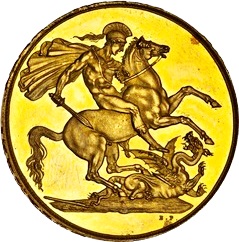
2 Pounds - George IV Uniface Pattern (1825)
| Country | United Kingdom |
| Year | 1825 |
| Denomination | 2 Pounds |
| Face value | £2 |
| Mint | Royal Mint · Llantrisant |
| Circulation | Non-circulating |
| Composition | Gold plated copper |
| Diameter | 28.0mm |
| Shape | Round |
| Edge | Lettered: ANNO REGNI NONO |
| Orientation | Medal alignment ↑↑ |
| Rev. artist | Jean Baptiste Merlen |
| Grade scale | UK (EF/UNC) |
Crowned shield of arms and mantle, legend around.
BRITANNIARUM REX FID: DEF:
Plain
Find this on eBay
Affiliate2 Pounds - George IV Uniface Pattern price history
Daily limit reachedAbout the 1825 2 Pounds - George IV Uniface Pattern
The 1825 2 Pounds - George IV Uniface Pattern is a collector 2 pounds coin, struck in gold plated copper. It measures 28mm across. Reverse design: Plain.
Common questions
How much is the 1825 2 Pounds - George IV Uniface Pattern worth?
No verified sale of the 1825 2 Pounds - George IV Uniface Pattern has been logged on MyCoinage yet.
What is the George IV uniface shield two pounds?
A trial striking of the crowned shield reverse used on George IV's double sovereign, with the other side left blank. It was made inside the Mint to test the die, was never legal tender and was not issued to the public.
What does 'Best that can be done June 27th 1828' mean on the Royal Mint example?
The Royal Mint Museum's uniface shield trial, RMM 1297, has that note scratched into its plain side. The record does not explain it, but it reads as a working comment on the quality achieved, and it dates the trial to 1828.
Who designed the shield on this pattern?
Jean Baptiste Merlen, the French engraver employed at the Royal Mint from 1820. His crowned shield on an ermine mantle replaced Pistrucci's St George on the double sovereigns of 1824 to 1826 and on the sovereign from 1825.
How do I identify the 1825 2 Pounds - George IV Uniface Pattern?
Check the diameter 28mm and the metal (gold plated copper) against the specification table on this page. The reverse design is described above.
History and design
George IV's double sovereign changed design in the mid-1820s. The 1823 coin had carried Pistrucci's St George, but the new Master of the Mint, Thomas Wallace, disliked several existing designs and had Jean Baptiste Merlen prepare new reverses. Merlen's crowned shield appeared on the double sovereigns of 1824 to 1826, which were struck only as patterns and proofs.
This piece is a uniface trial of that reverse: the shield side struck on its own with a plain back. The Royal Mint Museum's example, RMM 1297, is copper, weighs 8.19 g and has raised edge lettering reading ANNO REGNI NONO, the ninth year of the reign. Scratched on it is the note "Best that can be done June 27th 1828", which dates the trial to 1828 rather than to the year the site gives.
The struck side shows the quartered royal arms with the arms of Hanover on an escutcheon, crowned and set on an ermine mantle, with the legend BRITANNIARUM REX FID: DEF:. This is Merlen's design. The other side is blank. A matching trial of the bare head obverse was struck in the same way on a separate blank.
Collecting notes
This is a Mint trial, not a coin, and it never had a face value in use. No number struck is recorded and very few pieces are documented. Compare any example with the Royal Mint Museum's: copper at about 8 g, half the weight of the gold coin, with a plain back and a lettered edge.
The companion obverse trial is listed separately as the uniface bare head pattern. The finished gold coin is the shield-back double sovereign.
Sources
The history, design, varieties and collecting notes on this page are drawn from these sources. Prices come from recorded sales, not from them.
- George IV uniface two pounds (RMM 1297), The Royal Mint Museum, via Museum Data Service (read 12 Oct 2026)
- Double sovereign, Wikipedia (read 12 Oct 2026)
- Jean Baptiste Merlen, Wikipedia (read 12 Oct 2026)
- Sovereign (British coin), Wikipedia (read 12 Oct 2026)
- George IV 1824 bronzed copper Pattern Two-Pounds PR63, Sovereign Rarities (read 12 Oct 2026)
More 2 Pounds coins from nearby years