Scarce: fewer than 2,000,000 minted.
½ Sovereign - William IV large type (1835–1837)
| Country | United Kingdom |
| Year | 1835–1837 |
| Denomination | ½ Sovereign |
| Face value | 50p |
| Mintage by year |
Scarcest year: 146,800 struck
|
| Mint | Royal Mint · Llantrisant |
| Series | Half Sovereign |
| Circulation | Circulating |
| Demonetised | 1891 |
| Composition | Gold (.9167) (917/1000 fine) |
| Weight | 3.990g · 0.1176 t oz |
| Diameter | 19.4mm |
| Shape | Round |
| Orientation | Coin alignment ↑↓ |
| Obv. artist | William Wyon, after a bust by Francis Chantrey |
| Rev. artist | Jean Baptiste Merlen |
| Grade scale | UK (EF/UNC) |
Uncrowned portrait of King William IV right, legend around.
GULIELMUS IIII D: G: BRITANNIAR: REX F: D:
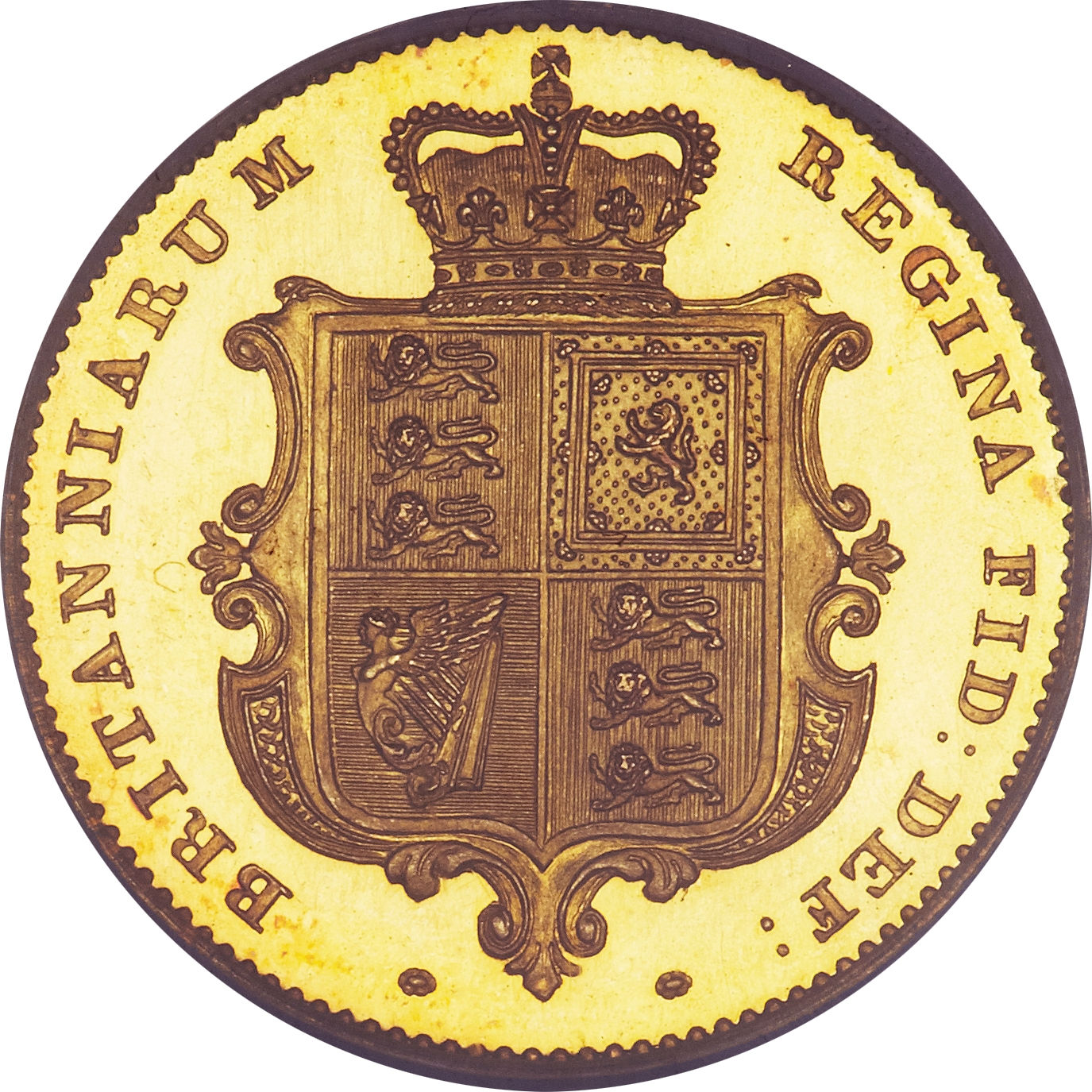
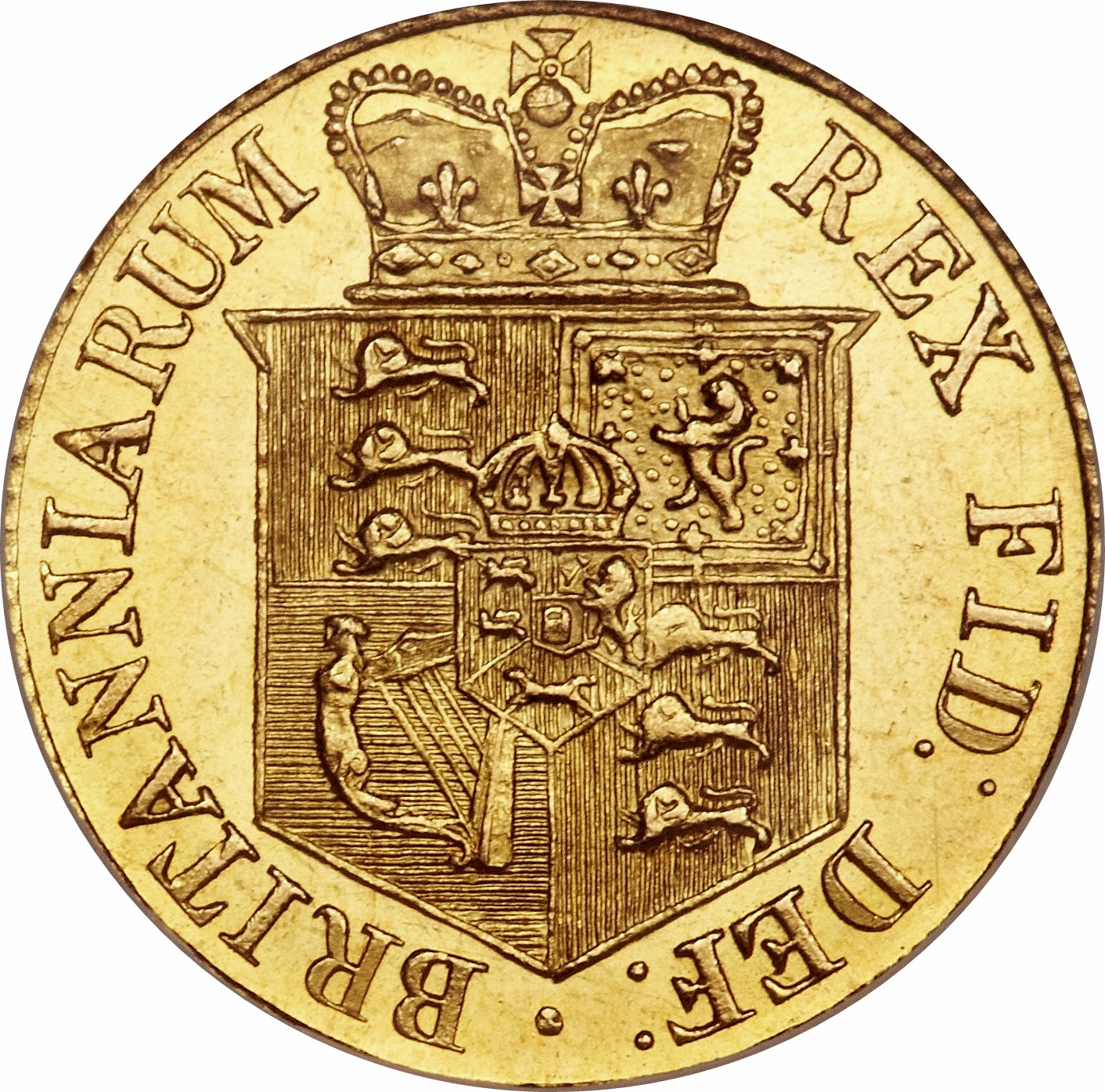
Crowned shield of arms and mantle, legend and date below.
Half Sovereign - William IV large type market value
Find this on eBay
AffiliateHalf Sovereign - William IV large type price history
Daily limit reachedHalf Sovereign - William IV large type value by year
1835 to 1837 · median sold prices| Year | Mintage | Circulated | Uncirculated | Sales | |
|---|---|---|---|---|---|
| 1835 | 772,500 | £300.00 (1) | 1 | ||
|
VF£12.50EF£28.00UNC£95.00
⭐ Pro: the 1835 coin's sales by grade, and the chart filtered to one year
Start 7-day free trial
|
|||||
| 1836 scarcest | 146,800 | £300.00 type | |||
| 1837 | 160,200 | £300.00 type | |||
One row for each year the ½ Sovereign - William IV large type was struck. Prices are medians of verified sold listings matched to that year from the listing: circulated is worn condition up to Extremely Fine, uncirculated is About Uncirculated or better. A count in brackets means fewer than three sales behind the figure; a grey figure marked "type" is the median across every year, shown where that year has no sale of its own yet; years with no sales yet fill in as sales are recorded. Most types have been searched year by year only since October 2026, so later years are still filling in. Use the grade table below for a price by condition across all years.
Half Sovereign - William IV large type value by grade
Realised auction prices · ⭐ Pro Expand rows for individual sale records| Grade | Latest | Median | 30d Δ | All-time range | Sales (1yr) | Total sales | Last sale | |
|---|---|---|---|---|---|---|---|---|
| VF | £300.00 🔒 | £300.00 (1) | – | £300.00 – £300.00 | 0 | 1 | 10-07-2024 | |
|
Loading…
|
||||||||
About the 1835 Half Sovereign - William IV large type
The 1835 Half Sovereign - William IV large type is a circulating ½ sovereign coin issued from 1835 to 1837 in the Half Sovereign series, struck in 91.67% gold. It weighs 3.99g and measures 19.4mm across. Reverse design: Crowned shield of arms and mantle, legend and date below.
Mintage figures are recorded for 3 years between 1835 and 1837, 1,079,500 coins in all. 1836 is the scarcest date, with 146,800 struck. It is no longer legal tender (withdrawn 1891), so its value is to collectors only.
Common questions
How much is the 1835 Half Sovereign - William IV large type worth?
The 1835 Half Sovereign - William IV large type has a price in one grade on MyCoinage so far: £300 in VF, the median of its verified sales. Its gold content is worth about £352 at today's spot price, which puts a floor under its value.
What is the sixpence-die half sovereign?
Some William IV half sovereigns of 1836 and 1837 were struck with an obverse die made for the sixpence, which gives a slightly larger portrait. Wikipedia, citing Lobel, says this may have been a Mint error. Clayton calls both dates of the variety rare.
How many William IV half sovereigns were minted from 1835 to 1837?
Coin Hunter gives 772,554 for 1835, 146,865 for 1836 and 160,207 for 1837, a total of 1,079,626. The 1836 figure is the smallest, and it is not split between normal coins and those from the sixpence obverse die.
Why are there small and large William IV half sovereigns?
In 1834 the coin was struck on a smaller flan to tell it apart from the sixpence. The change was unpopular, many 1834 coins were recalled, and from 1835 the half sovereign went back to its usual size of about 19.4 mm with the same weight.
Is a William IV half sovereign legal tender?
No. All gold coins from before Victoria's reign were called in by proclamation on 22 November 1890 and demonetised from 28 February 1891, according to Wikipedia. Victoria's later half sovereigns remain legal tender, but William IV's do not.
How do I identify the 1835 Half Sovereign - William IV large type?
Check the weight 3.99g and diameter 19.4mm and the metal (91.67% gold) against the specification table on this page. The reverse design is described above.
History and design
The half sovereign returned to full size in 1835. The previous year's coin had been struck on a smaller flan to keep it apart from the sixpence, which was the same size and was gilded by fraudsters, but Clayton says the change was not popular and Wikipedia records that 120,000 of the small coins were recalled and melted. From 1835 to 1837 the coin was struck at its usual diameter of about 19.4 mm, with the weight and fineness unchanged.
Coin Hunter gives 772,554 for 1835, 146,865 for 1836 and 160,207 for 1837, a total of 1,079,626. Kenyon records all three dates, as well as 1834, in the British Museum by 1884. William IV died in June 1837 and Victoria's first half sovereigns are dated 1838.
The obverse is William Wyon's bare head of the king facing right, engraved after a bust by Francis Chantrey, with GULIELMUS IIII D: G: BRITANNIAR: REX F: D: (William IV, by the grace of God King of the Britains, Defender of the Faith). Wikipedia says the reverse, modelled and engraved by Jean Baptiste Merlen, is close to the later George IV half sovereigns: a crowned, garnished shield of the royal arms with the Hanoverian arms in the centre, and ANNO and the date below.
From this reign the sixpence carried its value in words, which Wikipedia links to the same problem of gilded sixpences passed as half sovereigns.
Varieties and errors
Some 1836 and 1837 coins carry a slightly different, larger portrait, apparently struck from obverse dies made for the sixpence. Wikipedia, citing Lobel, says this may have been an error by the Mint, and Clayton describes both dates of the variety as rare. Coin Hunter lists the 1836 coin as the obverse from a sixpence die. No separate mintage is recorded.
Collecting notes
On 1836 and 1837 coins, compare the portrait with a normal coin of the type: the sixpence-die head is larger in relation to the flan. The Royal Mint Museum's 1837 proof has a milled edge and weighs 3.98 g. The coin was followed by Victoria's Young Head half sovereign, which dropped the arms of Hanover.
Sources
The history, design, varieties and collecting notes on this page are drawn from these sources. Prices come from recorded sales, not from them.
- Half sovereign, Wikipedia (read 12 Oct 2026)
- William IV's British coinage, Wikipedia (read 12 Oct 2026)
- Ten Shillings: Half Sovereign, Tony Clayton, Coins of the UK (read 12 Oct 2026)
- William IV proof half-sovereign, 1837 (RMM 89), The Royal Mint Museum, via Museum Data Service (read 12 Oct 2026)
- Coin values by year, William IV (year pages 1835 to 1837, read one by one), Coin Hunter (read 12 Oct 2026)
- Sovereign (British coin), Wikipedia (read 12 Oct 2026)
- The Gold Coins of England (1884): William IV, Robert Lloyd Kenyon, via TreasureRealm (read 12 Oct 2026)
More from Half Sovereign