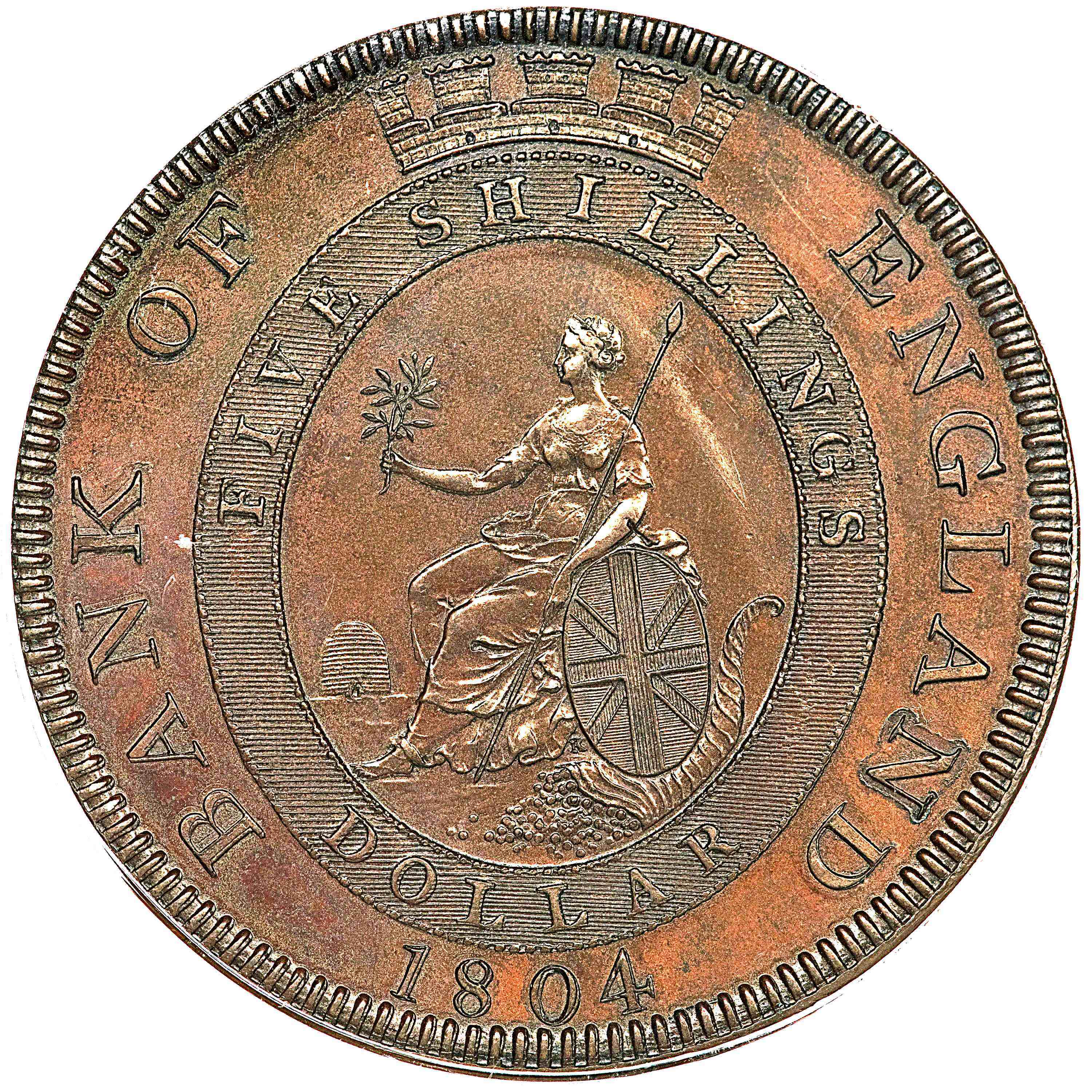
1 Dollar - George III Pattern (1798)
| Country | United Kingdom |
| Year | 1798 |
| Denomination | 4 Shillings |
| Face value | 20p |
| Mint | Royal Mint · Llantrisant |
| Circulation | Non-circulating |
| Demonetised | Yes |
| Composition | (White metal) |
| Shape | Round |
| Obv. artist | Conrad Heinrich Küchler |
| Rev. artist | Conrad Heinrich Küchler |
| Grade scale | UK (EF/UNC) |
Laureate and draped bust of King George III right, legend around.
Crowned quartered shield of arms, divided date above, legend around.
Find this on eBay
Affiliate1 Dollar - George III Pattern price history
Daily limit reached1 Dollar - George III Pattern value by grade
Realised auction prices · ⭐ Pro Expand rows for individual sale records| Grade | Latest | Median | 30d Δ | All-time range | Sales (1yr) | Total sales | Last sale | |
|---|---|---|---|---|---|---|---|---|
| EF | £2,400.00 🔒 | £2,400.00 (1) | – | £2,400.00 – £2,400.00 | 0 | 1 | 05-09-2010 | |
|
Loading…
|
||||||||
| VF | £850.00 🔒 | £850.00 (1) | – | £850.00 – £850.00 | 0 | 1 | 01-03-2020 | |
|
Loading…
|
||||||||
About the 1798 1 Dollar - George III Pattern
The 1798 1 Dollar - George III Pattern is a collector 4 shillings coin, struck in (White metal). Reverse design: Crowned quartered shield of arms, divided date above, legend around.
It is no longer legal tender, so its value is to collectors only.
Common questions
How much is the 1798 1 Dollar - George III Pattern worth?
Verified sold prices for the 1798 1 Dollar - George III Pattern run from £850 to £2,400 across 2 grades, taking the median for each grade. Condition makes the difference, so check the grade table above before pricing one.
Was the 1798 dollar ever used as money?
No. It is a pattern, a trial piece for a coin that was never issued. The dollar actually put into circulation by the Bank of England was the 1804 Britannia design overstruck on Spanish dollars at Soho.
Who made the 1798 pattern dollar?
The dies were the work of Conrad Heinrich Küchler, Matthew Boulton's engraver at the Soho Mint in Birmingham. A master puncheon for the crowned shield, attributed to Küchler and stamped with Ralph Heaton's initials, was sold by Woolley and Wallis in 2016.
What metals were 1798 pattern dollars struck in?
Copper examples are well documented, including a plain-edged Spink lot of 23.93 g and a Goldberg lot catalogued as ESC 170. The site records a white metal striking, which has not been confirmed in a published catalogue entry.
How many 1798 pattern dollars were made?
No number is recorded. Spink cites one copper variety as R6 in ESC, the English Silver Coinage reference, and describes it as an extremely scarce variety. Each die and metal combination is catalogued separately.
History and design
In the late 1790s Britain had almost no new silver coin. The Royal Mint Museum records that the Bank of England turned to countermarking Spanish dollars in 1797, and that Matthew Boulton's Soho Mint near Birmingham, with its steam presses, already held the contract for the cartwheel copper coinage of that year. The 1798 dollar is a pattern from Soho, a trial design for a large silver coin that was never adopted.
The dollar that finally went into circulation, in 1804, was a quite different design, Britannia within a crowned band, overstruck on Spanish dollars at Soho for the Bank of England. No record of how many 1798 patterns were struck is known.
The dies were engraved by Conrad Heinrich Küchler, the German medallist who worked for Boulton from 1793 and designed the cartwheel penny and twopence. The obverse is a laureate and draped bust of George III facing right. Spink describes one die with the first leaf pointing to the upright of the E in DEI and with K on the truncation.
The reverse shows a crowned shield of the royal arms, which Spink calls a 'spade' shield, the flat-topped form used on the spade guinea. A master puncheon for this shield, attributed to Küchler and stamped R.H. for Ralph Heaton, was sold by Woolley and Wallis in 2016, catalogued as a pattern Bank of England shield dollar.
Varieties and errors
The patterns differ in die details such as leaf position and the initials on the truncation. Spink describes a plain-edged copper example weighing 23.93 g (ESC 1913), and Goldberg sold a copper proof catalogued as ESC 170.
Collecting notes
These are trial pieces, not coins of the realm. Check the metal, weight and edge against a catalogue such as ESC, since the varieties are defined by die details and metal, and look for the K on the truncation and the leaf position on the obverse. The issued coin is the Bank of England dollar.
Sources
The history, design, varieties and collecting notes on this page are drawn from these sources. Prices come from recorded sales, not from them.
- Lot 397: Pattern Dollar, 1798, in copper, by C H Küchler, Spink (read 12 Oct 2026)
- Pattern Bank of England Shield Dollar, 1798, master puncheon die (lot 442), Woolley and Wallis (read 12 Oct 2026)
- ESC 170: Pattern Bank Dollar, 1798 (Goldberg sale 31, lot 2441), WildWinds (read 12 Oct 2026)
- Conrad Heinrich Küchler, Wikipedia (read 12 Oct 2026)
- George III, Royal Mint Museum (read 12 Oct 2026)