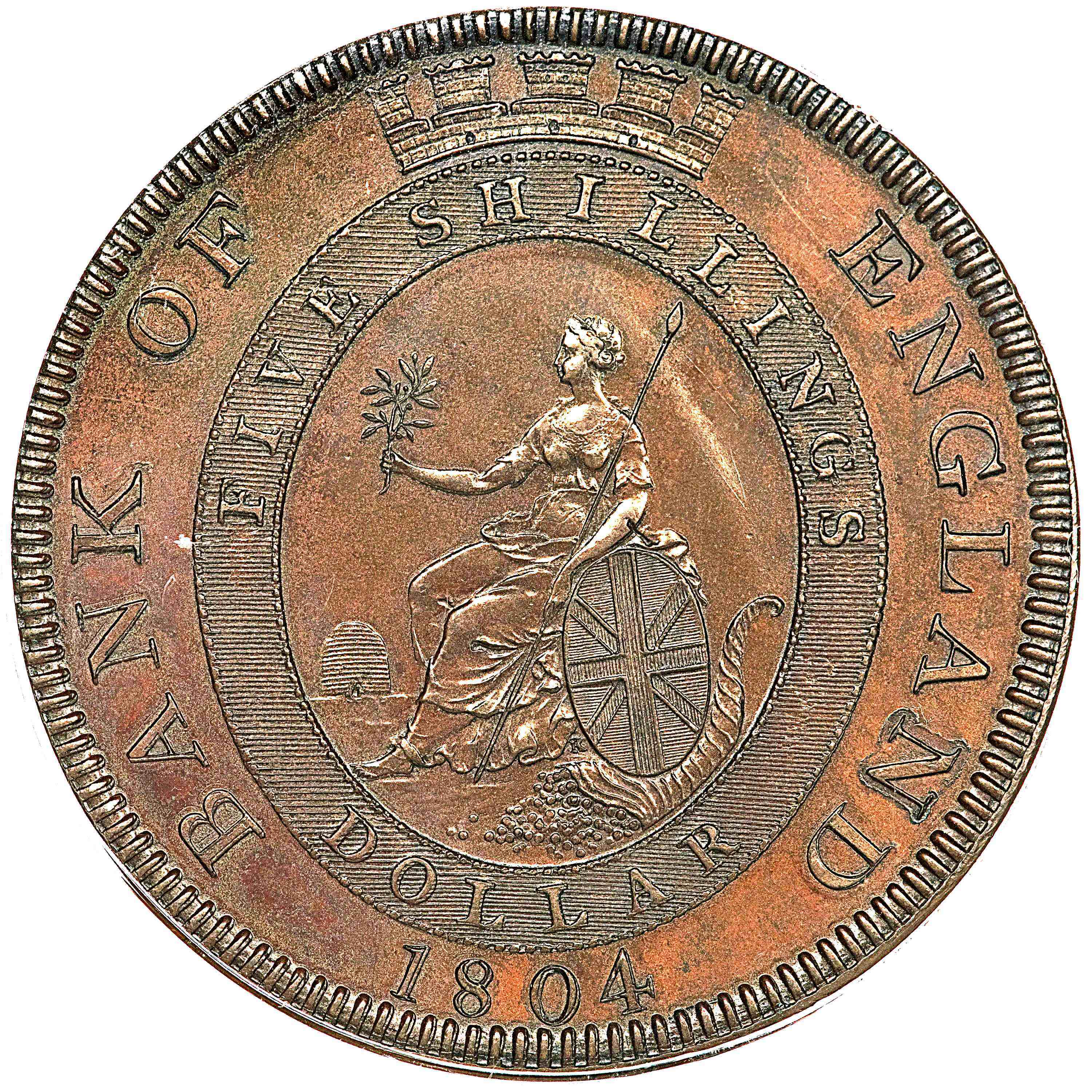
1 Dollar - George III Pattern mule (1804)
| Country | United Kingdom |
| Year | 1804 |
| Denomination | 4 Shillings |
| Face value | 20p |
| Mint | Royal Mint · Llantrisant |
| Circulation | Non-circulating |
| Demonetised | Yes |
| Composition | Gold (.9167) (917/1000 fine) |
| Weight | 38.850g · 1.1450 t oz |
| Shape | Round |
| Orientation | Medal alignment ↑↑ |
| Grade scale | UK (EF/UNC) |
Laureate, draped and cuirassed bust left, legend around.
Laureate, draped and cuirassed bust right; 'K' on truncation.
Find this on eBay
Affiliatemule 1 Dollar price history
Daily limit reachedAbout the 1804 1 Dollar - George III Pattern – mule
The 1804 1 Dollar - George III Pattern – mule is a collector 4 shillings coin, struck in 91.67% gold. It weighs 38.85g. Reverse design: Laureate, draped and cuirassed bust right; 'K' on truncation.
It is no longer legal tender, so its value is to collectors only.
Common questions
How much is the 1804 1 Dollar - George III Pattern – mule worth?
No verified sale of the 1804 1 Dollar - George III Pattern – mule has been logged on MyCoinage yet. Its gold content is worth about £3,430 at today's spot price, which puts a floor under its value.
Why does this George III dollar have a head on both sides?
It was struck from two obverse dies, so it is a mule with no reverse. Numismatic News reports that the two sides carry different effigies of George III, both of the kind used on the Bank of England's dollars during the silver shortage of 1804.
Who struck the gold double-headed dollar?
Dix Noonan Webb catalogued it as by William J. Taylor, after John Phillp and Conrad Küchler. Taylor is known to have acquired a number of Bank dollar dies, which, according to Peck's British Museum catalogue, he used freely for restriking.
How many gold double-obverse dollars exist?
Dix Noonan Webb described the piece it sold in London in September 2016 as believed to be unique. A gold double-obverse pattern graded by NGC was offered by MDC Monaco in 2021; it is not established whether that is the same coin.
Is the gold mule dollar a real Bank of England coin?
No. The Bank of England issued silver dollars, overstruck on Spanish 8 reales, with the King on one side and Britannia on the other. A gold piece with two portraits is a trial or later private striking from the dies and never passed as money.
How do I identify the 1804 1 Dollar - George III Pattern – mule?
Check the weight 38.85g and the metal (91.67% gold) against the specification table on this page. The reverse design is described above.
History and design
In 1804 the Bank of England answered a severe shortage of silver by having its Spanish dollars overstruck at Matthew Boulton's Soho Mint with George III's portrait and a figure of Britannia. Numismatic News notes that the effigies on those dollars appear on this gold piece, which was struck from two obverse dies, giving a head on each side and no reverse.
Dix Noonan Webb sold the coin in London at its sale of 21 to 23 September 2016, describing it as believed to be unique and crediting it to William J. Taylor, after John Phillp and Conrad Küchler. Taylor, according to C. Wilson Peck's catalogue of the British Museum's copper coins, obtained a number of Bank dollar dies, "which he used freely for re-striking". That makes this most likely a later striking from surviving dies rather than a trial made for the Bank in 1804.
Each side carries a laureate bust of George III, and the report on the sale stresses that the two effigies differ. Küchler was Boulton's engraver at Soho from 1793 and, according to the Royal Mint Museum, cut the portrait used on the issued Bank of England dollars. The catalogue credits John Phillp as well, but no published description says which portrait is his.
The gold metal sets the piece apart from every issued dollar, all of which were struck in silver over Spanish 8 reales.
Collecting notes
This is a cabinet piece rather than a coin, and there is no circulating counterpart to compare it with. The documented example was sold at auction with its history. A second gold double-obverse dollar, graded NGC PF 66 Star Ultra Cameo and signed CHK and K, was offered by MDC Monaco in 2021 and is the subject of the other mule entry. Whether these are the same coin or two is not established, so any example should be matched against both sale records.
Sources
The history, design, varieties and collecting notes on this page are drawn from these sources. Prices come from recorded sales, not from them.
- Two-headed gold 'dollar' star of sale, Numismatic News (read 12 Oct 2026)
- Two-Headed British Pattern Coin Among NGC-graded Rarities in MDC Monaco Sale, NGC (read 12 Oct 2026)
- George III, Royal Mint Museum (read 12 Oct 2026)
- Conrad Heinrich Küchler, Wikipedia (read 12 Oct 2026)