
Sells occasionally: 4 verified sales in the last 12 months.
1 Dollar - George III Bank of England Token (1804)
| Country | United Kingdom |
| Year | 1804 |
| Denomination | 4 Shillings |
| Face value | 20p |
| Mint | Royal Mint · Llantrisant |
| Circulation | Non-circulating |
| Demonetised | Yes |
| Composition | Copper |
| Shape | Round |
| Obv. artist | Conrad Heinrich Küchler |
| Rev. artist | Conrad Heinrich Küchler |
| Grade scale | UK (EF/UNC) |
Laureate and draped bust right, legend around.
GEORGIUS III DEI GRATIA REX
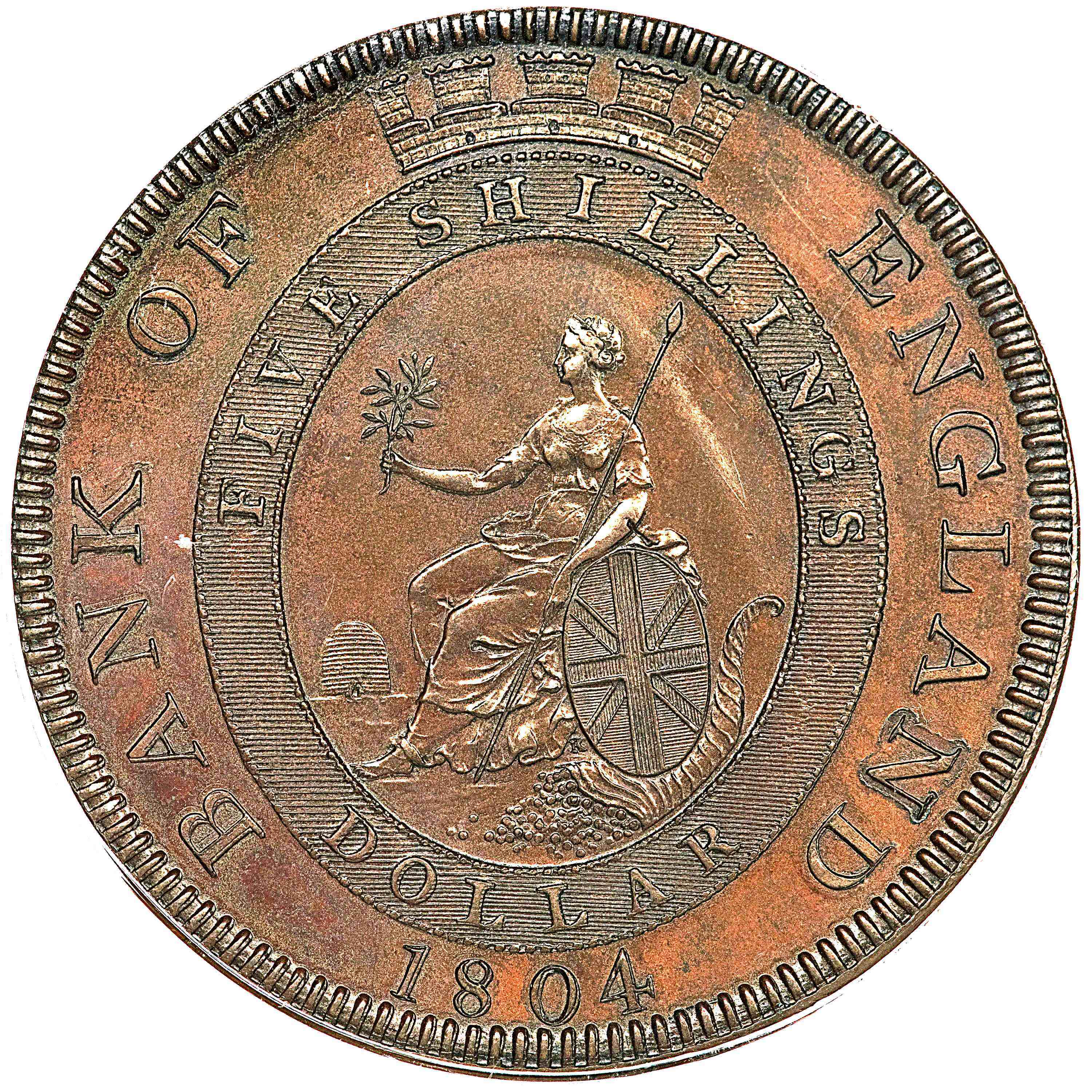
Seated figure of Britannia left, holding olive branch in right hand with spear i nleft hand and shield bearing the Union flag, all within inner band with legend around and date below.
BANK OF ENGLAND 1804 FIVE SHILLINGS DOLLAR
1 Dollar - George III Bank of England Token market value
Find this on eBay
Affiliate1 Dollar - George III Bank of England Token price history
Daily limit reached1 Dollar - George III Bank of England Token value by grade
Realised auction prices · ⭐ Pro Expand rows for individual sale records| Grade | Latest | Median | 30d Δ | All-time range | Sales (1yr) | Total sales | Last sale | |
|---|---|---|---|---|---|---|---|---|
| VF | £279.50 🔒 | £215.14 | – | £145.00 – £372.38 | 4 | 5 | 22-07-2026 | |
|
Loading…
|
||||||||
About the 1804 1 Dollar - George III Bank of England Token
The 1804 1 Dollar - George III Bank of England Token is a collector 4 shillings coin, struck in copper. Reverse design: Seated figure of Britannia left, holding olive branch in right hand with spear i nleft hand and shield bearing the Union flag, all within inner band with legend around and date below.
It is no longer legal tender, so its value is to collectors only.
Common questions
How much is the 1804 1 Dollar - George III Bank of England Token worth?
The 1804 1 Dollar - George III Bank of England Token has a price in one grade on MyCoinage so far: £215 in VF, the median of its verified sales.
Is a copper 1804 Bank of England dollar genuine?
It can be. Copper strikes from the dollar dies are recorded by Christie's and Spink as patterns and proofs (ESC 152), and one copper die trial still shows the engraver's guide lines. They were never currency: the issued dollar was silver, overstruck on Spanish coins.
What was the Bank of England dollar?
A five shilling silver coin made by overstriking Spanish dollars at Matthew Boulton's Soho Mint. The Royal Mint Museum says it replaced countermarked dollars that had been heavily counterfeited, and that nearly all were dated 1804 whatever year they were struck.
Who designed the Bank of England dollar?
Conrad Heinrich Küchler, Boulton's engraver at Soho. His initials C.H.K. appear on the shoulder of the King's bust. He also engraved the 1797 cartwheel penny and twopence.
How heavy is a copper Bank of England dollar?
It varies. Spink describes a copper pattern on a thick planchet weighing 36.73 g, much heavier than a silver dollar of about 27 g. Weigh and measure a copper piece and compare it with the catalogue entry for its dies.
History and design
The Bank of England dollar was the last of the Bank's emergency answers to the silver shortage. The Royal Mint Museum records that Spanish dollars countermarked at the Mint in 1797 and again in 1804 were heavily counterfeited, so Matthew Boulton's Soho Mint was engaged to overstrike the Spanish coins completely with a new design on its steam presses. The silver dollars carried the date 1804, although the Coins and History Foundation notes that striking went on until 1811.
This entry is the same design struck in copper. Christie's and Spink catalogue copper pieces as patterns, and a copper die trial sold by Goldberg still shows the guide lines the engraver scribed on the die, and the weight scratched in the field. They were trial strikings and never circulated. No number struck is recorded.
Both sides are by Conrad Heinrich Küchler, Boulton's engraver from 1793. The obverse shows a laureate, draped and armoured bust of George III with GEORGIUS III DEI GRATIA REX and the initials C.H.K. on the shoulder. The reverse has Britannia seated left with an olive branch, spear and Union shield, a beehive in front and a cornucopia beside her, inside a band reading FIVE SHILLINGS DOLLAR under a mural crown, with BANK OF ENGLAND 1804 around.
Tony Clayton lists five obverse dies and three reverse dies for the dollar, told apart by the leaf above the King's head pointing to the E of DEI, the stops in C.H.K. and after REX, and the form of the K below the shield. Christie's gives dies C/2 for its copper example.
Varieties and errors
Recorded copper strikes include a pattern from dies C/2 (ESC 152), a heavy piece on a thick planchet of 36.73 g, and a die trial with scribed guide lines.
Collecting notes
Identify the dies using Clayton's leaf position, the truncation initials and the K under the shield, then compare weight and thickness with the catalogue entry. On the silver dollars, Clayton notes, the Spanish host coin can often be identified beneath the design. The circulating coin is the silver Bank of England dollar.
Sources
The history, design, varieties and collecting notes on this page are drawn from these sources. Prices come from recorded sales, not from them.
- George III, Royal Mint Museum (read 12 Oct 2026)
- George III, pattern Bank of England Dollar, 1804, struck in copper (lot 1539801), Christie's (read 12 Oct 2026)
- Pattern Dollar, 1804, in copper, on a thick planchet (lot 392000163), Spink (read 12 Oct 2026)
- ESC 152: Copper Die-Trial Bank Dollar, 1804 (Goldberg sale 31, lot 2449), WildWinds (read 12 Oct 2026)
- Conrad Heinrich Küchler, Wikipedia (read 12 Oct 2026)
- Dollar (Bank of England), 1804 (NCM 1930-25), Nottingham Museums, via Museum Data Service (read 12 Oct 2026)
- The Curious Case of the Bank of England Dollar, Coins and History Foundation (read 12 Oct 2026)
- Five Shillings, Quarter Guinea and Five and Six, Tony Clayton, Coins of the UK (read 12 Oct 2026)


