1 Dollar - George III Bank of England Token (1804)
"Bank of England dollar"
Circulating version: 1804 1 Dollar - George III Bank of England Token
| Country | United Kingdom |
| Year | 1804 |
| Denomination | 5 Shillings |
| Face value | 25p |
| Mint | Royal Mint · Llantrisant |
| Circulation | Circulating |
| Demonetised | Yes |
| Composition | Silver (.903) (903/1000 fine) |
| Weight | 26.000g · 0.7548 t oz |
| Diameter | 41.0mm |
| Thickness | 1.60mm |
| Shape | Round |
| Orientation | Medal alignment ↑↑ |
| Obv. artist | Conrad Heinrich Küchler |
| Grade scale | UK (EF/UNC) |
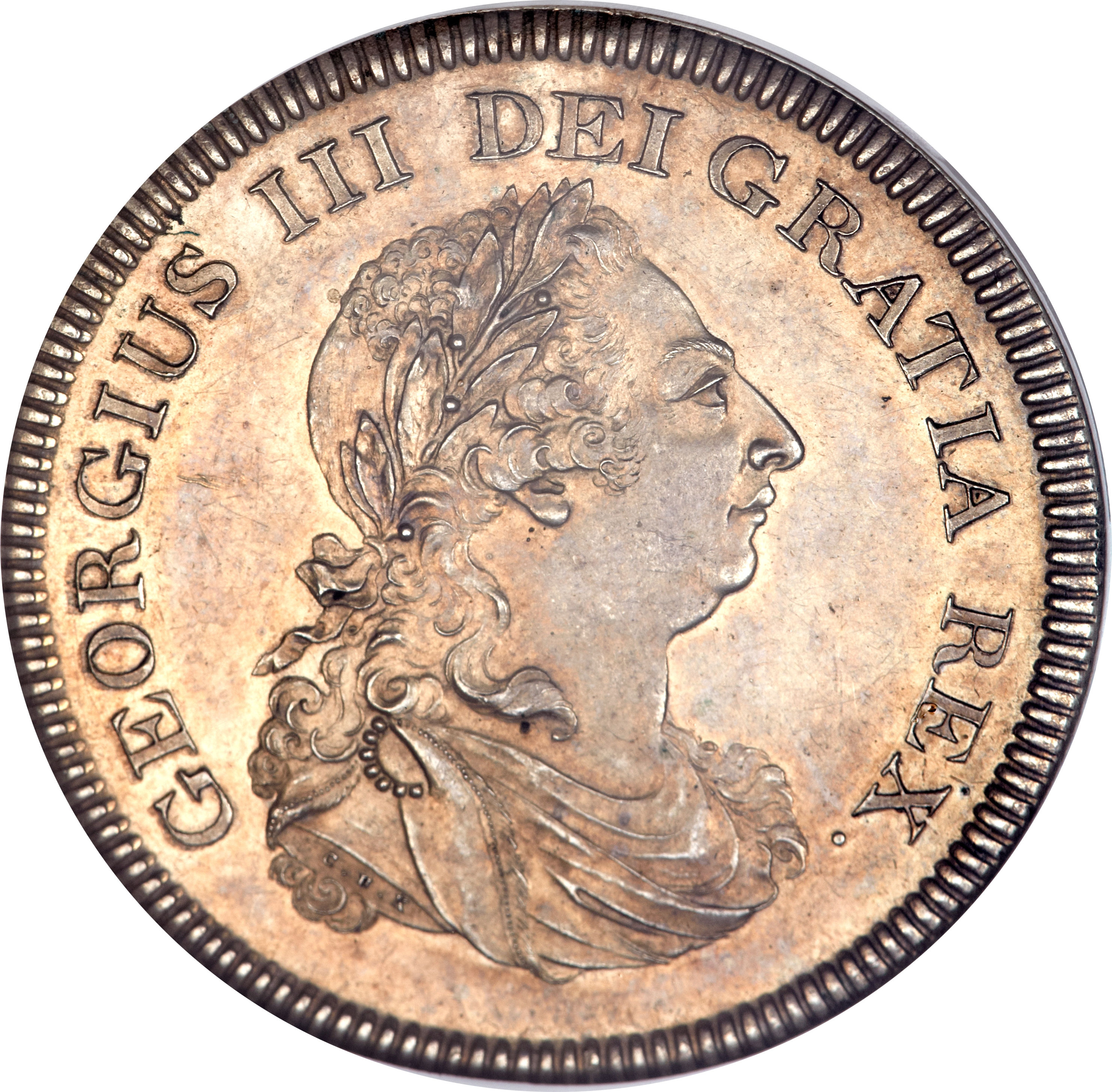
Laureate and draped bust of King George III facing right, legend around,
GEORGIUS III DEI GRATIA REX
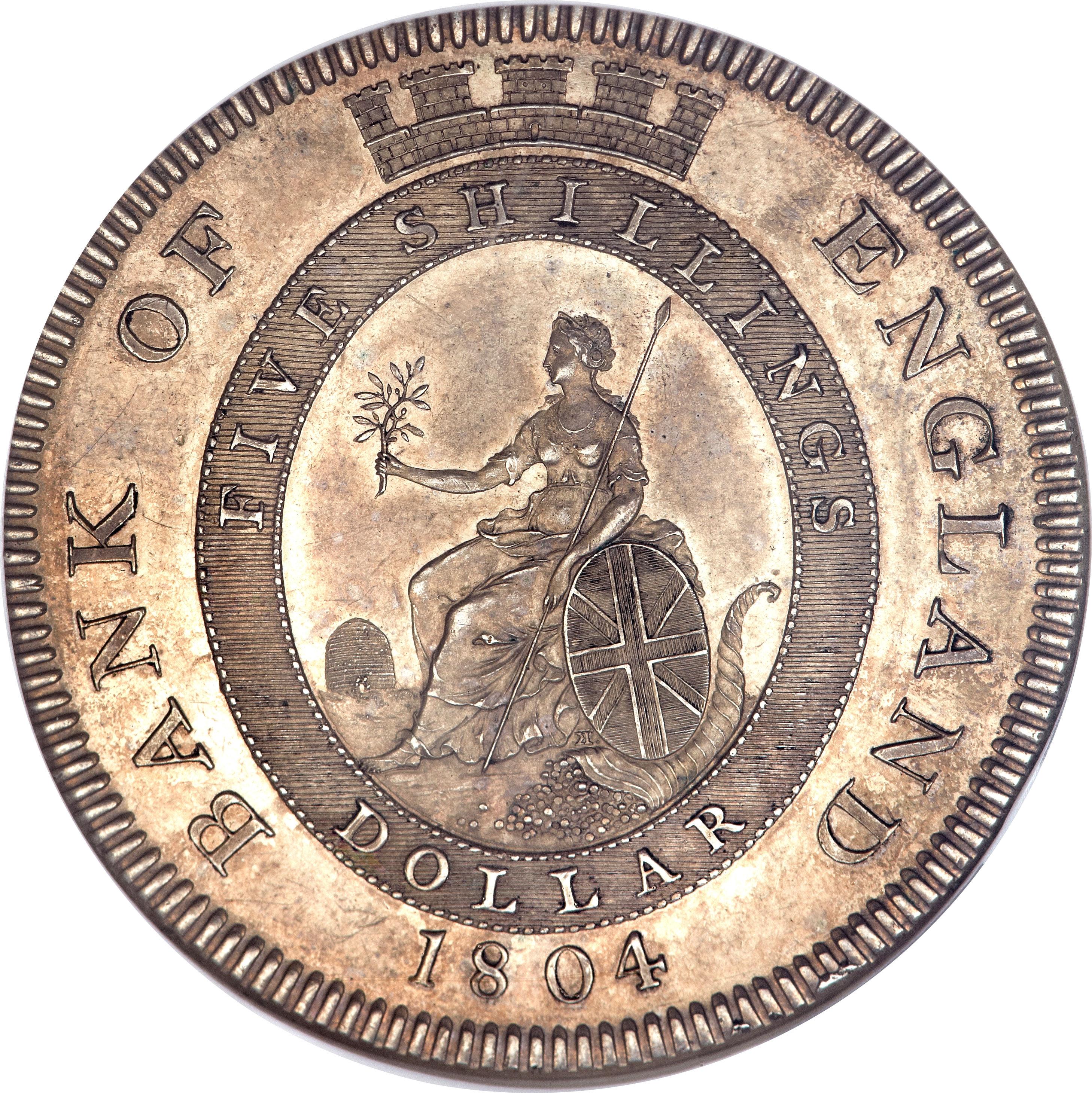
Seated image of Britannia left, holding olive branch in right hand and spear in left, shield bearing the Union flag resting to left, beehive to left, cornucopia to right, all within a garter surmounted by a castellated "crown" of five circular stone turrets.
Find this on eBay
Affiliate1 Dollar - George III Bank of England Token price history
Daily limit reachedAbout the 1804 1 Dollar - George III Bank of England Token
The 1804 1 Dollar - George III Bank of England Token is a circulating 5 shillings coin, struck in 90.3% silver. It weighs 26g and measures 41mm across. Reverse design: Seated image of Britannia left, holding olive branch in right hand and spear in left, shield bearing the Union flag resting to left, beehive to left, cornucopia to right, all within a garter surmounted by a castellated "crown" of five circular stone turrets.
It is no longer legal tender, so its value is to collectors only.
Common questions
How much is the 1804 1 Dollar - George III Bank of England Token worth?
No verified sale of the 1804 1 Dollar - George III Bank of England Token has been logged on MyCoinage yet. Its silver content is worth about £30.13 at today's spot price, which puts a floor under its value.
What is a Bank of England dollar?
A five-shilling piece issued by the Bank of England in place of crowns, made by overstriking Spanish dollars with a new design at Matthew Boulton's Soho Mint. The King's head is on one side and Britannia on the other, with BANK OF ENGLAND 1804.
Why do all Bank of England dollars say 1804?
The Royal Mint Museum explains that striking continued for some years, but nearly all pieces carry the date 1804 regardless of when they were made. The date marks the issue, not the year a particular coin was struck.
Can you see the Spanish coin underneath?
Often, yes. Tony Clayton notes that it is not uncommon to identify the original coin that was overstruck. Traces of the Spanish legend, date or design can show through on either side, and the host's mint and date can sometimes be read.
How many Bank of England dollars were made?
No mintage figure is published. CoinVarieties records the mintage as unknown. Striking ran on for several years after 1804, and the dollars circulated until the Royal Mint's new silver arrived with the recoinage of 1816 to 1817.
How is the 1804 1 Dollar - George III Bank of England Token different from the circulating coin?
This is a collector version of the 1804 1 Dollar - George III Bank of England Token, not the coin found in change. It is struck in 90.3% silver rather than copper.
How do I identify the 1804 1 Dollar - George III Bank of England Token?
Check the weight 26g and diameter 41mm and the metal (90.3% silver) against the specification table on this page. The reverse design is described above.
History and design
By 1797 silver was so short that the Bank of England bought Spanish dollars and issued them with a small countermark of the King's head, first oval and then, from 1804, octagonal. The Royal Mint Museum records that both marks were heavily counterfeited. The answer was to overstrike the whole coin with a new design at Matthew Boulton's Soho Mint in Birmingham, using his steam-powered presses.
Wikipedia's Boulton article notes that he obliterated the old design in restriking, but that good forgeries still reached the Bank within days. The Royal Mint Museum says striking went on for some years, though nearly all pieces bear the date 1804. No mintage is published. Wikipedia adds that the dollars circulated until the Royal Mint again struck silver in quantity in 1816, when they were withdrawn.
The obverse portrait is by Conrad Heinrich Küchler, Boulton's engraver at Soho: a laureate, draped and armoured bust of George III to the right, signed C.H.K. on the shoulder, with GEORGIUS III DEI GRATIA REX. The reverse shows Britannia seated to the left with her attributes, a beehive before her and a cornucopia beside her, within a band reading FIVE SHILLINGS DOLLAR topped by a mural crown, with BANK OF ENGLAND 1804 around.
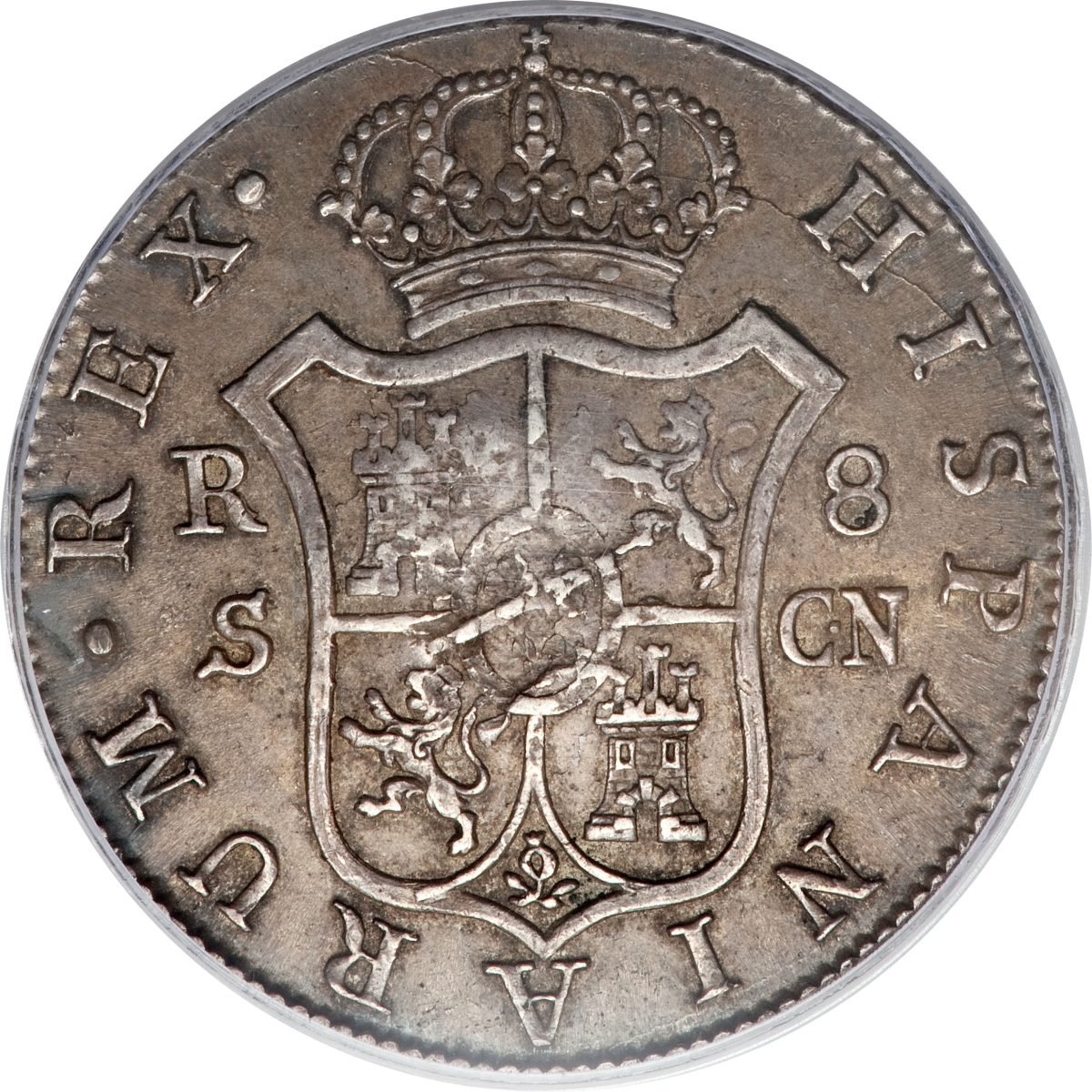
Every piece is struck over a Spanish or Spanish colonial 8 reales. Clayton notes that it is not uncommon to identify the host coin. CoinVarieties illustrates one struck over an 8 reales of Seville dated 1799 and says most were struck on Mexican or Peruvian coins.
Varieties and errors
Tony Clayton lists five obverse dies, told apart by where the top leaf of the wreath points against the E of DEI, by C.H.K. or CHK on the truncation and by the stop after REX, and three reverse dies, with a K below the shield in relief, inverted in relief or inverted and incuse. He records ten combinations. The Royal Mint Museum also holds an obverse brockage of this type, a striking error.
Collecting notes
Look for traces of the Spanish host on either side and note them, since host mint and date add interest. Then identify the obverse and reverse dies from the leaf, the initials and the K. Contemporary forgeries exist in quantity; Amgueddfa Cymru holds one in copper alloy weighing 24.0 g. Museum examples of genuine pieces weigh about 26.5 to 27.1 g, so weigh any example and check the sharpness of the lettering.
Proofs exist in silver and in bronzed copper. The countermarked dollars that came before are covered on the octagonal countermark page.
Sources
The history, design, varieties and collecting notes on this page are drawn from these sources. Prices come from recorded sales, not from them.
- George III, Royal Mint Museum (read 12 Oct 2026)
- Pictures of Crowns of George III, Tony Clayton, Coins of the UK (read 12 Oct 2026)
- George III one dollar obverse brockage (RMM 1141), The Royal Mint Museum, via Museum Data Service (read 12 Oct 2026)
- Bank of England countermarked dollar (counterfeit), 32.321/6.307, Amgueddfa Cymru - Museum Wales, via Museum Data Service (read 12 Oct 2026)
- Five Shillings, Quarter Guinea and Five and Six, Tony Clayton, Coins of the UK (read 12 Oct 2026)
- Conrad Heinrich Küchler, Wikipedia (read 12 Oct 2026)
- Dollar (Bank of England), NCM 1930-25, Nottingham Museums, via Museum Data Service (read 12 Oct 2026)
- Token; five shilling; bank token (TWCMS : M1289), North East Museums, via Museum Data Service (read 12 Oct 2026)
- George III proof one dollar, 1804 (RMM 1139), The Royal Mint Museum, via Museum Data Service (read 12 Oct 2026)
- George III one dollar, 1804 (RMM 1140), The Royal Mint Museum, via Museum Data Service (read 12 Oct 2026)
- Great Britain 1804 Bank of England dollar, CoinVarieties (read 12 Oct 2026)
- Matthew Boulton, Wikipedia (read 12 Oct 2026)
More 5 Shillings coins from nearby years