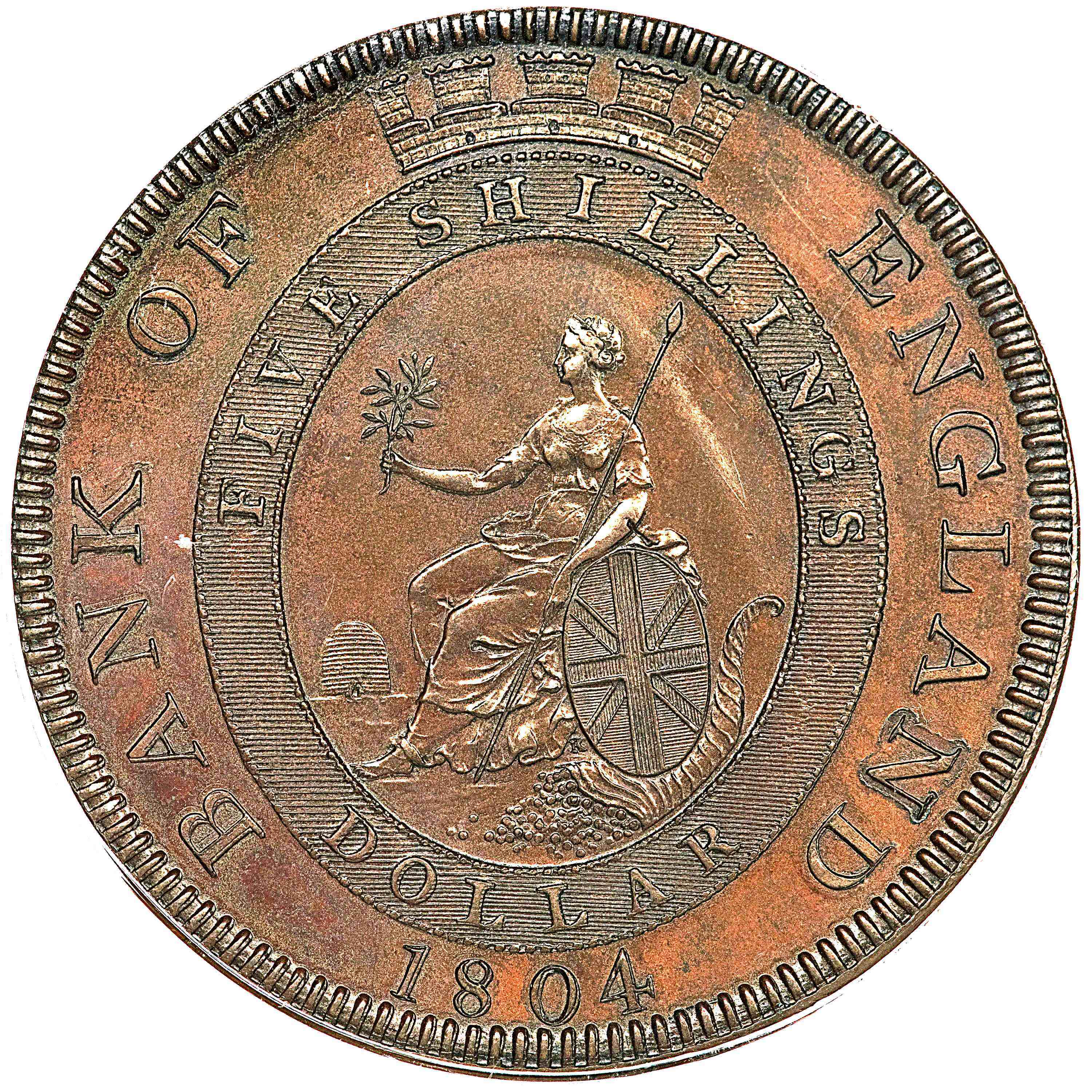
1 Dollar British Trade Dollar Gold Proof (1895–1900)
| Country | United Kingdom |
| Year | 1895–1900 |
| Denomination | 4 Shillings |
| Face value | 20p |
| Mint | Royal Mint · Llantrisant |
| Circulation | Non-circulating |
| Demonetised | Yes |
| Composition | Gold |
| Weight | 34.700g |
| Diameter | 39.0mm |
| Thickness | 3.00mm |
| Shape | Round |
| Orientation | Medal alignment ↑↑ |
| Grade scale | UK (EF/UNC) |
Standing figure of Britannia holding trident and shield with merchant ship in background, date in exergue.
Chinese characters and Jawi script in ornamental flower.
Find this on eBay
Affiliate1 Dollar British Trade Dollar – Gold Proof price history
Daily limit reachedAbout the 1895 1 Dollar British Trade Dollar – Gold Proof
The 1895 1 Dollar British Trade Dollar – Gold Proof is a collector 4 shillings coin issued from 1895 to 1900, struck in gold. It weighs 34.7g and measures 39mm across. Reverse design: Chinese characters and Jawi script in ornamental flower.
It is no longer legal tender, so its value is to collectors only.
Common questions
How much is the 1895 1 Dollar British Trade Dollar – Gold Proof worth?
No verified sale of the 1895 1 Dollar British Trade Dollar – Gold Proof has been logged on MyCoinage yet. Its gold content is worth up to £3,354 at today's spot price, which puts a floor under its value.
How do I identify the 1895 1 Dollar British Trade Dollar – Gold Proof?
Check the weight 34.7g and diameter 39mm and the metal (gold) against the specification table on this page. The reverse design is described above.
History and design
This is a collector version of the 1 Dollar British Trade Dollar. The history below is that coin's; the mintage, varieties and collecting notes on its page do not apply to this strike.
The British trade dollar was struck for British trade in the Far East, not for use at home. Wikipedia explains that Britain wanted its own dollar so that colonies such as Hong Kong and the Straits Settlements no longer depended on the foreign silver coins then circulating there. It was first struck in 1895 for both colonies, and after the Straits dollar was introduced in 1903 it served Hong Kong alone, with the last coins dated 1935.
The Royal Mint Museum records that some 270 million pieces were struck over about forty years, and that the coin seems to have met the needs of those who lobbied for it. Most were made in India. Coins marked B came from the Bombay Mint and those marked C from Calcutta, while the few with no mint mark were struck in London. Output varied widely: CoinVarieties, quoting the Standard Catalog of World Coins, gives 37,471,000 for 1911 B but only 363,000 for 1900 C and 648,847 for 1904 B.
The coin was designed by George William de Saulles. His Britannia stands on the shore holding a trident and a British shield, with a merchant ship under full sail behind her. There is no portrait of the monarch, so the same design ran unchanged through the reigns of Victoria, Edward VII and George V.
The other side has an arabesque border with the Chinese character for longevity at the centre and the denomination in two scripts, Chinese and Jawi Malay. The Bombay B is placed in the middle prong of the trident and the Calcutta C on the ground between Britannia's left foot and the shield. The coin was struck in .900 silver.
Sources
- British trade dollar, Royal Mint Museum (read 10 Oct 2026)
- Trade dollar (section: United Kingdom), Wikipedia (read 10 Oct 2026)
- Great Britain 1895-B dollar, and the dollar pages for each date and mint to 1934-B (read one by one), CoinVarieties (citing the Standard Catalog of World Coins and Spink) (read 10 Oct 2026)
- Extremely rare gold trade dollar from Bombay Mint highlights Baldwin's auction, Coin World (read 10 Oct 2026)