Victorian Penny Value UK: Bun Head & Old Head Complete Guide
The Victorian penny is the cornerstone of any 19th-century British coin collection. Struck in bronze from 1860 to 1901, the series breaks into the iconic Bun Head portrait (1860–1894) and the austere Old Head / Veiled Head portrait (1895–1901). Common dates trade at £1–£5 in circulated grade; key dates such as the 1869 and the 1882 without H mintmark reach £500–£3,000. This guide covers identification, the rare-date list, variety hunting, patina assessment and where to buy authenticated examples.
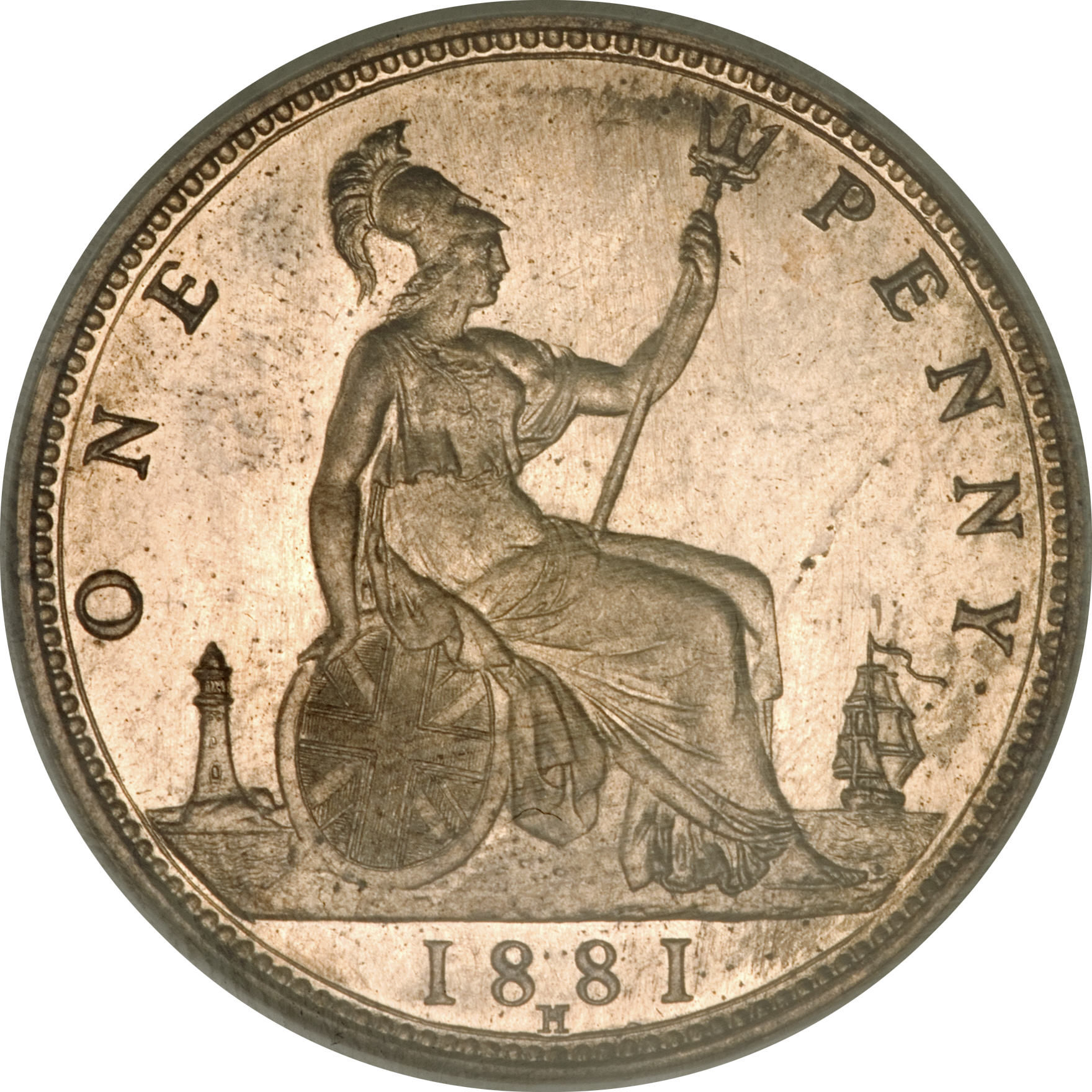
The Victorian Bun Head penny (1860–1894)
In 1860 the Royal Mint replaced the previous copper penny (1797–1860, 34 mm and 18.8 g) with a smaller, lighter bronze coin (30.81 mm and 9.4 g). The new design was the work of Leonard Charles Wyon, whose obverse showed Victoria with her hair pulled back into a tidy bun. The reverse depicted Britannia seated by the sea, holding a trident, with a lighthouse on the right and a ship on the left.
The Bun Head series ran for 35 years and is one of the most-collected portrait runs in British numismatics. Several minor varieties exist within the series, distinguished by reverse details (lighthouse and ship variants, rim border styles) and obverse die states (the "9" and "6" digits in date positions evolved subtly over the decades). For most collectors, the important distinctions are date and grade; for advanced collectors, the variety nuances multiply the price differentials substantially.
Bun Head pennies were struck in three places over the run:
- The Royal Mint, Tower Hill, the primary producer for the entire series.
- Ralph Heaton & Sons, Birmingham, produced under contract in 1874, 1875, 1876, 1881, 1882 and a few other years. These coins carry an H mintmark below the date.
- James Watt & Co, produced a small batch in 1860–1862 (rare; specialists\' market only).
The Victorian Old Head penny (1895–1901)
In 1893 (silver) and 1895 (bronze) the Royal Mint replaced Wyon\'s Bun Head portrait with Thomas Brock\'s Old Head, also called the Veiled Head. The new portrait showed Victoria as an elderly widow, in her veil and a small crown, an explicit visual statement of mourning for Prince Albert (who had died in 1861). The Old Head portrait ran on the penny from 1895 to 1901, the final year of Victoria\'s reign.
The Old Head penny retains the bronze format (30.81 mm, 9.4 g) and the Britannia reverse, with subtle revisions: the lighthouse beams differ slightly, the ship sits at a different angle, and the rim border carries a different beaded pattern. For pricing purposes, Old Head pennies trade at small premium over equivalent-date Bun Heads, not because they\'re scarcer (mintages were similar) but because the seven-year run produces a more contained set that is easier to complete.
Notable Old Head dates:
- 1895 "dot" vs "no-dot". The first-year issue exists in two reverse varieties distinguished by a small dot near the "ONE PENNY" legend. The dot variant is scarcer and trades at 50–100% premium.
- 1897 high tide vs low tide. Two reverse die states differing in the apparent water level around Britannia\'s feet. Easy to miss but matters for completionists.
- 1901. Victoria\'s final year; high mintage and not particularly rare, but a popular "closing the reign" piece for collectors.
Key dates to know
The 19th century includes several Victorian penny dates that command significant premium. Be aware that 1903 is not Victorian, that\'s Edward VII, who succeeded Victoria in January 1901, so 1902 onwards belongs to a different series. Within the Victorian range:
| Year & type | Why notable | Mintage | Realised range (circulated, UNC) |
|---|---|---|---|
| 1860 Bun Head, toothed | First-year bronze; transition from copper | 5.05 million | £5, £200 |
| 1869 | Key date. Lowest Bun Head mintage | 2.58 million | £100, £1,500 |
| 1873 narrow date | Reverse variety on otherwise-common year | n/a (subset) | £15, £120 |
| 1874 H Heaton | Heaton mint contract | 6.66 million | £5, £75 |
| 1881 H Heaton | Heaton mint contract | 3.76 million | £8, £120 |
| 1882 H Heaton | Common 1882 issue | 7.53 million | £3, £60 |
| 1882 NO H | Major rarity. Royal Mint without H mintmark | Unknown; survival in low hundreds | £500, £3,000 |
| 1895 dot reverse | First-year Old Head, dot variety | n/a (subset) | £25, £200 |
| 1895 no-dot reverse | First-year Old Head, common variety | 5.39 million | £5, £80 |
| 1860 Bun Head pattern | Pattern striking; tiny mintage | Single-digit population | £3,000, £15,000 |
Realised prices by year cluster and grade
For collectors building a Victorian penny date run on a budget, the table below summarises typical realised price ranges for non-rarity years across the main grades. These are the everyday Bun Head and Old Head dates, not the 1869 or 1882-no-H outliers covered above.
| Year cluster | VG | F | VF | EF | UNC |
|---|---|---|---|---|---|
| 1860–1869 (early Bun Head) | £3, £8 | £6, £15 | £15, £35 | £40, £120 | £100, £300 |
| 1870–1880 (mid Bun Head) | £2, £5 | £4, £10 | £10, £25 | £25, £80 | £60, £200 |
| 1881–1894 (late Bun Head) | £1, £4 | £3, £8 | £8, £20 | £20, £60 | £50, £150 |
| 1895–1901 (Old Head) | £1, £4 | £3, £8 | £8, £20 | £20, £55 | £40, £130 |
Ranges are realised auction sales over 24 months from Baldwin\'s, Spink, Noonans and dealer published price lists. Within each cluster, individual years vary, particularly 1869 (sharply higher) and the Heaton-mintmark years.
Spotting Bun Head varieties
A complete Victorian penny collection isn\'t just about dates, it\'s about the varieties within each year. Five high-impact varieties to watch for:
- 1860 toothed vs beaded border. The first-year bronze penny exists with two rim styles. Toothed (the more common) shows individual short bars around the rim; beaded shows small round dots. Beaded is rarer and trades at 30–50% premium.
- 1873 narrow date vs wide date. The spacing of the "1873" differs between two die states. Wide-date variants are scarcer.
- Open vs closed 9. Several Bun Head years (especially 1879–1889) show differences in how the "9" loop closes at the top. Closed 9 is the more common form; open 9 is scarcer on certain dates.
- 1879 wide vs narrow date. Similar to 1873; the spacing distinction matters for variety collectors.
- Lighthouse and ship varieties. Throughout the Bun Head series, the reverse has at least four distinct die states for the Britannia scene. The "Gouby" reference series (Michael Gouby\'s standard catalogue) documents these in detail.
For a casual collector, dates and grade are sufficient. For a serious Victorian penny collection, a copy of The British Bronze Penny 1860–1901 by Michael Gouby is the standard variety reference and a worthwhile £30 investment.
Cleaning and patina, what affects value
Victorian pennies develop a distinctive surface over decades: the original mint-red copper oxidises to a deep chocolate brown, sometimes with subtle blue or violet iridescence on high-relief areas. This patina is highly desirable to collectors. Three rules:
- Don\'t clean. No brass cleaner, no acid, no abrasive. Cleaning strips the chocolate patina and leaves the surface with a harsh pink/orange "new" cast that no informed buyer wants. Cleaned Victorian pennies typically lose 50–80% of their value. PCGS and NGC will assign a "Cleaned" details grade or refuse to grade.
- Original red is rare and valuable. An "original red" Bun Head penny with substantial mint-red surfaces remaining is exceptional and trades at significant premium (often 5–10× the standard UNC price). These are usually pristine ex-Royal-Mint specimens that escaped circulation entirely.
- Verdigris is bad. Green crust on copper indicates active corrosion, usually from PVC-induced acidic damage. It can be conserved by a professional but it permanently affects value. Avoid coins with visible verdigris unless the price reflects the condition.
The single best investment in protecting a Victorian penny\'s value is replacing any PVC storage with inert Mylar or polypropylene. PVC off-gases hydrochloric acid over decades and produces the characteristic green slime on copper alloys. Modern coin albums (Lighthouse, Whitman, Saflib) and 2x2 cardboard holders with Mylar windows are inert and inexpensive.
Counterfeit risks
Victorian pennies are widely faked at three risk tiers. Knowing each helps you avoid losses:
- Period cast counterfeits (1880s–1920s). Genuine forgeries from the Victorian period itself, usually slightly underweight and undersize, with fine-detail loss. These are increasingly easy to spot under magnification and have historical interest of their own. Most numismatists treat them as collectibles in their own right rather than outright fakes.
- Date-altered modern fakes. The most active threat today. Counterfeiters take a common host coin (e.g. 1865 or 1868) and rework the final digit to create a 1869. Tooling marks under 10x loupe usually reveal these, parallel scratches near the digit edges, depressions where metal was cut, or spacing slightly off compared to a working-die reference. Anything claimed to be a 1869 under £100 should be assumed altered until professionally graded.
- Modern reproductions. Cheap mass-produced Victorian penny copies from Eastern Europe and China appear regularly online. Usually one of three giveaways: wrong weight, wrong alloy (golden brass instead of bronze) or wrong diameter. These are simple to identify with a scale and calliper and should never deceive an attentive buyer.
Related coins on MyCoinage
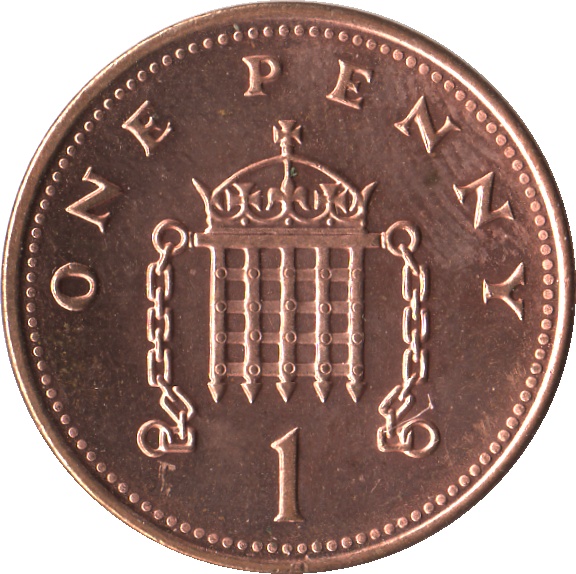
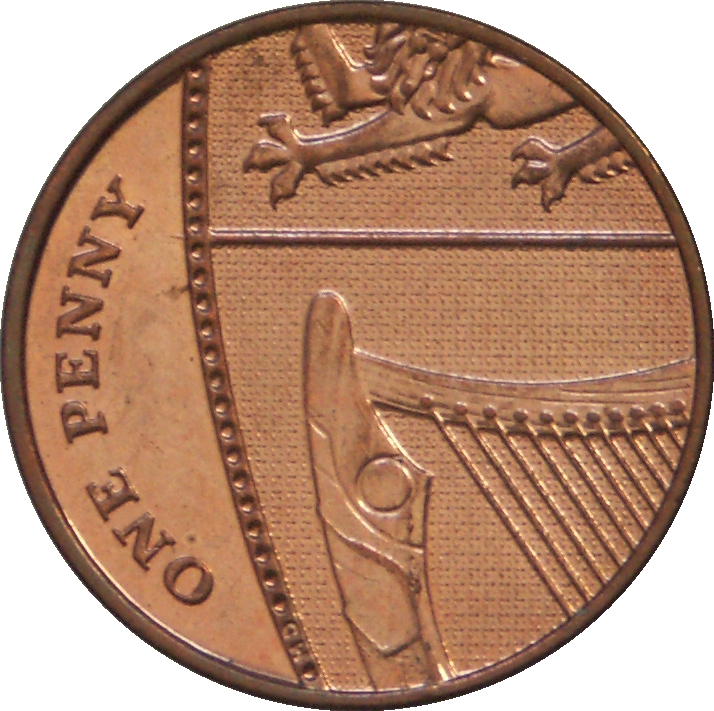
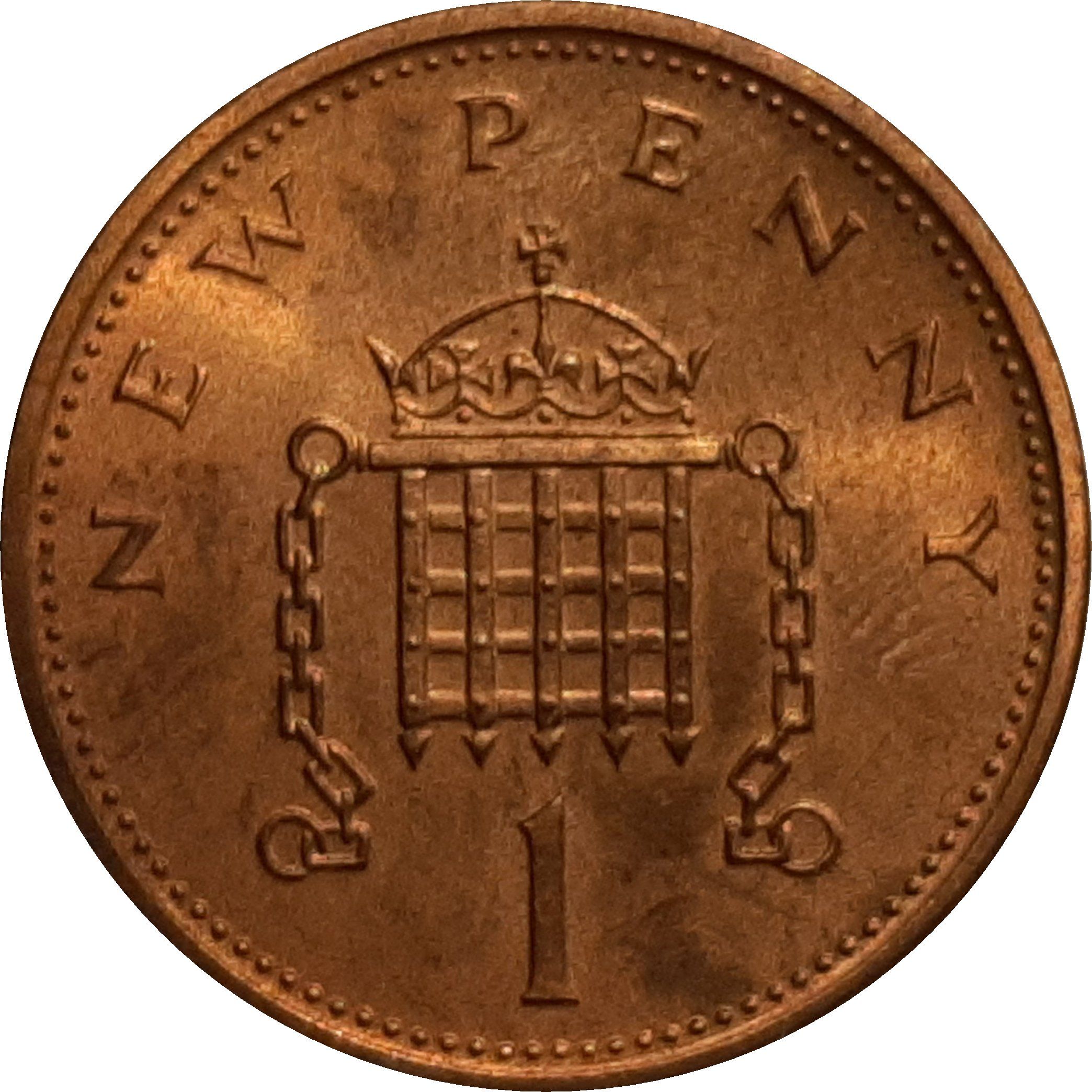
Browse every UK penny in the catalogue →
Related guides
- Victoria Coins Value Guide, the full silver, bronze and gold series under Victoria.
- Halfpenny Values UK, the Victorian halfpenny is a natural companion piece.
- Farthing Values UK, the smallest bronze denomination.
- 1p Coin Values UK, the modern penny series, decimal era.
- Junk Silver UK Coins, the silver companion to a Victorian bronze collection.
- How to Spot Fake British Coins, the full counterfeit-detection workflow.