Common: 10,000,000 or more minted. Sells regularly: 21 verified sales in the last 12 months.
50 Pence - Elizabeth II 2nd portrait Entry into EEC (1973)
"EEC 50p"
| Country | United Kingdom |
| Year | 1973 |
| Denomination | 50 Pence |
| Face value | 50p |
| Mintage | 89,775,000 |
| Mint | Royal Mint · Llantrisant |
| Circulation | Circulating |
| Demonetised | 1998 |
| Composition | Copper-nickel |
| Weight | 13.500g |
| Diameter | 30.0mm |
| Thickness | 2.30mm |
| Shape | Equilateral curve heptagon (7-sided) |
| Edge | Plain |
| Orientation | Medal alignment ↑↑ |
| Obv. artist | Arnold Machin |
| Rev. artist | David Wynne |
| Grade scale | UK (EF/UNC) |
Second crowned portrait of Queen Elizabeth II right, wearing the Girls of Great Britain and Ireland tiara, legend around.
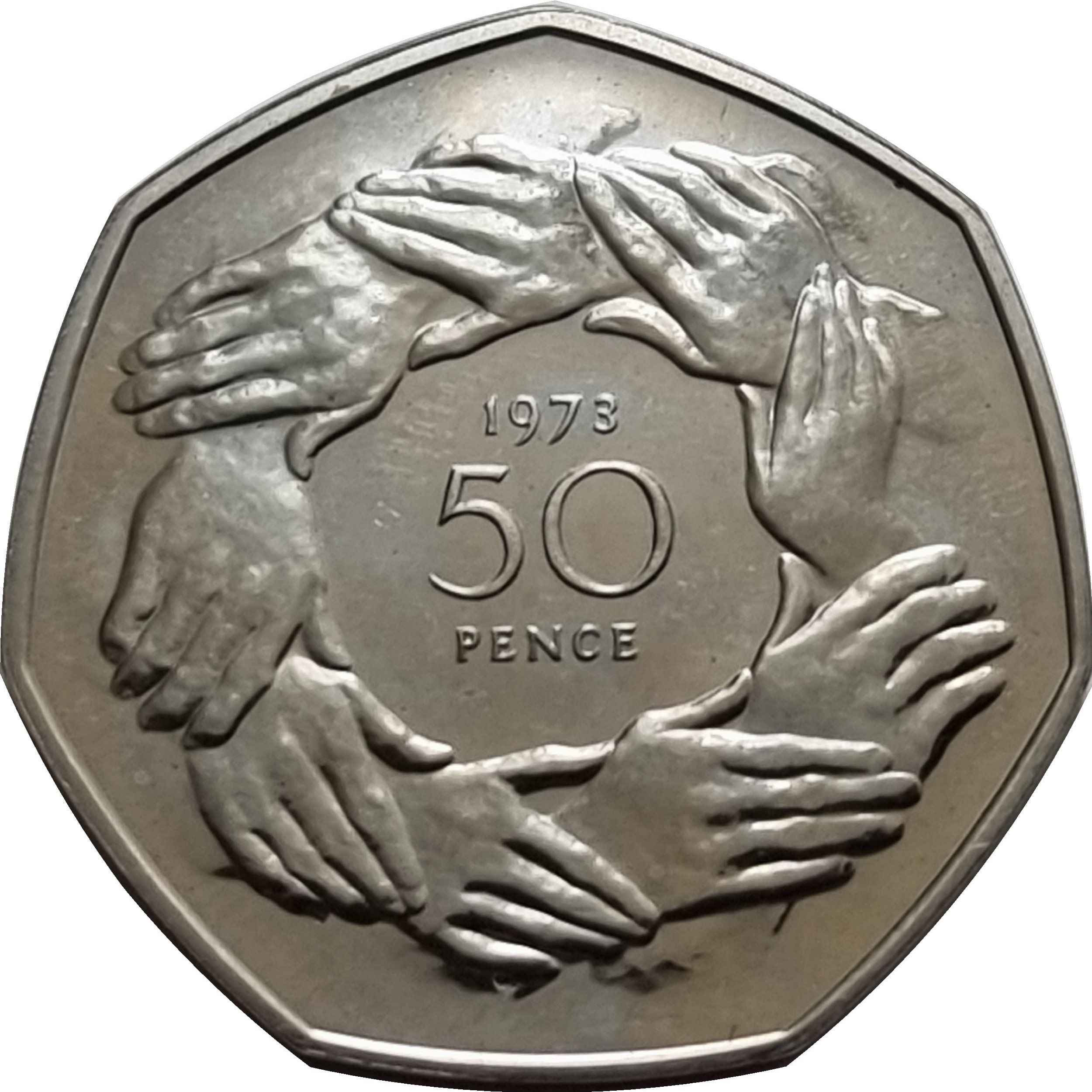
Denomination below date surrounded by circle of nine hands, symbolising the nine members of the EEC, clasping one another in a mutual gesture of trust, assistance and friendship.
Entry into EEC 50p market value
Find this on eBay
AffiliateEntry into EEC 50p price history
Daily limit reachedEntry into EEC 50p value by grade
Realised auction prices · ⭐ Pro Expand rows for individual sale records| Grade | Latest | Median | 30d Δ | All-time range | Sales (1yr) | Total sales | Last sale | |
|---|---|---|---|---|---|---|---|---|
| UNC | £3.99 🔒 eBay | £3.99 (1) | – | £3.99 – £3.99 | 1 | 1 | 01-09-2026 | |
|
Loading…
|
||||||||
| VF | £5.42 🔒 eBay | £2.59 | ▼2.8% | £1.16 – £5.45 | 19 | 19 | 16-10-2026 | |
|
Loading…
|
||||||||
| PR-65 | £6.49 🔒 eBay | £6.49 (1) | – | £6.49 – £6.49 | 1 | 1 | 10-10-2026 | |
|
Loading…
|
||||||||
About the 1973 50 Pence - Elizabeth II – Entry into EEC
The 1973 50 Pence - Elizabeth II – Entry into EEC is a circulating 50 pence coin, struck in copper-nickel. It weighs 13.5g and measures 30mm across. Reverse design: Denomination below date surrounded by circle of nine hands, symbolising the nine members of the EEC, clasping one another in a mutual gesture of trust, assistance and friendship.
89,775,000 were struck. It is no longer legal tender (withdrawn 1998), so its value is to collectors only.
Common questions
How much is the 1973 50 Pence - Elizabeth II – Entry into EEC worth?
Verified sold prices for the 1973 50 Pence - Elizabeth II – Entry into EEC run from £2.59 to £6.49 across 3 grades, taking the median for each grade. Condition makes the difference, so check the grade table above before pricing one.
Is the 1973 EEC 50p rare?
No. The Royal Mint's figures give a circulating mintage of 89,775,000, the second highest for any year of the large 50p after the 188,400,000 struck in 1969. It is one of the most heavily produced commemorative 50p coins.
Who designed the 1973 50p with the hands?
The sculptor David Wynne designed the reverse. He modelled the nine hands on people he could study easily, including himself, his wife, one of his sons and a craftsman from his studio. The Queen's portrait on the obverse is by Arnold Machin.
What do the nine hands on the 1973 50p mean?
They stand for the nine members of the European Economic Community after the United Kingdom joined. The Royal Mint describes them as clasping one another in a mutual gesture of trust, assistance and friendship. No hand represents a particular country.
Can I still spend a 1973 EEC 50p?
No. It is a large-size 50p, and the Royal Mint states that the larger coin first introduced in 1969 was demonetised in 1998, after the smaller 50p arrived on 1 September 1997. It will not be found in change today.
How do I identify the 1973 50 Pence - Elizabeth II – Entry into EEC?
Check the weight 13.5g and diameter 30mm and the metal (copper-nickel) against the specification table on this page. The reverse design is described above.
History and design
The United Kingdom joined the European Economic Community in 1973, and the Royal Mint marked the accession with a new reverse for the 50p. It was the first commemorative 50p, issued only four years after the denomination itself appeared.
It was struck as a normal circulating coin. The Royal Mint's figures give 89,775,000, the only 50p issued for circulation dated 1973. That is the second highest figure for any year of the large 50p, behind the 188,400,000 of 1969 and just ahead of the 89,086,000 Britannia coins of 1980.
The sculptor David Wynne designed the reverse. The Royal Mint describes it as the inscription 50 PENCE and the date of the year, surrounded by nine hands, symbolising the nine members of the Community, clasping one another in a mutual gesture of trust, assistance and friendship.
The Royal Mint Museum holds Wynne's early artwork, which shows a ring of ten hands. Norway had been expected to join, and when it withdrew the number of members fell from ten to nine, so Wynne amended the design.
He modelled the hands on people close by: his own, those of his wife and one of his sons, a craftsman from his studio and a girl who helped look after his children. One of her hands remains in the finished design and looks more delicate than the rest. The Mint has often been asked whether it stands for a particular country, and the Museum is clear that it does not.
The obverse carries Arnold Machin's portrait of the Queen, as on the Britannia 50p of the time. The date appears on the reverse.
Collecting notes
This is a large-size 50p, 30mm across and 13.5g. The Royal Mint states that the larger coin was demonetised in 1998, after the smaller 50p was introduced on 1 September 1997, so the EEC coin cannot be spent and no longer appears in change.
With close to 90 million struck, circulated examples are common. Condition is what separates one from another: look at the knuckles and fingertips, the highest points of the design, and at the Queen's cheek and hair on the other side, where wear and bag marks show first.
Proof versions were also made for collectors in 1973 and have mirrored fields. The design was the only departure from the Britannia 50 new pence during the 1970s, and the next commemorative 50p did not follow until the 1992 to 1993 Single Market coin.
Sources
The history, design, varieties and collecting notes on this page are drawn from these sources. Prices come from recorded sales, not from them.
- Royal Mint mintage figures data file (mintages.json), The Royal Mint (read 9 Oct 2026)
- 50p Coin Designs and Specifications, The Royal Mint (read 9 Oct 2026)
- 1973 Elizabeth II The United Kingdom's Accession to the European Economic Community 50p Coin, The Royal Mint (read 9 Oct 2026)
- David Wynne fifty pence artwork, Royal Mint Museum (read 9 Oct 2026)
- Fifty pence (British coin), Wikipedia (read 9 Oct 2026)
- Fifty Pence Varieties, by Bill Exley, Blunham.com (read 9 Oct 2026)
More 50 Pence coins from nearby years