
Mythic: a key date.
5 Pounds - George III Pattern (1820)
| Country | United Kingdom |
| Year | 1820 |
| Denomination | 5 Pounds |
| Face value | £5 |
| Mintage | 25 |
| Mint | Royal Mint · Llantrisant |
| Circulation | Non-circulating |
| Demonetised | Yes |
| Composition | Gold (.9167) (917/1000 fine) |
| Weight | 39.960g · 1.1777 t oz |
| Shape | Round |
| Edge | Lettered: DECUS ET TUTAMEN ANNO REGNI LX |
| Orientation | Coin alignment ↑↓ |
| Obv. artist | Benedetto Pistrucci |
| Rev. artist | Benedetto Pistrucci |
| Grade scale | UK (EF/UNC) |
Laureate portrait of King George III right, legend around, date below.
GEORGIUS III D G BRITANNIAR REX F D
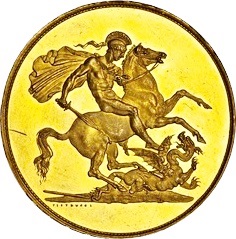
St. George on horseback slaying the dragon right,
5 Pounds - George III Pattern market value
Find this on eBay
Affiliate5 Pounds - George III Pattern price history
Daily limit reached5 Pounds - George III Pattern value by grade
Realised auction prices · ⭐ Pro Expand rows for individual sale records| Grade | Latest | Median | 30d Δ | All-time range | Sales (1yr) | Total sales | Last sale | |
|---|---|---|---|---|---|---|---|---|
| VF | £200,000.00 🔒 | £200,000.00 (1) | – | £200,000.00 – £200,000.00 | 0 | 1 | 11-06-2025 | |
|
Loading…
|
||||||||
About the 1820 5 Pounds - George III Pattern
The 1820 5 Pounds - George III Pattern is a collector 5 pounds coin, struck in 91.67% gold. It weighs 39.96g. Reverse design: St. George on horseback slaying the dragon right,.
25 were struck. It is no longer legal tender, so its value is to collectors only.
Common questions
How much is the 1820 5 Pounds - George III Pattern worth?
The 1820 5 Pounds - George III Pattern has a price in one grade on MyCoinage so far: £200,000 in VF, the median of its verified sales. Its gold content is worth about £3,528 at today's spot price, which puts a floor under its value.
How many 1820 five pound coins were made?
About 25. Wikipedia gives approximately 25 specimens, distributed among Royal Mint officials, leading numismatists and other notable people, with examples given to the Royal Mint and the British Museum. Heritage describes the figure as a purported mintage of 25. No official record of the number has been published.
Was the 1820 £5 coin ever legal tender in circulation?
No. It is a pattern, struck in 1820 as a trial of a denomination authorised in 1816 but not yet issued. The gold five pound piece was next made as a proof in 1826 and 1839, and was first struck for circulation only in 1887.
Who designed the 1820 George III five pounds?
Benedetto Pistrucci. The reverse is his St George and the dragon, first used on the sovereign in 1817, here shown without the Garter. Heritage credits the whole piece to Pistrucci and notes that William Wyon is believed to have helped complete the work.
Was the 1820 five pounds struck before George III died?
Probably not. A pencil note recorded by Richard Lobel tells of Pistrucci ordering pieces struck as the king died, and Edward Hawkins wrote of a race to finish them in time. William John Hocking and others concluded the dies were not ready until after the king's death on 29 January 1820.
How do I identify the 1820 5 Pounds - George III Pattern?
Check the weight 39.96g and the metal (91.67% gold) against the specification table on this page. The reverse design is described above.
History and design
The Coinage Act 1816 put Britain on the gold standard, and a Privy Council committee recommended gold coins of ten shillings, twenty shillings, two pounds and five pounds, which the Prince Regent approved on 3 August 1816. The sovereign and half sovereign followed in 1817, but the two larger pieces were not struck. No coin worth more than a guinea had been issued for circulation since 1753, the last year of the five guinea piece.
The five pound denomination was finally struck in 1820, as a pattern only. Wikipedia records about 25 specimens, given to Royal Mint officials, leading numismatists and other notable people, with examples going to the Royal Mint and the British Museum. The Royal Mint Museum still holds one (RMM 1161), weighing 40 g, with a raised lettered edge and the dies turned upside down to each other. The story that Pistrucci had pieces struck as the king lay dying is doubted: William John Hocking and others concluded the dies were finished only after George III's death on 29 January 1820.
The reverse is Benedetto Pistrucci's St George and the dragon, the design he created for the sovereign of 1817, here without the surrounding Garter and with no legend or date. Pistrucci's name appears at lower left and the initials of William Wellesley Pole, Master of the Mint, sit near the broken spear.
The obverse carries the laureate head of George III facing right, with the legend GEORGIUS III D G BRITANNIAR REX F D (George III, by the grace of God, King of the Britains, Defender of the Faith) and the date. The Royal Mint Museum records that Pistrucci was commissioned to model George III's portrait for the gold and silver coins planned for 1817. Heritage credits the piece to Pistrucci and notes that William Wyon is believed to have helped complete it. The edge reads DECUS ET TUTAMEN ANNO REGNI LX in raised letters, the sixtieth year of the reign.
Collecting notes
With about 25 struck and some of those in institutions, examples appear only at major auctions. Check for the raised edge lettering with the regnal year LX, the upside-down die alignment of the Royal Mint Museum piece, and a weight close to 40 g. Heritage describes its example as a proof with mirrored fields and frosted devices.
The matching two pound pattern of 1820 was also never put into production. The five pound piece was next made for the 1826 proof set, the George IV five pounds, and was not struck for circulation until 1887. The reverse is the same St George first seen on the 1817 sovereign.
Sources
The history, design, varieties and collecting notes on this page are drawn from these sources. Prices come from recorded sales, not from them.
- Five pounds (gold coin), Wikipedia (read 12 Oct 2026)
- George III pattern five pounds, 1820 (RMM 1161), The Royal Mint Museum, via Museum Data Service (read 12 Oct 2026)
- Great Britain 1820 5 pounds, CoinVarieties (quoting Heritage Auctions sale 3096, lot 30320) (read 12 Oct 2026)
- Benedetto Pistrucci, Royal Mint Museum (read 12 Oct 2026)
- Sovereign (British coin), Wikipedia (read 12 Oct 2026)
- Five Pounds or Guineas, Tony Clayton, Coins of the UK (read 12 Oct 2026)
More 5 Pounds coins from nearby years


