5 Guineas - George I (1716–1726)
| Country | United Kingdom |
| Year | 1716–1726 |
| Denomination | 5 Guineas |
| Face value | £5.25 |
| Mint | Royal Mint · Llantrisant |
| Circulation | Circulating |
| Demonetised | Yes |
| Composition | Gold (.9167) (917/1000 fine) |
| Weight | 41.900g · 1.2349 t oz |
| Shape | Round |
| Edge | Lettered: DECVS ET TVTAMEN ANNO REGNI |
| Orientation | Coin alignment ↑↓ |
| Obv. artist | John Croker |
| Grade scale | UK (EF/UNC) |
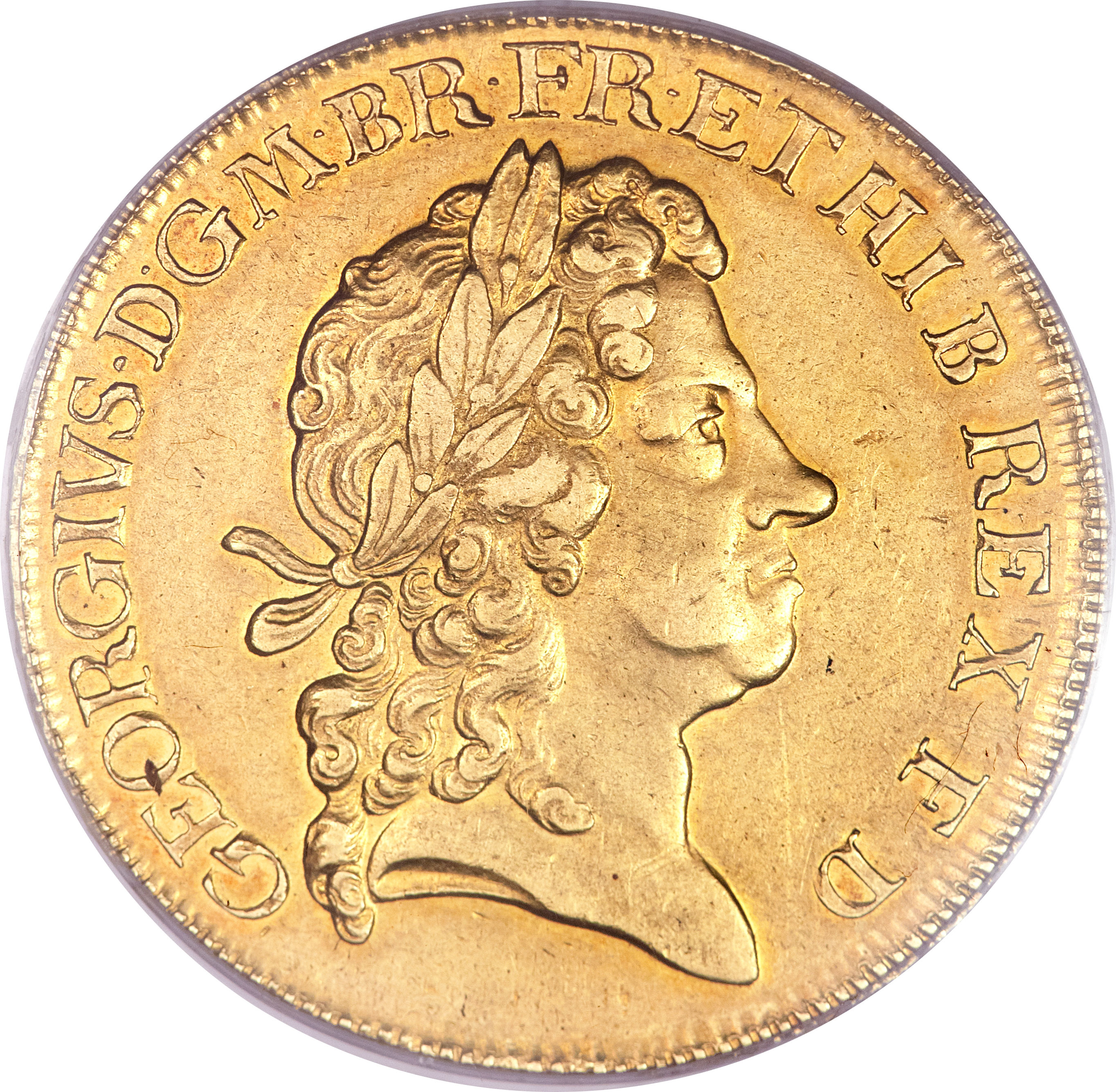
Laureate portrait of King George I right, legend around.
GEORGIVS D G M BR FR ET HIB REX F D
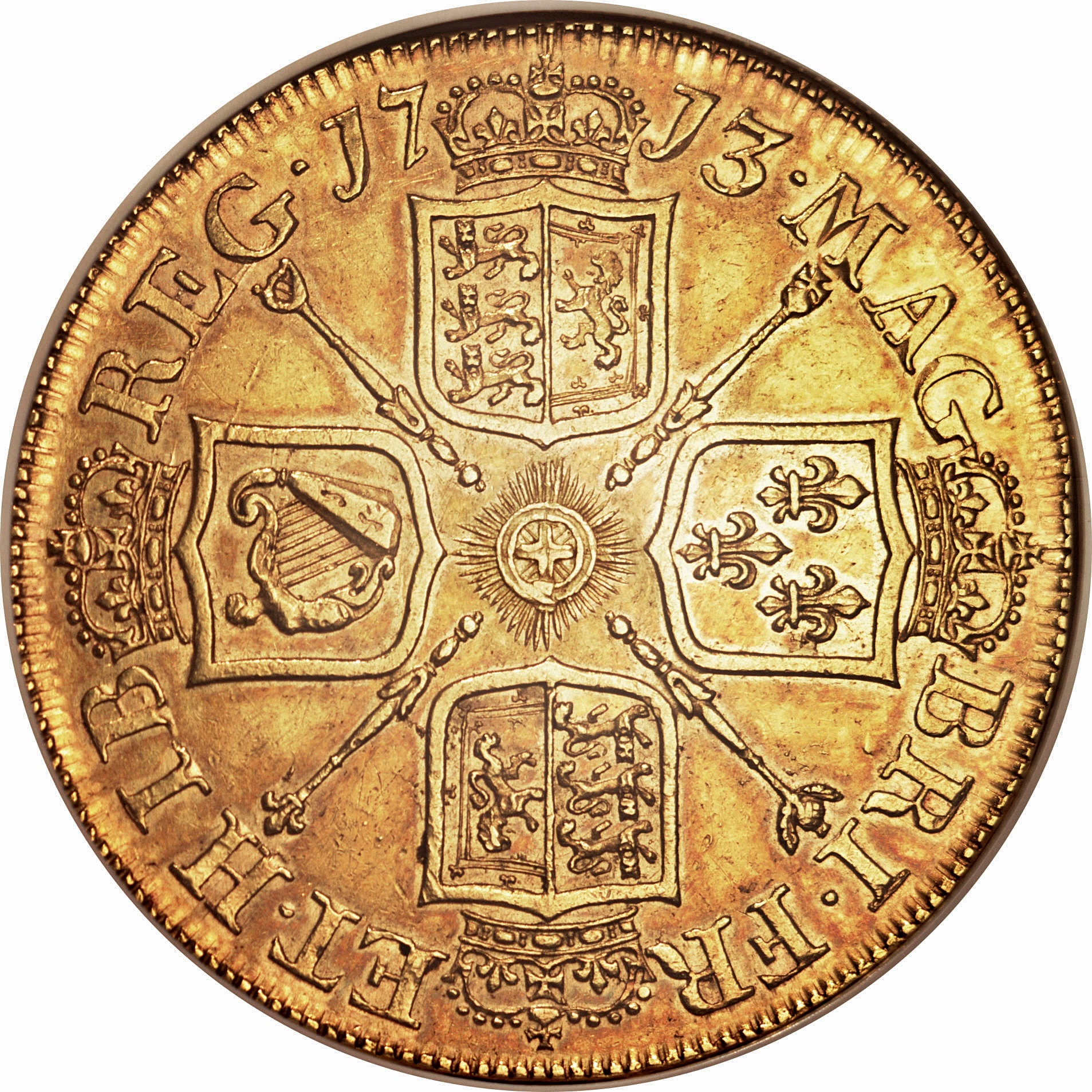
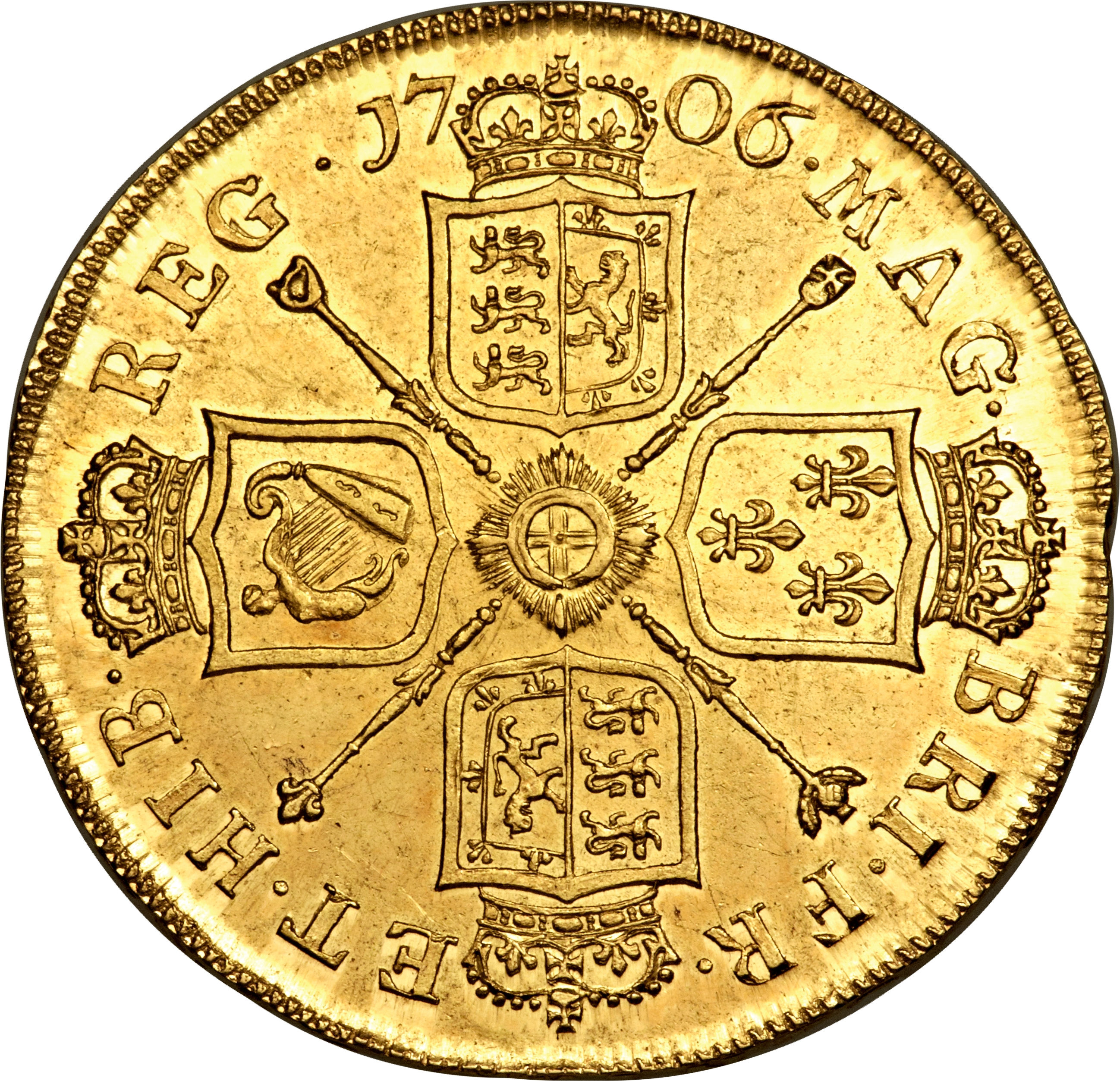
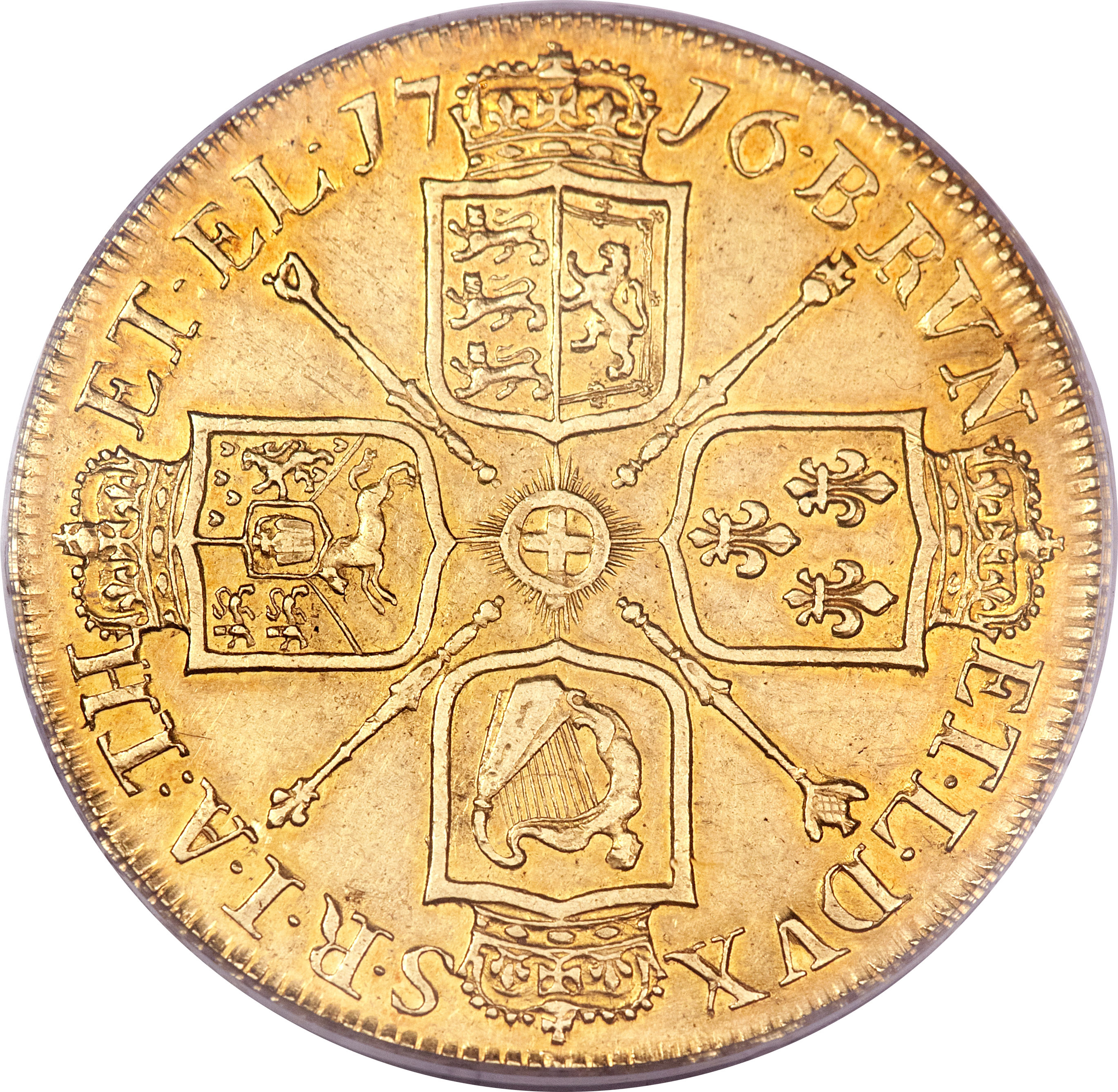
Crowned cruciform shields around central Garter star with sceptres bearing national emblems in angles, divided date above, legend around.
BRVN ET L DVX S R I A TH ET EL
Find this on eBay
AffiliateAbout the 1716 5 Guineas - George I
The 1716 5 Guineas - George I is a circulating 5 guineas coin issued from 1716 to 1726, struck in 91.67% gold. It weighs 41.9g. Reverse design: Crowned cruciform shields around central Garter star with sceptres bearing national emblems in angles, divided date above, legend around.
It is no longer legal tender, so its value is to collectors only.
Common questions
How much is the 1716 5 Guineas - George I worth?
No verified sale of the 1716 5 Guineas - George I has been logged on MyCoinage yet. Its gold content is worth about £3,712 at today's spot price, which puts a floor under its value.
Which years were George I five guineas struck?
1716, 1717, 1720 and 1726, according to Wikipedia, which also lists the regnal year on each edge: SECVNDO, TERTIO, SEXTO and DECIMO TERTIO. CoinVarieties describes the type as issued 1716 to 1720 and 1726 and calls all dates scarce.
How many George I five guinea coins were made?
No mintage is recorded for any date. CoinVarieties gives the figure as unknown but scarce. The Royal Mint Museum and the Science Museum Group each hold a 1726 example, weighing 41.85 g and 41.81 g.
What does the edge inscription on a five guinea coin mean?
DECVS ET TVTAMEN ANNO REGNI means 'an ornament and a safeguard, in the year of the reign', followed by the regnal year in Latin words. A 1726 coin reads DECIMO TERTIO, the thirteenth year of George I's reign.
What was a five guinea coin worth?
Five guineas. The guinea's value floated until a royal proclamation of December 1717 fixed it at 21 shillings, so the five guinea piece passed for 105 shillings. Wikipedia notes the coin was also called a five-pound piece.
How do I identify the 1716 5 Guineas - George I?
Check the weight 41.9g and the metal (91.67% gold) against the specification table on this page. The reverse design is described above.
History and design
The five guinea piece was the largest gold coin regularly struck in Britain, and under George I it was coined in only four years: 1716, 1717, 1720 and 1726. It was not yet a coin of fixed value. The guinea floated with the price of gold until a royal proclamation of December 1717, following Isaac Newton's report as Master of the Mint, set it at 21 shillings, which made the five guinea piece worth 105 shillings.
No mintage is recorded for any date, and CoinVarieties describes every date as scarce. The Royal Mint Museum holds a 1726 example from the Tower mint weighing 41.85 g, and the Science Museum Group holds another weighing 41.81 g.
The obverse is John Croker's laureate bust of the king to the right, with long hair, and the legend GEORGIVS D G M BR FR ET HIB REX F D. Croker, born in Dresden, was Chief Engraver from 1705 and cut almost all of George I's coin dies.
The reverse carries four crowned shields in a cross: England and Scotland impaled, France, Ireland, and the Electorate of Hanover. Between them run four sceptres topped by an orb, a thistle, a lis and a harp, and the Star of the Garter sits in the centre. The legend BRVN ET L DVX S R I A TH ET EL and the date give the king's German titles.
Unlike the smaller guineas, the edge is lettered DECVS ET TVTAMEN ANNO REGNI, "an ornament and a safeguard, in the year of the reign", followed by the regnal year in words. The edge therefore dates each coin twice: SECVNDO on 1716, TERTIO on 1717, SEXTO on 1720 and DECIMO TERTIO on 1726.
Collecting notes
Read the edge as well as the date. The regnal year should match the date on the reverse, and an edge that is worn, tooled or mismatched is a warning sign. Weight is the other quick test: recorded examples weigh about 41.8 g.
George II continued the denomination until 1753, when it was struck for the last time. The guinea family as a whole was replaced by the sovereign after the Coinage Act of 1816. The double is the two guineas of 1717, 1720 and 1726.
Sources
The history, design, varieties and collecting notes on this page are drawn from these sources. Prices come from recorded sales, not from them.
- Five guineas (British coin), Wikipedia (read 12 Oct 2026)
- Catalogue of the Coins, Tokens, Medals, Dies and Seals in the Museum of the Royal Mint, Vol. I Part I (Hocking, 1906), George I pages, Royal Mint Museum library (read 12 Oct 2026)
- George II, Royal Mint Museum (read 12 Oct 2026)
- John Croker (engraver), Wikipedia (read 12 Oct 2026)
- Five Guinea coin of George I, 1726, Science Museum Group, via Museum Data Service (read 12 Oct 2026)
- George I five guineas, 1726 (RMM 288), The Royal Mint Museum, via Museum Data Service (read 12 Oct 2026)
- Great Britain 1716 5 guineas, CoinVarieties (read 12 Oct 2026)
- Isaac Newton, Royal Mint Museum (read 12 Oct 2026)
- The Story of The Guinea, The Royal Mint (read 12 Oct 2026)