5 Guineas - George II Young portrait (1729–1741)
| Country | United Kingdom |
| Year | 1729–1741 |
| Denomination | 5 Guineas |
| Face value | £5.25 |
| Mint | Royal Mint · Llantrisant |
| Circulation | Circulating |
| Demonetised | 1891 |
| Composition | Gold (.9167) (917/1000 fine) |
| Weight | 41.900g · 1.2349 t oz |
| Diameter | 37.0mm |
| Shape | Round |
| Edge | Lettered: DECUS ET TUTAMEN ANNO REGNI |
| Orientation | Coin alignment ↑↓ |
| Obv. artist | John Croker |
| Rev. artist | John Sigismund Tanner |
| Grade scale | UK (EF/UNC) |
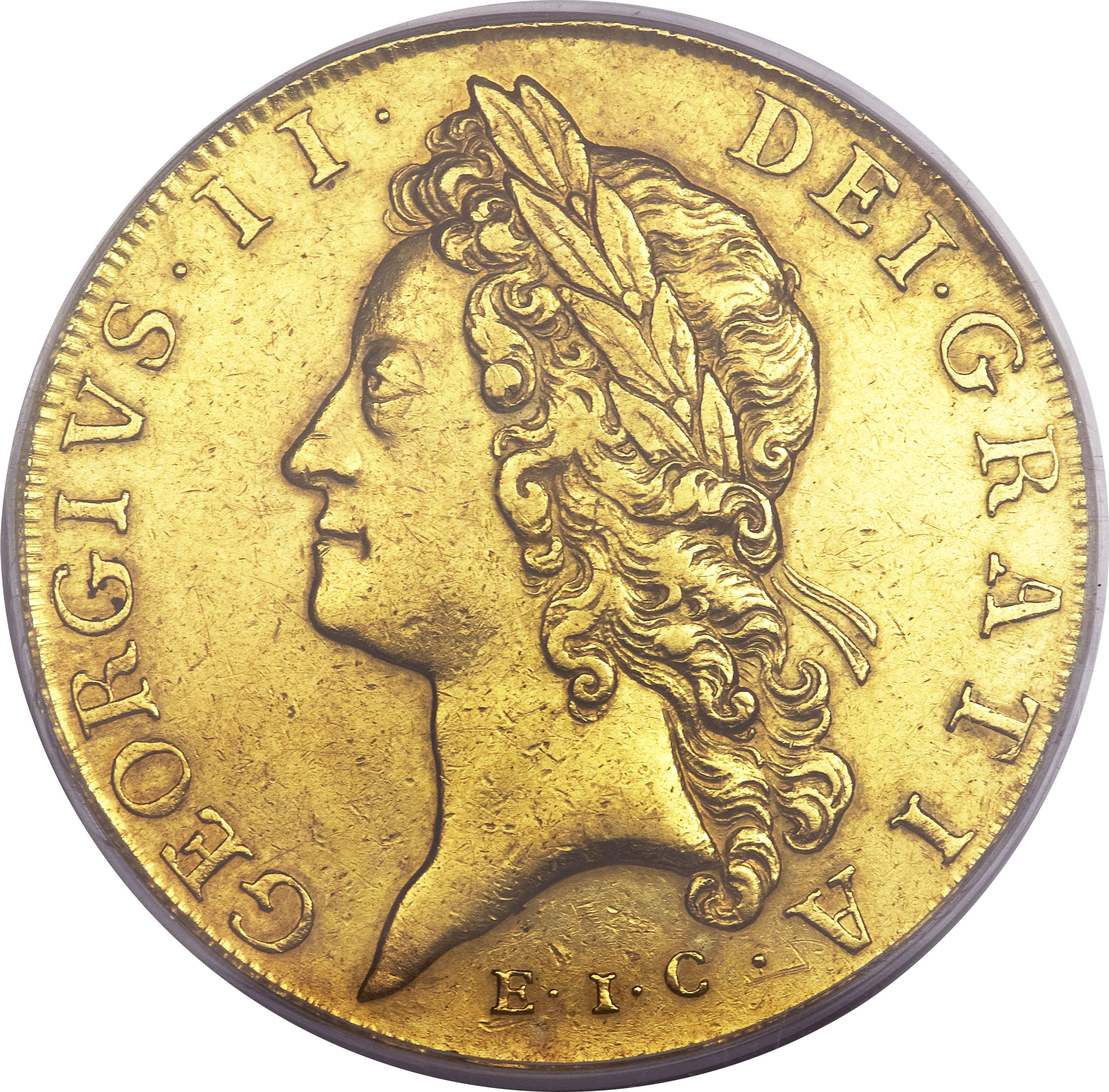
Young laureate portrait of King George II left, legend around.
GEORGIVS II DEI GRATIA
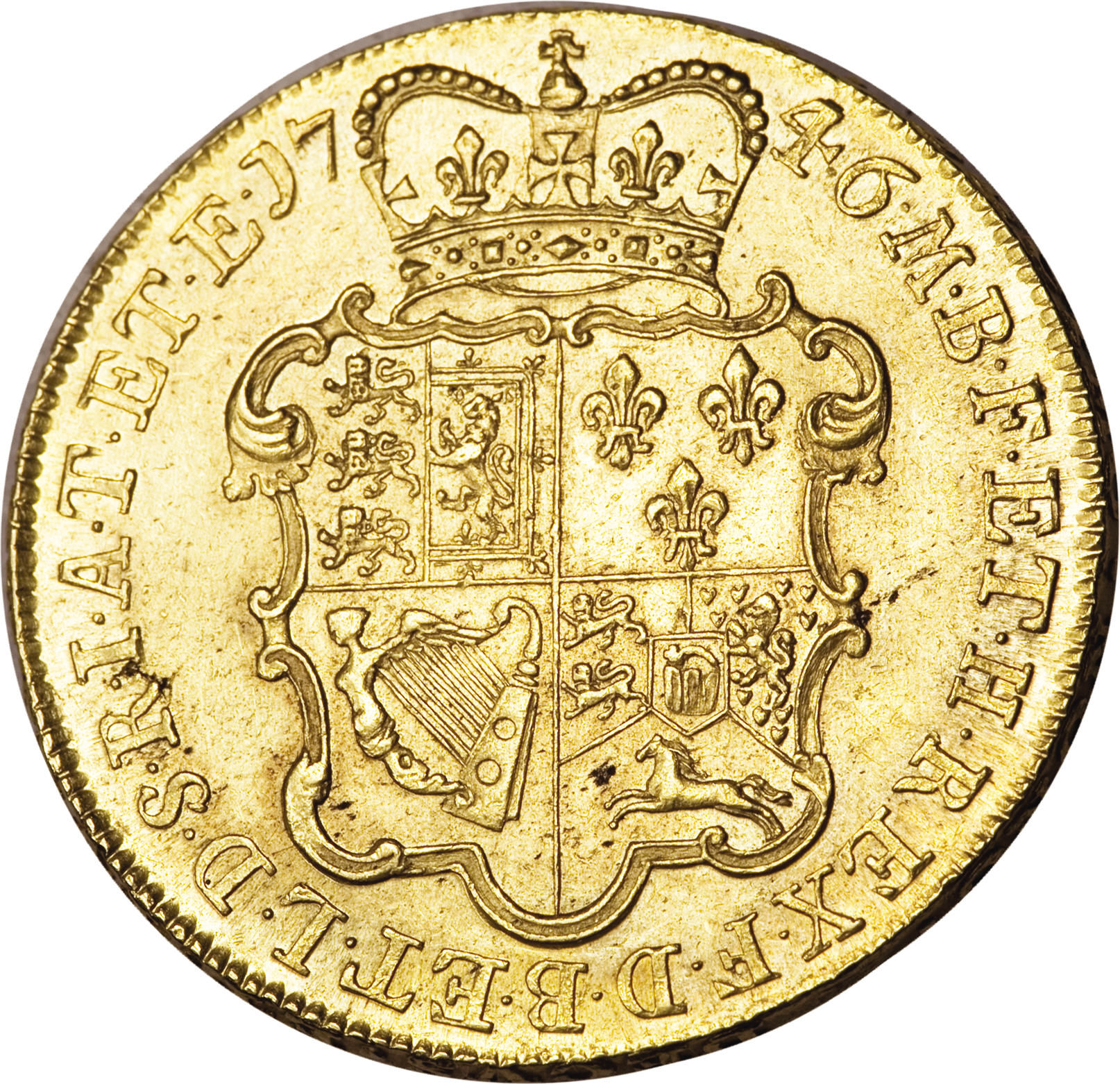
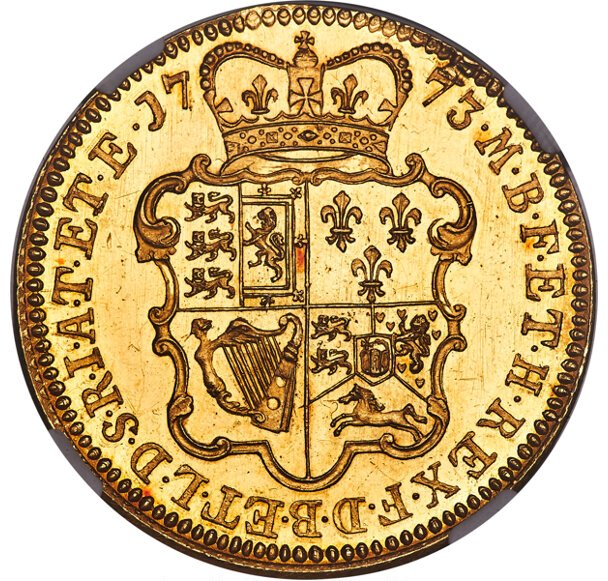
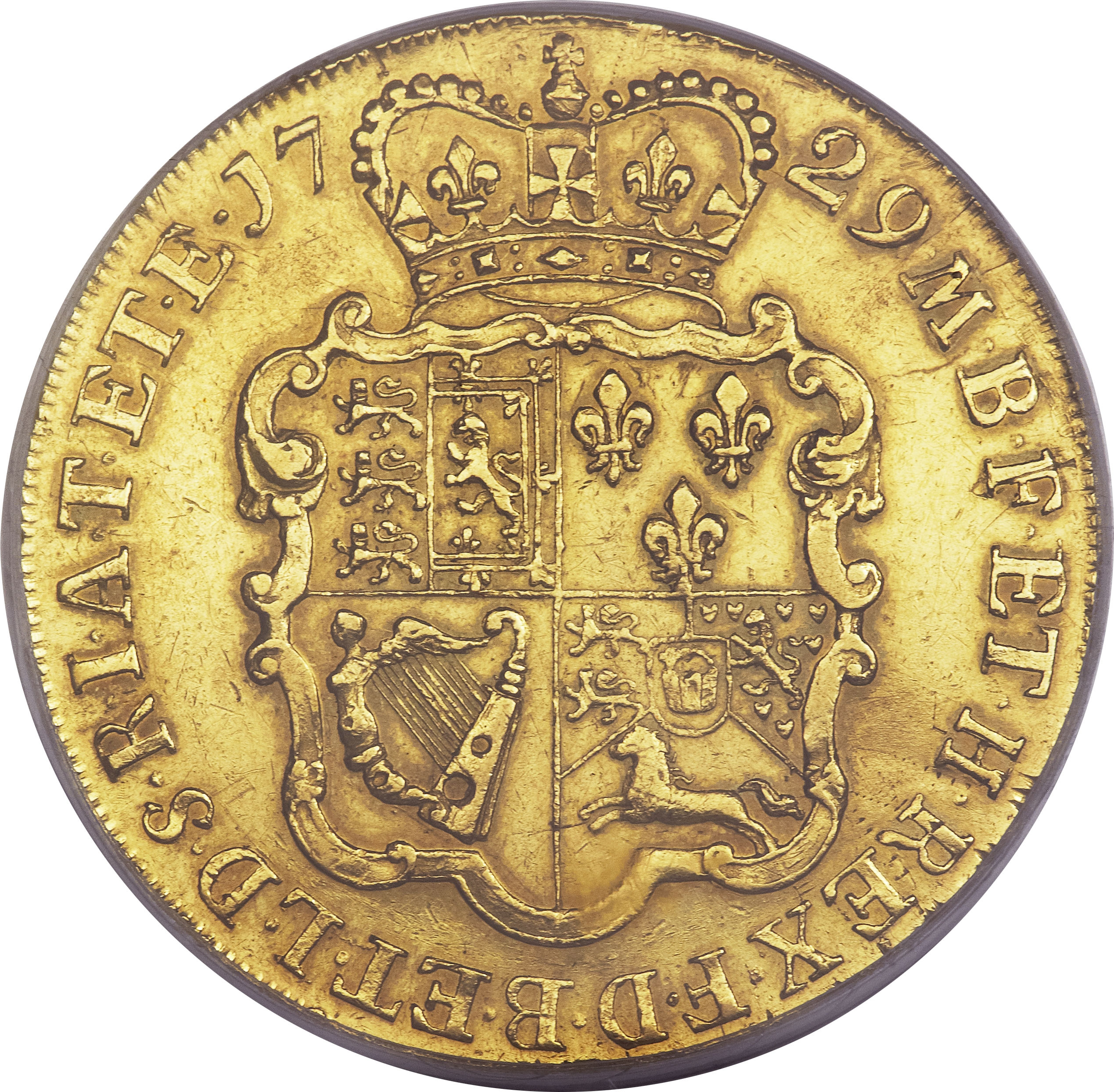
Crowned quartered shield of arms, divided date above, legend around.
M B F ET H REX F D B ET L D S R I A T ET E
5 Guineas - George II Young portrait market value
Find this on eBay
Affiliate5 Guineas - George II Young portrait price history
Daily limit reached5 Guineas - George II Young portrait value by grade
Realised auction prices · ⭐ Pro Expand rows for individual sale records| Grade | Latest | Median | 30d Δ | All-time range | Sales (1yr) | Total sales | Last sale | |
|---|---|---|---|---|---|---|---|---|
| AU-58 | £32,000.00 🔒 | £32,000.00 (1) | – | £32,000.00 – £32,000.00 | 0 | 1 | 12-12-2024 | |
|
Loading…
|
||||||||
About the 1729 5 Guineas - George II Young portrait
The 1729 5 Guineas - George II Young portrait is a circulating 5 guineas coin issued from 1729 to 1741, struck in 91.67% gold. It weighs 41.9g and measures 37mm across. Reverse design: Crowned quartered shield of arms, divided date above, legend around.
It is no longer legal tender (withdrawn 1891), so its value is to collectors only.
Common questions
How much is the 1729 5 Guineas - George II Young portrait worth?
The 1729 5 Guineas - George II Young portrait has a price in one grade on MyCoinage so far: £32,000 in AU-58, the median of its verified sales. Its gold content is worth about £3,700 at today's spot price, which puts a floor under its value.
How many George II young head five guineas were made?
No mintage is published for any date. CoinVarieties gives the figure as unknown but rare for 1729 and 1741, and describes all dates of the type as rare. Clayton lists 1729, 1729 EIC, 1731, 1735, 1738, 1741 and a 1741 overdate.
What does EIC mean on a 1729 five guineas?
It shows the gold was imported by the East India Company. A Royal Warrant of November 1729 allowed the letters EIC under the king's head on coins struck from Company gold. The Royal Mint Museum holds a 1729 EIC five guineas weighing 41.8 g with a lettered edge.
What is written on the edge of a five guineas?
DECUS ET TUTAMEN ANNO REGNI, an ornament and a safeguard in the year of the reign, followed by the regnal year in Latin. Wikipedia gives TERTIO for 1729, QVARTO for 1731, OCTAVO for 1735, DVODECIMO for 1738 and DECIMO QVARTO for 1741.
Is a George II five guineas legal tender?
No. Wikipedia records that all gold coins from before Victoria's reign were called in by Royal Proclamation on 22 November 1890 and demonetised from 28 February 1891.
How do I identify the 1729 5 Guineas - George II Young portrait?
Check the weight 41.9g and diameter 37mm and the metal (91.67% gold) against the specification table on this page. The reverse design is described above.
History and design
The five guineas was the largest gold coin regularly struck in Britain, 37 mm across and weighing 41.8 to 42.0 g under George II according to Wikipedia. Its value had been fixed at five pounds five shillings since the guinea was set at 21 shillings in 1717. George II's series began in 1729, two years into the reign, and the young head was used in 1729, 1731, 1735, 1738 and 1741.
No mintage is recorded for any date, and CoinVarieties calls every date of the type rare. Part of the 1729 issue was struck from gold imported by the East India Company: the Royal Mint Museum records that a Royal Warrant of November 1729 authorised the letters EIC under the king's head on such coins, and the museum holds a 1729 EIC five guineas weighing 41.8 g.
The obverse is John Croker's young laureate head facing left, with GEORGIVS II DEI GRATIA. Croker, born in Dresden in 1670, had been Chief Engraver since 1705.
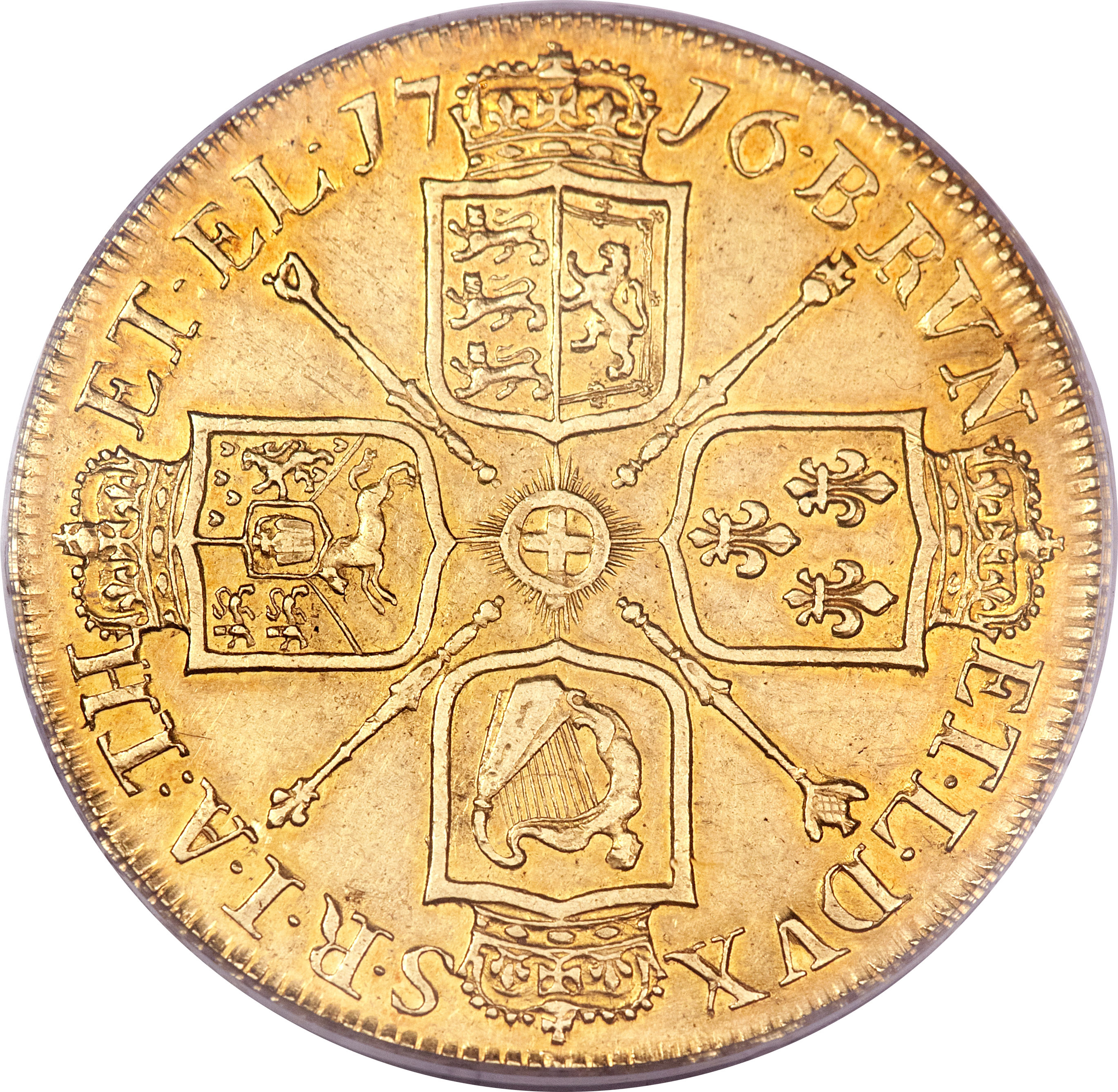
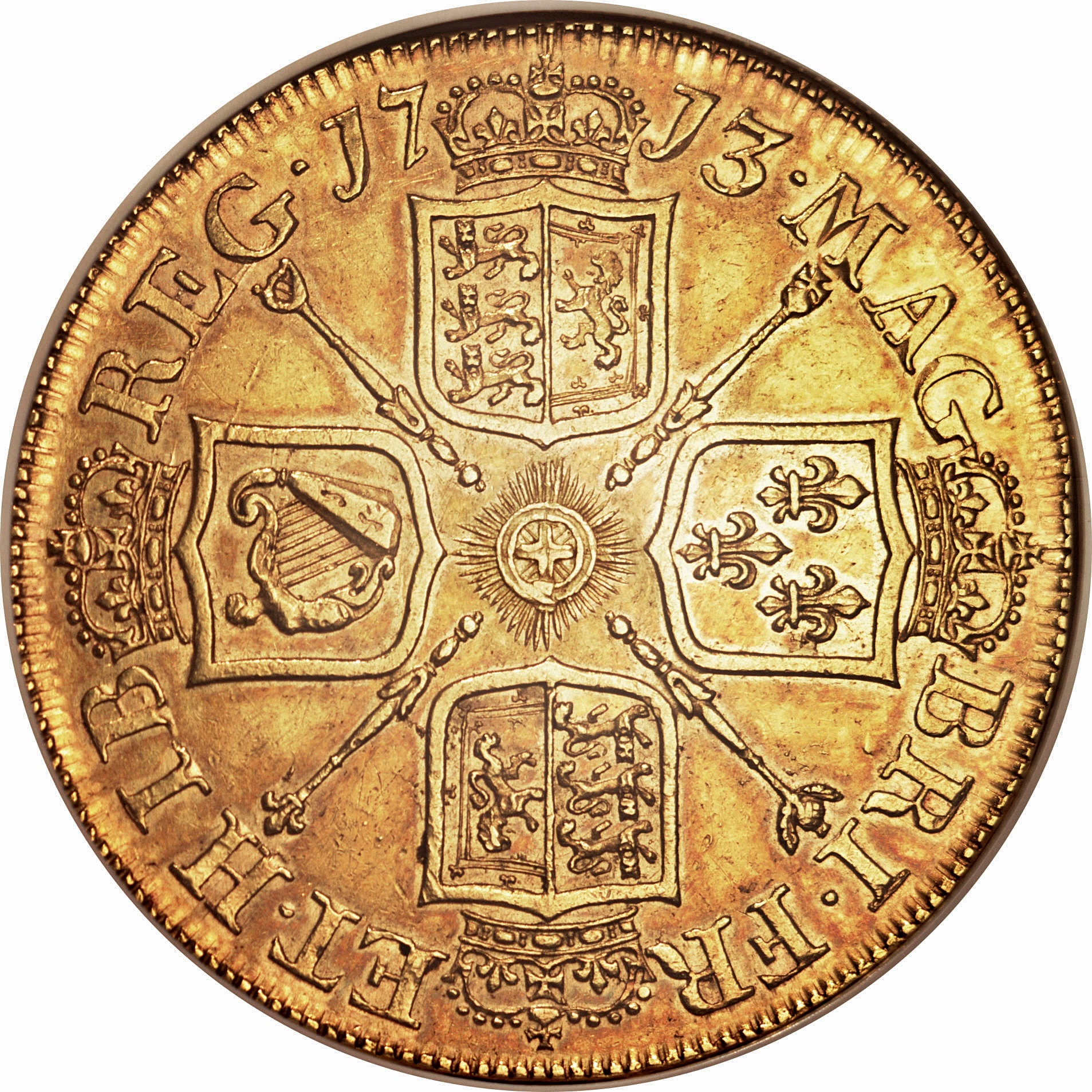
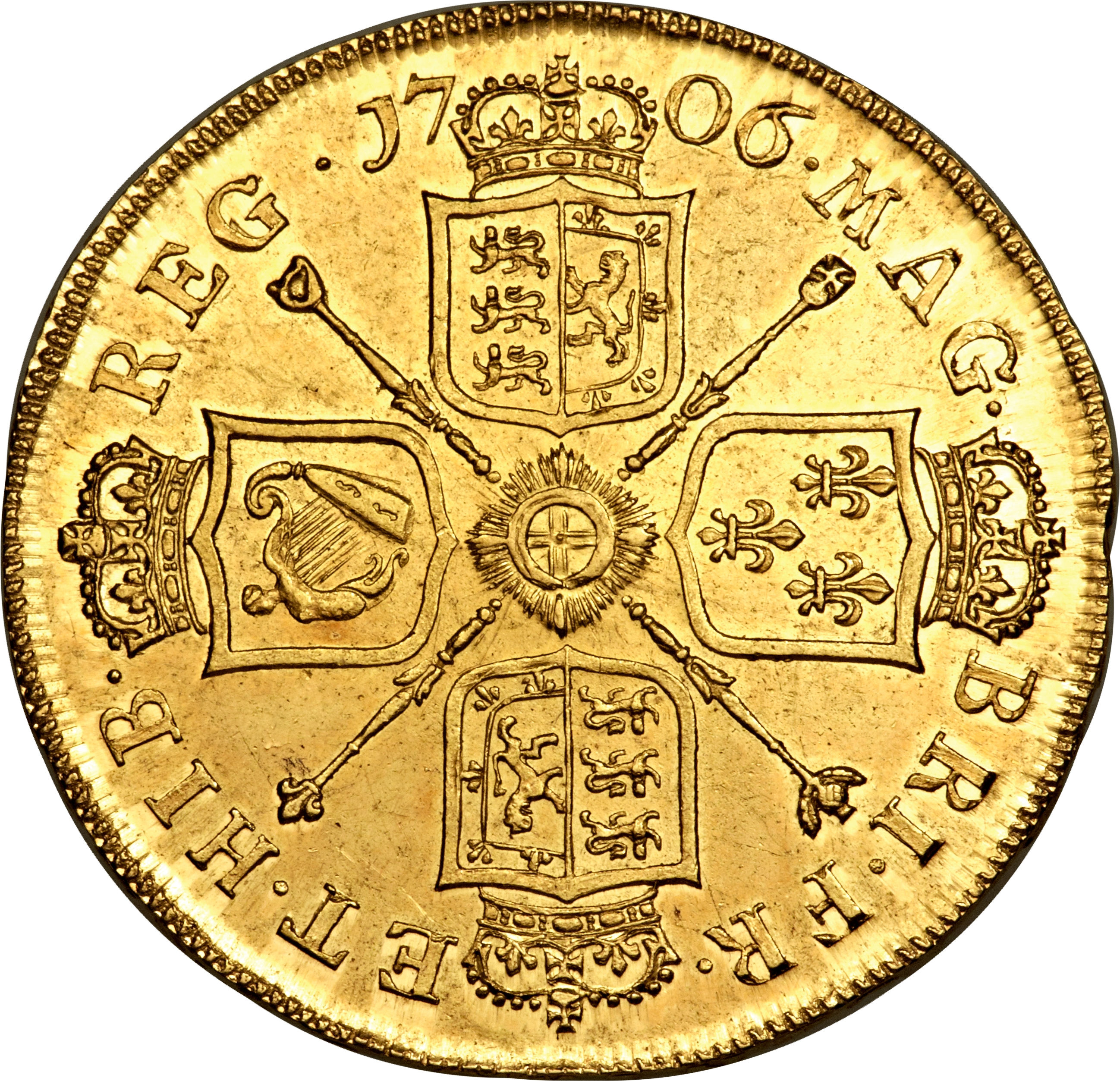
The reverse replaced the four cruciform shields of George I with a single ornate crowned shield, which the Royal Mint Museum credits to John Ochs. John Sigismund Tanner, appointed Croker's assistant in 1729, made the reverse dies. The shield quarters England and Scotland, France, Hanover and Ireland, with the date split by the crown and M B F ET H REX F D B ET L D S R I A T ET E around. Clayton notes the shield was slightly redesigned after 1730.
The edge is lettered DECUS ET TUTAMEN ANNO REGNI, an ornament and a safeguard in the year of the reign, followed by the regnal year, from TERTIO in 1729 to DECIMO QVARTO in 1741.
Varieties and errors
The 1729 EIC coin is the only young head five guineas with a provenance mark. Clayton lists a 1741 overdate, given as 1741/35 in his history and 1741/38 in his value list. The Royal Mint Museum holds a 1731 proof, and Spink refers to proof strikings of 1729.
Collecting notes
Check that the regnal year on the edge matches the date on the reverse, and look closely at the edge lettering for signs of filing or a mount. On a 1729 coin, check for EIC under the head. The old head five guineas followed in 1746.
Sources
The history, design, varieties and collecting notes on this page are drawn from these sources. Prices come from recorded sales, not from them.
- George II, Royal Mint Museum (read 12 Oct 2026)
- The Sensational Pattern Proof 1733 2-Guineas by Croker (The Piccadilly List, lot 23), Spink (read 12 Oct 2026)
- Five guineas (British coin), Wikipedia (read 12 Oct 2026)
- Five Pounds and Five Guineas, Tony Clayton, Coins of the UK (read 12 Oct 2026)
- George II five guineas, 1729, EIC (RMM 460), The Royal Mint Museum, via Museum Data Service (read 12 Oct 2026)
- Values of Five Pounds and Five Guineas, Tony Clayton, Coins of the UK (read 12 Oct 2026)
- George II proof five guineas, 1731 (RMM 461), The Royal Mint Museum, via Museum Data Service (read 12 Oct 2026)
- Great Britain 1741 5 guineas, CoinVarieties (read 12 Oct 2026)
- Great Britain 1729 5 guineas, CoinVarieties (read 12 Oct 2026)
- Sovereign (British coin), Wikipedia (read 12 Oct 2026)