Common: 10,000,000 or more minted. Sells often: 121 verified sales in the last 12 months.
3 Pence - George VI with 'IND:IMP' (1937–1948)
"Threepenny bit"
| Country | United Kingdom |
| Year | 1937–1948 |
| Denomination | 3 Pence |
| Mintage by year |
Scarcest year: 620,700 struck
|
| Mint | Royal Mint · Llantrisant |
| Circulation | Circulating |
| Demonetised | 1971 |
| Composition | Nickel brass (79% Cu, 20% Zn, 1% Ni) |
| Weight | 6.800g |
| Diameter | 21.8mm |
| Thickness | 2.60mm |
| Shape | Dodecagonal (12-sided) |
| Edge | Plain |
| Orientation | Medal alignment ↑↑ |
| Obv. artist | Thomas Humphrey Paget |
| Rev. artist | Frances Madge Kitchener, modified by Percy Metcalfe |
| Grade scale | UK (EF/UNC) |
| Tags | Flower |
Uncrowned portrait of King George VI left, legend around,
GEORGIVS VI D:G:BR:OMN:REX F:D:IND:IMP
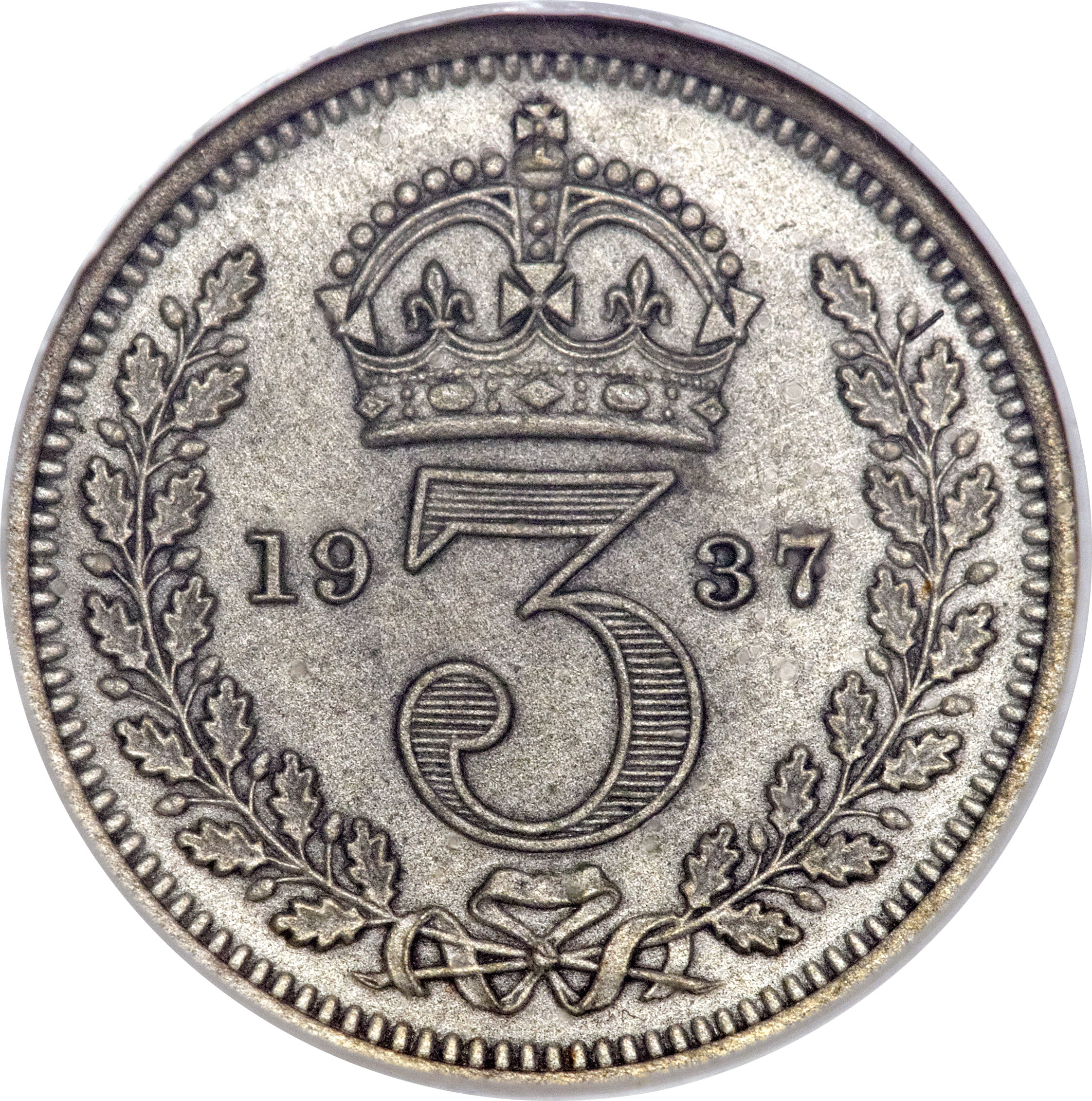
Three-headed 'thrift' plant, denomination above, date below.
THREE PENCE
3 Pence - George VI with 'IND:IMP' market value
Find this on eBay
Affiliate3 Pence - George VI with 'IND:IMP' value by year
1937 to 1948 · median sold prices| Year | Mintage | Circulated | Uncirculated | Sales | |
|---|---|---|---|---|---|
| 1937 | 45,707,900 | £2.24 | £4.37 (1) | 15 | |
|
VF£12.50EF£28.00UNC£95.00
⭐ Pro: the 1937 coin's sales by grade, and the chart filtered to one year
Start 7-day free trial
|
|||||
| 1938 | 14,532,300 | £2.77 | £4.26 type | 17 | |
|
VF£12.50EF£28.00UNC£95.00
⭐ Pro: the 1938 coin's sales by grade, and the chart filtered to one year
Start 7-day free trial
|
|||||
| 1939 | 5,603,000 | £2.03 type | £4.26 type | ||
| 1940 | 12,636,000 | £2.03 type | £4.26 type | ||
| 1941 | 60,239,400 | £2.01 | £4.14 | 35 | |
|
VF£12.50EF£28.00UNC£95.00
⭐ Pro: the 1941 coin's sales by grade, and the chart filtered to one year
Start 7-day free trial
|
|||||
| 1942 | 103,214,400 | £2.11 | £6.34 (1) | 15 | |
|
VF£12.50EF£28.00UNC£95.00
⭐ Pro: the 1942 coin's sales by grade, and the chart filtered to one year
Start 7-day free trial
|
|||||
| 1943 | 101,702,400 | £2.12 | £6.34 (1) | 13 | |
|
VF£12.50EF£28.00UNC£95.00
⭐ Pro: the 1943 coin's sales by grade, and the chart filtered to one year
Start 7-day free trial
|
|||||
| 1944 | 69,760,000 | £1.79 | £1.94 (2) | 17 | |
|
VF£12.50EF£28.00UNC£95.00
⭐ Pro: the 1944 coin's sales by grade, and the chart filtered to one year
Start 7-day free trial
|
|||||
| 1945 | 33,942,400 | £1.57 | £4.26 type | 9 | |
|
VF£12.50EF£28.00UNC£95.00
⭐ Pro: the 1945 coin's sales by grade, and the chart filtered to one year
Start 7-day free trial
|
|||||
| 1946 scarcest | 620,700 | £2.03 type | £4.26 type | ||
| 1948 | 4,230,400 | £2.03 type | £4.26 type | ||
One row for each year the 3 Pence - George VI with 'IND:IMP' was struck. Prices are medians of verified sold listings matched to that year from the listing: circulated is worn condition up to Extremely Fine, uncirculated is About Uncirculated or better. A count in brackets means fewer than three sales behind the figure; a grey figure marked "type" is the median across every year, shown where that year has no sale of its own yet; years with no sales yet fill in as sales are recorded. Most types have been searched year by year only since October 2026, so later years are still filling in. Use the grade table below for a price by condition across all years.
3 Pence - George VI with 'IND:IMP' value by grade
Realised auction prices · ⭐ Pro Expand rows for individual sale records| Grade | Latest | Median | 30d Δ | All-time range | Sales (1yr) | Total sales | Last sale | |
|---|---|---|---|---|---|---|---|---|
| UNC | £4.37 🔒 eBay | £5.35 | – | £1.94 – £6.34 | 6 | 6 | 09-09-2026 | |
|
Loading…
|
||||||||
| EF | £2.49 🔒 eBay | £2.49 (1) | – | £2.49 – £2.49 | 1 | 1 | 20-09-2026 | |
|
Loading…
|
||||||||
| VF | £2.02 🔒 eBay | £2.00 | ▼22.7% | £0.41 – £16.05 | 107 | 107 | 16-10-2026 | |
|
Loading…
|
||||||||
| F | £2.23 🔒 eBay | £1.74 | – | £1.49 – £2.23 | 4 | 4 | 13-08-2026 | |
|
Loading…
|
||||||||
| VG | £0.47 🔒 eBay | £0.47 (1) | – | £0.47 – £0.47 | 1 | 1 | 26-09-2026 | |
|
Loading…
|
||||||||
| aUNC | £4.14 🔒 eBay | £2.57 (2) | – | £0.99 – £4.14 | 2 | 2 | 24-09-2026 | |
|
Loading…
|
||||||||
About the 1937 3 Pence - George VI with 'IND:IMP'
The 1937 3 Pence - George VI with 'IND:IMP' is a circulating 3 pence coin issued from 1937 to 1948, struck in nickel brass (79% Cu, 20% Zn, 1% Ni). It weighs 6.8g and measures 21.8mm across. Reverse design: Three-headed 'thrift' plant, denomination above, date below.
Mintage figures are recorded for 11 years between 1937 and 1948, 452,188,900 coins in all. 1946 is the scarcest date, with 620,700 struck. It is no longer legal tender (withdrawn 1971), so its value is to collectors only.
Common questions
How much is the 1937 3 Pence - George VI with 'IND:IMP' worth?
Verified sold prices for the 1937 3 Pence - George VI with 'IND:IMP' run from £0.47 to £5.35 across 6 grades, taking the median for each grade. Condition makes the difference, so check the grade table above before pricing one.
Why is there no 1947 brass threepence?
None were struck with that date. Wikipedia, citing the Royal Mint's annual report for 1947, says demand for the denomination was small that year and the Mint supplied it from stocks already on hand. The brass threepence was struck in every other year from 1937 to 1952.
Which George VI brass threepence is the rarest date?
1946, with 620,734 struck according to Coin Hunter, against 4,230,400 for 1948, the next lowest date with IND IMP. Tony Clayton notes that he never found a 1946 in change during the 1960s. Among the later coins without IND IMP, 1949 is lower still.
Who designed the thrift threepence?
Frances Madge Kitchener designed the thrift plant, and the Royal Mint had Percy Metcalfe rework it into a more stylised version without telling her. The portrait of George VI on the obverse is by Thomas Humphrey Paget, whose initials HP sit below the truncation.
Is the brass threepence still legal tender?
No. After Decimal Day on 15 February 1971 the threepence had no place in the new system, and it ceased to be legal tender after 31 August 1971, according to Wikipedia and Tony Clayton. The Royal Mint Museum dates its demonetisation to the end of the decimal transitional period in 1971.
How do I identify the 1937 3 Pence - George VI with 'IND:IMP'?
Check the weight 6.8g and diameter 21.8mm and the metal (nickel brass (79% Cu, 20% Zn, 1% Ni)) against the specification table on this page. The reverse design is described above.
History and design
By the mid-1930s the small silver threepence was unpopular in England, and bronze coin was heavy to handle in bulk: Wikipedia records that London Transport alone dealt with 600 tons of it a year. The Royal Mint's answer was a thick twelve-sided threepence in nickel-brass, prepared for Edward VIII and issued instead with the portrait of George VI. A proclamation of 18 March 1937 set its design, and the first pieces were given out at the Royal Maundy on 25 March.
The public was slow to take to it. The Royal Mint Museum says it came into its own in the wartime blackouts, when its shape made it easy to find in a pocket of change, and from June 1941 brass and bronze coin was struck at a secret temporary mint at Pinewood. Coin Hunter's figures for the eleven dates total 452,189,217, peaking at 103,214,400 in 1942. Nothing is dated 1947: Wikipedia, citing the Mint's annual report, says that year's small demand was met from stock.
The obverse carries Humphrey Paget's uncrowned portrait of the King facing left, which the Royal Mint Museum describes as the classic coinage head of the 20th century. The proclamation gives the legend as GEORGIVS VI D:G:BR:OMN:REX F:D:IND:IMP, the full royal title including Emperor of India.
The reverse shows a three-headed thrift plant with THREE PENCE above and the date below. Frances Madge Kitchener drew the original design, and the Mint had Percy Metcalfe rework it into a more stylised version without telling her. She threatened legal action, which was settled with a joint statement to the press. Tony Clayton reads the plant as a pun on thrift at a time when saving was being encouraged.
Varieties and errors
The coins were first struck in collars with sharp corners. Tony Clayton records that collar failures led to a more rounded collar during 1941, and that sharp collars came back in 1948. Wikipedia says some of each year's output from 1941 to 1949 had rounded corners. CoinVarieties lists a few 1937 matte proofs, distinct from the ordinary 1937 proof.
Collecting notes
1946 is the key date at 620,734, less than a sixth of the next lowest, 1948 at 4,230,400. Clayton says he never found a 1946 in change in the 1960s. 1939, at 5,603,021, is the third lowest. Wikipedia's threepence article notes that nickel-brass wears very quickly, which is why high-grade examples of 1946 are hard to find.
Coin Hunter and Clayton list a 1937 proof, issued in that year's proof set. From 1949 IND IMP was removed from the legend, which makes the 1949 to 1952 threepence a separate type. Brass threepences ceased to be legal tender after 31 August 1971 and no longer turn up in change.
Sources
The history, design, varieties and collecting notes on this page are drawn from these sources. Prices come from recorded sales, not from them.
- Coin values by year, George VI (year pages 1937 to 1948, read one by one), Coin Hunter (read 10 Oct 2026)
- Great Britain 1943 3 pence KM-849, CoinVarieties (read 10 Oct 2026)
- Initials on British coins, TreasureRealm (read 10 Oct 2026)
- Values of Three Pence coins, Tony Clayton, Coins of the UK (read 10 Oct 2026)
- Threepence (British coin), Wikipedia (read 10 Oct 2026)
- Brass threepence, Wikipedia (read 10 Oct 2026)
- Three Pence, Tony Clayton, Coins of the UK (read 10 Oct 2026)
- The London Gazette, 19 March 1937, issue 34381, page 1818 (coinage proclamation of 18 March 1937), The Gazette (read 10 Oct 2026)
- Humphrey Paget, Royal Mint Museum (read 10 Oct 2026)
- Threepence, Royal Mint Museum (read 10 Oct 2026)
- Domestic coinage, Royal Mint Museum (read 10 Oct 2026)
- Great Britain 1946 3 pence KM-849, CoinVarieties (read 10 Oct 2026)
- Great Britain 1937 3 pence KM-849, CoinVarieties (read 10 Oct 2026)
More 3 Pence coins from nearby years