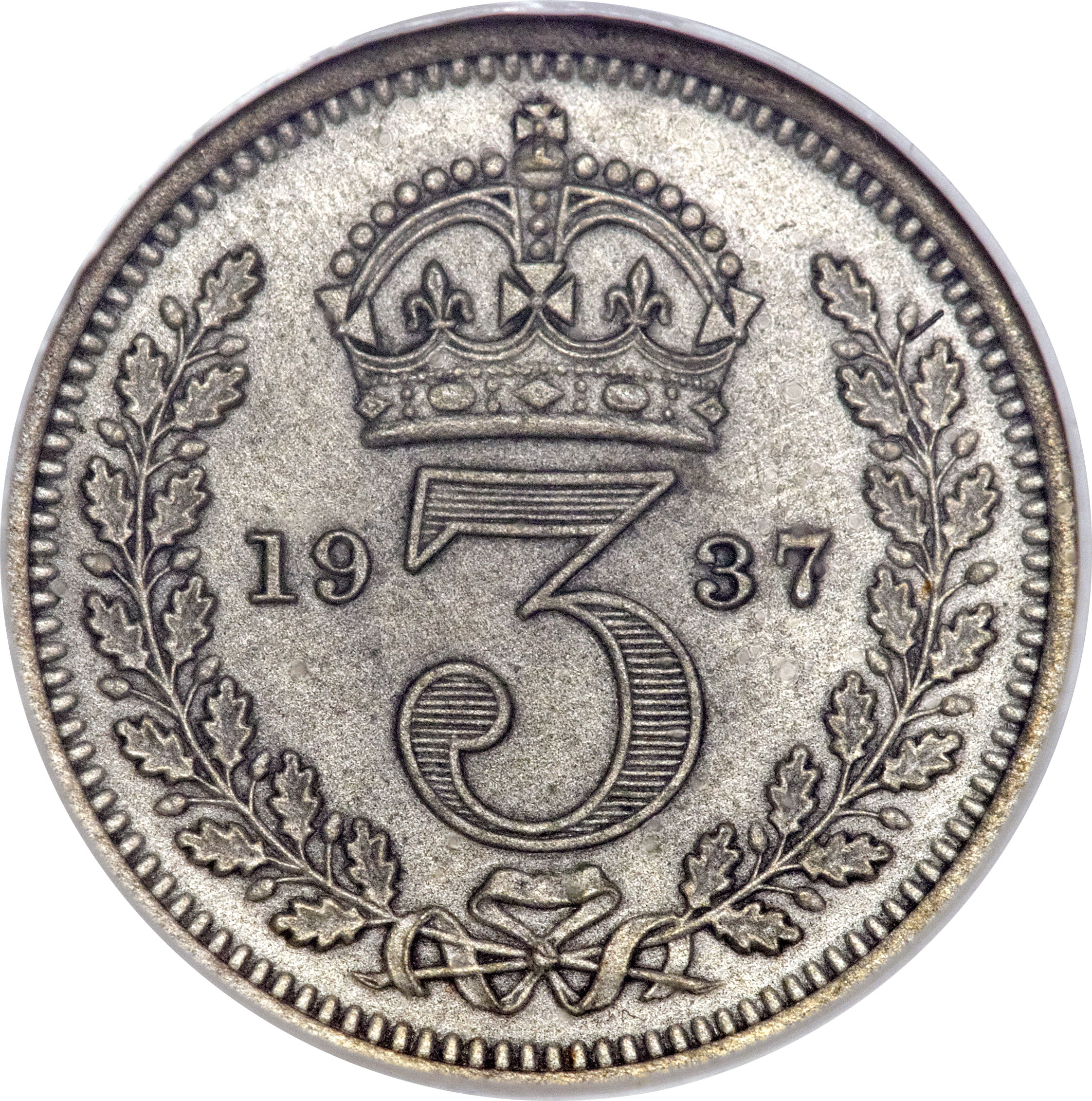
3 Pence - George V Trial (1936)
| Country | United Kingdom |
| Year | 1936 |
| Denomination | 3 Pence |
| Mint | Royal Mint · Llantrisant |
| Circulation | Non-circulating |
| Demonetised | Yes |
| Composition | Copper-nickel |
| Weight | 4.180g |
| Shape | Scalloped |
| Orientation | Medal alignment ↑↑ |
| Grade scale | UK (EF/UNC) |
Uncrowned portrait of King George V left, legend around.
Circular pattern.
Find this on eBay
Affiliate3 Pence - George V Trial price history
Daily limit reachedAbout the 1936 3 Pence - George V Trial
The 1936 3 Pence - George V Trial is a collector 3 pence coin, struck in copper-nickel. It weighs 4.18g. Reverse design: Circular pattern.
It is no longer legal tender, so its value is to collectors only.
Common questions
How much is the 1936 3 Pence - George V Trial worth?
No verified sale of the 1936 3 Pence - George V Trial has been logged on MyCoinage yet.
Was a large George V threepence ever issued?
No. Every threepence issued for circulation under George V was the small silver coin, and Coin Hunter lists only the silver threepence among the coins dated 1936. The Royal Mint Museum records that the larger 12-sided nickel-brass threepence was introduced in 1937, under George VI.
Why was the Mint testing a new threepence in 1936?
The silver threepence had become unpopular for its small size. Wikipedia says that by the end of George V's reign it was decided to introduce a more substantial coin, and the Royal Mint Museum says the 12-sided threepence was the answer to criticism of the old coin's size.
Is a trial threepence legal tender?
No. A trial piece is a test striking made while a coin is being developed and was never issued as money, so it has no legal tender status. The issued nickel-brass threepence was itself demonetised on 31 August 1971, according to Tony Clayton.
How do I identify the 1936 3 Pence - George V Trial?
Check the weight 4.18g and the metal (copper-nickel) against the specification table on this page. The reverse design is described above.
History and design
By the 1930s the small silver threepence had fallen out of favour in England. The Royal Mint Museum says changing habits made it unpopular, and Wikipedia records that by the end of George V's reign it was decided to introduce a more substantial threepence with a more convenient weight for its value, while the silver coin carried on alongside it.
The answer, as the Royal Mint Museum describes it, was a 12-sided nickel-brass threepence weighing almost five times as much as the silver one, introduced in 1937. Tony Clayton explains that trial pieces were struck in three thicknesses (1.75 mm, 2.0 mm and 2.5 mm), and that the thickest was chosen because thinner pieces could operate slot machines in place of a sixpence or shilling. Wikipedia adds that twelve experimental pieces were sent to a slot machine maker for testing.
This catalogue entry is a 1936 trial threepence with the portrait of George V. The published accounts of the trials describe pieces with Edward VIII's portrait, and no published reference documents a George V version, so its exact place in that programme is not known.
The catalogue describes an uncrowned portrait of George V facing left on a scalloped copper-nickel flan, with a circular pattern on the reverse. None of these details could be confirmed from a published source, so the designer, legend and dimensions are not stated here.
Collecting notes
Any piece offered as a George V trial threepence should come with provenance or a specialist attribution. Clayton notes that some Edward VIII trial threepences were not returned and found their way into circulation, which shows that trial pieces can surface outside the Mint. Compare with the issued George V oak sprig silver threepence, the circulating coin of 1936.
Sources
The history, design, varieties and collecting notes on this page are drawn from these sources. Prices come from recorded sales, not from them.
- Threepence, Royal Mint Museum (read 10 Oct 2026)
- Three Pence, Tony Clayton, Coins of the UK (read 10 Oct 2026)
- Threepence (British coin), Wikipedia (read 10 Oct 2026)
- 1936 Coin Values, George V, Coin Hunter (read 10 Oct 2026)
More 3 Pence coins from nearby years