Common: 10,000,000 or more minted.
3 Pence - George VI incl. Colonial (1937–1945)
| Country | United Kingdom |
| Year | 1937–1945 |
| Denomination | 3 Pence |
| Mintage by year |
Scarcest year: 371,000 struck
|
| Mint | Royal Mint · Llantrisant |
| Circulation | Circulating |
| Demonetised | Yes |
| Composition | Silver (.500) (500/1000 fine) |
| Weight | 1.410g · 0.0227 t oz |
| Diameter | 16.0mm |
| Thickness | 0.95mm |
| Shape | Round |
| Edge | Plain |
| Orientation | Medal alignment ↑↑ |
| Obv. artist | Thomas Humphrey Paget |
| Rev. artist | George Kruger Gray |
| Grade scale | UK (EF/UNC) |
| Tags | Flower Cross |
Uncrowned portrait of King George VI left, legend around.
GEORGIVS VI D:G:BR:OMN:REX
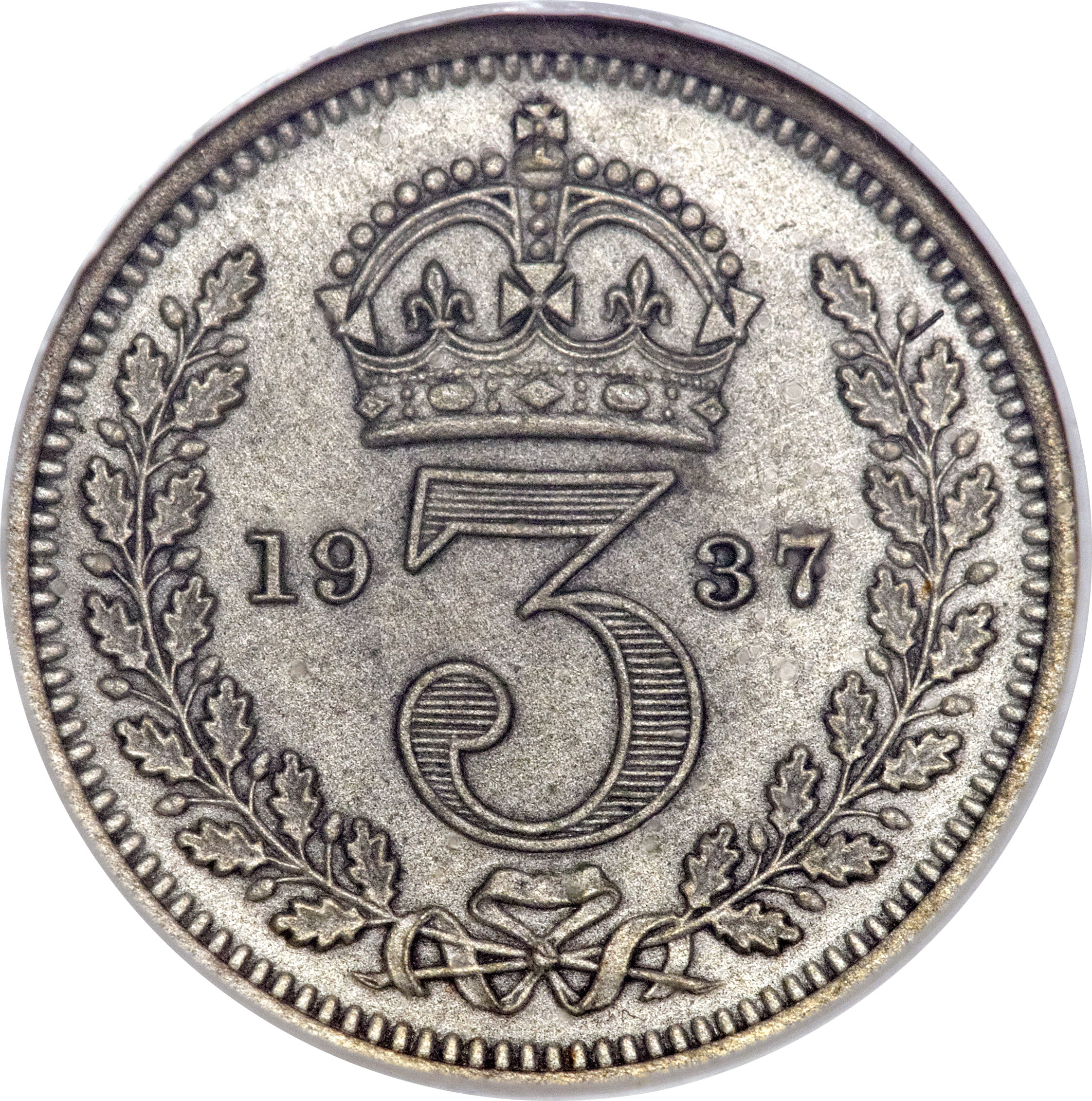
St. George's cross over Tudor rose dividing date, legend above, denomination below.
FID:DEF:IND:IMP THREE PENCE
Find this on eBay
Affiliate3 Pence - George VI incl. Colonial price history
Daily limit reached3 Pence - George VI incl. Colonial value by year
1937 to 1945 · median sold prices| Year | Mintage | Circulated | Uncirculated | Sales | |
|---|---|---|---|---|---|
| 1937 | 8,148,100 | ||||
| 1938 | 6,402,400 | ||||
| 1939 | 1,355,800 | ||||
| 1940 | 7,914,400 | ||||
| 1941 | 7,979,400 | ||||
| 1942 | 4,144,000 | ||||
| 1943 | 1,379,200 | ||||
| 1944 | 2,005,500 | ||||
| 1945 scarcest | 371,000 |
One row for each year the 3 Pence - George VI incl. Colonial was struck. Prices are medians of verified sold listings matched to that year from the listing: circulated is worn condition up to Extremely Fine, uncirculated is About Uncirculated or better. A count in brackets means fewer than three sales behind the figure; a grey figure marked "type" is the median across every year, shown where that year has no sale of its own yet; years with no sales yet fill in as sales are recorded. Most types have been searched year by year only since October 2026, so later years are still filling in. Use the grade table below for a price by condition across all years.
About the 1937 3 Pence - George VI incl. Colonial
The 1937 3 Pence - George VI incl. Colonial is a circulating 3 pence coin issued from 1937 to 1945, struck in 50% silver. It weighs 1.41g and measures 16mm across. Reverse design: St. George's cross over Tudor rose dividing date, legend above, denomination below.
Mintage figures are recorded for 9 years between 1937 and 1945, 39,699,800 coins in all. 1945 is the scarcest date, with 371,000 struck. It is no longer legal tender, so its value is to collectors only.
Common questions
How much is the 1937 3 Pence - George VI incl. Colonial worth?
No verified sale of the 1937 3 Pence - George VI incl. Colonial has been logged on MyCoinage yet.
Is there a 1945 silver threepence?
Yes, but almost none survive. Wikipedia gives 370,000 struck and Tony Clayton nearly 400,000, all ordered to be melted down. Clayton says only two are known, the second reported in Coin News in February 2020. A brass threepence dated 1945 is a different coin, struck in large numbers.
Why were silver threepences made for the colonies?
The silver threepence stayed popular in Scotland and the West Indies after the brass coin won over England. Tony Clayton says it was last struck for UK circulation in 1941, and the coins dated 1942, 1943 and 1944 were made for use in the West Indies.
Who designed the George VI silver threepence?
George Kruger Gray designed the reverse, a shield of St George on a Tudor rose, and his initials K G sit below the rose. The obverse is Humphrey Paget's uncrowned portrait of George VI, with HP below the truncation.
How is this different from a Maundy threepence?
The 1937 proclamation gave the ordinary silver threepence the St George shield and rose, while the Maundy threepence kept a crowned figure 3 in an oak wreath. A George VI silver threepence with a crowned 3 is from a Maundy set, not this coin.
How do I identify the 1937 3 Pence - George VI incl. Colonial?
Check the weight 1.41g and diameter 16mm and the metal (50% silver) against the specification table on this page. The reverse design is described above.
History and design
In 1937 George VI's coinage had two threepences. The new twelve-sided brass coin was meant to replace the small silver one, but Wikipedia records that the silver piece was kept on because there may have been some uncertainty over how well the new coin would be accepted. The silver threepence, in .500 silver, remained popular in Scotland and the West Indies.
The brass coin won. The Royal Mint Museum says it had almost completely superseded its silver rival by 1941, and Tony Clayton records that 1941 was the last year the silver coin was struck for UK circulation. The coins dated 1942, 1943 and 1944 were made for the West Indies. Clayton adds that nearly 400,000 dated 1945 were struck and then ordered to be melted. Coin Hunter's figures for the eight issued dates total 39,347,125.
The obverse carries Humphrey Paget's uncrowned portrait of the King facing left, with his initials HP below the truncation. The 1937 proclamation gives the legend GEORGIVS VI D:G:BR:OMN:REX, the shorter form the proclamation also gives the crown and half crown.
George Kruger Gray designed the reverse: the shield of St George laid over a Tudor rose, with the date divided by the shield. The proclamation sets the inscription as FID:DEF:IND:IMP with THREE PENCE, and specifies a plain edge. Kruger Gray's initials K G sit below the rose, just above THREE PENCE. The Maundy threepence of the same years kept the old crowned figure 3.
Varieties and errors
The 1945 coins are the great rarity: Clayton says only two are known to have survived the melt, the second reported in Coin News in February 2020. CoinVarieties also lists a few 1937 matte proofs.
Collecting notes
The colonial dates are the ones to look for. Clayton calls 1942 to 1944 relatively scarce, particularly 1944, and Chard says the last three dates are fairly scarce, especially in higher grades. By mintage the lowest date is 1939 at 1,355,860, close to 1943 at 1,397,220. 1937 was also issued as a proof in that year's proof set.
Any George VI silver threepence with a crowned 3 is a Maundy coin, such as the 1937 Maundy threepence. A brass threepence dated 1945 is a different coin, struck in large numbers (33,942,466 in Coin Hunter's figures).
Sources
The history, design, varieties and collecting notes on this page are drawn from these sources. Prices come from recorded sales, not from them.
- Coin values by year, George VI (year pages 1937 to 1944, read one by one), Coin Hunter (read 10 Oct 2026)
- Great Britain 1944 3 pence KM-848, CoinVarieties (read 10 Oct 2026)
- Threepence, Royal Mint Museum (read 10 Oct 2026)
- Brass threepence, Wikipedia (read 10 Oct 2026)
- Three Pence, Tony Clayton, Coins of the UK (read 10 Oct 2026)
- The London Gazette, 19 March 1937, issue 34381, page 1818 (coinage proclamation of 18 March 1937), The Gazette (read 10 Oct 2026)
- Threepence (British coin), Wikipedia (read 10 Oct 2026)
- Silver Threepences Story, Chard (read 10 Oct 2026)
- Humphrey Paget, Royal Mint Museum (read 10 Oct 2026)
- Initials on British coins, TreasureRealm (read 10 Oct 2026)
- George Kruger Gray, Wikipedia (read 10 Oct 2026)
- Great Britain 1937 3 pence KM-848, CoinVarieties (read 10 Oct 2026)
More 3 Pence coins from nearby years