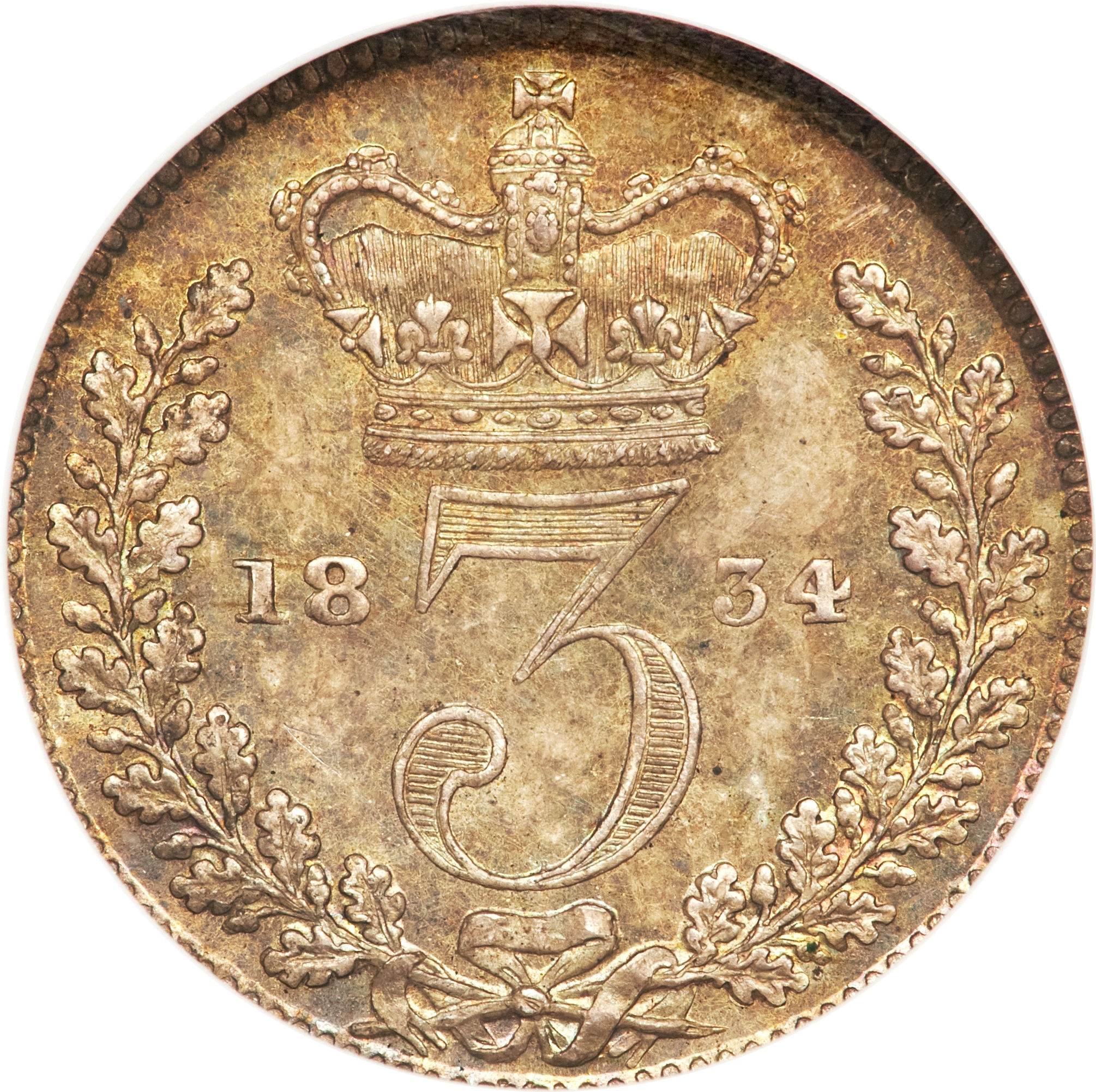
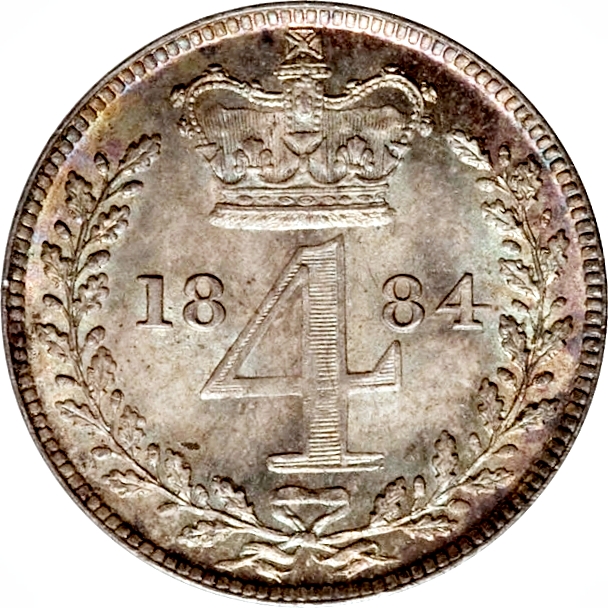
Very Rare: fewer than 100,000 minted.
2 Pence - William IV Maundy issues (1831–1837)
| Country | United Kingdom |
| Year | 1831–1837 |
| Denomination | 2 Pence |
| Mintage | 4,752 |
| Mint | Royal Mint · Llantrisant |
| Series | Maundy Money |
| Circulation | Non-circulating |
| Composition | Silver (.925) (925/1000 fine) |
| Weight | 0.940g · 0.0280 t oz |
| Diameter | 13.0mm |
| Shape | Round |
| Orientation | Coin alignment ↑↓ |
| Obv. artist | William Wyon |
| Rev. artist | Jean Baptiste Merlen |
| Grade scale | UK (EF/UNC) |
Uncrowned portrait of King William IV right, legend around.
Crowned denomination dividing date within oak wreath.
Find this on eBay
Affiliate2 Pence - William IV Maundy issues price history
Daily limit reachedAbout the 1831 2 Pence - William IV Maundy issues
The 1831 2 Pence - William IV Maundy issues is a collector 2 pence coin issued from 1831 to 1837 in the Maundy Money series, struck in 92.5% silver. It weighs 0.94g and measures 13mm across. Reverse design: Crowned denomination dividing date within oak wreath.
A mintage of 4,752 is recorded for one date of this type; figures for each year are not held.
Common questions
How much is the 1831 2 Pence - William IV Maundy issues worth?
No verified sale of the 1831 2 Pence - William IV Maundy issues has been logged on MyCoinage yet. Its silver content is worth about £1.12 at today's spot price, which puts a floor under its value.
Why was a silver twopence still made under William IV?
Only for the Royal Maundy. Wikipedia records that the silver twopence was issued for circulation in 1817, 1818 and 1820 and afterwards only as Maundy money. The only copper twopence was Boulton's coin of 1797.
How many William IV Maundy twopences were struck?
CoinVarieties, citing standard catalogues, gives 3,564 for 1834. No second reference was found for the other dates, but the annual Maundy issue was a few thousand pieces, tiny beside any circulating coin of the time.
Is the William IV Maundy twopence legal tender?
Yes, in principle. Maundy money was never demonetised, and Wikipedia explains that at decimalisation in 1971 all Maundy pieces were deemed to be denominated in new pence, so this coin is now worth 2p at face value.
Who designed the William IV Maundy twopence?
The reverse, a crowned 2 dividing the date within an oak wreath, is the 1822 design that Wikipedia credits to Jean Baptiste Merlen. The King's portrait was engraved by William Wyon from a bust by Francis Chantrey, according to the Royal Mint Museum.
How do I identify the 1831 2 Pence - William IV Maundy issues?
Check the weight 0.94g and diameter 13mm and the metal (92.5% silver) against the specification table on this page. The reverse design is described above.
History and design
The silver twopence had a short life as a circulating coin after the Great Recoinage. Wikipedia records circulation issues in 1817, 1818 and 1820, after which silver twopences were issued only as Maundy money; the only copper twopence had been Matthew Boulton's coin of 1797, struck at his Soho Mint. So under William IV the twopence existed only as one of the four small silver coins handed out at the Royal Maundy on Maundy Thursday.
Tony Clayton notes that complete four-coin sets are available for every year from 1822, and William IV's run covers each year from 1831 to 1837. CoinVarieties gives 3,564 for 1834. Far more Maundy coins were struck than the ceremony required: Wikipedia says that in the 19th century as many as sixty times the needed number were made, many going to dealers and Mint officials.
The reverse shows a crowned numeral 2 dividing the date, all within an oak wreath. Wikipedia credits this version of the crowned numeral design, introduced in 1822, to Jean Baptiste Merlen; it is still used on Maundy money today, with only the crown altered since.
The obverse carries the King's bare head facing right. The Royal Mint Museum credits William Wyon with engraving William IV's coinage portraits, based on a bust by the sculptor Francis Chantrey.
Varieties and errors
Clayton's values list proof Maundy sets dated 1831 in silver and in gold. No other varieties or mint errors are documented for the twopence of this reign.
Collecting notes
Maundy coins of this period were kept rather than spent, and Clayton says they rarely turn up in worse than VF condition. Toning, scratches and signs of mounting matter more than wear. Clayton's lists treat the four coins of 1d, 2d, 3d and 4d as a set, the form in which they were issued.
The smallest coin of the set is the William IV Maundy penny, and the threepence of the same years was also struck for colonial circulation.
Sources
The history, design, varieties and collecting notes on this page are drawn from these sources. Prices come from recorded sales, not from them.
- Royal Maundy, Wikipedia (read 12 Oct 2026)
- Twopence (British pre-decimal coin), Wikipedia (read 12 Oct 2026)
- Great Britain 1834 2 pence, CoinVarieties (read 12 Oct 2026)
- Values of Maundy Sets, Tony Clayton, Coins of the UK (read 12 Oct 2026)
- William Wyon, Royal Mint Museum (read 12 Oct 2026)
- Maundy Money, Tony Clayton, Coins of the UK (read 12 Oct 2026)
More from Maundy Money