Scarce: fewer than 2,000,000 minted.
3 Pence - William IV Maundy and Colonial issues (1831–1837)
| Country | United Kingdom |
| Year | 1831–1837 |
| Denomination | 3 Pence |
| Mintage by year |
Scarcest year: 400,000 struck
|
| Mint | Royal Mint · Llantrisant |
| Series | Maundy Money |
| Circulation | Non-circulating |
| Composition | Silver (.925) (925/1000 fine) |
| Weight | 1.410g · 0.0419 t oz |
| Diameter | 16.0mm |
| Thickness | 0.80mm |
| Shape | Round |
| Orientation | Coin alignment ↑↓ |
| Obv. artist | William Wyon |
| Rev. artist | Jean Baptiste Merlen |
| Grade scale | UK (EF/UNC) |
Uncrowned portrait of King William IV facing right, legend around.
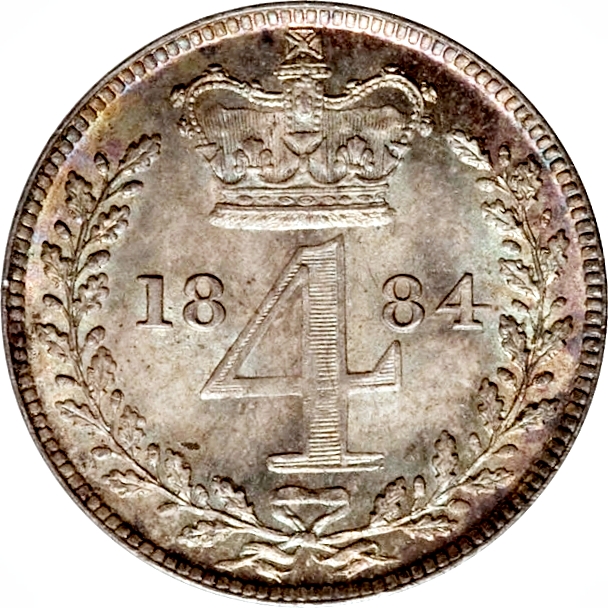
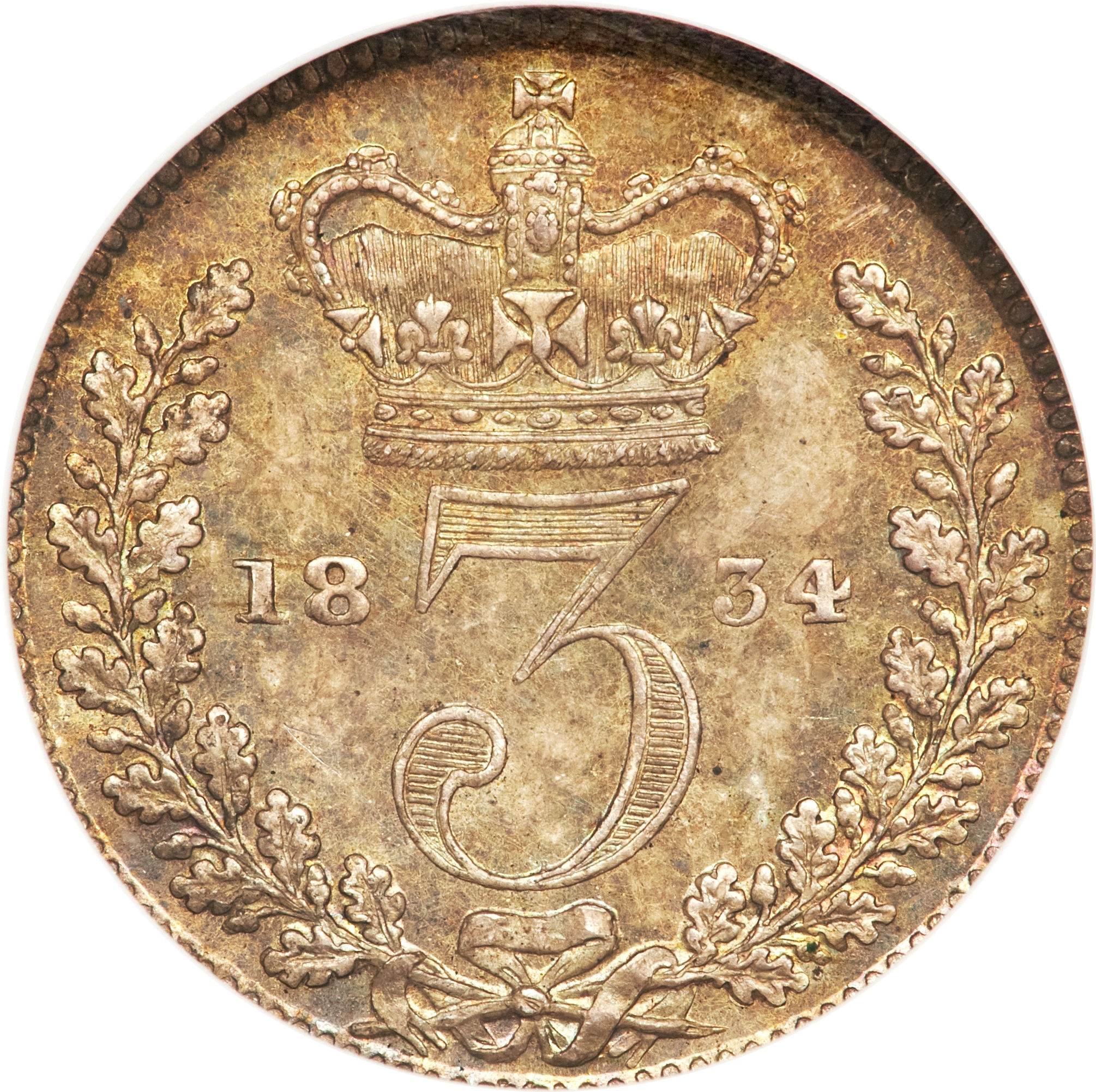
Crowned denomination dividing date within oak wreath.
Find this on eBay
Affiliate3 Pence - William IV Maundy and Colonial issues price history
Daily limit reached3 Pence - William IV Maundy and Colonial issues value by year
1834 to 1837 · median sold prices| Year | Mintage | Circulated | Uncirculated | Sales | |
|---|---|---|---|---|---|
| 1834 scarcest | 400,000 | ||||
| 1835 | 491,000 | ||||
| 1836 | 411,000 | ||||
| 1837 | 430,000 |
One row for each year the 3 Pence - William IV Maundy and Colonial issues was struck. Prices are medians of verified sold listings matched to that year from the listing: circulated is worn condition up to Extremely Fine, uncirculated is About Uncirculated or better. A count in brackets means fewer than three sales behind the figure; a grey figure marked "type" is the median across every year, shown where that year has no sale of its own yet; years with no sales yet fill in as sales are recorded. Most types have been searched year by year only since October 2026, so later years are still filling in. Use the grade table below for a price by condition across all years.
About the 1831 3 Pence - William IV Maundy and Colonial issues
The 1831 3 Pence - William IV Maundy and Colonial issues is a collector 3 pence coin issued from 1831 to 1837 in the Maundy Money series, struck in 92.5% silver. It weighs 1.41g and measures 16mm across. Reverse design: Crowned denomination dividing date within oak wreath.
Mintage figures are recorded for 4 years between 1834 and 1837, 1,732,000 coins in all. 1834 is the scarcest date, with 400,000 struck.
Common questions
How much is the 1831 3 Pence - William IV Maundy and Colonial issues worth?
No verified sale of the 1831 3 Pence - William IV Maundy and Colonial issues has been logged on MyCoinage yet. Its silver content is worth about £1.67 at today's spot price, which puts a floor under its value.
How can I tell a Maundy threepence from a currency one?
The design is the same. Wikipedia says the Maundy dies had a more polished field, so Maundy coins show a prooflike surface that the colonial currency coins lack. Dates 1831 to 1833 can only be Maundy, since currency striking began in 1834.
Where did the William IV currency threepences circulate?
In the colonies. Wikipedia's Royal Maundy article says the circulation threepences struck from 1834 were initially for the West Indies. The threepence was not issued for general circulation in Britain until 1845, under Victoria, according to the Royal Mint Museum.
How many William IV threepences were made?
CoinVarieties, citing standard catalogues, gives 200,000 currency coins for 1834 and 491,000 for 1835, plus 2,904 Maundy pieces in each year. Figures for the other dates were not confirmed from a second reference.
Is the William IV threepence legal tender?
The Maundy pieces are. Maundy money was never demonetised, and at decimalisation in 1971 all Maundy coins were deemed to be denominated in new pence. No opened reference gives a demonetisation date for the colonial currency coins.
How do I identify the 1831 3 Pence - William IV Maundy and Colonial issues?
Check the weight 1.41g and diameter 16mm and the metal (92.5% silver) against the specification table on this page. The reverse design is described above.
History and design
After the Great Recoinage of 1816 to 1817 the threepence was struck mainly for the Royal Maundy, with occasional colonial issues, Tony Clayton explains. The Royal Mint Museum adds that by the early 18th century the coin had survived only as part of the small annual Maundy issue, and that it did not become a general circulation coin in Britain until 1845.
Under William IV, Maundy threepences were struck every year from 1831 to 1837. From 1834 the Mint also struck identical coins for circulation, initially for the West Indies according to Wikipedia. CoinVarieties gives 200,000 currency coins for 1834 and 491,000 for 1835, plus 2,904 Maundy pieces in each of those years. Wikipedia notes that many Maundy threepences given to poor recipients were spent, which is why they are now scarcer than the other Maundy values.
The obverse carries the King's bare head facing right with GULIELMUS IIII D G BRITANNIAR REX F D. The Royal Mint Museum credits William Wyon with engraving William IV's coinage portraits from a bust by the sculptor Francis Chantrey.
The reverse shows the new-style crowned 3 dividing the date within a wreath. Wikipedia credits the 1822 version of this Maundy reverse, with the numeral inside an oak wreath, to Jean Baptiste Merlen. Maundy and currency coins were struck from the same design, so the difference lies only in the dies and finish.
Varieties and errors
Wikipedia states that Maundy threepences were struck from dies with a more polished field, giving them a prooflike surface the colonial currency coins lack. Clayton's values list proof Maundy sets dated 1831 in silver and gold. No mint errors are documented.
Collecting notes
Any coin dated 1831, 1832 or 1833 must be a Maundy piece. For 1834 to 1837, a mirror-like field points to Maundy, while a plainer field points to a currency coin. Clayton warns, of the similar Victorian coins, that judging this by the quality of strike is not easy without experience. Clayton lists separate values for currency and Maundy coins of this reign.
The other coins of the Maundy set include the William IV Maundy twopence, and the William IV three halfpence was also made for colonial circulation in these years.
Sources
The history, design, varieties and collecting notes on this page are drawn from these sources. Prices come from recorded sales, not from them.
- Threepence (British coin), Wikipedia (read 12 Oct 2026)
- Royal Maundy, Wikipedia (read 12 Oct 2026)
- Great Britain 1834 3 pence, CoinVarieties (read 12 Oct 2026)
- Great Britain 1835 3 pence, CoinVarieties (read 12 Oct 2026)
- Values of Three Pence, Tony Clayton, Coins of the UK (read 12 Oct 2026)
- William Wyon, Royal Mint Museum (read 12 Oct 2026)
- Threepence, Royal Mint Museum (read 12 Oct 2026)
- Three Pence, Tony Clayton, Coins of the UK (read 12 Oct 2026)
More from Maundy Money