Very Rare: fewer than 100,000 minted.
1 Penny - George V 1st Maundy issue (1911–1920)
"Maundy penny"
| Country | United Kingdom |
| Year | 1911–1920 |
| Denomination | 1 Penny |
| Mintage | 6,007 |
| Mint | Royal Mint · Llantrisant |
| Series | Maundy Money |
| Circulation | Non-circulating |
| Composition | Silver (.925) (925/1000 fine) |
| Weight | 0.470g · 0.0140 t oz |
| Diameter | 11.0mm |
| Shape | Round |
| Edge | Plain |
| Orientation | Medal alignment ↑↑ |
| Obv. artist | Bertram Mackennal |
| Rev. artist | Jean Baptiste Merlen |
| Grade scale | UK (EF/UNC) |
Uncrowned portrait of King George V left, legend around.
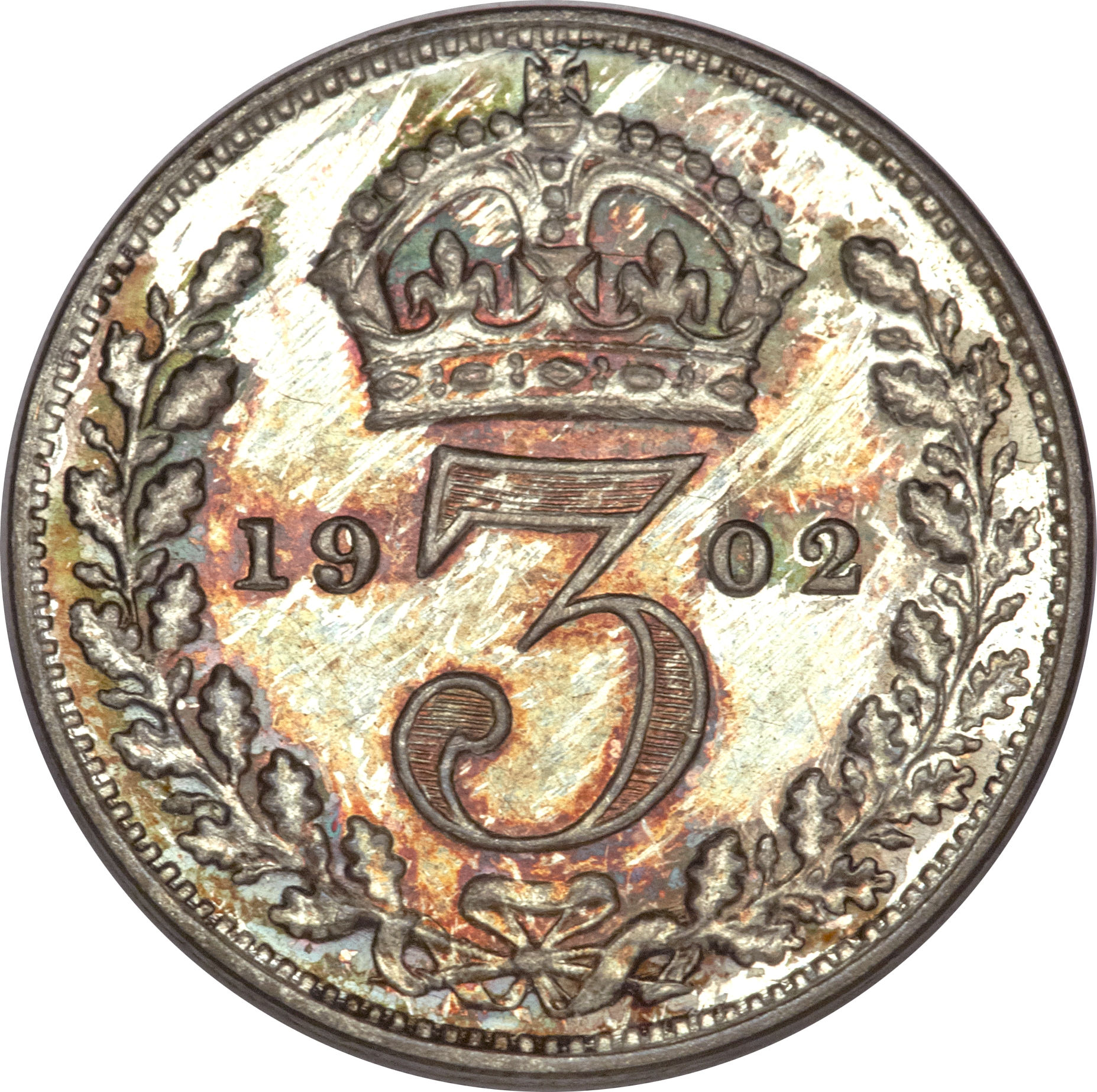
Crowned denomination dividing date within oak wreath.
Find this on eBay
Affiliate1 Penny - George V 1st Maundy issue price history
Daily limit reachedAbout the 1911 1 Penny - George V 1st Maundy issue
The 1911 1 Penny - George V 1st Maundy issue is a collector 1 penny coin issued from 1911 to 1920 in the Maundy Money series, struck in 92.5% silver. It weighs 0.47g and measures 11mm across. Reverse design: Crowned denomination dividing date within oak wreath.
A mintage of 6,007 is recorded for one date of this type; figures for each year are not held.
Common questions
How much is the 1911 1 Penny - George V 1st Maundy issue worth?
No verified sale of the 1911 1 Penny - George V 1st Maundy issue has been logged on MyCoinage yet.
How many George V Maundy pennies were made from 1911 to 1920?
Coinstrail's catalogue gives between 1,590 (1913) and 2,072 (1915) a year, 17,801 over the ten dates. The numbers are small because Maundy sets have gone only to recipients and officials since 1909, when sale through banks ended.
Is the 1911 to 1920 Maundy penny solid silver?
It is sterling silver, 92.5 percent fine, as Coinstrail and the Royal Mint's own set pages record. Wikipedia notes that Maundy coins, like the rest of the silver coinage, were reduced to .500 silver in 1921, so 1920 is the last sterling date of the reign.
Was there a 1911 proof Maundy penny?
Yes. Tony Clayton lists a 1911 proof Maundy set alongside the ordinary 1911 set. Coin Hunter also lists 1911 proofs of the larger silver and gold coins. No separate count of the proof Maundy penny was found.
Is a George V Maundy penny legal tender?
Technically yes. Wikipedia notes that Maundy coins are legal tender but do not circulate because of their silver content and collector value. At decimalisation in 1971 their face values changed from old to new pence, the Royal Mint Museum says, so this penny now counts as 1p.
How do I identify the 1911 1 Penny - George V 1st Maundy issue?
Check the weight 0.47g and diameter 11mm and the metal (92.5% silver) against the specification table on this page. The reverse design is described above.
History and design
Maundy money is struck for the Royal Maundy, the service on the day before Good Friday at which the sovereign or a deputy gives elderly recipients purses of specially made silver coins. The Royal Mint Museum explains that the white purse holds as many pence as the monarch has years, in four silver denominations from one to four pence. The penny is the smallest.
This first George V Maundy penny ran from 1911 to 1920 in sterling silver. Coinstrail's catalogue gives 1,913 for 1911 and between 1,590 and 2,072 in later years. Numbers had been small since 1909: Wikipedia and Tony Clayton record that until 1908 Maundy sets could be ordered through banks, but from 1909 they went only to recipients and those involved in the ceremony. Wikipedia adds that the service was usually attended in these years by Princess Helena or Princess Marie Louise rather than the King.
The obverse is Bertram Mackennal's bare head of George V facing left, the portrait the Royal Mint credits on its George V Maundy set pages. The reverse is a crowned figure 1 within an oak wreath, with the date. Wikipedia credits the wreathed design to Jean Baptiste Merlen, who introduced it in 1822, with the crown altered by Leonard Charles Wyon in 1888. The edge is plain.
The coin is sterling silver, 92.5 percent fine, as Coinstrail and the Royal Mint record. Wikipedia records that Maundy coins followed the rest of the silver coinage down to .500 fineness in 1921, so this is the last sterling Maundy penny until 1947.
Collecting notes
Maundy pennies were not made to circulate, and Clayton notes that Maundy coins after 1820 rarely turn up below very fine. Single pennies are found as well as complete four-coin sets; Wikipedia notes that sets passed to officials came in presentation cases rather than purses. Clayton lists a proof Maundy set for 1911. No recognised varieties or mint errors are documented for this type.
At decimalisation the Maundy coins were revalued in new pence, so this penny is legal tender for 1p. The .500 silver Maundy penny of 1921 to 1927 followed.
Sources
The history, design, varieties and collecting notes on this page are drawn from these sources. Prices come from recorded sales, not from them.
- 1915 George V Maundy Set, The Royal Mint (read 10 Oct 2026)
- Maundy money, Wikipedia (read 10 Oct 2026)
- Maundy money, Royal Mint Museum (read 10 Oct 2026)
- Penny of George V, silver coins (list and 1911 entry), Coinstrail (read 10 Oct 2026)
- Maundy Money, Tony Clayton, Coins of the UK (read 10 Oct 2026)
- Values of Coins of the UK, Maundy Sets, Tony Clayton, Coins of the UK (read 10 Oct 2026)
- 1911 Coin Values, George V, Coin Hunter (read 10 Oct 2026)
More from Maundy Money